
Nouvelle
Environmental Human Rights Defenders and the Role of Geneva

Mise à jour: 06 Juil 2026
Environmental human rights defenders are those who strive to protect and promote human rights relating to the environment. However, evidence suggests that they remain highly vulnerable and under attack across the globe. This update looks at the steps taken by the international community in Geneva to protect, promote, and uphold the rights of environmental defenders.
Human rights and the environment are intrinsically intertwined: a clean, healthy and sustainable environment is essential in the enjoyment of our human rights. Governments must protect and promote and businesses must respect environmental rights if we wish to tackle environmental challenges, such as the triple planetary crisis.
Environmental rights are not abstract, remote, irrelevant concepts; they are measurable, prominent and functional aspects of society and its ecology. More than 100 countries incorporate constitutional rights to a healthy environment, yet communities and environmental defenders continue to face the worst consequences. When environmental rights are violated, people and the planet suffer from reduced health and well-being.
LATEST NEWS
- Financing the transition, Silencing defenders | Coalition for Human Rights in Development | 24 June 2026
- Protecting Civic Space: How Climate Advocacy is at Risk during UNFCCC Conferences | Palestinian Institute for Climate Strategy (PICS) and Climate Activist Defenders (CAD) | June 2026
- Protecting Environmental Rights Defenders Is Key to Giving Communities a Voice | Sharan Srinivas, Just Security | 9 June 2026
- First ever European Forum on environmental human-rights defenders from across the continent | Council of Europe | 4 June 2026
- Killed for speaking up: UN sounds alarm over attacks on environmental defenders | UN News | 4 June 2026
- Time for Europe to Recognize the Right to a Healthy Environment | HRW | 5 June 2026
- Environmental Human Rights Advocacy Pathway | ISHR | 5 June 2026
On World Environment Day, the International Service for Human Rights (ISHR) launched the Environmental Human Rights Advocacy Pathway— a free, self-paced toolkit designed to help environmental human rights defenders navigate UN and regional mechanisms to defend the right to a clean, healthy and sustainable environment, as part of its e-learning space, the ISHR Academy.
Who are environmental human rights defenders?
According to the United Nations, environmental human rights defenders (EHRDs) are “individuals and groups who, in their personal or professional capacity and in a peaceful manner, strive to protect and promote human rights relating to the environment, including water, air, land, flora and fauna.”
Environmental defenders, many of whom are part of or represent indigenous peoples, remain highly vulnerable and under attack across the globe. Evidence suggests that as the climate crisis intensifies, violence against EHRDs also increases, whether through assaults, murders, intimidation, harassment, stigmatization, and criminalization.
In 2024, at least 146 attacks against environmental defenders were recorded worldwide by the Global Witness, taking the total number of defenders killed between 2012 and 2023 to 2,253. Killings took many forms last year, including murder, extrajudicial execution and deaths in detention – with 142 lethal attacks. There were four documented long-term disappearances in 2024, where the defender has been missing for a period of more than six months. These occurred in the Philippines, Mexico, Honduras and Chile. Such a number, however, is likely to be an underestimation as underreporting remains an issue globally, particularly across Asia and Africa. Obstacles to verify suspected violations also present a problem, particularly documenting cases in active conflict zones.
Once again, Indigenous Peoples were victims of around a third of lethal attacks, despite making up around 6% of the global population.
During the 46th session of the Human Rights Council in 2021, Mary Lawlor, Special Rapporteur on human rights defenders, presented a report showing that among 1,323 human rights defenders killed since 2015, EHRDs are the most targeted (A/HRC/46/35).
As the field of human rights obligations related to a clean, safe, healthy and sustainable environment expands, the need to protect those who protect our environmental rights also becomes more urgent.
UN Declaration on Human Rights Defenders
The Declaration on Human Rights Defenders, adopted by the General Assembly on 9 December 1998 in its resolution 53/144, is based on and incorporates human rights enshrined in legally-binding international instruments. The Declaration reaffirms rights that are instrumental to the defense of human rights, including, inter alia, freedom of association, freedom of peaceful assembly, freedom of opinion and expression, and the right to gain access to information, to provide legal aid and to develop and discuss new ideas in the area of human rights (see A/63/288, annex, para. 2).
The Declaration thus requires that states:
- Recognize the value and important contribution of human rights defenders to peace, sustainable development and human rights;
- Respect human rights defenders on a non-discriminatory basis, protect them against any arbitrary action as a consequence of the legitimate exercise of the rights referred to in the Declaration, and ensure access to effective remedies in the case of violations and prompt and impartial investigations of alleged violations;
- Reinforce their work by creating an enabling environment, through legislative, administrative and other steps, promoting public understanding of human rights, creating independent national institutions for the promotion and protection of human rights and promoting the teaching of human rights.
Defenders Policy
The UN has recognized the threats to environmental defenders and called for their protection. UNEP builds on this work to support environmental defenders through its Defenders Policy to promote greater protection for individuals and groups who are defending their environmental rights and identifies solutions to mitigate the abuse of environmental rights which affects a growing number of people in many parts of the world.
- Denounce the attacks, torture, intimidation and murders of environmental defenders;
- Advocate with states and non-state actors, including business, for better protection of environmental rights and the people standing up for these rights;
- Support the responsible management of natural resources;
- Request government and companies’ accountability for the different events where environmental defenders have been affected / murdered.
Geneva Roadmap 40/11 for Environmental Human Rights Defenders
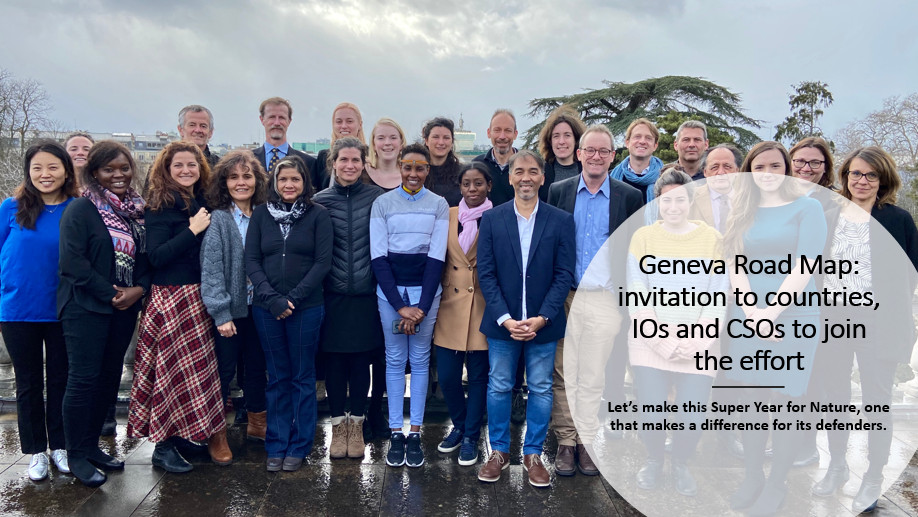
Environmental Human Rights Defenders Workshop at Palais Eynard, February 2020
We have no choice: We have to mobilize the international community to strengthen the defense of environmental defenders.
– Yves Flückiger, Rector, University of Geneva
A wide range of civil society and multilateral efforts are emerging in Geneva. The Human Rights Council resolution 40/11 – Recognizing the contribution of environmental human rights defenders to the enjoyment of human rights, environmental protection and sustainable development– was adopted by the Human Rights Council by consensus on 21 March 2019. Following the adoption, platforms, coalitions and networks of defenders met in February 2020 to launch the Geneva Roadmap 40/11 for the implementation of this Human Rights Council Resolution 40/11.
The actions envisaged at the time were thwarted by the pandemic and its consequences, but the orientations of this Roadmap defined then remain fully relevant. Its preparation included an expert meeting to help articulate and put forward possible steps of action for the research, environmental and human rights communities to feed into human rights processes as well as environmental ones.
Protecting EHRDs in International Frameworks and Mechanisms
In response to the growing threats towards environmental defenders, instruments at the global and regional level already exist, and a growing number of States have put national responses mechanisms in place to protect those engaged in protecting our environmental rights.
IUCN Resolution on EHRDs
Members of the International Union for Conservation of Nature (IUCN) voted to adopt resolution (WCC 2020 Res 115), “Protecting environmental human and peoples’ rights defenders and whistleblowers”, that urges governments to adopt and uphold laws aimed at protecting them. The resolution also encourages the IUCN Director General, in collaboration with State, non-State members, and with EHRDs, to develop an IUCN policy and action plan to protect environmental defenders and whistleblowers.
Regional Agreement on Access to Information, Public Participation and Justice in Environmental Matters in Latin America and the Caribbean (Escazú Agreement)
The Regional Agreement on Access to Information, Public Participation and Justice in Environmental Matters in Latin America and the Caribbean, or Escazú Agreement, was adopted in Escazú, Costa Rica, on 4 March 2018, and entered into force on 22 April 2021.
A landmark agreement for the region, the treaty is also the first legally binding instrument to include specific provisions for the protection and promotion of human rights defenders in environmental matters. Under Article 9 “Human rights defenders in environmental matters”, member States must guarantee a safe and enabling environment for environmental defenders, protect and promote their rights including the freedom to participate in activities regarding environmental matters, and take measures to prevent, investigate and punish attacks, threats or intimidations against them.
UNECE Convention on Access to Information, Public Participation in Decision-making and Access to Justice in Environmental Matters (Aarhus Convention)
The UNECE Convention on Access to Information, Public Participation in Decision-making and Access to Justice in Environmental Matters, adopted on 25 June 1998 in the Danish city of Aarhus at the Fourth Ministerial Conference in the ‘Environment for Europe’ process, was created to empower the role of citizens and civil society organisations in environmental matters and is founded on the principles of participative democracy. Together with its Protocol on Pollutant Release and Transfer Registers, it protects every person’s right to live in an environment adequate to his or her health and well-being. A Convention about government accountability, transparency and responsiveness, the Aarhus Convention reaffirms the need to ensure the due protection of environmental defenders.
UN Special Rapporteur on Environmental Defenders under the Aarhus Convention
At its third extraordinary session in Geneva on 23-24 June 2022, the Meeting of the Parties to the Convention on Access to Information, Public Participation in Decision-Making and Access to Justice in Environmental Matters (Aarhus Convention) elected by consensus Mr. Michel Forst as the independent Special Rapporteur on environmental defenders. The Special Rapporteur’s role – operational with immediate effect – is to take measures to protect any person experiencing or at imminent threat of penalization, persecution, or harassment for seeking to exercise their rights under the Aarhus Convention.
The Special Rapporteur was elected pursuant to the decision establishing a rapid response mechanism for the protection of environmental defenders adopted its seventh session in Geneva, on 21 October 2021. Advancing practical measures to uphold the right to a clean, healthy and sustainable environment, this is the first such mechanism specifically safeguarding environmental defenders to be established within a legally binding framework either under the United Nations system or other intergovernmental structure.
Special Procedures of the Human Rights Council
Independent human rights experts with mandates to report and advise on human rights from a thematic or country-specific perspective, the following UN Special Rapporteurs have worked on the protection of environmental human rights defenders.
The International Service Human Rights (ISHR) has published a Practical Guide to the UN Special Procedures provides an overview of the system of independent human rights experts known as the Special Procedures, and the different ways human rights defenders can make use of it to further their human rights causes.
UN Special Rapporteur on the situation of human rights defenders
The UN Special Rapporteur on the situation of human rights defenders, first established by the Human Rights Commission in 2000 and renewed by the Human Rights Council in 2020, aims to promote the effective implementation of the UN Declaration on Human Rights Defenders.
Mary Lawlor is the Special Rapporteur on the situation of human rights defenders since 1 May 2020. As part of her mandate to seek, receive and respond to information on the situation of human rights defenders, including environmental defenders. In her report to HRC46, she stated that among 1,323 human rights defenders killed since 2015, EHRDs are the most targeted (A/HRC/46/35). In her report to the UN General Assembly in 2025, entitled « Tipping points: human rights defenders, climate change and a just transition » (A/80/114) she examines contributions by human rights defenders to addressing climate change and achieving a just transition, despite the risks they face.
UN Special Rapporteur on the rights of Indigenous Peoples
As a significant proportion of environmental human rights defenders are from indigenous communities, the work of the UN Special Rapporteur on the rights of Indigenous Peoples allows the independent expert to examine and respond to information on the situation of human rights defenders, to engage with Governments and others on the implementation of the Declaration and to recommend strategies to protect human rights defenders. Created in 2001 by the Human Rights Commission, the Special Rapporteur also regularly draws attention to the threats against Indigenous human rights defenders in country visits, reports and statements.
Albert K. Barume is the current Special Rapporteur on the rights of Indigenous Peoples and took up the role in December 2024. The report by a previous mandate holder also emphasized how protected areas and conservation measures to protect biodiversity have also been associated with human rights violations against indigenous peoples in many parts of the world (A/71/229).
UN Special Rapporteur on the right to a clean, healthy and sustainable environment
The mandate on the right to a clean, healthy and sustainable environment exists to examine the human rights obligations relating to the enjoyment of a clean, healthy and sustainable environment. The Special Rapporteur is tasked to identify the challenges and obstacles to the global recognition and implementation of such a right, and to report human rights violations.
In the report of the Special Rapporteur on human rights and the environment to the 43rd session of the Human Rights Council, « Right to a healthy environment: good practices » (A/HRC/43/53), the Special Rapporteur emphasized that « a crucial aspect of public participation involves the protection of environmental human rights defenders, who are often harassed, intimidated, criminalized or even murdered. »
Working Group on Enforced or Involuntary Disappearances
The Working Group on Enforced or Involuntary Disappearances dedicated its report to the 60th session of the Human Rights Council on “Enforced Disappearances in the Context of the Defence of Land, Natural Resources, and the Environment » (A/HRC/60/35/Add.4). The report examines the alarming global trend of enforced disappearances targeting individuals defending land, natural resources, and the environment and how these disappearances often occur in contexts of systemic discrimination, weakened rule of law, and powerful economic interests, with the complicity or acquiescence of State authorities.
Right to a Healthy Environment & EHRDs
The landmark recognition of the right to clean, health, and sustainable environment at the 48th session of the Human Rights Council has also recognized the human rights of environmental human rights defenders, especially within the context of business and corporate activities.
Recalling the Guiding Principles on Business and Human Rights, which underscore the responsibility of all business enterprises to respect human rights, including the rights to life, liberty and security of human rights defenders working in environmental matters, referred to as environmental human rights defenders.
— The human right to a clean, healthy and sustainable environment (A/HRC/RES/48/13)
UN Secretary-General Report on Safety of Journalists and the Issue of Impunity
The UN Secretary-General presented to the UN General Assembly the report Safety of journalists and the issue of impunity (A/80/114), describing the current situation in relation to the safety of journalists and media workers worldwide. It focuses on the safety of those reporting on climate change, environmental and disaster issues, including women journalists and media workers. It also provides an overview of the activities of the United Nations Network of Focal Points on the safety of journalists and the issue of impunity. The report concludes with recommendations to improve the safety of journalists reporting on climate change, environmental and disaster issues.
Role of International Geneva
Various international and local organizations in Geneva – listed below in alphabetical order – are engaged in the protection of environmental human rights defenders.
Amnesty International
Amnesty International is a global movement of more than 10 million people who are committed to creating a future where human rights are enjoyed by everyone. They also work in ensuring that human rights defenders, including those activists for the climate and the environment, are protected.
Center for International Environmental Law (CIEL)
CIEL is committed to strengthening and using international law and institutions to protect the environment, promote human health, and ensure a just and sustainable society. They work closely with communities in developing and using international processes and international law to protect their environment and defend their human rights.
Earthjustice
Earthjustice is a nonprofit public-interest environmental law organization that goes to court to defend the planet and its people. They also have a longstanding commitment to defending environmental human rights defenders around the world.
Geneva Academy of International Humanitarian Law and Human Rights
The Geneva Academy provides postgraduate education, conducts academic legal research and policy studies, and organizes training courses and expert meetings. Through close interaction with international organizations, NGOs, experts, governments and the private sector, they actively participate in global discussions on human rights defenders, among others.
Geneva Institute for Human Rights (GIHR)
The Geneva Institute for Human Rights is a nongovernmental, nonprofit organization based in Geneva. Its key objective is to raise awareness and understanding about the importance of human rights.
Geneva Science-Policy Interface (GSPI)
Geneva Science-Policy Interface is a platform that strives to enhance scientific engagement with global governance actors within the Geneva ecosystem. Diving into how science can help policy, GSPI has worked at providing an understanding of contemporary environmental civil society challenges faced by environmental human rights defenders.
Human Rights Watch
Human Rights Watch investigates and reports on abuses happening in all corners of the world and works to protect the most at risk, from vulnerable minorities and civilians in wartime to refugees and children in need. They also champion human rights law to ensure governments protect people and defenders, and prevent corporations from continuing to cause extreme environmental degradation.
ICCA Consortium
The ICCA Consortium is an international association dedicated to promoting the appropriate recognition of and support to ICCAs (territories and areas conserved by indigenous peoples and local communities) in the regional, national and global arena. This purpose is set in the context of the broader vision of conserving biodiversity and ecological functions; nurturing the sustainable livelihoods and well-being of indigenous peoples and local communities; and achieving the full respect of their cultural diversity and individual and collective rights.
International Service for Human Rights (ISHR)
The International Service for Human Rights is an independent, non-profit organization promoting and protecting human rights, supporting human rights defenders, strengthening human rights systems, as well as leading and participating in coalitions for human rights change. Following a year-long project involving consultations with human rights defenders, a coalition of 18 international and regional human rights organizations released the Declaration +25, a landmark document complementing the 1998 UN Declaration on Human Rights Defenders taking into account relevant regional and international jurisprudential developments of the last 25 years.
International Union for Conservation of Nature (IUCN)
The International Union for Conservation of Nature (IUCN) is an international organization working in the field of nature conservation and sustainable use of natural resources. As environmental defender issues receive unprecedented international attention, questions arise about the role and response from promoters of conservation activity and cooperation in general. IUCN plays a crucial role in the protection of environmental defenders in policy frameworks and activities.
Special Procedures of the UN Human Rights Council
Independent human rights experts with mandates to report and advise on human rights from a thematic or country-specific perspective, various UN Special Rapporteurs have worked on the protection of environmental human rights defenders. (See section above.)
UNECE Convention on Access to Information, Public Participation in Decision-making and Access to Justice in Environmental Matters (Aarhus Convention)
The UNECE Convention on Access to Information, Public Participation in Decision-making and Access to Justice in Environmental Matters, adopted on 25 June 1998 in the Danish city of Aarhus at the Fourth Ministerial Conference in the ‘Environment for Europe’ process, was created to empower the role of citizens and civil society organisations in environmental matters and is founded on the principles of participative democracy. Together with its Protocol on Pollutant Release and Transfer Registers, it protects every person’s right to live in an environment adequate to his or her health and well-being. A Convention about government accountability, transparency and responsiveness, the Aarhus Convention reaffirms the need to ensure the due protection of environmental defenders.
UN Environment Programme (UNEP), Europe Office
The United Nations Environment Programme (UNEP) is the leading global environmental authority that sets the global environmental agenda and serves as an authoritative advocate for the global environment. UNEP’s Defenders Policy promotes greater protection for individuals and groups who are defending their environmental rights, and identifies solutions to mitigate the abuse of environmental rights which affects a growing number of people in many parts of the world.
UN Information Portal on Multilateral Environmental Agreements (InforMEA)
The InforMEA Initiative brings together multilateral environmental agreements to develop harmonized and interoperable information systems for the benefit of Parties and the environmental community at large. InforMEA provides a free online course on Environmental Human Rights Defenders.
UN Office of the High Commissioner for Human Rights (OHCHR, UN Human Rights)
The UN Office of the High Commissioner for Human Rights (OHCHR) is the leading UN entity on human rights. OHCHR has a unique role to play in protecting civic space and enhancing participation, as it works to supporting opportunities to improve civic space at country level, while enhancing strategic responses to threats, strengthening good protection practices, including protection networks, and raising the visibility and increase support for the work of defenders and influence the narrative, among others.
University of Geneva (UNIGE)
The Pôle / l’Institut de Gouvernance de l’Environnement et Développement Territorial (GEDT) (Environmental Governance and Territorial Development Unit/Institute) within the University of Geneva promotes close scientific and educational collaboration, from a transdisciplinary perspective, with the disciplines of natural and physical sciences and economics. This includes research on environmental human rights defenders and the challenges they face.
Universal Rights Group (URG)
The Universal Rights Group is a small, independent think tank dedicated to analyzing and strengthening global human rights policy. It is the only such institution in Geneva and the only think tank in the world focused exclusively on human rights. URG highlights the important role of, and the risks faced by, environmental human rights defenders and conducts regional capacity-building workshops to ensure that EHRDs are able to better connect to the protection and support mechanisms available at national, regional and international levels.
Resources
General Resources
- Advancing Environmental Rights | UNEP
- Environmental Rights Initiative | UNEP
- Promoting Greater Protection for Environmental Defenders Policy | UNEP
- The Geneva Roadmap: supporting environmental human rights defenders | University of Geneva
- The Environmental Defenders Crisis: Towards a Geneva Road Map | Geneva Science-Policy Interface
- At Risk: Understanding Contemporary Environmental Civil Society Challenges | Geneva Science-Policy Interface
- Indigenous Human Rights Defenders | UN Permanent Forum on Indigenous Issues
- Guidance of the UN Working Group on Business and Human Rights on ensuring respect for human rights defenders | UN Working Group on Business and Human Rights
Articles, Speeches and Reports
- A UN Committee Election Could Worsen Civil Society Access to the World Body | Maithili Pai and Francisco Pérez | PassBlue | 18 March 2026
- Safeguarding Civil Society Space at the United Nations – A Crucial Element in Human Rights Promotion and Protection | ICJ & FES | 17 March 2026
- A/80/345 | Safety of journalists and the issue of impunity | UN Secretary-General
- Roots of resistance: Documenting the global struggles of defenders protecting land and environmental rights | Global Witness | 17 September 2025
- New report highlights global threats against environmental lawyers | Lawyers for Lawyers | 5 June 2025
- More than 2,100 land and environmental defenders killed globally between 2012 and 2023 | Global Witness | 10 September 2024
- Elections and global crises put freedom of expression to the test | Geneva Solutions | 23 June 2024
- A Press for the Planet: Journalism in the Face of the Environmental Crisis | World Press Freedom Day, 3 May 2024; joint statement | 3 May 2024
- Celebrating the UN Declaration on Human Rights Defenders | Michel Forst | 9 December 2023
- How criminalisation is being used to silence climate activists across the world | The Guardian | 12 October 2023
- Declaration+25: Articulating international standards to protect the right to defend rights | ISHR | 19 June 2024
- The 1st ASEAN Environmental Rights Working Group Meeting | ASEAN | 22 August 2023
- How environmental conflicts hurt — and motivate — women activists | Grist | 15 June 2023
- Un expert de l’ONU salue le rejet par le Vatican de la « doctrine de la découverte » | UN News | 10 April 2023
- UN rapporteur on environmental defenders: ‘The French state’s response seemed largely disproportionate’ | Le Monde | 31 March 2023
UN Rapporteur on environmental defenders Michel Forst shared his view on the recent clashes between environmental defenders and the police in the context of oppositions to the construction of a water reservoir in western France, claiming that the use of physical violence when managing demonstrations is worrying. Michel Forst elaborated on this topic in an op-ed on the criminalisation of environmental defenders. - Here’s How We Protect Earth’s Defenders | Mie Hoejris Dahl | Atmos | 4 January 2023
- Threatened environmentalists have a new protector | Michelle Langrand | Geneva Solutions | 15 July 2022
- Conservation is becoming more dangerous: increasing violations and threats | IUCN | 16 March 2022
- Environmental human rights defenders must be heard and protected | OHCHR | 9 March 2022
- The Escazú Agreement, Human Rights and Healthy Ecosystems Dialogue Series | UNDP | 2022
- Report of Mary Lawlor, Special Rapporteur on the situation of human rights defenders to HRC46 (A/HRC/46/35)| UN | 24 December 2020
- Militante de la biodiversité et menacée de mort | University of Geneva | 25 November 2020
- Environmental Rule of Law: First Global Report | UNEP| 2019
- Environmental Human Rights Defenders in the Spotlight at the Human Rights Council | CIEL | 29 March 2019
- Report of Michel Forst, former Special Rapporteur on the situation of human rights defenders to the UNGA (A/71/281) | UN | 2016
GEN Events


Protecting Environmental Defenders | HRC52 Side Event
20 March 2023


Conservation NGOs at Risk
9 March 2022


Learning

The Protection of Human Rights and the Environment
12-16 September 2022 | Geneva Academy

Mini Course on Environmental Defenders
Online Course | UN Information Portal on Multilateral Environmental Agreements (InforMEA)
Attribution
Photo by Victor Barro / Friends of the Earth International