
Regards sur les années
2025 in Review
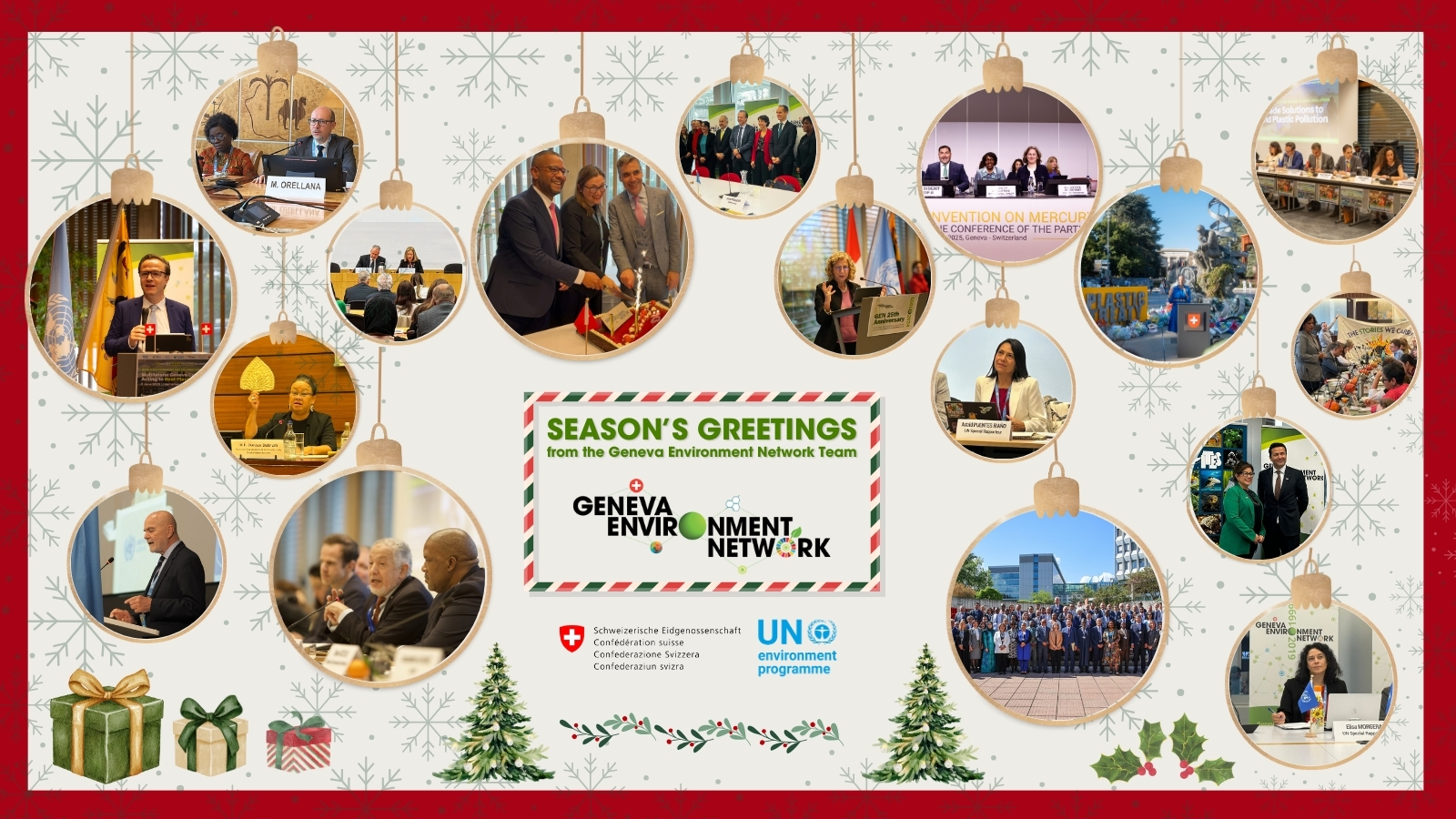
2025 was another intense and challenging year for environmental governance. Major negotiations and intergovernmental meetings in Geneva and beyond led to important decisions to tackle the triple planetary crisis of climate change, nature loss, and pollution.
As the world’s capital of multilateralism, Geneva stands at the heart of numerous debates and negotiations in the fields of science, health, human rights, sustainable development, trade and green finance, employment, peacebuilding and security, disaster risk reduction, humanitarian response, nature conservation, chemicals and pollution, as well as digital transformation and innovation. This unique interdisciplinarity gives International Geneva unmatched expertise to confront the triple planetary crisis of climate change, biodiversity loss, and pollution.
In 2025, the Geneva Environment Network convened 91 multi-stakeholder events. Among these, highlights include:
- One United Environment Family joined the International Environment House on 20 January to conclude the celebration of the 25th Anniversary of the Geneva Environment Network. The GEN@25 Environment Forum featured over fifty organizations and secretariats, showcasing how international Geneva creates synergies, drives innovation and boosts ambition to advance environmental action. It also included an exhibition on the making of the International Environment House and the network. The celebration culminated with a high-level panel reflecting on “Multilateralism Looking at the Future – Protecting the Environment with Humanity at the Center”.
- The Geneva Beat Plastic Pollution Dialogues, offered member states and stakeholders a platform to discuss priorities and expectations from the process. In the run-up to the intergovernmental negotiating committee to develop the international legally binding instrument resuming its fifth session (INC-5.2) from 5 to 14 August 2025 in Geneva, at the Palais des Nations, the World Environment Day celebration in Geneva marked an important milestone to build momentum. The GEN Team supported the artist Benjamin Von Wong in the realization of the sculpture – The Thinker’s Burden – on Place des Nations during the negotiation, and other activities in the margins of the negotiation. The artwork was largely covered by international media and nominated among the top 10 art installations features in My Modern Met.
- The Human Rights Talks, on the side lines of the three annual sessions of the Human Rights Council. In 2025, GEN hosted the second edition of the Geneva Rights and Environment Talks with the UN Special Rapporteur on the right to a healthy environment, the second edition of the Geneva Rights and Climate Talks with the UN Special Rapporteur on human rights and climate change, and the fifth edition of the Geneva Toxic Free Talks with the UN Special Rapporteur on toxics and human rights. In addition, a special series unpacking the ICJ Advisory Opinion on climate change was co-convened. GEN has also hosted events with the UN Special Rapporteur on the rights to water and sanitation, and the Special Rapporteur on environmental defenders under the Aarhus Convention, among other activities.
- The Geneva Environment Network in partnership with Switzerland, Senegal, UNEP/GRID-Geneva, UNECE, the International Institute for Sustainable Development (IISD), the Intergovernmental Forum on Mining, Minerals, Metals and Sustainable Development (IGF), The Forum on Trade, Environment, & the SDGs (TESS) and the World Resources Forum launched the Geneva Dialogues on Mineral and Metal Resources, aimed at enhancing the activities undertaken by various actors in to support the environmental sustainability management of minerals and metals along their full lifecycle.
- In the lead-up to the inaugural session of the Plenary of the ISP-CWP in Geneva, in February 2026, as well as the plenaries of other science-policy platforms in 2026, a Science-Policy Day took place on17 December 2025. Through an interactive fair, lightning talks, fireside chats, panel discussion, and a networking reception, the special event Strengthening the Science-Policy Interface to Address the Triple Planetary Crisis, provided opportunities to engage and exchange with leading experts, stakeholders and Members States working in the interface of science and policy, fostering collaboration to advance solutions for today’s environmental challenges.
The Geneva Environment Network supported partners in hosting numerous other events, and welcomed 39 visiting delegations and student groups to the International Environment House. We also kept the Geneva community engaged and informed on environmental activities and issues through our weekly newsletter and media resources. → Access videos and summaries of past events and a list of upcoming events.
In February 2025, the 10th Geneva Engage Awards honoured excellence in digital outreach across International Geneva throughout 2024, under the theme « Engage2Connect ». The Geneva Environment Network proudly won the Accessibility Award.
We extend our heartfelt thanks to Switzerland, our partners, and all stakeholders for their continued support and collaboration, and for continuing to make Geneva a global hub advancing international environmental governance. The Geneva Environment Network team deeply values working with you all.
And while we are celebrating, this year again others might be struggling for their lives in other parts of this planet. Conscious of the challenges some of your countries might be facing we stand with those who suffer and our United Nations colleagues around the world, working to contribute to a world in peace, standing for human rights and respecting obligations arising from treaties and other sources of international law.
Selection of Quotes for 2025
The Role of Geneva and Multilateralism
For the past 25 years, the Geneva Environment Network has been a cornerstone of international environmental governance, together with many institutions that make Geneva a global hub for environmental governance.
— Katrin SCHNEEBERGER, State Secretary and Director, Federal Office for the Environment, Switzerland at Geneva Environment Network High-Level 25th Anniversary Celebration on 20 January 2025
Geneva is not just a scenery, it’s a vital hub for global cooperation, especially in the field of pollution.
— H.E. Amb. Felix WERTLI, Switzerland Ambassador for the Environment at the Host Country Reception for INC-5.2 on 5 August 2025
Geneva’s expertise and institutions offer crucial support for the implementation of the future plastics treaty. Existing forums, mechanisms, and initiatives can help countries avoid starting from scratch and foster effective collaboration and information sharing.
— Kate ROBERTSON, Technical Officer (Legal), Public Health Law and Policies Unit, Department of Health Promotion, World Health Organization at World Environment Day Celebration 2025 | Multilateral Geneva Collectively Acting to Beat Plastic Pollution on 5 June 2025
Geneva played influential role in shaping advisory opinions and ensuring they have a tangible impact.
— Francesca MINGRONE, Senior Attorney, Center for International Environmental Law at 2025 Geneva Dialogues on Human Rights and Climate Change: The Role of Geneva in Building on the Historic Advisory Opinions on Climate Change on 3 September 2025
Environmental Multilateralism
Environmental multilateralism is exactly about playing by the rules, setting high standards, having non-regression, ensuring that what we do today does not negatively impact upon tomorrow.
— Inger ANDERSEN, Executive Director, UN Environment Programme at Geneva Environment Network High-Level 25th Anniversary Celebration on 20 January 2025
Because the triple planetary crisis is one crisis. Because action on the triple planetary crisis is action on human health, prosperity, equity and peace. And because the triple planetary crisis, despite all our efforts, is intensifying. To weave this tapestry, we must unite. And to unite, we must work to overcome the fragmentation of the environmental movement that has taken place over the last 50 or so years… This is why working on environmental policy coherence and synergies is so important. Because it is when we reach for synergistic coherence that we are the strongest.
— Inger ANDERSEN, Executive Director, UN Environment Programme at Geneva Environment Network High-Level 25th Anniversary Celebration on 20 January 2025
Multilateralism remains our most powerful tool for addressing global environmental challenges, uniting us to protect our planet while keeping humanity at the heart of our efforts.
— Katrin SCHNEEBERGER, State Secretary and Director, Federal Office for the Environment, Switzerland at Geneva Environment Network High-Level 25th Anniversary Celebration on 20 January 2025
Investor–state dispute settlement (ISDS) are preventing actions necessary to prevent the worst impacts of the Triple Planetary Crisis.
— Astrid PUENTES RIAÑO, UN Special Rapporteur on the right to a clean, healthy and sustainable environment at Human Rights Impacts of Investor-State Dispute Settlement Mechanisms | HRC58 Side Event on 12 March 2025
The most urgent action States should take is stopping the siloed approach. We have scientific data and evidence that climate change, biodiversity loss and pollution are all linked. We need to consider them all together.
— H.E. Amb. Christian GUILLERMET FERNÁNDEZ, Permanent Representative of Costa Rica to the UN Office and other international organizations in Geneva at Ocean Issues are Human Rights Issues | HRC58 Side Event on 13 March 2025
Today, environmental diplomacy is everywhere. We can no longer talk about development without talking about resilience and climate change and adaptation. You can no longer pretend to protect health without thinking of pollution. We cannot prevent pandemics without biodiversity and ecosystems.
— Claire THUAUDET, Deputy Permanent Representative of France to the United Nations in Geneva and other international organizations in Switzerland at Geneva Environment Network High-Level 25th Anniversary Celebration on 20 January 2025
In the face of disruptions in global trade and ongoing geopolitical tensions, we have come together to deliver something truly meaningful. Today’s achievement is a landmark for global trade governance: the entry into force of WTO’s first agreement with environmental sustainability at its core. But it is more than that. At a time the international trading system faces profound challenges, it sends a powerful signal that WTO members can work together in a spirit of cooperation and shared responsibility to deliver solutions to global challenges. This achievement is not only for the planet and our oceans, but for people everywhere.
— Ngozi OKONJO-IWEALA, Director-General, WTO at a Special General Council meeting for the entry into force of WTO Agreement on Fisheries Subsidies on 15 September 2025.
Faced with the triple planetary crisis and geopolitical tensions, UNECE’s Aarhus Convention and it Protocol on Pollutant Release & Transfer Registers serve as vital instruments to ensure the public has a voice in shaping the path forward.
— Tatiana MOLCEAN, UNECE Executive Secretary at the Joint High-level Segment under the Meetings of the Parties to the Aarhus Convention and its Protocol on PRTRs on 20 November 2025
We need to enhance synergies within clusters, between clusters, within hubs and between hubs. This is how Switzerland is approaching the UN80 process, in particular in the human-environmental cluster. A good example of both using existing assets and enhancing synergies is the chemicals and waste cluster. Through coordinated work and joint programs among the Basel, Rotterdam and Stockholm Conventions and the Minamata Convention, and now with the Global Framework on Chemicals, there is the opportunity for better and aligned implementation, sharing of knowledge and reduction of duplication. This approach enables the achievement of greater impact with fewer resources, a strategy that would benefit other environmental clusters and is needed as resources keep shrinking.
— Jonas PASQUIER, Minister, Global Affairs, Permanent Mission of Switzerland to the UN Office and other international organizations in Geneva at the Briefing on the 7th Session of the United Nations Environment Assembly | GENeva UNEA Briefing on 25 November 2025
Science-Policy
We cannot share the knowledge of Indigenous Peoples if this is seen as a “nice-to-have”. We need to have equality between science and Indigenous knowledge to co-create new knowledge.
— Ghazali OHORELLA, Legal Counsel, International Indian Treaty Council at Towards the Third UN Ocean Conference: Human Rights Obligations in Relation to Ecosystems and Their Biomes | HRC58 Side Event & Geneva Rights and Environment Talks on 14 March 2025
Transformational shifts need transformational solutions, and the science-policy panel helps ensure we make the right one.
— Kay WILLIAMS, Head, Global Framework on Chemicals Secretariat at Briefing on the Preparations for the Resumed 3rd Session of the Ad Hoc Open-ended Working Group on a Science-Policy Panel on Chemicals, Waste and Pollution Prevention | Road to OEWG 3.2 Series on 29 May 2025
The right to science means the right to truthful, transparent, and independent knowledge, one that serves people and the planet, not vested interests. Upholding this right is foundational to all climate action and to the protection of human rights in a warming world.
— Lindsey Fielder COOK | Interim Deputy Director and Representative for Climate Change, QUNO at The Right to Science Under Threat on 3 July 2025
We, scientists, need to make people care enough about something to push policymakers to take effective decisions.
— Jane MUNCKE, Managing Director and Chief Scientific Officer, Food Packaging Forum at Road to UNGA & UNEA | Global Governance on Endocrine Disruptors: From Science to Policy on 1 September 2025
Les scientifiques et les chercheurs ne devraient jamais craindre de dire la vérité.
— António GUTERRES, UN Secretary-General, at High-level Event on Early Warnings for All at the Extraordinary Session of the World Meteorological Congress on 22 October 2025
This Science-Policy Panel on Chemicals, Waste and Pollution is not merely a technical tool to organize knowledge, it is a clear expression of the will of the international community to acknowledge that sustainability is a collective project that requires strong institutions, ongoing cooperation and science capable of guiding bold decisions.
— Alejandro NARIO | National Director, Quality and Environmental Assessment, Ministry of Environment, Uruguay at Introducing the Intergovernmental Science-Policy Panel on Chemicals, Waste and Pollution: Its Foundational Document, Draft Rules of Procedure and Next Steps on 19 November 2025
Carry forward the Geneva spirit of cooperation, dialogue and shared responsibility. We look forward to building more bridges between science and policy to guide us towards solutions that can transform knowledge into action, and action into hope.
— Ivonne HIGUERO, Secretary-General, CITES Secretariat at Strengthening the Science-Policy Interface to Address the Triple Planetary Crisis on 17 December 2025
Science is not negotiable. Scientific findings can be uncomfortable for policymakers. Rejecting evidence is not an acceptable solution.
— H.E. Amb. Felix WERTLI, Switzerland Ambassador for the Environment at Strengthening the Science-Policy Interface to Address the Triple Planetary Crisis on 17 December 2025
Climate Change
Climate finance is too often framed as generosity, rather than obligations.
— H.E. Amb. Patricia Ann HERMANNS, Permanent Representative of the Commonwealth of The Bahamas to the United Nations Office and other international organizations in Geneva at the HRC58 side event by the Independent Expert on the effects of foreign debt on 10 March 2025
Climate defenders have long served as watchdogs highlighting the lack of ambition, action, and prioritization in phasing out fossil fuels as the main cause of climate change, while defending the right to access information, exposing how ignoring fossil fuels hinders meaningful climate mitigation and human rights protection, and revealing the systematic suppression of public understanding about how ending fossil fuel reliance is the most impactful climate and human health action to prevent toxic pollution, protect biodiversity, and safeguard human resilience against climate change.
— Elisa MORGERA, UN Special Rapporteur on human rights and climate change at Climate Defenders’ Right to Participate in Climate Action on 4 July 2025
What the IPCC is to science, the International Court of Justice Advisory Opinion now is to law.
— Benjamin SCHACHTER, Coordinator, Environment and Climate Change Team, OHCHR at Delivery of ICJ Advisory Opinion on Climate Justice | Live Diplomatic Screening and Commentary on 23 July 2025
Science is clear: extreme weather and climate change impacts are worsening. The question before us is not whether we act, but whether we act in time, together, and with the courage required. The cost of action may seem high. The cost of inaction is much higher.
— Celeste SAULO, WMO Secretary-General at COP30in Belém: Joining Forces for a Common Purpose on 17 September 2025
The cry of the poor and the cry of the planet are one… Adaptation is not enough: we need bottom-up multilateralism and action at the root of the crisis.
— Rodrigo PERET, Franciscans Friar, Pastoral Land Commission of Uberlândia | Franciscans International at COP30 and Human Rights: Call from Global South Catholic on 18 September 2025
The Paris Agreement’s spirit, will and ambition are alive — the energy transition is underway and must accelerate.
— H.E. Amb. Céline JURGENSEN, Permanent Representative of France to the UN in Geneva at Geneva Launch: Green Technology Book EXPO25 Special Edition | Advancing Climate Action Ten Years After the Paris Agreement on 10 October 2025
We all agree that climate impacts are no longer distant warnings; they are daily realities[…] In the face of these challenges, innovation and technology offer powerful tools for change. Yet deployment of climate solutions remains far too slow. One key reason is the gap in knowledge about what technologies already exist, how those technologies work and how they can be good for the climate as well as for business.
— Edward KWAKWA, Assistant Director General, Global Challenges and Partnerships Sector, WIPO at Geneva Launch: Green Technology Book EXPO25 Special Edition | Advancing Climate Action Ten Years After the Paris Agreement on 10 October 2025
Nature Loss
Achieving harmony with nature requires more than technical solutions, it demands we uphold the human right of every person to a clean, healthy and sustainable environment.
— H.E. Amb. Anita PIPAN, Permanent Representative of the Republic of Slovenia to the United Nations Office and other international organizations in Geneva at International Biodiversity Day Celebration 2025 | Multilateral Geneva Creating Interlinkages and Driving Transformative Change in Harmony with Nature and Sustainable Development on 22 May 2025
Conservation is a moral imperative and a responsibility for generations to follow.
— H.E. Amb. Eldiyor TOSHMATOV, Permanent Representative of the Republic of Uzbekistan to the United Nations Office and other international organizations in Geneva at World Wildlife Day 2025 Celebration on 3 March 2025
Trade can be a force for nature, protecting biodiversity and diversifying economies.
— Pedro Manuel MORENO, Deputy Secretary-General, UN Trade and Development at Changemakers for Sustainable Trade — Advancing circular and biodiversity-based economies | UNCTAD16 Parallel Event on 22 October 2025
Pollution
Confronting daunting policy challenges, we are reminded about the emergency of our mission. All hands on deck are required to fulfill our mission of a cleaner planet and healthy people.
— Rolph PAYET, Executive Secretary, Basel, Rotterdam and Stockholm Conventions at Briefing on the 2025 Meetings of the Conferences of the Parties to the Basel, Rotterdam and Stockholm Conventions | Road to 2025 BRS COPs on 10 April 2025
The right to know goes beyond the four walls of the workplace: it protects workers individually, the health of communities and families, and the environment at large.
— Halshka GRACZYK, Technical Specialist, Occupational Safety and Health and Working Environment Branch, ILO at The Right to Know – Modernising the Rotterdam Convention | Road to 2025 BRS COPs on 19 March 2025
We will not overcome the gravity of the toxification of the planet one case at a time.
— Marcos ORELLANA, UN Special Rapporteur on toxics and human rights at Special Rapporteur on Toxics: Overcoming Barriers to Justice in Toxics Cases | HRC60 Side Event on 16 September 2025
I remain optimistic the Minamata Convention will continue making a positive impact on people’s lives everywhere and will serve as a shining example of multilateral cooperation and a model of an actionable multilateral environmental agreement.
— Monika STANKIEWICZ, Executive Secretary, Minamata Convention on Mercury at the Briefing on the 6th Meeting of the Conference of the Parties to the Minamata Convention on Mercury on 2 October 2025
If we don’t act now, by 2050, we might come back to the era before Fleming, meaning that no antibiotic will be effective to treat disease. This is why the one health approach and leadership dialogues on health are critical.
— Jacqueline ALVAREZ, Head, Chemicals and Health Branch, UNEP at the Briefing on the 7th Session of the United Nations Environment Assembly | GENeva UNEA Briefing on 25 November 2025
Healthy planet and healthy people are two sides of the same coin.
— Arnold KREILHUBER, Director, Europe Office, UN Environment Programme at the Eleventh session of the Conference of the Parties of the WHO Framework Convention on Tobacco Control Strategic Dialogue « Healthy Planet, Healthy Future: Uniting for Tobacco-free Generations » on 17 November 2025
Human Rights
Human rights are being suffocated by the climate crisis, and by a morally bankrupt global financial system that too often obstructs the paths to greater equality and sustainable development.
— António GUTERRES, UN Secretary-General, at Opening Session of the 58th Session of the Human Rights Council on 24 February 2025
A people-centric approach should be at the core of the water-energy governance.
— H.E. Amb. Marcos GÓMEZ MARTÍNEZ, Permanent Representative of Spain to the UN Office and other international organizations in Geneva at The Water-Energy Nexus and the Human Right to Water | HRC60 Side Event on 16 September 2025
Public participation, access to information, access to remedy are key pillars of the right to a healthy, safe, clean, and sustainable environment. Local communities are 24/7 watchdogs.
— Pui Yi WONG, Researcher, Basel Action Network at Preventing Plastic and E-Waste Trafficking: Lessons from the Frontlines | 2025 BRS COPs Side Event on 4 May 2025
Circular Economy
The growth of our well-being should be decoupled from the growth of economic activity. A circular economy is instrumental in delivering such decoupling.
— Janez POTOČNIK, Co-chair, International Resource Panel at Spotlight on Circularity | Geneva Dialogues on Mineral and Metal Resources | UNECE Resource Management Week Side Event on 26 March 2025
We will not get circular until we deal with the toxicity issue.
— Steven STONE, Chair, UN Partnership for Action on Green Economy | Deputy Director, Industry and Economy Division, UN Environment Programme at Employment in the Circular Economy: Leveraging Circularity to Create Decent Work on 4 December 2025
Just Transition
If we want a just transition, we must integrate corporate accountability.
— Ana Maria SUAREZ FRANCO, Secretary General, FIAN International at 2025 Geneva Dialogues on Human Rights and Climate Change: The Role of Geneva in Building on the Historic Advisory Opinions on Climate Change on 3 September 2025
A transition that isn’t just is simply a shift. Justice must be the foundation, or the transition is not real.
— Yves LADOR, Representative of Earthjustice to the United Nations in Geneva at Just Transition and Human Rights | Reducing Dependence on New Mineral Resource Extraction on 1 July 2025
Mineral and Metal Resources
The environmental, social, and economic challenges and opportunities in relation to minerals and metal resources are deeply intertwined and interconnected. Progress on the sustainable management of these resources and their contribution to the achievement of Sustainable Development Goals will require intensive international cooperation, clear legal frameworks, and partnerships and efforts from a wide range of stakeholders.
— Carolyn DEERE BIRKBECK | Executive Director, Forum on Trade, Environment & the SDGs (TESS), Geneva Graduate Institute at Launch of the Geneva Dialogues on Mineral and Metal Resources on 13 February 2025
Challenges related to mineral and metal resources are numerous, but we have the tools to address them.
— Dario LIGUTI | Director, Sustainable Energy, United Nations Economic Commission for Europe at Launch of the Geneva Dialogues on Mineral and Metal Resources on 13 February 2025
Addressing mercury in ASGM is not only an environmental task, it is a matter of justice, human rights and protecting our health and future generations.
— Lia ESQUILLO, Program Director, IPEN at Strengthening the Minamata Convention: A New Approach to the Global Mercury Trade and Use in ASGM | Minamata COP-6 Online Event on 14 October 2025
Selection of Key Outcomes of Environmental Negotiations in 2025
January 2025
- In accordance with the UN General Assembly (UNGA) resolution A/RES/77/158 declaring 2025, the International Year of Glaciers’ Preservation was officially launched with a special event in Geneva on 21 January 2025.
February 2025
- The 78th Meeting of the Standing Committee to the Convention on International Trade in Endangered Species of Wild Fauna and Flora (CITES) saw progress to strengthen compliance with the Convention, in the fight against wildlife crime, and enhanced cooperation for ensuring the sustainability and legality of international wildlife trade and paved the way for the 20th Conference of the Parties (CoP20).
- The resumed session of the Sixteenth meeting of the Conference of the Parties to the Convention on Biological Diversity (COP 16) successfully addressed all decisions suspended in Cali, Colombia in 2024. Parties Committed to establishing permanent arrangements for the financial mechanism, mobilizing funds and improving existing financial instruments to close the global biodiversity finance gap and achieve the target of mobilizing at least 200 billion dollars a year by 2030; adopted a Strategy for Resource Mobilization; enhanced the planning, monitoring, reporting and review (PMRR) mechanisms required to measure implementation of the Kunming Montreal Global Biodiversity Framework; and launched the Cali Fund for the Fair and Equitable Sharing of Benefits from the use of Digital Sequence Information on Genetic Resources (DSI).
April 2025
- The 58th session of the UN Human Rights Council (HRC58) adopted, without a vote, resolution A/HRC/RES/58/16 on “The human right to a clean, healthy and sustainable environment: Ocean and Human Rights”. It is also to be noted that Costa Rica delivered a statement on behalf of 45+ countries during the interactive dialogue with the UN Special Rapporteur on the right to a healthy environment, reminding that environmental human rights defenders are amongst the most at-risk human rights defenders in the world.
- The fifth meeting of the Board of the Fund for Responding to Loss and Damage (FRLD) (B5) adopted a decision to launch the start-up phase of the FRLD, naming it the Barbados Implementation Modalities (BIM), for the FRLD to deliver a first set of interventions between 2025 and 2026 for a total amount of 250 million USD.
May 2025
- The 2025 meetings of the Conference of Parties to the Basel, Rotterdam and Stockholm Conventions (2025 BRS COPs) adopted a series of bold decisions to advance the sound management of chemicals and wastes, including the listing of chemicals under the Stockholm and Rotterdam Conventions such as chlorpyrifos, LC-PFCAs, medium-chain chlorinated paraffins, and a specific exemption for the UV-328 listing, ensuring this would not set a precedent for future listings. The Basel Convention adopted a decision amending Annex IV on disposal operations, to be effective in 1 January 2030, which are aimed at improving/updating descriptions, improving environmental controls, and clarifying descriptions, towards providing enhanced clarity as to what is defined as waste under the Convention, as well as decisions on technical guidelines on lead acid batteries, on pneumatic tyres, and on the environmentally sound management of wastes containing various POPs, including a new guideline specifically on UV-328 (a chemical used in plastics). Other key outcomes are the launch used textiles and textile wastes as a new area of work; the adoption of a decision to continue strengthening international cooperation and coordination with other organizations; and on synergies in preventing and combating illegal traffic and trade in hazardous chemicals and wastes.
June 2025
- The Seventy-eight World Health Assembly (WHA78) advanced significantly the global health and environmental agenda, with the historic adoption of the pandemic treaty, alongside significant decisions such as updating the Global action plan (GAP) on antimicrobial resistance (AMR), for discussion at next year’s World Health Assembly (WHA79) in 2026, and adopting the first-ever Global action plan on climate change and health for 2025–2028, marking an important step forward in global health and climate policy.
- The eighth session of the Global Platform for Disaster Risk Reduction endorsed an eight-point call to action The Geneva Call for Disaster Risk Reduction.
- The 113th Session of the International Labour Conference adopted of Convention No. 192 and Recommendation No. 209 — the first international labour standards to protect workers from biological hazards in the working environment, setting a global standard to safeguard workers’ health, now and in the future. Additionally, the general discussion on innovative approaches to tackling informality and promoting transitions towards formality to promote decent work, resulted in conclusions and recommendations.
- The 2025 UN Ocean Conference adopted the Nice Ocean Action Plan, a two-part framework that comprises a political declaration “Our ocean, our future: united for urgent action” stressing that the ocean plays an essential role in mitigating the adverse effects of climate change and over 800 voluntary commitments by governments, scientists, UN agencies, and civil society since the previous conference.
- The Intergovernmental Meeting to Consider the Establishment of the new Science-Policy Panel on Chemicals, Waste and Pollution established the Intergovernmental Science-Policy Panel on Chemicals, Waste and Pollution (ISP-CWP), completing a global scientific trifecta alongside the Intergovernmental Panel on Climate Change (IPCC) and the Intergovernmental Science-Policy Platform on Biodiversity and Ecosystem Services (IPBES).
- The seventy-ninth session of the Executive Council (EC-79) of the World Meteorological Organization agreed on an action plan on Artificial Intelligence (AI) to strengthen the entire weather, climate, water science to services value cycle (EC Doc 4.1); and agreed to accelerate the rollout of the Early Warnings for All initiative – WMO’s top overriding priority (EC DOC 3.1); endorsed the WMO Youth Action Plan, a reinvigorated gender action plan; future research and operational activities, including on greenhouse gas monitoring. (EC Doc 3.2) and WMO’s active participation in the Fifth International Polar Year (IPY-5), scheduled for 2032–2033.
- The Hong Kong International Convention for the Safe and Environmentally Sound Recycling of Ships – aimed at ensuring that ships, when being recycled after reaching the end of their operational lives, do not pose any unnecessary risk to human health and safety or to the environment – entered into force on 26 June 2025.
July 2025
- The Inter-American Court of Human Rights issued a landmark ruling on States’ responsibilities to tackle the climate crisis in response to the request by the Republics of Colombia and Chile. In this major judicial ruling (known as Advisory Opinion 32), the Court sets out what human rights law demands of governments in the face of the climate emergency. The ruling draws on an unprecedented participatory process involving over 260 amicus briefs and 160 delegations of States, Indigenous and Afro-descendant Peoples, frontline communities, and civil society groups taking part in the oral hearings.
- The 59th session of the UN Human Rights Council (HRC59) adopted without a vote the annual resolution on human rights and climate change A/HRC/RES/59/24, with a focus this year on climate finance; as the resolution acknowledges how climate finance is a tool for addressing to the challenges of climate change, including in adaptation and in increasing economic and non-economic loss and damage, and for the enjoyment of human rights.
- The International Court of Justice (ICJ) released its advisory opinion on States’ obligations with respect to climate change and the legal consequences for failing to live up to these obligations. The world’s highest court unanimously ruled that States have an obligation to protect the environment from greenhouse gas (GHG) emissions, the obligation under the Paris Agreement on climate change to limit global warming to 1.5°C above pre-industrial levels, and act with due diligence and cooperation to fulfill this obligation. The Court further ruled that if States breach these obligations, they incur legal responsibility and may be required to cease the wrongful conduct, offer guarantees of non-repetition and make full reparation depending on the circumstances. The ICJ has adopted the Advisory Opinion unanimously — only the fifth time in its nearly eighty-year history that it has done so.
- The 15th meeting of the Conference of the Contracting Parties (COP15) to the Convention on Wetlands adopted 25 draft resolutions intended to further the protection and wise use of wetlands.
- The 30th Session of the International Seabed Authority (ISA30) adopted a decision to advance work on the development of a Common Heritage Fund, which will serve as one of the possible mechanisms to implement the economic benefits of the regime in the Area. It accepted proposal by Fiji, Jamaica, Malta and Singapore for the establishment of 1 November as the International Day of the Deep Seabed.
September 2025
- The Agreement on Fisheries Subsidies entered into force on 15 September 2025, becoming the first multilateral agreement negotiated under the World Trade Organization (WTO) to place environmental sustainability at its core. Under this new treaty, subsidies for vessels and operators engaged in illegal, unreported, or unregulated (IUU) fishing are prohibited. The agreement further bans support for fishing in overfished stocks and for fishing in unregulated high seas. Provisions on special and differential treatment are provided to allow flexibility for developing countries.
- The World Flora Online (WFO) Association, a freely accessible portal resulting from an international initiative to catalogue all the plant species in the world to achieve Target 1 of the Global Strategy for Plant Conservation, was launched at the Geneva Botanical Garden.
- The Agreement on Marine Biological Diversity of Areas beyond National Jurisdiction — BBNJ Agreement, also known as the High Seas Treaty — reached the milestone of 60 ratifications, triggering its entry into force on 17 January 2026, providing a global framework to advance international biodiversity goals, including the commitment to protect 30% of land and sea by 2030 under the Kunming-Montreal Global Biodiversity Framework.
October 2025
- The 60th session of the Human Rights Council (HRC60) adopted various environment-related resolutions, including on rising sea levels and human rights, the human rights to safe drinking water and sanitation, the rights of Indigenous Peoples, and the extension of the mandate of the UN Special Rapporteur on the rights of Indigenous Peoples.
- At the Extraordinary Session of the World Meteorological Congress, WMO Secretary-General Celeste Saulo launched a Call to Action on Accelerating the Implementation of the Early Warnings for All Initiative and a new report Early Warnings for All in Focus: Hazard Monitoring and Forecasting. WMO, together with the Global Water Partnership (GWP), officially launched the Community of Practice (CoP) on Flood Forecasting, a collaborative space for professionals working on flood forecasting, warning, and early action. WMO also adopted the first WMO Youth Action Plan and the World Meteorological Congress endorsed actions to promote Artificial Intelligence for forecasts and warnings.
- The 2025 IUCN World Conservation Congress adopted 148 Resolutions, including the first-ever global policy on synthetic biology and nature conservation, a motion to recognize ecocide as a crime, and motions to strengthen governance and inclusion and the first motion (Motion 042) across the entire global multilateral system to explicitly address fossil fuel production as a threat to nature. The Congress also welcomed over 100 new Members into its Union during the Congress – including six states Armenia, Tajikistan, Marshall Islands, Gabon, Tuvalu, and Zimbabwe.
- The Association of Southeast Asian Nations (ASEAN) adopted the ASEAN Declaration on the Right to a Safe, Clean, Healthy and Sustainable Environment at the 47th ASEAN Summit held in Kuala Lumpur, Malaysia. The Declaration states its commitment to “advance the right to a safe, clean, healthy and sustainable environment for present and future generations” and to promote and foster “the implementation of environmental law” and of “multilateral environmental agreements to which all ASEAN Member States are parties”. They also commit to improve “efforts to provide for a safe and enabling environment” to ensure the exercise of this right.
November 2025
- The Sixth Meeting of the Conference of the Parties to the Minamata Convention on Mercury (COP-6) adopted 22 decisions aimed at advancing the Convention’s mission to safeguard human health and the environment from mercury pollution, including the establishment of a global phase-out of dental amalgam by 2034 and several phasedown measures for Parties to adopt in the meantime; increased efforts eliminate mercury-added skin-lightening products. COP-6 also advanced work to reduce mercury use in Artisanal and small-scale gold mining (ASGM) and enhance accountability of buyers and intermediaries across the gold trade; to improve effective participation of Indigenous Peoples; enhancing international cooperation. At COP-6 the International Indigenous Peoples Forum on Mercury was established and the Minamata Convention’s Women’s Caucus, and the Youth Declaration on Mercury were launched.
- The Framework Convention for the Protection of the Marine Environment of the Caspian Sea, also known as the “Tehran Convention” saw the entry into force of its third protocol, the Protocol on Environmental Impact Assessment in a Transboundary Context (EIA protocol), which provides Caspian states with a framework to assess environmental impacts of major projects — such as industrial development, pipelines, and offshore operations — before launch, ensuring transparency, stakeholder input, and cross-border cooperation.
- The 30th UN Climate Change Conference (COP30) endorsed a sweeping package to scale up climate finance and accelerate the implementation of the Paris Agreement, calling for mobilizing at least $1.3 trillion per year by 2035 for climate action, alongside doubling adaptation finance by 2025 and triple by 2035. It also confirmed the operationalization and replenishment cycles for the Fund for Responding to Loss and Damage (FRLD). Various initiatives were launched, including a new dialogue process on climate and trade, the Just Transition mechanism, and the Belém Health Action Plan.
- The joint High-level Segment of the eighth session of the Meeting of the Parties to the Convention on Access to Information, Public Participation in Decision-making and Access to Justice in Environmental Matters (Aarhus Convention MoP8) and of the fifth session of the Meeting of the Parties to the Protocol on Pollutant Release and Transfer Registers (Protocol on PRTRs MoPP5) adopted the Geneva Declaration on advancing public rights to tackle the triple planetary crisis in the face of geopolitical tensions, reaffirming the commitment to promote environmental democracy and its key components, such as, access to information, public participation in decision-making, access to justice and protection of environmental defenders, as essential prerequisites for building a sustainable future for present and future generations.
- The Eleventh session of the Conference of the Parties to the World Health Organization Framework Convention on Tobacco Control (WHO FCTC) adopted a decision to strengthen Article 18 on the environment by establishing a coordination mechanism, developing science-based studies and research, developing awareness campaigns, identifying, exposing, and countering greenwashing, and considering comprehensive regulatory options.
December 2025
- The 20th meeting of the Conference of the Parties to the Convention on International Trade in Endangered Species of Wild Fauna and Flora (CITES CoP20) adopted 353 decisions that will shape international trade regulation in endangered species and on the Convention’s next three‑year agenda. CITES Appendices have been amended with 82 new listing to increase protection of several flora and fauna species or to recognize conservation successes. Parties adopted enhanced measures addressing online wildlife crime, illicit financial flows, corruption, annual illegal trade reporting, and reinforced mandates for the implementation of CITES Big Cats and Tree Species Task Forces outcomes, as well as new frameworks, regional plans, including the Samarkand Declaration and Action Plan, to reinforce conservation, management, and monitoring of various species. Parties also endorsed guidance on artificially propagated plant material, updated provisions for the management of confiscated specimens, and expansion of electronic permitting and digital traceability systems.
- The Seventh Session of the United Nations Environment Assembly (UNEA-7) adopted 11 resolutions, 3 decisions, and a Ministerial Declaration, advancing action on topics such as the sound management of minerals, metals, chemicals, and waste to the sustainable use of Artificial Intelligence, international cooperation against wildfires, antimicrobial resistance, the protection of glaciers and of coral reefs, and finding sustainable solutions through sport. UNEA-7 also adopted the UNEP Medium-Term Strategy for the next four years, endorsing UNEP as the leading global environmental authority.
2024 in Review
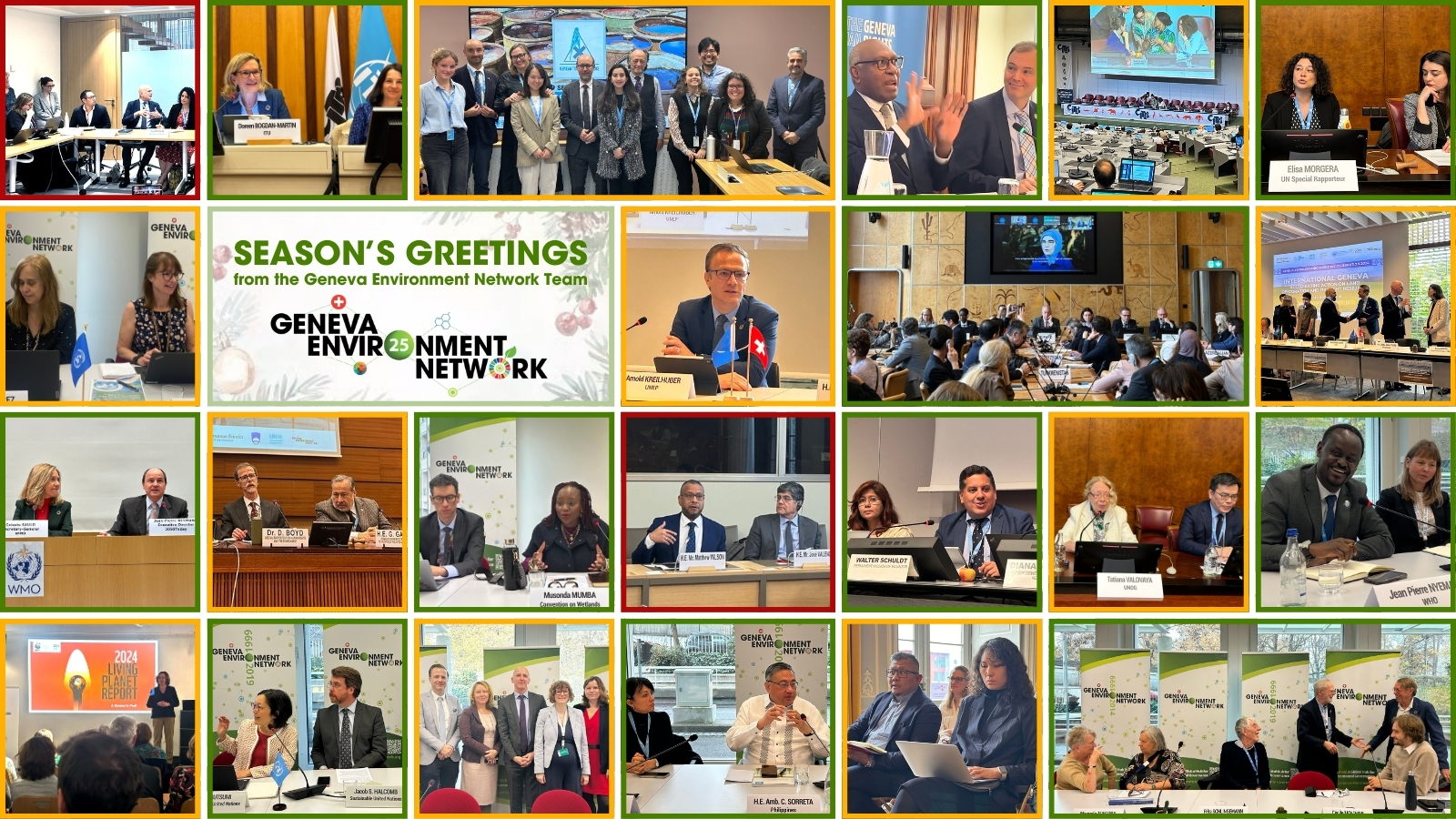
2024 was another busy year for environmental governance, with major negotiations and intergovernmental meetings in Geneva and beyond, leading to important decisions to tackle the triple planetary crisis of climate change, biodiversity loss, and pollution, we are facing.
As the world capital for multilateralism, Geneva is at the center of numerous debates and negotiations in the fields of science, health, human rights, development, trade and green finance, employment, peacebuilding and security, disaster risk reduction, humanitarian response, nature conservation, chemicals and pollution, as well as digital transformation and innovation. This interdisciplinarity allows International Geneva to have unique cross-disciplinary expertise on climate change, biodiversity loss and pollution.
In 2024, the Geneva Environment Network organized or co-organized 84 multi-stakeholder events, which served as platform for the launch of 16 publications and of a coalition. Among these, the team would like to highlight and warmly thank the co-conveners of:
- The Geneva Beat Plastic Pollution Dialogues, while following closely the developments of the plastics treaty negotiations, the dialogues offered member states and stakeholders a platform to discuss priorities and expectations from the process. The Dialogues addressed plastics impacts on health, human rights, and biodiversity, as well as business responsibility. They also supported the launch of important scientific research, increasing their outreach and impact to international Geneva and beyond.
- The Human Rights Talks, organized on the side lines of the three annual sessions of the Human Rights Council. GEN co-organized with Earthjustice and other partners talks around the thematic Special Rapporteurs with mandates related to the environment. The Geneva Rights and Environment Talks featured discussions with the Special Rapporteur on the right to a clean, healthy and sustainable environment and reflected on the challenges posed by the rapid decline of nature and biodiversity and the intertwined human rights implications. The Geneva Rights and Climate Talks discussed challenges posed by climate change from a human rights perspective with key inputs form the Special Rapporteur on human rights and climate change. For the fourth year in a row, the Geneva Toxic Free Talks discussed the negative impacts of hazardous chemicals, and concrete steps towards a toxic-free world. The talks have been instrumental in addressing current and often forgotten challenges and Geneva’s role in advancing on these issues. The partnerships around the Geneva Roadmap 40/11 on environment human rights defenders is also to be highlighted.
The Geneva Environment Network supported partners in hosting numerous other events and welcomed 41 visiting delegations and student groups to the International Environment House. The Geneva community was kept informed of environment-related activities and issues through the weekly newsletter and media resources.
The team would like to thank Switzerland, its partners, and other stakeholders for their continued support and collaboration, and for continuing to make Geneva a global hub for international environmental governance.
And while we are celebrating, this year again others might be struggling for their lives in other parts of this planet. Conscious of the challenges some of your countries might be facing we stand with those who suffer and our United Nations colleagues around the world, working to contribute to a world in peace, standing for human rights and respecting obligations arising from treaties and other sources of international law.
Selection of Quotes for 2024
The Role of Geneva and Multilateralism
Our work in the multilateral system requires us to fight against centrifugal forces.
— Inger ANDERSEN | UNEP Executive Director at UNEP Europe Office Staff Meeting on 15 January 2024.
The paradox is that, despite recognizing the critical need for cooperation with local and regional governments, states often hesitate to include references to them in legal documents. Yet, it is obvious that states will have to rely on local and regional governments to effectively implement the internationally negotiated rules. This obstruction is due to a traditional preference for multilateralism among member states.
— Kamelia KEMILEVA | Co-Director, Global Cities Hub at International Day of Zero Waste 2024 | Geneva Celebration on 27 March 2024
Geneva is an important cluster of environmental and health governance. It brings actors together to work jointly and will ensure that the plastics treaty provisions will use that expertise, to ensure mutual supportiveness and synergies and not hierarchies between existing instruments.
— Michel TSCHIRREN | Head, Global Affairs Section, Federal Office for the Environment, Switzerland at Chemicals in the Plastics Treaty: Perspectives on Protecting Human Health on 6 April 2024
In a climate of global crises, we have Geneva as a hub for human rights processes and solutions.
— Luc DOCKENDORF | Deputy Permanent Representative of the Grand Duchy of Luxembourg to the United Nations Office and other international organizations in Geneva at 2024 Geneva Dialogues on Human Rights and Climate Change on 14 May 2024
There is potential to increase cooperation and visibility of the environmental agenda even though multilateralism is under pressure, even though environmental policies are often unpopular.
— H.E. Amb. Julien THÖNI | Deputy Permanent Representative of Switzerland to the United Nations Office and other International Organizations in Geneva at How to Keep the United Nations Environmental Agenda in Times of crisis? on 15 November 2024
The environment holds a mirror to ourselves. We live in a world of the triple planetary crisis, and the crises we face require us to fix our relationship with the environment.
— Arnold KREILHUBER | Director, Europe Office, UN Environment Programme at How to Keep the United Nations Environmental Agenda in Times of crisis? on 15 November 2024
The future of environmental diplomacy lies in a human rights-centered approach and a stronger commitment to multi-stakeholder engagement. Through the pressure from associations, NGOs, and civil society, we can push governments to act.
— Cécile MOLINIER | Former Director, UN Development Programme, Geneva Representation Office | Member, Executive Committee, Greycells at From Stockholm to Rio and Geneva | Six Decades of Enhancing Collaboration in the Fight Against the Triple Planetary Crisis: A Roundtable with Elders | GEN @ 25
There is growing interest in taking environmental governance to the next level, and I believe Geneva will continue to play a key role in this evolution.
— Arthur DAHL | President, International Environment Forum | Former Deputy Assistant Executive Director, UN Environment Programme at From Stockholm to Rio and Geneva | Six Decades of Enhancing Collaboration in the Fight Against the Triple Planetary Crisis: A Roundtable with Elders | GEN @ 25 on 28 November 2024
As we navigate the digital era, Geneva ecosystem offers great opportunities to merge technological innovation and sustainability.
— H.E. Amb. Jürg LAUBER | Permanent Representative of Switzerland to the United Nations and other Organizations in Geneva at 3rd High Level Meeting of 2050Today on 4 December 2024.
Genève est un lieu où les mots ont une importance capitale. Ici, des négociations cruciales son menées, des déclarations sont faites, et des accords sont signés. À la suite de ces négociations, déclarations et accords, l’ONU mène des actions affectant des millions de personnes à travers le monde. Genève est parfois un lieu des déclarations, mais pas toujours à l’écoute. Cependant, les véritables succès de Genève viennent lorsque nous sommes aptes à écouter. C’est en écoutant que nous comprenons, que nous nous connectons et que nous trouvons un terrain d’entente.
— H.E. Amb. Peter MACDOUGALL | Permanent Representative of Canada to the United Nations Office and other international organizations in Geneva at the inauguration of the OPUS CARBON Exhibition on 10 December 2024
Biodiversity Loss
Nature is assaulted by the triple planetary crisis, and pressure is intense. By INC-5, I wish we have ambition: we have to ensure that biodiversity is covered in there.
— Musonda MUMBA | Secretary General, Ramsar Convention on Wetlands at Biodiversity and the Global Plastics Treaty: IUCN’s Proposal for a Specific Article on “Biodiversity Aspects” in the Future Treaty on 26 March 2024
The Global Biodiversity Framework is a true example of our collecting and ambitious desire to address the planetary challenges by working across silos and bridging the gap across the so-called environmental agenda. It is only through the whole-of government and the whole of society approaches, which are so interwoven through the GBF that we will succeed in securing the future we want.
— Monika STANKIEWICZ | Executive Secretary of the Minamata Convention at Minamata Online on 18 April 2024
Nature-based Solutions tap on the power of nature, allowing to link people and nature.
— Verónica RUIZ | Programme Manager, Climate and Disaster Resilience, International Union for Conservation of Nature (IUCN) at Humanitarian Networks and Partnerships Week (HNPW) on 8 May 2024
We all know that the devastating impacts of climate change and nature loss are all around us. The situation today is worse than what was predicted 10 years ago, and everyone, everywhere, is affected. But we all know what needs to be done. Every country needs to implement the Biodiversity Plan on the ground, applying a human rights-based approach in addressing the drivers of biodiversity loss.
— Kirsten SCHUIJT | Director General, WWF Internationalat Geneva at Biodiversity Day Celebration 2024 | International Geneva Implementing the Biodiversity Plan on 22 May 2024
It is imperative to change the way we relate to nature and to come to the collective realization that there will be no peace among us as long as we are not able to make peace with nature.
— H.E. Amb. Gustavo GALLÓN – Permanent Representative of Colombia to the UN office and other international organizations in Geneva at Geneva at Biodiversity Day Celebration 2024 | International Geneva Implementing the Biodiversity Plan on 22 May 2024
The protection of biodiversity is not only an environmental agenda and an effort but fundamentally it is a social and economic responsibility.
— Moustapha Kamal GUEYE | Director, Priority action programme on just transitions, International Labour Organization at Geneva at Biodiversity Day Celebration 2024 | International Geneva Implementing the Biodiversity Plan on 22 May 2024
Biodiversity is our life, health, food, water. Indigenous Peoples from across the world collectively work together to make sure we protect and defend the environment. For us, every day is biodiversity day.
— Lucy MULENKEI | Executive Director, Indigenous Information Network | Co Chair, International Indigenous Forum on Biodiversity | Co Chair, Indigenous Women Biodiversity Network at Geneva at Biodiversity Day Celebration 2024 | International Geneva Implementing the Biodiversity Plan on 22 May 2024If we leave behind rivers, lakes, plants and animals, human beings will not survive.
— Surya DEVA | UN Special Rapporteur on the Right to development at The Human Rights of Future Generations and Sustainable Development | HRC57 Side Event on 16 September 2024
Climate Change
It is important to developing countries and the most vulnerable one to climate change to discuss whether we are doing just transitions. We need the courts and judicial remedies to guide it, to push it forward, to see if we do not go over our natural resources or whether we are dealing with bilateral or international financial institutions in terms of loss and damage funds.
— H.E. Amb. Carlos SORRETA | Permanent Representative of the Philippines to the UN and other international organizations in Geneva at Environmental Rule of Law: Tracking Progress and Charting Future Directions | Global Report Launch on 12 March 2024
The human body is an ecosystem, and this little ecosystem needs clean water to survive, fresh air, food of course and shelter. Humans, instead of protecting what is very much needed and absolutely fundamental for our survival, are attacking and polluting everything we touch. We pollute the whole environment, creating this global warming situation and all of that is having a very negative repercussion on human health.
— Maria NEIRA | Director of Department of Environment, Climate Change and Health, World Health Organization at Geneva at Biodiversity Day Celebration 2024 | International Geneva Implementing the Biodiversity Plan on 22 May 2024
The response to climate change must be at the level of the magnitude of the problem we face.
— Maria NEIRA | Director of Department of Environment, Climate Change and Health, World Health Organization at The New Resolution on Climate Change and Health: The Incentives for Policy Change – Promoting Action by Leveraging Opportunities | WHA77 Side Event | 27 May 2024
It is our duty as scientists to convey the planet’s alarms to the world in an unbiased way that also inspires action and hope.
— Ko BARRET | Deputy Secretary General, WMO at The People’s Climate Vote: What does the World Want in Terms of Climate Action on 27 June 2024
Sustainability is no longer cheap. It costs and for Small Islands Developing States, the cost is building on top of other costs for countering climate change.
— H.E. Amb. Nella Pepe TAVITA-LEVY | Permanent Representative of the Independent State of Samoa to the United Nations Office and other international organizations in Geneva at Geneva Trade Week 2024 on 9 September 2024.
Every part per million and every fraction of a degree temperature has real impact on our lives and our planet.
— Celeste SAULO | Secretary-General, World Meteorological Organization at the launch of WMO’s annual Greenhouse Gas Bulletin on 28 October 2024
When citizens unite for climate change, they can lead change that influences climate policies at all levels.
— Agi VERES | Director, UNDP Office in Geneva at Pushing Boundaries Through Collective Action: How Can Citizens Drive Systems Change and Catalyze Climate Action? | Climate Solutions to Keep 1.5° Alive | GEN @ 25 on 2 December 2024
At COP29, once again we did not see climate talks deliver on climate justice. It is time that climate obligations are rooted in legal obligations.
— H.E. Amb. Sumbue ANTAS | Permanent Representative of the Republic of Vanuatu to the UN Office and other international organizations in Geneva at Climate Justice Hearings at the International Court of Justice: Unpacking Key Arguments and Drawing Lessons from a Human Rights Perspective on 12 December 2024
Chemicals, Waste and Pollution
Chemical pollution might be invisible, but its impacts are very visible on our health.
— Vito BUONSANTE | Policy & Technical Adviser, IPEN at Chemicals in the Plastic Treaty: Perspectives on Protecting Human Health on 28 March 2024
Workers are overexposed to chemicals: 1 million workers lose their life every year due to chemical exposures. Whether it causes fatal diseases or injuries or non-fatal injuries that lead to disabilities, chemical pollution constitutes a global health crisis having a heavy economic impact on countries. The science-policy panel could shed light on these issues.
— Halshka GRACZYK | Technical Specialist, Occupational Safety and Health, International Labor Organization (ILO) at Road to OEWG 3 | Towards a Science-Policy Panel to Contribute Further to the Sound Management of Chemicals and Waste and to Prevent Pollution: An Overview on 16 May 2024
Pollution’s impact on human health and the environment is one of the world’s most urgent problems. We should not stay silent in front of this silent threat.
— H.E. Amb Fernando ESPINOSA OLIVERA | Deputy Permanent Representative of Mexico to the United Nations Office and other international organizations in Geneva at The Silent Threat: Exploring pollution’s impact on health | GHF2024 on 27 May 2024
Children and youth are the most harmed but least heard population group when it comes to the unsound management of chemicals and waste. The longtime neglect of the specific risks to children and youth, and of global chemicals and waste science and policy processes is now starting to shift.
— Shannon LISA | Chemicals & Waste Youth Platform, Major Group for Children and Youth at Road to OEWG 3 Series | Briefing on the Preparations for the 3rd Session of the Ad Hoc Open-Ended Working Group on a Science-Policy Panel to Contribute Further to the Sound Management of Chemicals and Waste and to Prevent Pollution on 6 June 2024
We need to get out of the hibernation modality and start the work in the chemicals, waste and pollution realm.
— Jacqueline ALVAREZ | Chief, Chemicals and Health Branch, UNEP at Chemicals and Waste Negotiations Briefing 2024 on 11 June 2024
The international chemicals and waste governance is a fantastic toolbox. Some instruments are being forged, some operationalized and others are having their first stones to be laid. All play a crucial role in building a home where chemicals and waste are managed soundly.
— Océane DAYER | Waste and Chemicals Focal Point, Federal Office for the Environment, Switzerland at Chemicals and Waste Negotiations Briefing 2024 on 11 June 2024
We live in a fish bowl: we share the same water, air and soil and so will our children. How dirty do you want the water in the fish bowl to be?
— Frankie ORONA | Executive Director | Society of Native Nations at Launch and Panel Discussion | Safeguarding the Integrity of a Science Policy Panel on Chemicals, Waste and Pollution Prevention on 12 June 2024
We are sending vitamins but what they are sending us back toxic waste.
— Sedat GÜNDOĞDU | Professor, Çukurova University at Plastic Waste Trade: A New Colonialist means of Pollution Transfer | Basel OEWG-14 Side Event on 27 June 2024
This Global Framework on Chemicals is a key multistakeholder instrument through which we can and must deliver change.
— Kay WILLIAMS | Head, Global Framework on Chemicals at Launch and Panel Discussion | Chemicals and Waste Issues of Concern: Priorities for Further Work and Potential Further International Action – A Summary Analysis of Stakeholders’ Views on 11 October 2024
The sound management of chemicals is a journey that requires vision, cooperation and sustained commitments.
— Rolph PAYET | Executive Secretary, Basel, Rotterdam and Stockholm Conventions at Briefing on the 2025 Meetings of the Conferences of the Parties to the Basel, Rotterdam and Stockholm Conventions | Road to 2025 BRS COPs on 5 December 2024
Plastic Pollution
Together we possess the collective wisdom, resources and determination to make a meaningful impact. Let’s seize this opportunity to forge a path towards a sustainable future free from the scourge of plastic pollution, finding creative solutions for this complex matter.
— H.E. Amb. José VALENCIA | Permanent Representative of Ecuador to the World Trade Organization & Chair, Committee on Trade and Environment at Plastics Pollution and Environmentally Sustainable Plastics Trade: Call for Action on 9 April 2024
The plastic treaty MUST include obligations for reducing the production of primary plastic polymers. The science is clear: more production means more pollution.
— Valentina SIERRA | Former Permanent Mission of Uruguay to the United Nations in Geneva at Plastic Production: Latest Views from Scientists and the Public on 16 April 2024
Sometimes, cleaning up plastic pollution feels like emptying an ocean with a teaspoon. But there are no small initiatives. They all pay off in the end with thousands of them.
— Elise D’EPENOUX | SeaCleaners at 2nd Ocean Blue Talk on 7 June 2024.
We should all listen to people telling stories to produce the human-level connection necessary to stir change. Telling stories is not just about challenges but also about possibilities. For instance, going plastic-free does not make one unhappy or feeling deprived. One of the hardest things we have been deprived of is the possibility to imagine a life that is both frugal and happy.
— David AZOULAY | Director, Environmental Health Programme, CIEL at Plastic Waste Trade: A New Colonialist means of Pollution Transfer | Basel OEWG-14 Side Event on 27 June 2024
The recycling symbol should be looked at as the circle of poison for plastic as recycling is possible, but just not for plastics as long as it contain hazardous additives. Thus, recycling of plastics just continues producing microplastics
— Jim PUCKETT | Executive Director, Basel Action Network at Plastic Waste Trade: A New Colonialist means of Pollution Transfer | Basel OEWG-14 Side Event on 27 June 2024
More production and more consumption mean more pollution.
— Melissa WANG | Honorary Research Fellow, University of Exeter | Senior Scientist, Greenpeace International at Road to Busan | Global Producer Responsibility for Plastic Pollution on 23 July 2024
We simply produce too much plastic. If we do not tackle root causes of this, our impact won’t be as significant.
— H.E. Amb. Matthew WILSON | Permanent Representative of Barbados to the UN Office and Other International Organizations in Geneva at WTO Trade and Environment Week 2024 on 7 October 2024
Galvanizing efforts to strengthen the health aspects of the future plastics treaty has never been more critical.
— Bernardo ROCA-REY | Deputy Permanent Representative and Chargé d’affaires a.i. & Minister-Counsellor, Permanent Mission of Peru to the UN and Other International Organizations in Geneva at Road to Busan | Strengthening the Health Aspects of the Future Plastics Treaty on 14 November 2024
People have the right to know about the harmful impacts of plastics throughout the whole life cycle. Meaningful participation is essential in the plastics treaty that is free, inclusive, equitable and transparent for all rights holders.
— Ana Paula SOUZA | Human Rights Officer, Office of the United Nations High Commissioner for Human Rights (OHCHR) at Road to Busan | Prioritizing Principles of Accountability, Transparency and Justice in the Future Global Plastics Treaty on 29 October 2024
Human Rights and the Environment
The international community will be watching us and our actions will contribute to the implementation of the 2030 Agenda. Constructive engagement can deliver bold, timebound and ambitious outcomes of UNEA-6. The right to a clean, healthy and sustainable environment is a catalyst for sustainable development.
— H.E. Leila BENALI | Minister of Energy Transition and Sustainable Development, Morocco | UNEA President at High-Level Briefing on the 6th Session of the United Nations Environment Assembly on 6 February 2024
The Human Rights Council exists to hear victims’ voices. Not allowing hybrid meetings at the Council is not a technical problem but a political issue.
— Yves LADOR | Representative to the United Nations in Geneva, Earthjustice at Human Rights and the Environment: Meeting on Activities Related to 55th Session of the Human Rights Council on 8 February 2024
A war on nature is a war against human rights.
— António GUTERRES | Secretary-General, United Nations at Opening of the 55th session of the UN Human Rights Council on 26 February 2024
Human rights should not be conditioned by economic interests of private actors. This illustrates what lies at the heart of the debate of the international economic system. We believe that economic growth should not be prioritized over the protection of the environment because without it, there will no longer be any humanity to enjoy the benefits of economic growth.
— H.E. Amb. Gustavo GALLÓN | Permanent Representative of Colombia to the UN office and other international organizations in Geneva at Business, Planetary Boundaries, and the Right to a Clean, Healthy and Sustainable Environment | HRC55 Side Event on 5 March 2024
In a world that is finite, we have to recognize that wealthy countries have to reduce their ecological footprints, as there are billions in the Global South who are more in need for this energy to attain a decent standard of living and enjoy their human rights.
— David BOYD | UN Special Rapporteur on human rights and environment at Business, Planetary Boundaries, and the Right to a Clean, Healthy and Sustainable Environment | HRC55 Side Event on 5 March 2024
It is necessary to transform the existing economic paradigm. Human rights and the environment must take precedence over profit.
— H.E. Amb. Smiljana KNEZ | Ambassador-at-Large for Climate Change, Slovenia at Business, Planetary Boundaries, and the Right to a Clean, Healthy and Sustainable Environment | HRC55 Side Event on 5 March 2024
We do not need a bunch more research about what the problem is, we know what the problem is, and we do not need a bunch more research about what the solutions are because we know what the solutions are. What we really need to do is to focus with intensity on holding states to their obligations and that will have cascade effects on businesses right down to the people on the ground whose rights are being violated.
— David BOYD | UN Special Rapporteur on human rights and environment at Protecting Environmental Defenders: Updates and Challenges | Geneva Rights and Environment Talks on 11 March 2024
Beyond every environmental issue there are environmental defenders risking their lives. We need to change the narrative when we talk about climate change, and putting the lives behind it at the center of discussions.
— Emiliana RICKENMANN MONTES | Centre de conseils et d’appui pour les jeunes en matière de droits humains (CODAP), Colombia at Protecting Environmental Defenders: Updates and Challenges | Geneva Rights and Environment Talks on 11 March 2024
We need urgent new commitments to address the triple planetary crisis. The human rights approach offers a way out of it, and I urge you to implement it.
— Volker TÜRK | UN High Commissioner for Human Rights at High-Level Informal Presidential Discussion at the 56th Session of the Human Rights Council on 20 June 2024.
A human rights economy can deliver for people and planet because it shifts our focus from growth to humanity.
— Olivier DE SCHUTTER | UN Special Rapporteur on extreme poverty and human rights at Interactive Dialogue with Special Rapporteur on extreme poverty and human rights (HRC56) on 2 July 2024
Despite increasing pressure from NGOs, activists, and international bodies, governments are not ready to seriously tackle the triple planetary crisis. Instead, they respond with increasing attacks and repression of activists.
— Michel FORST | UN Special Rapporteur of the Aarhus Convention on Environmental Defenders at The Crucial Role of Environmental Defenders in Ensuring a Safe Climate | Geneva Rights and Climate Talks on 3 July 2024
Health and environment are concepts, but when we discuss them as rights, we attach a more important element to them: obligations.
— Ana Paula DE SOUZA | Human Rights Officer, Office of the United Nations High Commissioner for Human Rights (OHCHR) at Human Rights in the Plastic Pollution Treaty | Geneva Toxic Free Talks 2024 on 19 September 2024
The path forward is a human rights-based approach. We need to do much better as a community to ensure that obligations are given effect because the urgency of the crisis does not come through only in the outcomes of climate negotiations.
— Benjamin SCHACHTER | Coordinator, Environment and Climate Change Team, UN Office of the High Commissioner for Human Rights at Pushing Boundaries Through Collective Action: How Can Citizens Drive Systems Change and Catalyze Climate Action? | Climate Solutions to Keep 1.5° Alive | GEN @ 25 on 2 December 2024
La Journée internationale des droits de l’Homme, que nous célébrons aujourd’hui, nous rappelle un fait incontournable : la protection de l’environnement est indissociable de la protection des droits fondamentaux. Les catastrophes naturelles, les sécheresses, les incendies ou les inondations ont des conséquences dévastatrices sur les populations les plus vulnérables, augmentant les déplacements forcés, aggravant les inégalités et compromettant les droits à la santé, à l’eau ou à la sécurité alimentaire. Défendre un environnement sain, c’est défendre la dignité humaine, comme nous l’avons rappelé lors du dernier Conseil des droits de l’Homme.
C’est dans des lieux comme celui-ci, le Palais des Nations, où se croisent cultures, civilisations et idées, que cette transformation peut et doit trouver une impulsion. Il en va de notre responsabilité à tous.
— H.E. Amb. Jérôme BONNAFONT | Permanent Representative of France to the UN in Geneva at the inauguration of the OPUS CARBON Exhibition on 10 December 2024
This is not a conversation. This is not about formalities. We need decisions and actions on the ground. The Right to a healthy environment is a tool to help countries advance action we need.
— Astrid PUENTES | UN Special Rapporteur on the right to a clean, healthy and sustainable environment at Climate Justice Hearings at the International Court of Justice: Unpacking Key Arguments and Drawing Lessons from a Human Rights Perspective on 12 December 2024
Trade and Environment
Sustainable trade can flourish the biodiversity it relies on. Let us trade in a way that protects our oceans, forests and our air.
— Chantal Line CARPENTIER | Head, Trade and Environment, UN Trade and Development (UNCTAD) at UNCTAD 7TH Biotrade Congress on 25 March 2024
We are at a pivotal moment where trade policies have become a powerful catalyst for environmental sustainability.
— Ngozi OKONJO-IWEALA | Director-General, World Trade Organization at WTO Trade and Environment Week High-Level Panel “Trade for Clean Energy Transition for All” on 9 October 2024
Gender and Environment
Harms caused by toxics, pollution and waste disproportionately affect women, and women’s role in this movement is indispensable; they are putting forward effective solutions to environmental challenges and pioneering zero waste practices.
— H.E. Amb. Burak AKÇAPAR | Permanent Representative of Türkiye to UNOG at Toxics, Zero Waste, Women and Human Rights | HRC57 Side Event on 13 September 2024
It is becoming clear that there are differentiated impacts of chemicals and pollution on women and girls, but there is no enough differentiated date to act on that. We are acting on blind.
— Marcos ORELLANA | Special Rapporteur on toxics and human rights at Gender and Toxics: Confronting Environmental Violence (Toxic Free Talks 2024) on 19 September 2024
Water
We need to consider water cycles as a global common heritage through global agreements and institutions. Through those we can establish as a common responsibility for humanity to tackle —climate change.
— Pedro ARROJO-AGUDO | UN Special Rapporteur on the human rights to water and sanitation at Interactive Dialogue with UN SR on the human rights to water and sanitation on 16 September 2024
Transboundary water cooperation is not just about water governance. It is about peace and stability, strengthening resilience, welfare of communities, regional integration, human health and protection of ecosystems.
— Tatiana MOLCEAN | Executive-Secretary, United Nations Economic Commission for Europe at Dialogue Session “From the Bandung Spirit Water Summit to the UN 2026 Water Conference” on 6 December 2024
Peace
There can be no long-lasting peace without environmental sustainability and equity.
— Marie-Laure SALLES | Director of the Graduate Institute of International and Development Studies at the Launch of the Geneva Graduate Institute Hoffman Centre for Global Sustainability on 23 September 2024
Land Degradation and Restoration
Land droughts and water do not know borders.
— Sonja KOEPPEL | Secretary, UN Water Convention at Geneva World Environment Day Celebration 2024 | International Geneva Accelerating Action on Land Restoration and Drought Resilience | Road to UNCCD COP 16 on 5 June 2024
Drought, land degradation, and desertification amplified by climate change pose an immense challenge to global stability and human well-being. Safe, orderly, and dignified migration and robust land restoration efforts must be vital components of any effective response. Addressing the root causes of this crisis demands considered action from all sectors of society. By prioritizing the needs of displaced communities and investing in long-term resilience, we can work towards a future where migration is a choice, not a necessity.
— Nicholas BISHOP | Disaster Risk Reduction Lead, International Organization for Migration (IOM )at Geneva World Environment Day Celebration 2024 | International Geneva Accelerating Action on Land Restoration and Drought Resilience | Road to UNCCD COP 16 on 5 June 2024
The good news is that it can be done. From the Sahel in Africa to Central Asia to Central America, countries and communities are showing that land restoration is both achievable and worthwhile, bringing multiple benefits to both people and nature.
— Xenya SCANLON | Chief, Communications, External Relations and Partnerships, United Nations Convention to Combat Desertification (UNCCD) at Geneva World Environment Day Celebration 2024 | International Geneva Accelerating Action on Land Restoration and Drought Resilience | Road to UNCCD COP 16 on 5 June 2024
Land degradation affects over 3 billion people, and the triple planetary crisis wreaks havoc on our lands. But nature is resilient, and by restoring it, we can fight back.
— Arnold KREILHUBER | Director, Europe Office, UN Environment Programme at Geneva World Environment Day Celebration 2024 | International Geneva Accelerating Action on Land Restoration and Drought Resilience | Road to UNCCD COP 16 on 5 June 2024
Selection of Key Outcomes of Environmental Negotiations in 2024
February
- The 66th meeting of the Global Environment Facility (GEF) Council agreed to invest $1.1 billion to tackle the triple planetary crisis.
- The 14th Meeting of the Conference of the Parties (COP14) to the Convention on the Conservation of Migratory Species of Wild Animals (CMS) held in Samarkand, Uzbekistan, agreed on the addition of 14 species to the coverage of the Convention, including the Eurasian Lynx, Pallas’s Cat and Sand Tiger Shark. Other measures were adopted to safeguard species such as the Chimpanzee and Giraffe.
- The Global Partnership on Ecological Connectivity (GPEC) was established on the margins of the 14th Meeting of the Conference of the Parties (COP14) to the Convention on the Conservation of Migratory Species of Wild Animals (CMS) to ensure that areas of importance to migratory species are identified, protected and connected.
March
- In March, the Sixth Session of the United Nations Environment Assembly (UNEA-6) concluded with the adoption of 15 resolutions, two decisions, and a Ministerial Declaration. UNEA-6 hosted the first Multilateral Environmental Agreements Day (MEA Day) showcasing the role of these agreements, many of which are based in Geneva, in implementing the global environmental agenda and boosting multilateralism. The assembly also elected by acclamation H.E. Abdullah Bin Ali Amri, Chairman of the Environment Authority of Oman as UNEA-7 President and the Bureau Members.
- The World Trade Organization’s 13th Ministerial Conference (MC13) reached outcomes on development, e-commerce work programme and moratorium, and dispute settlement reform, and adopted the Abu Dhabi Ministerial Declaration, recognizing the role that the multilateral trading system can play in contributing towards the achievement of the UN 2030 Agenda and its Sustainable Development Goals. The Conference saw a wave of acceptances of the Agreement on Fisheries Subsidies but no major agreement on harmful fisheries subsidies was reached, which was deplored by stakeholders. Co-sponsors of three environmental initiatives at the WTO presented at the Conference the next steps they are taking to advance work on plastics pollution, environmental sustainability, and fossil fuel subsidy reform. Two new members, Comoros and Timor-Leste, joined WTO.
- The first meeting of the Advisory Board of the Santiago Network selected Geneva been as the host of the headquarters of the secretariat.
April
- The European Court of Human Rights delivered a landmark ruling in the case Verein KlimaSeniorinnen Schweiz and Others v. Switzerland, finding that the Swiss authorities are not taking sufficient action, despite their duties under the European Convention of Human Rights, to mitigate the effects of climate change.
- The UN Secretary-General launched his Panel on Critical Energy Transition Minerals an initiative focusing on ensuring fairness, sustainability, and respect for human rights throughout the entire process of sourcing and using critical minerals needed for the clean energy transition.
May
- The World Intellectual Property Organization (WIPO) Member States approved by consensus the first WIPO Treaty to address the interface between intellectual property, genetic resources and traditional knowledge and the first to include provisions specifically for Indigenous Peoples as well as local communities.
- The 77th World Health Assembly recognized climate change and health as one of its six strategic objectives of its General Programme of Work 2025-2028 (GPW 14). It also adopted the Climate Change and Health resolution, encouraging members to take bold action such as decarbonization of health systems, facilities, and supply chains, cross-ministry and with national authorities cooperation, resource mobilization, and awareness-raising among the public and health sector on the interdependence between climate change and health. WHA77 also approved a resolution on antimicrobial resistance to mobilize action, providing a roadmap WHO strategic and operational priorities to address drug-resistant bacterial infections in the human health sector (2025–2035).
June
- WMO 78th Executive Council EC‑78 made a landmark decision to acknowledge the critical role of youth as future leaders and decision-makers approved nine resolutions on WMO Earth system observation and prediction, the Global Greenhouse Gas Watch implementation plan, new ambitions on cryosphere, and endorsed SERCOM initiatives, notably on drought management, International Airways Volcano Watch, climate data and data rescue, business continuity in times of crises, and climate and Health.
- The third session of the Ad Hoc Open-Ended Working Group on the Science-Policy Panel to contribute further to the sound management of chemicals and waste and to prevent pollution took place in Geneva in June. Despite making significant progress, delegates were unable to finalize the work. It will resume in 2025 at a session to be organized back-to-back with the Intergovernmental Meeting.
- IPBES won the 2024 Blue Planet Prize, awarded annually to individuals and organizations to recognize outstanding achievements in scientific research and its application, which have helped provide solutions to global environmental problems.
July
- In response to UN General Assembly (UNGA) resolution 77/334 UN-Water developed the first United Nations System-wide Strategy for Water and Sanitation. The Strategy was launched at the fourth annual SDG 6 Special Event on 16 July 2024, held in the margins of the UN High-level Political Forum on Sustainable Development (HLPF). The Strategy was approved by the High-Level Committee on Programmes during its 47th session and endorsed by the UN System Chief Executives Board for Coordination during its first regular session of 2024.
- The 27th meeting of the Plants Committee (PC27) of the Convention on International Trade in Endangered Species of Wild Fauna and Flora (CITES) adopted several draft decisions and recommendations relating to orchids for submission to CoP20. The Committee updated nomenclature references and guidance for artificially propagated species, such as for Malagasy ebonies and Agarwood species, respectively and agreed to export quotas for a limited number of rosewood specimens for countries that demonstrated that the proposed trade will be sustainable.
- At the 33rd meeting of the CITES Animals Committee (AC33) for the first time in CITES history, sharks and rays were included in the Review of Significant Trade (RST). Reptiles, including the Ball python (Python regius), were also included in RST. Several key areas in the conservation and sustainable management of big cats, aquatic species, birds and other species were also addressed during the meeting. Six species, including Seychelles kestrel (Falco araeus), ground parrot (Pezoporus wallicus), Tampico pearly mussel (Unio tampicoensis tecomatensis) and Shansi argali (Ovis jubata), were selected as potential candidates for Periodic Review. The Committee agreed on draft decisions to gather comprehensive information on priority amphibian species and encouraged biosecurity measures to reduce pathogen transmission. The Committee further agreed on recommendations for Parties to implement measures for ensuring sustainable trade in songbirds and encouraged Parties to share methods and tools used to prioritize marine ornamental fish which may warrant further research and other considerations.
August
- The Intergovernmental Panel on Climate Change (IPCC) 61st Plenary Session agreed on the outlines of the IPCC Special Report on Climate Change and Cities and the 2027 IPCC Methodology Report on Inventories for Short-lived Climate Forcers.
September
- The UN Secretary-General appointed Retno L.P. Marsudi of Indonesia Special Envoy on Water, aiming at galvanizing partnerships and concerted efforts to advance the water agenda, including the follow-up on the outcomes of the UN 2023 Water Conference.
- The Pact of the Future and its annexed Global Digital Compact and a Declaration on Future Generations (A/RES/79/1) were adopted as outcome of the Summit of the Future. It represents a vision for international cooperation based on the realities of today and the challenges of tomorrow.
- At the 79th United Nations General Assembly (UNGA) High-Level Meeting on Antimicrobial Resistance (AMR) members a political declaration, committing to a clear set of targets and actions, including reducing the estimated 4.95 million human deaths associated with bacterial AMR annually by 10% by 2030.
October
- The 57th session of the UN Human Rights Council (HRC57) adopted resolutions: A/HRC/57/L.26 on Biodiversity and human rights, which requests OHCHR to increase its support, technical assistance and capacity-building for States, with their consent, to implement approaches that integrate the promotion and protection of human rights in the context of conservation of biological diversity; encourages the strengthening of means of implementation, as well as of all forms of technical and scientific cooperation, to contribute to the full and effective implementation of the Kunming-Montreal Global Biodiversity Framework; requests the OHCHR to conduct a global analytical study on the implementation of a human-rights based approach into the goals and targets of the Kunming-Montreal Global Biodiversity Framework.
- The tenth session of the Meeting of the Parties to the Water Convention (MOP 10) adopted 25 decisions, stressing the importance of transboundary water cooperation for peace and sustainable development at global and regional levels.
November
- The 13th Meeting of the Conference of the Parties to the Vienna Convention for the Protection of the Ozone Layer (COP13) and 36th Meeting of the Parties to the Montreal Protocol on Substances that Deplete the Ozone Layer (MOP36) adopted a total of 27 decisions (4 under the Vienna Convention and 23 under the Montreal Protocol), including on enhancing atmospheric monitoring of substances controlled by the Protocol addressing the need to detect and attribute unexpected emissions of controlled substances; on measures to deepen their understanding of the difference and to disseminate information on best practices and technologies for reducing HFC-23 emissions.
- The 16th meeting of the Conference of the Parties to the Convention on Biological Diversity (CBD COP 16) agreed on an expanded role of Indigenous Peoples and local communities in biodiversity decision-making, establishing a subsidiary body on Article 8(j) and related provisions of the Convention, adopted a decision on the role of people of African descent in the implementation of the Convention, adopted an agreement on the operationalization of a new global mechanism to share benefits from digital genetic information. With pending items where agreement was not reached, COP 16 will resume in Rome from 25-27 February 2025.
- The 29th UN Climate Change Conference (COP29) decided to triple finance to developing countries from the previous goal of USD 100 billion annually to USD 300 billion annually by 2035. COP29 also adopted the international standards for a centralized carbon market under the UN and agreed on the extension of Enhanced Lima Work Programme on Gender for 10 years and on support for the least developed countries to carry out national adaptation plans.
- The Fourth Global High-Level Ministerial Conference on Antimicrobial Resistance (AMR) adopted the Jeddah Commitments , which lay out practical, actionable and cross-sectoral steps stakeholders can take to address this complex health issue.
- UNECE Industrial Accidents Convention’s CoP-13 adopted the 2025-2026 workplan, setting out key activities to enhance support for all Member States within the UNECE region, and reaching beyond, Priorities include strengthening industrial safety in the energy transition, advancing mine tailings safety, and further strengthening implementation of the Convention along with other international instruments and agreements, and support countries’ progress towards accession.
December
- The Intergovernmental Negotiating Committee to develop an international legally binding instrument on plastic pollution, including in the marine environment, met for its fifth sessions, with significant progress made including during the intersessional period. INC-5conclude in agreement that the ‘Chair’s Text’ dated 1 December will serve as a basis for the resumed session at a later date in 2025.
- At the initiative of 2050Today, the Geneva Climate Action Forum, nearly 40 players in international Geneva have pledged to reduce their greenhouse gas emissions by an average of one third by 2030. They have drawn up a concrete Action Plan for decarbonising International Geneva demonstrating that a collective mechanism for reducing their carbon footprint is now in place and available to all institutions.
- Ninety-eight States and twelve international organizations participated in the oral proceedings before the International Court of Justice which obtained for the first time in history, the mandate to address the obligations of States with regard to climate change, under multiple sources of law including international environmental law and human rights law.
- The sixteenth meeting of the Conference of the Parties (COP16) to the United Nations Convention to Combat Desertification (UNCCD) adopted 39 decisions, including creation of a Caucus for Indigenous Peoples and a Caucus for Local Communities, continuation of the Convention’s Science-Policy Interface to strengthen science-based decision-making. A prototype launch of the International Drought Resilience Observatory, the first global AI-driven platform to help countries assess and enhance their capacity to cope with harsher droughts. Over USD 12 billion were pledged to tackle desertification, land degradation and drought around the world, especially in the most vulnerable countries
- The two landmark studies were adopted and launched in Windhoek, Namibia during the 11th Intergovernmental Platform on Biodiversity and Ecosystem Services (IPBES) Plenary. The Nexus assessment report tackles the intertwined global crises of biodiversity loss, water and food insecurity, health risks and climate change, showing how these all interact, cascade and compound each other, making efforts to address them separately ineffective and counterproductive.The Transformative Change assessment report focuses on the underlying causes of the biodiversity crisis, the drivers of change and available options. The report calls for a “whole-of-society” approach to addressing the biodiversity crisis, meaning that there is a role for every person and organisation to create transformative change at multiple levels.
2023 in Review

2023 was another busy year for environmental governance, with major negotiations and intergovernmental meetings in Geneva and beyond, leading to landmark decisions to tackle the triple planetary crisis we are facing.
As the world capital for multilateralism, Geneva is at the center of numerous debates and negotiations in the fields of science, health, human rights, development, trade and green finance, employment, peacebuilding and security, disaster risk reduction, humanitarian response, nature conservation, chemicals and pollution, as well as new technologies and innovation. This interdisciplinarity allows International Geneva to have unique cross-disciplinary expertise on climate change, biodiversity loss and pollution.
In 2023, the Geneva Environment Network organized 67 multi-stakeholder events, supported partners in hosting numerous other events, and welcomed 30 groups of students at the International Environment House. We also kept the Geneva community informed of environment-related activities and issues through our weekly newsletter and web resources.
We would like to thank Switzerland, our partners, and other stakeholders for their continued support and collaboration, and for continuing to make Geneva a global hub for international environmental governance.
And while we are celebrating, others might be struggling for their lives in other parts of this planet. Conscious of the challenges some of your countries might be facing we stand with those who suffer and our United Nations colleagues around the world, working to contribute to a world in peace, standing for human rights and respecting obligations arising from treaties and other sources of international law.
Click here for the list and summaries of our events.
Selection of Quotes for 2023
The Role of Geneva and Multilateralism
We live in unprecedented times. Challenges are more global than ever. Our world is facing strong headwinds of fragmentation. We need to look beyond our own horizons. We need to work towards different perspectives, and to lay the groundwork for an open and inclusive dialogue. Such an approach is the hallmark of International Geneva.
— Alain BERSET, President of Swiss Federal Council, speaking at the Geneva Day of the World Economic Forum Annual meeting on 17 January 2023
As Geneva plays a crucial role as place to coordinate multilateral solutions, let us make the best use of the collective efforts and use them to address the collective challenges we face.
— Katrin SCHNEEBERGER, State Secretary and Director, Federal Office for the Environment, Switzerland, speaking at the opening of the 2023 Basel, Rotterdam, and Stockholm Conventions Conference of the Parties on 1 May 2023
The International Geneva ecosystem represented today is unique. It allows for these exchanges, essential to process of finding solutions, not only to mitigate and effect of crises and solve them, but also to prevent them.
— Nathalie FONTANET, State Councilor, Republic and Canton of Geneva, speaking at the Geneva Day of the World Economic Forum Annual meeting on 17 January 2023
It is clear the importance of international Geneva in connecting the dots in collaborating, manifesting and realizing that urgency that should drive us in addressing environmental challenges.
— Arnold KREILHUBER, Director, Europe Office, UNEP at Briefing on the 6th Session of the United Nations Environment Assembly on 6 December 2023
Let our collective International Geneva presence positively contribute to having tangible outcomes for the good of future generations. Our expertise in multilateralism is key to make any tangible outcome possible.
— H.E. Amb. Jamal AL MUSHARAKH, Permanent Representative of the United Arab Emirates to the United Nations Office and other international organizations in Geneva at Briefing on the UN Climate Change Conference (COP28) on 21 November 2023
Geneva’s multilateralism is so rich that every actor offers a piece of the puzzle in tackling plastic pollution.
— Carolyn DEERE BIRKBECK, Director, Forum on Trade, Environment and the SDGs (TESS) at World Environment Day Celebration | Multilateral Solutions to Beat Plastic Pollution on 5 June 2023
The environmental work happening in Geneva is fragmented, it goes in different directions. The meeting place for the environment in Geneva is done by the Geneva Environment Network.
— Yves LADOR, Representative to Earth Justice to the United Nations in Geneva at Right to Science, Central to the Future Science-Policy Panel to Contribute Further to the Sound Management of Chemicals and Waste and to Prevent Pollution | Geneva Toxic Free Talks on 22 September 2023
We are all living in the middle of the triple planetary crisis of climate change, pollution, and biodiversity loss. These are the biggest threats facing humankind and the natural world. Each element of the triple crisis is deeply connected to each other; therefore, we need to address them together.
— Elizabeth MREMA, Deputy Executive Director of UNEP, speaking at Science-Policy Panel on Chemicals, Waste and Pollution Prevention: Building the Linkages from Science to Action, a side event to the BRS COPs 2023, organized in the framework of the Road to OEWG 2 Series, on 2 May 2023
Our planet is currently facing a triad of environmental problems caused by climate change, pollution and biodiversity loss. This calls for urgent and collective action to mitigate impacts avoid the reaching of the threshold of irreversibility and ensure a sustainable and habitable future for the generations to come. […] UNEA-6 outcomes must be bold, time-bound and ambitious to deliver on the current environmental challenges. They need to represent the current collective thinking of prevailing environmental issues and will be a vital step in the need for action.
— H.E. Amb. Omar ZNIBER, Permanent Representative of Morocco to the United Nations in Geneva at Briefing on the 6th Session of the United Nations Environment Assembly on 6 December 2023
Environmental multilateralism matters. […] We are currently not yet where we want and need to be. International cooperation must be improved through more effective inclusive and networked multilateralism.
— Michel TSCHIRREN, Head, Global Affairs Section, Federal Office for the Environment, Switzerland at Briefing on the 6th Session of the United Nations Environment Assembly on 6 December 2023
Biodiversity Loss
Threats to the species of our planet are even greater today than they were 50 years ago, as exploitative trade, environmental degradation, and habitat loss continue to threaten the world’s biodiversity. All countries must take bolder action to address these challenges.
— H.E. Amb. Bathsheba Nell CROCKER, Permanent Representative of the United States to the United Nations Office at Geneva, speaking at the Geneva World Wildlife Day Celebration | 50 Years of Partnerships for Wildlife Conservation and Sustainability on 3 March 2023
This year’s World Wildlife Day is dedicated to partnerships, and the list of partners here already set a good example of what we can do in Geneva by bringing different parties together. We all know that biodiversity is in great danger, and in no small part due to the damage we ourselves have unwittingly inflicted upon nature and wildlife over the years. Therefore, it’s also part of our task to try to reverse this trend of weakening or extinction of species. This can’t be achieved without strong partnerships.
— H.E. Amb. Lotte KNUDSEN, Head of the Delegation of the European Union to the United Nations and other international organizations in Geneva, speaking at the Geneva World Wildlife Day Celebration | 50 Years of Partnerships for Wildlife Conservation and Sustainability on 3 March 2023
To stop wildlife exploitation, we must ensure compliance and effective implementation of the Convention by all Parties. Legal tools and procedures are the instruments for it.
— Ivonne HIGUERO, Secretary-General, CITES Secretariat at Briefing on the 77th meeting of the CITES Standing Committee on 17 November 2023
We close this second Leaders Forum here in Geneva, inspired to put word into deed when it comes to conserving nature. We have reached a point where business as usual simply isn’t an option, so when we make promises to the planet, we need to find ways to make those a reality.
— Grethel AGUILAR, Director General, IUCN at the closure of the IUCN Leaders Forum, on 13 October 2023
The Ramsar Convention on Wetlands is not only focused on actual sites, it considers the protection of assets also from toxic poisoning. When we poison our beautiful sites, we are poisoning ourselves and the sentient beings that depend on them. When birds migrate, they carry mercury with them which is the reason why we have mercury in the Arctic. Ecosystems are so interconnected that the sentient beings that we share the planet with are also poisoned, so we need to rethink how the crisis happens and the gender responsiveness of our policymaking.
We need to go beyond talk and really take actions because we are on the edge and dangerously so. When these crises impact us, they impact everyone regardless of economic status. Each one of us on every corner of the planet is affected.
— Musonda MUMBA, Secretary General, Ramsar Convention on Wetlands at “Making Peace with Our Rivers”: The Importance of the Health of Aquatic Ecosystems to the Realization of the Human Right to Water, Taking a Gender Perspective on 15 September 2023
The moment when an idea begins to pick up momentum is when it is most at risk of being co-opted. Nature positive can be the rallying cry for a more sustainable world, but we must ensure it is more than a slogan, and drives all of us to take transformative and measurable action – right now.
— Marco LAMBERTINI, Special Envoy of WWF International in ‘Nature positive’ has hit the mainstream. We need to ensure it delivers transformation, not greenwashing
Climate Change
Climate science should serve every sector and it is increasingly clear that climate change, climate action and climate impacts affect everybody.
— Elena MANAENKOVA | Deputy Secretary-General, World Meteorological Organization at Briefing on the UN Climate Change Conference (COP28) on 21 November 2023
In the face of climate change, our reaction must not be despair but accelerated action. There is no scarcity of solutions, but that of deployment… Ultimately, more of the connections that we need have to become partnerships that lead to tech deployment and tangible impact on the ground.
— Darren TANG, Director General of WIPO, speaking at the celebration of the 10th anniversary of WIPO GREEN on 1 November 2023
Energy is critical to supporting peace, cooperation, economic and social development, and quality of life in our region and beyond. Experts have found clear pathways for policymakers to attain a resilient and carbonneutral energy system… Only bold, immediate, and sustained action can develop resilient energy systems that ensure affordable access to energy AND decarbonize our energy systems in time to avoid a climate disaster.
— Tatiana MOLCEAN, Executive Secretary, UNECE speaking at the 32nd Session of the Committee on Sustainable Energy on 13 September 2023.
Any discussion about Solar Radiation Modification should not reduce or in no way be used as an excuse to reduce efforts for mitigation and adaptation.
— H.E. Amb. Felix WERTLI, Switzerland Ambassador for the Environment at Perspectives on Solar Radiation Modification Governance on 12 October 2023
COP28 will be the space to close the climate ambition gap. Ambition is not only about numbers. Ambition is really about people, workers who have the right skills to change our energy systems, food, agriculture and transport. Ambition is about enterprises that are capable of innovating, investing in new production methods, and building new business models. Ambition is about communities that can diversify their economies and transform them in particular those that are coal and fossil-fuel dependent.
— Moustapha Kamal GUEYE, Director, Priority Action Programme on Just Transitions Towards Environmentally Sustainable Economies and Societies, ILO at Briefing on the UN Climate Change Conference (COP28) on 21 November 2023
Climate change is interrelated with good governance. Each State is responsible for the well-being and human rights of its population. We are trying to do our bit, but the question of habitability pushes the limit of what good governance can do nationally.
We cannot continue to look at human rights exclusively within the national obligations of each State but must hold each one of us responsible for violations occurring globally. We cannot continue to hide behind the division between collective and individual rights. The climate emergency is affecting all human rights and we need all countries to genuinely engage.
— Samuel LANWI, Deputy Permanent Representative of the Marshall Islands to the UN Office in Geneva, speaking at the policy dialogue “What is habitability? Climate Change & Human Rights” by the HABITABLE Project team, on 27 June 2023
By subscribing to a common framework to reduce greenhouse gas emissions, International Geneva, a global centre of governance, is showing its resolve to act for the climate.
— Jean-Pierre REYMOND, Executive Director of 2050Today at the signature of the 2050Today Charter at Palais Eynard, on 5 December 2023
Chemicals, Waste and Pollution
Two weeks of intense meetings and high emotions have achieved very positive results for the protection of people and the planet… This success is a testament to the power of multilateralism and constructive dialogue between nations.
— Rolph PAYET, Executive Secretary, Basel, Rotterdam and Stockholm Conventions, speaking on the outcomes of the 2023 Basel, Rotterdam, and Stockholm Conventions Conference of the Parties that took place from 1-12 May 2023
Ten years ago, governments, the scientific community and stakeholders were united to create the comprehensive yet practical set of rules of the Minamata Convention on Mercury. The hard work then is bearing its fruits today. In a short period time we gather 147 parties and every part of the Convention is achievable.
I can easily imagine the Convention and its main provisions to be fully implemented in some 15 years. I look forward to our next meeting when we can celebrate and be proud of even further achievements.
— Monika STANKIEWICZ, Executive Secretary, Minamata Convention Secretariat at Minamata Convention: A Decade of Global Commitment to Make Mercury History on 30 October 2023
Pollution is a global problem. It has to be addressed by everyone – states, civil society, private sector, academia, indigenous people… It’s important to create a global consensus on the fact that pollution, biodiversity loss, and climate change are mutually reinforcing. They harm not only the environment but also people, who cannot fully enjoy a broad range of human rights, including for example, the right to a clean, healthy, sustainable environment, and access to safe and clean drinking water, among others.
Pollution disproportionately impacts those living in vulnerable settings. This exacerbates inequalities and impacts indigenous people drastically. Women and girls, especially those indigenous and rural, are most vulnerable and suffer from the impact of pollution. For this reason, among so many others, we cannot ignore that pollution must be on the agenda, linked with human rights issues.
H.E. Amb. Romy TINCOPA | Deputy Permanent Representative, Permanent Mission of Peru to the international organizations in Geneva at Advancing a Human Rights-based Approach to Pollution for People and the Planet | BRS COPs 2023 Side Event on 10 May 2023
We have the world on our hands and to safeguard it from the harm of chemicals and waste is a huge responsibility and challenge but also a great opportunity.
— Jacqueline ALVAREZ, Head, Chemicals and Health Branch, UNEP at Briefing on the 3rd Session of the Intergovernmental Negotiating Committee to Develop an International Legally Binding Instrument on Plastic Pollution (Plastic Pollution INC-3) on 12 October 2023
The burden of disease shows no signs of decreasing. Despite our many successes in our efforts, we still see a quarter of all global deaths can be attributed to the environment.
Health is a very important reason why we need to manage chemicals, deal with waste, and prevent pollution. These deaths are all avoidable.
— Lesley ONYON, Head, Chemical Safety and Health Unit, Department of Environment, Climate Change and Health, WHO at Briefing on the 1st Session of the Ad Hoc Open-Ended Working Group on the Science-Policy Panel to Contribute Further to the Sound Management of Chemicals and Waste and to Prevent Pollution on 12 January 2023
Science tells us that changes caused by chemicals and pollution are threatening human health and environmental health today. But the increasing environmental deterioration we are witnessing threaten our future.
From a scientific perspective, the most effective and comprehensive solutions for a sustainable future will be guided by precaution, simplification and transparency while ensuring that just transition at every phase. Our actions must be based on the best available scientific knowledge, and we must partner with Indigenous Peoples and other important knowledge holders and rights holders.
— Bethanie CARNEY ALMROTH of the Scientists Coalition for an Effective Plastics Treaty speaking at the Human Rights 75 Roundtable on the « Future of Human Rights, the Environment and Climate » on 12 December 2023
Being part of this call and being part of the global policymaking processes is something waste pickers don’t take lightly because we are literally being called to be on the table. These are tables that directly affect not just our lives, but also the lives of our families and future generations.
— John Xavier CHWEYA, Chairman, Kenya National Waste Pickers Welfare Association, speaking at the speaking at Beating Waste Pollution | Geneva Zero Waste Day Celebration on 30 March 2023
To frame youth and young children’s engagement in chemicals and waste policy-making today, our demographic can be described as the most harmed and the least heard.
Youth participation was merely a blip on the radar, recording only a 2% participation in SAICM multistakeholder process, and possibly less across MEAs.
— Shannon LISA, Interim Global Focal Point Chemicals & Waste Youth Platform, Major Group for Children and Youth (MGCY) at Connecting the dots: Youth and the National Implementation Plans (NIPs) | BRS COPs 2023 Side Event on 9 May 2023
Plastic Pollution
I don’t think plastics pollution and health – that connection – has been given the attention it needed. And not only that, we don’t have research that documents well how plastics affect human health throughout the [product] lifecycle. They do actually.
I think we need to review all the studies that have been done and try to start communicating and support the treaty process. We cannot wait until we have more research. While doing more research, we should also make use of what we have — which already indicates problems throughout the lifecycle of plastics.
A toothbrush can break down in 500 years, if at all. It’s not about us, it’s about the many generations to come.
— Tedros ADHANOM GHEBREYESUS, Director General, WHO, speaking at the Geneva Day of the World Economic Forum Annual meeting on 17 January 2023
Knowing that plastic is ubiquitous in the environment is terrible news, but to find it in our bloodstream or organs is worse.
— Maria NEIRA, Director, Department of Environment, Climate Change and Health, World Health Organization at World Environment Day Celebration | Multilateral Solutions to Beat Plastic Pollution on 5 June 2023
La Ville et le Canton de Genève, et aussi la Suisse, ont un rôle important parce que la production de déchets plastiques est liée au pouvoir d’achat. […] L’engagement de Genève internationale sur cette thématique peut jouer un rôle de premier plan dans la résolution de la crise plastique. La Genève internationale compte un fabuleux réseau d’expertise, d’organisations, des missions gouvernementale permanente, ONGs et d’institutions académique qui sont très actifs dans le domaine.
— Alfonso GOMEZ, Mayor, City of Geneva at World Environment Day Celebration | Multilateral Solutions to Beat Plastic Pollution on 5 June 2023
It is time to realize that plastic pollution threatens our world, lives and rights and to act accordingly addressing plastic pollution not only a waste problem but a human rights crisis.
— Peggy HICKS, Director of the Thematic Engagement, Special Procedures and Right to Development Division of the UN Human Rights Office (OHCHR) at World Environment Day Celebration | Multilateral Solutions to Beat Plastic Pollution on 5 June 2023
Nature is circular per se, the plastics treaty must go towards a circular economy that begins and ends in nature. For that, nature-based solutions could be a way to get out of this crisis.
— Karine SIEGWART, Senior Policy Advisor, International Union for Conservation of Nature at World Environment Day Celebration | Multilateral Solutions to Beat Plastic Pollution on 5 June 2023
Multilateral efforts have been a multiplier of action toward the premises of the plastic pollution treaty. In this context, the Geneva Beat Plastic Pollution Dialogues pollution played an important role in increasing the linkages between actors.
— David AZOULAY, Director, Geneva Office and Environmental Health Program, Center for International Environmental Law at World Environment Day Celebration | Multilateral Solutions to Beat Plastic Pollution on 5 June 2023
Human Rights and the Environment
I join hands with my colleagues from across the United Nations and call for the immediate release of Niloufar Bayani and her colleagues so that they may rejoin their family and return to their important work.
The world faces a triple planetary crisis and at this time, we need everyone with the qualifications, experience and expertise, like Niloufar, to help protect this beautiful planet that we call home.
— David R. BOYD, UN Special Rapporteur on human rights and the environment, speaking at Call for Release for Niloufar Bayani and her Fellow Environmental Conservationists on 14 February 2023
The rights-based approach involves the values of solidarity in the shaping of norms. It also involves self-awareness, empathy which is arguably one of the defining features of what makes us human. It also involves action to enhance visibility to address specific issues and vulnerabilities and to elaborate special measures of protection, to overcome the legacy and experience of discrimination.
Chemicals and waste instruments face a strong challenge of changing direction and becoming fit to overcome the global chemicals emergency. The human rights-based approach offers the tools to do this, to move us to a chemically safe circular economy.
— Marcos ORELLANA, UN Special Rapporteur on toxics and human rights speaking at an ICCM5 Side Event, Advancing a Human Rights-based Approach to Accelerate the Sound Management of Chemicals and Waste for People and the Planet
The historic resolutions of the Human Rights Council and the General Assembly in 2021 and 2022 respectively that allowed the adoption of the right to a clean, healthy and sustainable environment, would not have been possible without the contributions of women leaders. This is one among millions of examples of women and girls as inspiring role models in the context of environmental human rights defenders. When women and girls are involved in the design and implementation of environmental and climate policies, better outcomes are produced.
— David R. BOYD, UN Special Rapporteur on human rights and the environment, speaking at the International Women’s Day 2023 Celebration | Women, Girls, and the Triple Planetary Crisis on 8 March 2023
Fulfilling the rights to life and a clean, healthy, and sustainable environment requires the equitable phase-out of fossil fuels.
Human rights law requires those responsible for climate harms, including States & businesses, to be held accountable for remedying them. It is time that we ensure that environmental destruction carries criminal sanctions, as an essential deterrent.
— Volker TÜRK, UN High Commissioner for Human Rights, speaking at a press conference ahead of Human Rights Day on 6 December 2023.
The Geneva Roadmap is a very important initiative to follow up on the implementation of resolution 40/11 on the protection of environmental defenders. I welcome this panel in order to look at what has been done since March 2020, to better protect those who put their lives at risk, to preserve the future of our planet… We all have a role to play in contributing to a safe and enabling environment for environmental defenders.
— Michel FORST, Special Rapporteur of the Aarhus Convention on Environmental Defenders, speaking at Protecting Environmental Defenders | HRC52 Side Event on 20 March 2023
Environmental violence constitutes a major threat to the well-being, livelihood, and cultural integrity of Indigenous peoples worldwide. We are 476 million Indigenous peoples around the world, who guard our ancestral lands and protect the environment. We are disproportionately bearing the burden of environmental violence and its devastating consequences. The issue is urgent and requires immediate action. It affects not only the health and well-being of Indigenous peoples, but also erodes our cultural heritage, identity, and different way of life.
— Ghazali OHORELLA, Legal Counsel, International Indian Treaty Council, speaking at Advancing a Human Rights-based Approach to Pollution for People and the Planet, a side event to the BRS COPs 2023 on 10 May 2023
The right to a clean, healthy and sustainable environment is critical for our future, intergenerational equity and the rights of current and future generations. It is no small achievement to have achieved its universal recognition, but there’s a great deal that needs to be done to having implementation.
— Benjamin SCHACHTER, Environment team leader, OHCHR, speaking at the celebration of the 2nd anniversary of the recognition of the right to healthy environment by the Human Rights Council and the UN Human Rights Prize 2023 awarded to the Global Coalition of Civil Society, Indigenous Peoples, Social Movements, and Local Communities on 9 October 2023
Minerals and Resources
The topic of sustainable management of minerals has never been so high on the global political environment agenda and the reason is that minerals are essential for the future. The energy transition, infrastructure, and digitalization processes, among others, represent greener solutions but they can also cause detrimental environmental impacts. With an expected 500 per cent increase in the demand for minerals, environmental challenges are going to be even more acute.
— Laura PLATCHKOV, National Focal Point (UNEA5/12), Federal Office for the Environment, Switzerland, speaking at the Briefing on the Implementation of UNEA Resolution 5/12 on Environmental Aspects of Minerals and Metals Management on 28 February 2023
Geneva has been the protagonist from the beginning to the end of a process building on UNEA resolution 5/12, which looks into the environmental aspects of mining and metals. […] The Geneva Community has been collaborating on a resolution on circular economy transitions that speaks to how different sectors would transform themselves to address the triple planetary crisis and what collaboration around that transition would look like.
— Elisa TONDA, Chief, Resources and Markets Branch, UNEP at Briefing on the 6th Session of the United Nations Environment Assembly on 6 December 2023
Sand is the elephant in the room of development and of the energy transitions, but sand is also a fundamental building block for ecosystems, biodiversity and climate stability.
Sand is fundamental for fisheries, for the protection of shorelines, protecting us from storm surge and preventing salty infiltration of water. Extraction of sand is making people more vulnerable to climate change and of impairing the tourism industry by damaging beaches.
— Pascal PEDUZZI, Director, UNEP/GRID-Geneva at Launch of the Marine Sand Watch: Monitoring Marine Sand Extraction on 6 September 2023
We are witnessing an interesting trade-off at between climate action and all these massive impacts on the environment due to the increased mining, which underlines the energy transition that will enable climate action. While it feels like choosing the least of two evils, a science-policy panel can help in enabling us to understand what is happening.
— Georgios GEORGIADIS, Secretary, Convention on the Transboundary Effects of Industrial Accidents, United Nations Economic Commission for Europe at Science-Policy Panel on Chemicals, Waste and Pollution Prevention: Linking Science and Action Using a Life-Cycle Approach | WRF2023 Lab / Road to OEWG 2 Series on 6 September 2023
Trade and the Environment
“The world economy is not in good shape. We know people are bearing the brunt of slow growth, volatile prices, climate impacts and debt pressures. We have a responsibility to contribute to efforts to reinvigorate growth and opportunities for people everywhere.
We must have a substantive and meaningful Ministerial Conference with concrete results. It is welcome that stakeholders increasingly understand that trade is part of the solution for many contemporary global challenges we are facing. But we still have the onus on us here in Geneva to deliver.”
— Ngozi OKONJO-IWEALA, Director-General, World Trade Organization in her report to a meeting of the WTO’s Trade Negotiations Committee (TNC) on 12 December 2023
Gender and the Environment
Women and girls continue to be distinctly and disproportionately affected by the effects of the triple planetary crisis and this is not acceptable… More decisive action is required for making women equal partners in decision-making processes, be it at the local, national or international levels. Achieving gender equality is also the only way to tackle the challenges arising from the planetary crisis. We simply cannot ignore half of the planet.
— Damaris CARNAL, Switzerland’s former Focal Point for UN Environment Programme, speaking at the International Women’s Day 2023 Celebration | Women, Girls, and the Triple Planetary Crisis on 8 March 2023
The triple crisis of climate change, pollution and biodiversity loss threatens to be joined by a fourth crisis: the rights of women and girls. All of these crises exacerbate gender inequalities and undermine women and girls’ rights to a clean, healthy and sustainable environment. It is important to remember that International Women’s Day is not just about listening to women’s and girls’ voices and understanding how those crises are affecting them, but also that we also must ensure that they are at the forefront of shaping solutions as decision-makers.
— Osnat LUBRANI, Director, Geneva Office & Head, Humanitarian, UN Women, speaking at the International Women’s Day 2023 Celebration | Women, Girls, and the Triple Planetary Crisis on 8 March 2023
Water
The 2023 UN Water Conference marked a history. Nearly 50 years after the Mar Del Plata conference in Argentina, the UN convened a new conference in the midst of a global water crisis, with 2 billion people without warranted access to safe drinking water, and around 4 billion with a basic sanitation. A situation worsening day by day with ongoing climate change.
— Pedro ARROJO-AGUDO, Special Rapporteur on the human rights to safe drinking water and sanitation at Water for Shared Prosperity: From New York to Bali | Briefing in Preparation of the 10th World Water Forum
Tackling climate change and water scarcity from a human rights perspective requires inclusive democratic water governance based on transparency, public participation, international cooperation and accountability. It is our joint obligation to enforce these rights for everyone.
— H.E. Amb. Katharina STASCH, Permanent Representative of Germany to the United Nations in Geneva at “Making Peace with Our Rivers”: The Importance of the Health of Aquatic Ecosystems to the Realization of the Human Right to Water, Taking a Gender Perspective on 15 September 2023
We are facing a paradoxical water crisis on the planet, the Blue Planet, as 2 billion people do not have access to safe drinking water.
It does not represent a crisis of scarcity but one of governance. The main issue is that the large majority of these two billion people who do not have access to water safe drinking are extremely impoverished people living next to rivers or aquifers that are polluted with toxins or overexploited by abusive or unsustainable economic activities. The root of this crisis lies in the unsustainability of the current development model, based on the paradigm of the domination of nature.
— Pedro ARROJO-AGUDO, UN Special Rapporteur on the human rights to safe drinking water and sanitation at “Making Peace with Our Rivers”: The Importance of the Health of Aquatic Ecosystems to the Realization of the Human Right to Water, Taking a Gender Perspective on 15 September 2023
Digital Transformation
We are running out of time. It is almost eight years after the adoption of the 2030 agenda for sustainable development and the SDGs are off track, poverty and hunger are on the rise and we’re faced with a triple planetary crisis of climate change, pollution and biodiversity loss that has pushed humanity to the brink.
Only 12 percent of the SDGs targets are on track while progress on others have stalled. Using AI to help put the 2030 agenda back on track is no longer just an opportunity, it’s actually our responsibility.
— Doreen BOGDAN-MARTIN, Secretary-General, International Telecommunication Union (ITU) at AI for Good Summit on 6 July 2023
Peace and Security
Given our stewardship of the Blue Pacific Continent, we have a deep concern for and commitment to the need for urgent, immediate and proper action to combat the threat and impacts of climate change, biodiversity and habitat loss, waste and pollution, among other. In the Pacific, the single greatest threat to our peace and security comes not from great ships or fighter jets, but from pervasive insidiuous climate change. Rising sea levels do not respect our sovereign bodies.
— H.E. Amb. Mere FALEMAKA, Permanent Representative of the Pacific Islands Forum to the UN Office in Geneva, speaking at the Geneva Peace Week 2023 event on Conflict prevention in the context of climate change, lessons from the Pacific on 2 November 2023
Selection of Key Outcomes of Environment Negotiations in 2023
January
In January, at the World Economic Forum Annual Meeting 2023, over 50 Ministers of Trade representing a diversity of countries from all regions and levels of development launched a Coalition of Trade Ministers on Climate. Led by trade ministers from Ecuador, the European Union, Kenya and New Zealand, the Coalition seeks to provide high-level leadership and guidance to boost inclusive international cooperation on the nexus of climate, trade, and sustainable development.
March
In March, the 58th session of the Intergovernmental Panel on Climate Change adopted the Summary for Policymakers (SPM) and approved the longer report of the Synthesis Report of the Sixth Assessment Report. The landmark report provides policymakers an overview of the state of knowledge on the science of climate change.
The UN 2023 Water Conference also convened in New York for the first time since 1977 and adopted the Water Action Agenda. In an unprecedented political push for cross-border water cooperation, Ministers from Africa, Latin America and the Middle East have declared at the UN Water Conference their countries’ resolve to join the Water Convention.
The UN General Assembly has also adopted by consensus a resolution calling for an Advisory Opinion on Climate Change from the International Court of Justice (A/77/58). This historic resolution, forwarded by 18 core countries led by the Republic of Vanuatu, alongside 133 co-sponsor States, aims to seek clarity on countries’ climate change and human rights obligations under international law from the world’s highest court.
May
The 2023 meetings of the Conferences of the Parties to the Basel, Rotterdam and Stockholm Conventions concluded in May in Geneva, and adopted major decisions, which include eliminating the production and use of methoxychlor, UV-328 and dechlorane plus under the Stockholm Convention; listing terbufos under the Rotterdam Convention; and adopting technical guidelines under the Basel Convention on the environmentally sound management of plastic waste, POPs waste, and e-waste.
The UN Committee on the Rights of the Child adopted General Comment No. 26 on children’s rights and the environment, with a special focus on climate change, at its 93rd session in May in Geneva. The outcome highlights a remarkable global engagement and serves as authoritative guidance on how children’s rights are impacted by the environmental crisis and what governments must do to uphold these rights to ensure that children live in a clean, healthy, and sustainable world.
At the 76th World Health Assembly that took place in May in Geneva, the resolution on the impact of chemicals, waste and pollution on human health was adopted by Member States. The resolution aims to bolster the implementation of existing WHO strategies including implementation of the WHO Chemicals Roadmap which outlines key roles of the health sector in implementing the Strategic Approach to International Chemicals Management.
June
During its 5th session in June, the Intergovernmental Conference (IGC-5) on Marine Biodiversity of Areas Beyond National Jurisdiction (BBJN) agreed on a UN legally binding instrument to ensure the conservation and sustainable use of marine biological diversity of areas beyond national jurisdiction (A/CONF.232/2023/4). This historic “high seas” treaty aims at taking stewardship of the ocean on behalf of present and future generations, under the promises of protecting and cleaning the ocean, while sustainably managing fish stocks and lowering temperatures.
At the 111th Session of the General Conference of the International Labour Organization held in June in Geneva, a resolution concerning a just transition towards environmentally sustainable economies and societies for all has been adopted, underscoring that urgent action to advance just transition is an imperative to achieving social justice, decent work and poverty eradication, and to tackling environmental and climate change.
August
Leaders from eight South American nations — Bolivia, Brazil, Colombia, Ecuador, Guyana, Peru, Suriname, and Venezuela — convened in August in Belém do Pará, Brazil for the Amazon Summit, which adopted the Belém Declaration to address deforestation and protection of the Amazon.
In the same month, the Global Biodiversity Framework Fund (GBFF) was launched at the Seventh Global Environmental Facility (GEF) Assembly in Vancouver, Canada to support the implementation of the Kunming-Montreal Global Biodiversity Framework.
September
In September, the fifth International Conference on Chemicals Management (ICCM5) adopted the Global Framework on Chemicals – For a planet free of harm from chemicals and waste, a High-Level declaration, and a dedicated trust fund. With the adoption of this Global Framework, chemicals, waste and pollution are recognized at the same level as the crises of climate change and nature and biodiversity loss, which already have frameworks in place.
November
At the 5th meeting of the Conference of the Parties to the Minamata Convention on Mercury, held in November in Geneva, Parties defined new dates to phase out mercury-added products including cosmetics, strengthened ties with Indigenous Peoples, advanced the first effectiveness evaluation of the Convention, and reached an agreement on a threshold for mercury waste. They also unanimously adopted a gender action plan, and a digital strategy to guide the work of the Secretariat.
In 2023, with the second and third sessions (May and November) of the Intergovernmental Negotiating Committee to develop an international legally binding instrument on plastic pollution, including in the marine environment, the process pursuing resolution 5/14 adopted at the 5th session United Nations Environment Assembly reched its halfway mark.
December
The United Nations Climate Change Conference (COP28) resulted in the adoption of a decision on the first Global Stocktake under the Paris Agreement, which for the first time uses language on fossil fuels, calling for transitioning away from fossil fuels in energy systems. COP28 also saw operationalization of the loss and damage fund and a decision for the UN Office for Disaster Risk Reduction and the UN Office for Project Services will host the secretariat of the Santiago Network for Loss and Damage.
The ad-hoc open-ended working group (OEWG) to prepare proposals for the science-policy panel to contribute further to the sound management of chemicals and waste and to prevent pollution, pursuing UNEA resolution 5/8 held the its resumed first session and second session this year, being now halfway through the negotiations to be completed by the end of 2024.
The Global Coalition of Civil Society, Indigenous Peoples, Social Movements, and Local Communities for the Universal Recognition of the Human Right to a Clean, Healthy, and Sustainable Environment was recognized as one of the recipients of the 2023 United Nations Human Rights Prize. The Coalition is awarded for its essential role in advocating for the recognition of the right to a healthy environment by the UN General Assembly on 28 July 2022.
2022 in Review

Following the setbacks due to the COVID pandemic in 2020 and 2021, 2022 presented many opportunities to advance the global environmental agenda. In Geneva and beyond, major meetings led to landmark decisions to tackle the triple planetary crisis.
In the run-up to various negotiations, major meetings and UN days, we have enjoyed collaborating with many of the 100 institutions or secretariats in the Geneva region who contribute to the global environmental agenda, and other visiting organizations, to tackle the climate, biodiversity loss and pollution crisis we are facing.

In 2022, the Geneva Environment Network organized 56 multi-stakeholder events, supported partners in hosting numerous other events, and welcomed 20 groups of students at the International Environment House. We also kept the Geneva community informed of environment-related activities and issues through our newsletter and web resources.
We would like to thank Switzerland, our partners and stakeholders for their continued support and collaboration, and for continuing to make Geneva a global hub for international environmental governance. Congratulations and thank you!
Click here for the list and summaries of our events.
Selection of Quotes for 2022
The Role of Geneva
While the environment may be a cause of conflict, throughout history, it has been much more a source of cooperation. […] Geneva is one of the places where we can work together to put forward this issue of caring for the environment in a good cooperation spirit among countries.
― Philippe ROCH, Former Swiss State Secretary for the Environment, and Member of the Geneva Centre for Security Policy Board, speaking at the event Mobilizing International Geneva for Environmental Peacebuilding | 2nd International Conference on Environmental Peacebuilding on 3 February 2022.
Switzerland supports a number of platforms in Geneva to create networks and foster interdisciplinary, and multi-stakeholder cooperation. […] The White Paper on the Future of Environmental Peacebuilding is one concrete and excellent example of the Geneva-based expertise.
― H.E. Amb. Felix Baumann, Deputy Permanent Representative of Switzerland to the UN Office in Geneva, and Permanent Representative of Switzerland to the Conference on Disarmament, speaking at the event Mobilizing International Geneva for Environmental Peacebuilding | 2nd International Conference on Environmental Peacebuilding on 3 February 2022.
These UNEA resolutions [on ending plastic pollution, science-policy panel, and mineral governance] are highly relevant for Geneva. On plastic resolution, we have here a machinery of the chemicals and waste cluster who has a lot of expertise and competence to support such a process, as well as many institutions that are highly relevant for it – WHO, many civil society organizations and business associations, MEAs, WTO, etc. […] The same can be said about the science-policy panel on chemicals. We do not only have the IPCC here, which serves as a model, but most importantly we have all the main actors in the chemicals and waste cluster here in Geneva. Developing a new science-policy panel with the interaction and support of those is certainly not a good way for success. […] On mineral resources: a lot of the scientific work in that area has been done through GRID-Geneva for example together with the University and other actors here in Geneva. We also have a lot of expertise with the Missions: […] Geneva can bring in both expertise and political perspectives from the countries.
― H.E. Amb. Franz PERREZ, Switzerland Ambassador for the Environment, speaking at the High-Level Debriefing on the 5th Session of the United Nations Environment Assembly, on 24 March 2022.
UNEA was a tremendous success by launching new processes. In order to ensure that these processes will be successful, we need a strong machinery, we need good cooperation with all relevant actors, especially those here in Geneva and most important of course, we need a strong and ambitious engagement by Member States. Because without Member States, we will not be able to deliver ambition.
― H.E. Amb. Franz PERREZ, Switzerland Ambassador for the Environment, speaking at the High-Level Debriefing on the 5th Session of the United Nations Environment Assembly, on 24 March 2022.
Climate Change
Policy choices that lock the world into overshooting 1.5°C and gambling on return, rather than immediately and drastically slashing emissions— including through rapid phaseout of fossil fuel production and use and a halt to deforestation— invite permanent loss and irreversible damage to humans and ecosystems around the world. In the face of this latest IPCC [WGII] report, such choices are indefensible.
― Nikki REISCH, Director, Climate and Energy Program, Center for International Environmental Law, speaking at “COP26-COP27 Briefing on the IPCC Climate Change 2022 Report: Impacts, Adaptation & Vulnerability on 7 March 2022.
Climate change is the result of more than a century of unsustainable energy and land use and pattern of consumption and production. IPCC WGIII report shows how taking action now can move us towards a fairer and more livable world. We know what to do. We know how to do it and now it’s up to us to actually take action.
― Jim SKEA, IPCC Working Group III Co-Chair, speaking at the Briefing on the IPCC Climate Change 2022 Report: Mitigation of Climate Change on 8 April 2022.
Countries may currently face political challenges but this is the moment to draw lessons from the recent experiences of recovery. Rather than spending and investing in short-term unsustainable expenditures such as fossil fuel subsidies, it is important to invest in long term low-carbon solutions… If countries are unable to address these very fiscally heavy fossil fuel subsidies, they are likely to pay a higher cost later if they do not actually invest in the long-term solutions.
― Joy KIM, Senior Economic Affairs Officer, United Nations Environment Programme, speaking at a Fossil Fuel Subsidy Reform in Trade and Climate Discussion on « Subsidizing Fossil Fuels in Times of High Energy Prices« , on 16 May 2022.
In a world of increasing uncertainty, economic actors are looking to the science to help provide them with direction. For a topic like tipping points, I would hope economic actors do not rely on the Twitter sphere to understand implications but look to the IPCC to understand what they can act upon.
― Eric USHER, Head, United Nations Environment Programme’s Finance Initiative, speaking at “Climate Tipping Points, Irreversibility and their Consequences for Society, Environment and Economies | Switzerland’s Proposal for an IPCC Special Report” on 25 May 2022.
Climate change is the biggest public health threat that is facing humanity now. WHO will be supporting any initiative that will allow us to accelerate and put at a real scale the actions that are needed to face this major public health issue… I ask that you place the health argument as a main cause of concern because we are very quickly reaching the tipping point for public health.
― Maria NEIRA, Director, Department of Public Health and Environment at the WHO, speaking at Climate Tipping Points, Irreversibility and their Consequences for Society, Environment and Economies | Switzerland’s Proposal for an IPCC Special Report” on 25 May 2022.
The human rights treaties bodies have now to deal with a global problem, intrinsic of complexities. The same goes for climate change bodies, who have been resisting the inclusion of human rights. My work is to make the link, and ensure the stories of peoples on the ground on both these arenas as central to action.
― Ian FRY, UN Special Rapporteur on Human Rights and Climate Change, speaking at the HRC50 Side Event The Rights Holders’ Challenges Facing Climate Change, on 24 June 2022.
Biodiversity / Nature
Based on international and national human rights law, putting human rights at the heart of conservation is an obligation for governments, not an option.
― David BOYD, UN Special Rapporteur on Human Rights and the Environment, delivering video message at CBD Side Event “Applying a Human Rights-based Approach in the Post-2020 Global Biodiversity Framework” on 19 March 2022.
You cannot withdraw 50 billion tons of sand out of the environment per year without generating an impact on the environment and society.
― Pascal PEDUZZI, Director, UNEP/GRID-Geneva, speaking at “Sand and Sustainability: 10 Strategic Recommendations to Avert a Crisis Report Launch” on 26 April 2022.
Let’s stay optimistic, as there’s a lot of innovation and there’s a lot of good work. At the same time, let’s not be complacent. The window of opportunity to turn the tide and reverse biodiversity loss as well as tackle the climate crisis is quickly dwindling. It’s not lost yet but we do need to ask the questions to our bank who’s managing our money, when we go to supermarket, and when we vote. Don’t be complacent.
― Ivo MULDER, Head of UNEP Climate Finance Unit, speaking at “The Value of Nature: Finance for Biodiversity, organized in the sidelines of INTECOL 2022”, on 30 August 2022.
INTECOL aims to help strengthen the voice of ecological societies across the planet, and highlight the crucial need for ecology to help inform decision making and facilitate effective conservation and management.
― Alice C. HUGHES, Associate Professor at the University of Hong Kong focusing on Southeast Asian conservation science and capacity building across the global Tropics, speaking at the closing ceremony of INTECOL 2022, on 2 September 2022.
This is a very strategic Conference of the Parties that set in motion all of the work we are doing: help halt biodiversity loss, conserve wildlife, regulate trade in wildlife, ensure that these species survive in the wild, and ensure that indigenous peoples and local communities who rely on these species can thrive and have their livelihoods, contribute to the economy. Having CITES is a very important part of living with nature and ensuring that we don’t suffer any more biodiversity loss.
― Ivonne HIGUERO, Secretary-General, CITES Secretariat, speaking at the Briefing on the World Wildlife Conference | 19th meeting of the Conference of the Parties to CITES on 18 October 2022.
Plastic Pollution
Small islands already feel the significant effects of marine plastic pollution; there is no time to waste. We need a creative international instrument that deals effectively with the complexity of the plastic pollution crisis, a crisis that is both environmental and economic problem… We will get one opportunity to negotiate this international instrument. History tells us that we almost never amend international environmental agreements. We must ensure that this agreement can evolve over time to confront changing science and economic realities.
― Colin MURDOCH, Permanent Observer of the Organization of Eastern Caribbean States to the United Nations Office at Geneva, speaking at the Briefing on the 1st Session of the Intergovernmental Negotiating Committee to Develop an International Legally Binding Instrument on Plastic Pollution (Plastic Pollution INC-1), on 2 November 2022.
The whole cycle of plastics is now a global threat to human rights. We must ensure free, active, meaningful and informed participation in the new #PlasticsTreaty negotiations. We need clear boundaries on conflict of interest to ensure the new Treaty puts people before profits.
― Volker TÜRK, UN High Commissioner for Human Rights, 28 November 2022.
Plastic pollution is man-made and directly linked to climate change & biodiversity loss. We need a new #PlasticsTreaty to set up strict controls on plastic production to stop pollution. Plastics and chemical producers must be accountable.
― Volker TÜRK, UN High Commissioner for Human Rights, 2 December 2022.
Chemicals and Pollution
The scientific evidence we have about how humanity has exceeded the safe space of the planetary boundaries for chemical and pollution is dramatically shocking and should lead us to further action.
― Marcos ORELLANA, UN Special Rapporteur on toxics and human rights, speaking at the Geneva Toxic Free Talks on “The Right Not to be Exposed, a Contribution to a Toxic Free Planet”, celebrating the 25 years of the toxics and human rights mandate on 21 September 2022.
What we see now is a global embracement of the mandate, which is encouraging. The link between toxics and human rights and the significance of the mandate the need for international cooperation for the detoxification of the planet are now clearly understood. As we paused to celebrate 25 years of the mandate, let’s recognize the consensus and mobilization that the mandate was able to gather as a big achievement. Now it’s time for action.
― Marcos ORELLANA, UN Special Rapporteur on toxics and human rights, speaking at the Geneva Toxic Free Talks on “The Right Not to be Exposed, a Contribution to a Toxic Free Planet”, celebrating the 25 years of the toxics and human rights mandate on 21 September 2022.
The mandate to address toxics issues is embedded in the BRS Conventions, as it leads to the fundamental objective of these Conventions to protect human health and the environment, including the human rights to life, health, food, shelter and all other basic needs… Once governments and people start to realize that there is a need to achieve the right to a toxic free world, then it starts to have a lot more meaning to people who are greatly affected.
― Rolph PAYET, Executive Secretary, Basel Rotterdam and Stockholm Conventions, speaking at the Toxic Free Talks session on “The Right Not to be Exposed, a Contribution to a Toxic Free Planet” on 21 September 2022.
There are strong links between actions to address biodiversity loss and mercury pollution. Mercury is an extremely toxic pollutant, that can put further pressure on biodiversity and ecosystems… Being nature-positive for the people and planet is the way forward to address one of the triple planetary crisis.
― Monika STANKIEWICZ, Executive Secretary, Minamata Convention on Mercury, speaking at the Chemicals and Waste Negotiations Briefing on 7 December 2022.
Human Rights and the Environment
Rights-based approaches to protecting, conserving, and restoring biodiversity are the only effective and equitable way to save nature and save humanity. Rights-based approaches should be at the heart of the post–2020 Global Biodiversity. The right to a clean, healthy, and sustainable environment should be incorporated directly into the post-2020 GBF, as well as measurable targets related to its implementation. Putting human rights at the heart of conservation is an obligation for governments, not an option.
― David BOYD, speaking during a side event to the resumed sessions of CBD bodies in Geneva, “Applying a Human Rights-based Approach in the Post-2020 Global Biodiversity Framework” on 19 March 2022.
In the 21st century, environment and human rights cannot be considered separately. They mutually affect each other and if not addressed in a comprehensive manner, they can lead to tremendous disasters both for the planet and our fundamental human rights and well-being. A human-centered ecology as well as an ecologically-oriented human rights approach can reinforce each other.
― H.E. Amb. Jérôme BONNAFONT, Permanent Representative of France to the United Nations in Geneva and other international organizations in Switzerland, speaking at the Geneva Stockholm+50 Dialogue “ The Human Rights Council Contributions to Protecting Human and Natural Environment”, on 30 March 2022.
The right to a clean and Healthy Environment matters because it compels governments, businesses and institutions to respect, protect and fulfill that right. Enforcing this right could change so much. It could reduce which affects human health and is a significant cost to health systems. It could protect environmental defenders and indigenous people from persecution. It could make our cities more livable… Guaranteeing the right to a clean and healthy environment could change everything.”
― Marianna BOLSHAKOVA, Regional Coordinator, Environmental Law and Governance, UNEP Europe Office, speaking at the World Environment Day in Geneva “Celebrating the Right to a Healthy Environment: 50 Years of the Stockholm Declaration” on 30 May 2022.
The recognition of the right to a healthy and sustainable environment is bringing the people back into this issue and into the battle. It’s a question of legitimacy, and I think definitely it makes a change. People are talking about it in places I would never have thought of. It shows that people have a right to act for the environment.
― Yves LADOR, Representative of Earthjustice to the United Nations in Geneva, speaking at « The Triple Planetary Crisis: Breaking Silos » organized in the sidelines of INTECOL and Alternatiba Léman 2022”, on 31 August 2022.
We the people of the Marshall Islands are still suffering… The issue before this Council is straightforward and unambiguous. We put to you the human rights situation of the people whose only land was pulverized, with nuclear waste left behind. This legacy is beyond our capacity.
― Samuel K. Jr. LANWI, Deputy Permanent Representative of the Marshall Islands to the UN in Geneva, speaking at HRC51 on 7 October 2022.
The Aarhus Convention is undoubtedly the most important and lasting result of the Environment for Europe process. […] Aarhus convention allows any citizen of any state to challenge non-compliance by Parties. This has proven a powerful tool in exposing governments that fail to apply the Convention correctly.
― John HONTELEZ, Former Chief Advocacy Officer, Forest Stewardship Council, Former Secretary General of the European Environmental Bureau, Former Chairman of Friends of the Earth International, speaking at the High Level Briefing on the Environment for Europe Ministerial Conference | 30 Years of Achievements on 23 September 2022.
Trade and Environment
Among many amazing deliverables, and after 21 years, members concluded the multilateral Agreement on Fisheries Subsidies during MC12. Great contribution to Ocean sustainability, fisheries, and the livelihoods of millions of people. Historic.
— H.E. Amb. Santiago WILLS, Chair of fisheries subsidies negotiations, speaking at closure of the WTO 12th Ministerial Conference (MC12) in June 2022.
On fisheries subsidies, WTO members have for the first time concluded an agreement with environmental sustainability at its heart. This is also about the livelihoods of the 260 million people who depend directly or indirectly on marine fisheries.”
― WTO DG Ngozi OKONJO-IWEALA, speaking at closure of the WTO 12th Ministerial Conference (MC12) in June 2022.
Triple Planetary Crisis
What we really need to address the triple planetary crisis are standards that help us drive transformative change. We shouldn’t spend time on standards that are incremental. We need to look at the systems, actors, products and business models that will drive the future we need to see.
— Carolyn DEERE BIRKBECK, Director, Forum on Trade, Environment & the SDGs (TESS), speaking at “Standards and the Triple Planetary Crisis” on 1 December 2022.
Climate change, pollution and biodiversity loss cannot be addressed without guaranteeing that those who stand up against this triple environmental emergency can safely exercise their fundamental freedoms of expression, association and assembly to do so.
— Michel FORST, Special Rapporteur on Environmental Defenders under the Aarhus Convention, speaking at the meeting with Parties to the Aarhus Convention, other Member States, civil society and international partners on 23 November 2022 to present his vision for implementing the mandate following his election in June 2022.
Selection of Key Outcomes of Environment Negotiations in 2022
During the first quarter of the year, the United Nations Environment Assembly, in Nairobi, made history by adopting 14 resolutions, including a resolution setting up the path to a global treaty to end plastic pollution. Many of these resolutions are of particular interest for international Geneva.
The second segment of the 4th meeting of the Conference of the Parties to the Minamata Convention on Mercury concluded in March in Bali, Indonesia, with twelve decisions adopted as part of strengthening efforts against toxic mercury.
At the World Trade Organization (WTO) 12th Ministerial Conference (MC12) in June in Geneva, governments adopted an agreement on fisheries subsidies (WT/MIN(22)/W/22), after more than twenty years of negotiations.
The two-day international meeting, Stockholm+50: A Healthy Planet for the Prosperity of All – Our Responsibility, Our Opportunity, concluded with a statement containing several recommendations for an actionable agenda, including, among others, placing human well-being at the center of a healthy planet and prosperity for all; recognizing and implementing the right to a clean, healthy and sustainable environment; adopting system-wide changes in the way our current economic system works, and accelerate transformations of high impact sectors.
The 2021-2022 meetings of the Conferences of the Parties to the Basel, Rotterdam and Stockholm Conventions (BRS COPs) concluded in June in Geneva, agreeing on major decisions related to e-waste movement and ban of harmful chemicals affecting firefighters.
In July, the UN General Assembly adopted a landmark resolution, co-sponsored by over 100 Member States from all regions, recognizing the right to a clean, healthy and sustainable environment as a human right. No doubt that the Geneva international community was also very engaged in obtaining this recognition, and clear commitments to human rights were made in other negotiations.
The 14th meeting of the Conference of the Parties to the Convention on Wetlands (Ramsar Convention) concluded in Geneva, with the adoption of 21 resolutions.
The Sharm el-Sheikh Climate Change Conference – UNFCCC COP27, concluded in November with the adoption of the Sharm el-Sheikh Implementation Plan. Member States agreed to establish a funding mechanism to compensate vulnerable nations for ‘loss and damage’ from climate-induced disasters.
The 19th meeting of the Conference of the Parties to the Convention on International Trade in Endangered Species of Wild Fauna and Flora (CITES CoP19), or World Wildlife Conference, concluded in Panama in November, with a record number of species to be regulated by CITES.
In December, member states adopted the “Kunming–Montreal Global biodiversity framework”, and other important decisions at the UN Biodiversity Conference in Montreal.
2021 in Review
The COVID-19 pandemic continued impacting nearly every aspect of the global environmental agenda in 2021. In the run-up to various negotiations, major meetings and UN days, we have enjoyed collaborating with many of the 100 institutions or secretariats in the Geneva region who contribute to the global environmental agenda, to tackle the climate, biodiversity loss and pollution crisis we are facing.
In these challenging times, that lead to some landmark achievements, including the adoption of the right to a clean, healthy and sustainable environment at the Human Rights Council, we would like to thank Switzerland, our partners and stakeholders for the continued support, collaboration and for continuing to make Geneva a global hub for international environmental governance. Congratulations and thank you!
In 2021, the Geneva Environment Network organized 48 multi-stakeholder events and other 25 outreach and networking events, mostly online, in addition to 5 student information sessions with universities.
Click here for the list and summaries of our events.
Selection of Quotes for 2021
The world’s future looks a little bit brighter today. The United Nations, in an historical development, has for the first time recognised that everyone, everywhere, has a human right to live in a safe, clean, healthy and sustainable environment. This has life-changing potential in a world where the global environmental crisis causes more than nine million premature deaths every year. It will spark constitutional changes and stronger environmental laws, with positive implications for air quality, clean water, healthy soil, sustainably produced food, green energy, climate change, biodiversity and the use of toxic substances.
– David BOYD, Special Rapporteur on Human Rights and Environment | Speaking in the margins of the Human Rights Council on 8 October 2021
Switzerland is glad to host so many centres of excellence in Geneva. Alongside with Nairobi, Geneva is the global centre for international environmental policy, with a network that brings together so much expertise, commitment and engagement. Switzerland expresses its gratitude to UNEP for its excellent work, as well as all the individuals who make international Geneva to what it is.
– Katrin SCHNEEBERGER, Director, Swiss Federal Office for the Environment | Speaking at Nature-based Solutions and Ecosystems Restoration, on 7 June 2021 for World Environment Day
This series [- the Geneva Nature-based Solutions Dialogues -] comes at a very timely moment, as we try to further sustainable development by making peace with nature and by tackling the triple planetary crisis that we have imposed on ourselves. Pollution, biodiversity loss and climate change are human-made crises. While they require human-made solutions, we also need NbS because nature will be our best ally in addressing these challenges.
– Bruno POZZI, Director, Europe Office, UNEP | Speaking at Nature-based Solutions and Health, on 26 April 2021
The world urgently needs a new binding treaty to combat plastic pollution. The new treaty can become the “north star and southern cross” that unites all efforts and guides us in the right direction, while restoring accountability in the plastics value chain. We call on all actors to immediately start to explore and develop the concrete elements of the new treaty. We have no time to waste.
– Marco LAMBERTINI, Director General, WWF International | Speaking at High-Level Dialogue on Plastic Governance, on 11 March 2021
One of the crucial lessons from COVID-19 pandemic and others that have preceded is that we live in a deeply interconnected complex system. As such, we absolutely need to break down the persistent silos in decision-making. We must also recognize that the decisions taken today on the way we recover can lock-in damaging economic patterns that perpetuate ecosystem destruction, climate change and biodiversity loss. Alternatively, we can invest in healthier, greener and more equitable world by strengthening our capacity for prevention, detection and response through a complex systems approach.
– Cristina ROMANELLI, Programme officer, Biodiversity, Climate Change and Health, WHO | Speaking at Nature-based Solutions and Health on 26 April 2021
The interlinked crises of pollution, climate change and biodiversity act as threat multipliers – amplifying conflicts, tensions and structural inequalities, and forcing people into increasingly vulnerable situations. As these environmental threats intensify, they will constitute the single greatest challenge to human rights in our era.
All this is now painfully clear. The greatest uncertainty about these challenges is what policy-makers will do about them.
– Michelle BACHELET, UN High Commissioner for Human Rights | Speaking at the 48th session of the Human Rights Council, 13 September 2021
The Human Rights Council is designed to protect human rights. And climate change is the biggest threat to human rights this century. I think the Council would lose a lot of respect and credibility if it decides to ignore climate change, and refuses to create the position of a Rapporteur.
– Mohamed NASHEED, Ambassador for Ambition, Climate Vulnerable Forum | Speaking at Addressing the Adverse Impact of Climate Change on the Full and Effective Enjoyment of Human Rights (HRC48 Side Event) on 15 September 2021
The Right to Science is a key tool for humanity to confront the triple crisis of pollution, climate change, and biodiversity. For this it requires that measures be aligned with the best available science. In order to achieve that, science policy interface platforms that are free of conflict of interest are key and critical to transform knowledge into policy.
– Marcos ORELLANA, UN Special Rapporteur on toxics and human rights | Speaking at The right to science in the context of toxic substances – HRC48 Side Event on 22 September 2021
Pledges being made in Glasgow will directly affect the work done in the diplomatic circles, across the UN, NGOs, civil society organizations, and other bodies in Geneva. The new special rapporteur on human rights and climate change will break the silos that we have been talking about among institutions, and contribute to tackling climate change in a way that is more consistent and rooted in human rights.
– Samuel K. LANWI, Jr., Deputy Permanent Representative, Permanent Mission of the Republic of the Marshall Islands to the United Nations Office and other international organizations in Geneva | Speaking at Leveraging Glasgow’s Ambition in Geneva’s Multilateral Processes | Geneva Cryosphere Hub on 12 November 2021
Trade and the WTO are part of the solution to climate change and environmental degradation. […] I always say that trade is about people. But the fact is that people, in particular the most vulnerable, are increasingly paying the price of environmental degradation. Problems of the global commons represent some of the biggest threats to the future prosperity and security of people around the world.
– Ngozi OKONJO-IWEALA, Director-General of the WTO | Speaking at the Launch event of Ministerial Statements on Trade, Environment and Sustainable Development on 15 December 2021
A sizable fund allocation to implementation of chemicals and waste conventions will lead to immediate and concrete reductions in mercury and is simply necessary, also to contribute to a successful implementation of the other conventions that the Global Environment Facility serves.
– Monika STANKIEWICZ, Executive Secretary of the Minamata Convention on Mercury | Speaking at the Executive Briefing on the Fourth meeting of the Conference of the Parties to the Minamata Convention on Mercury on 19 October 2021
The Stockholm Convention has demonstrated its ability to adjust to new global developments and needs with regards to chemicals management. It has also resolved many challenges and continues to do so today. With new chemicals being considered for inclusion by the Conference of the Parties at every meeting, it is my hope is that we will see much more further impact from the implementation of the Stockholm Convention.
– Rolph PAYET, Executive Secretary, Basel, Rotterdam and Stockholm Conventions | Speaking at Celebrating 20 years of the Stockholm Convention: looking into the next 20 years on 27 July 2021
To get the level of ambition, we need enhance collaboration and coordination. The role of conventions then becomes important as each one provides important pieces towards the GBF, from the legal frameworks to policies and tools. Recognizing the contributions of these Conventions is key.
– Martha ROJAS URREGO, Secretary General, Ramsar Convention on Wetlands | Speaking at Executive Briefing on the United Nations Biodiversity Conference on 2 November 2021
CITES is well-recognized as a successful convention. But it addresses only one part of the biodiversity jigsaw: the international trade in wild species of fauna and flora is the focus. This is why it is so important to have a global biodiversity architecture. It is vital to ensure that our nature is conserved for future generations.
– Ivonne HIGUERO, Secretary-General of CITES | Speaking at the Executive Briefing on the United Nations Biodiversity Conference on 2 November 2021
We are faced with a wetland protection and restoration imperative. […] You can call it a crisis or an opportunity. Opportunity is preferable because at the end of the day, wetlands are some of the most cost-effective Nature-based Solutions. […] The Ramsar Convention on Wetlands provides an intergovernmental framework that offers opportunities for global collaboration around making the most of the opportunity that wetlands present for achieving sustainable development outcomes.
– Jerker TAMELANDER, Director, Science and Policy, Ramsar Convention on Wetlands | Speaking at Nature-based Solutions and Water, on 22 November 2021
Our union has strongly affirmed that the Global Biodiversity Framework must be fit for purpose. It must adopt ambitious goals and targets to address the loss of nature. […] Protected and conserved areas across the regional seascape and landscape are able to conserve biodiversity, but only if they are effectively managed and equitably governed. Rather than regarding them as a risk to people’s rights and responsibilities, IUCN regards this as one of the most powerful opportunities yet available to respect, support, and defend the territories and areas of indigenous people and local communities, as part of this global action.
– Trevor SANDWITH, Director, IUCN Center for Conservation Action | Speaking at the Executive Briefing on the United Nations Biodiversity Conference on 2 November 2021
Many economic activities and jobs are directly dependent on nature and the ecosystem services they provide. […] A natural environment that thrives also enables entreprises and jobs to thrive. But then of course the reverse is very true: if business-as-usual means environmental degradation, [some] sectors and within them the jobs in these sectors will disappear.
– Mito TSUKAMOTO, Head of the Development and Investment (DEVINVEST) Branch, ILO | Speaking at Decent Work Through Nature-based Solution for an Inclusive Socio-Economic Recovery on 30 August 2021
Negative impacts happen throughout the whole supply chain and lifecycle [of plastics], whether we are talking about impact on human health, the environment, or human rights enjoyment. […] The conclusion is that there is a need to look at the plastic crisis we are currently facing in the frame of a lifecycle and full supply chain in order to design policies solutions […] that are comprehensive and that will be efficient in helping us address this issue.
– David AZOULAY, Director, Environmental Health Program, Center for International Environmental Law | Speaking at Plastics in the Life Cycle/SCP, on 11 February 2021
With regards to IDP [WTO Informal Dialogue on Plastics Pollution and Environmentally Sustainable Plastics Trade], IISD alongside with parnters proposes to work in similar ways we have been doing with the fisheries subsidies negotiations, to undertake analysis, dialogues, issue briefs and close contacts with delegates from WTO membership. The objective we think for next year is to identify very clearly what role trade policy can play in managing the plastic problem, how it can play it, and the role there for WTO and the wider Geneva community.
– Peter WOODERS, Senior Director, Energy, International Institute for Sustainable Development (IISD) | Speaking at the Launch event of Ministerial Statements on Trade, Environment and Sustainable Development on 15 December 2021
The growing momentum for Nature-based Solutions is a critical opportunity for reframing the wrong understanding of the relationship between people and nature, and emphasizing how people are part of nature. By improving our relationship with nature, we could jointly walk towards a common goal, a just equal future that responds to the challenge of climate emergency and biodiversity loss. Nature-based Solutions offer an inclusive and holistic framing — based on solid environmental and social safeguards — to uphold human rights, and enable to a transition to a common goal.
– Veronica RUIZ, Programme Manager, Ecosystem-based Disaster Risk Reduction (EcoDRR), IUCN | Speaking at Nature-based Solutions and People on 6 December 2021 for concluding session of the Geneva Nature-based Solutions Dialogues
2020 in Review

The past nine months have seen an unprecedented disruption in the world due to the COVID-19 pandemic. It impacted nearly every aspect of the global environmental agenda. In these challenging times, we would like to thank Switzerland, the United Nations Environment Programme, our partners and stakeholders for the continued support, collaboration and for continuing to make Geneva a global hub for international environmental governance. Congratulations and thank you!
In 2020, the Geneva Environment Network organized 50 multi-stakeholder briefings and outreach events, mostly online, in addition to eight student information sessions with universities from Asia, Australia, Europe and North America.
Click here for the list and summaries of our events.
Selection of Quotes for 2020
Geneva is an international hub for environmental governance, in support to the Nairobi hub where UNEP is located. This is a central place to reinforce the synergies among the hubs. Indeed, a lot of international organizations, permanent missions, NGOs, platforms and academic institutions that are contributing to the global environmental agenda are based in Geneva.
– Bruno Pozzi, Director of Europe Office, UNEP (Speaking at The Environmental Agenda of International Geneva, on 1 September 2020.)
Biodiversity is the basis of all our life, but trends in biodiversity are not encouraging. We are experiencing an unprecedented wave of natural destruction. Today, we have to act together to do our part to address the current challenges, we have to reassess our relationship with nature and create the right economic incentives.
– H.E. Franz Perrez, Ambassador for the Environment, Switzerland (Speaking at “It’s Time for Nature » | GENeva World Environment Day Online Roundtable, on 5 June 2020)
It is a most important time to speak about nature-based solutions. Nature is a fundamental solution to multiple planetary crises: climate, biodiversity, development, social and economic recovery. Nature delivers multiple benefits such as jobs and livelihood. It also addresses poverty, a key element of climate change mitigation and adaptation, and helps prevent the emergence of new diseases. Nature-based solutions are ready to be scaled up – nature can be on our side to fight.
– Mario Boccucci, Head, UN REDD Programme Secretariat (Speaking at GENeva Environment Dialogues | The Nature-based Solutions Agenda on 4 June 2020.)
In 2021, we need to protect more, at least 30% should be protected land and sea, but then we have to manage sustainably the rest.
– Marco Lambertini, Director General, WWF International (Speaking at “It’s Time for Nature » | GENeva World Environment Day Online Roundtable, on 5 June 2020)
Nature is our ally in building back better. Nature-based solutions could provide a reduction of a third of the greenhouse gases and are much more than climate change: Mangroves help reduce flooding and nature-based solutions create jobs.
– Stewart Maginnis, Global Director, Nature-based Solutions Group, IUCN (Speaking at GENeva Environment Dialogues | The Nature-based Solutions Agenda on 4 June 2020.)
It is a time of unprecedented opportunity to build back better, learn what is inherently flawed about our relationship with nature. Epidemiologists have been warning of a pandemic outbreak risk for decades. Drivers of pandemics are not new – not even for coronaviruses – and zoonotic disease emerged largely as a result of human activity. Biodiversity destruction (through deforestation, uncontrolled urbanization, agricultural intensification, landscape and seascape homogenization) increased the probability for domesticated animals to enter in contact with wildlife and generate a spill over.
– Cristina Romanelli, Interagency Liaison on Biodiversity, Climate Change and Health, WHO (Speaking at GENeva Environment Dialogues | Emerging Infectious Diseases and Ecosystems Health, on 3 June 2020.)
As countries exit their lockdowns, we hope to see investment and prioritization of a green economy, circular economy.
– Elisabeth Mrema, Executive Secretary, Convention on Biological Diversity (Speaking at GENeva Environment Dialogues | UN Biodiversity Conference (CBD COP15), on 26 May 2020.)
There are many similarities between COVID-19 and climate change, but both give us opportunities – focus on the recovery, which opens unprecedented opportunities and hope such as recovery in a sustainable, green, healthy and safe manner. The SDGs are the best framework the world has at its disposal.
– Ovais Sarmad, Deputy Executive Secretary, UNFCCC (Speaking at GENeva Environment Dialogues | UNFCCC COP26, on 14 May 2020)
COVID-19 is triggering new questions for us as a society and for the scientific community such as the relation between human health, biodiversity and climate. To keep these risks at the lowest level we need to limit temperature increases to below 1.5°. If we continue on current trends, we are headed towards +4° of increase, which would affect more than 20% of all species, especially in the tropics. Increased exposure to and exploitation of wildlife, which increases the likelihood of diseases jumping species.
– Hans-Otto Pörtner, Co-chair, Working Group II, IPCC (Speaking at GENeva Environment Dialogues | The Impact of COVID-19 on Climate Science, on 2 July 2020)
Looking at the figures of plastic use, there is a doubt that the current regime is enough, more has to be done. A robust system has to address the entire lifecycle. We have to shift from this past idea that the main concern and task is to manage the waste. We have to come to a circular economy that thinks about the reduction of use, improve designs of substitutes and so on. We have to do some further work on how can we address the lifecycle, what is a robust regime to address it? What are the voluntary measures that we can take? What are the more legally binding measures that we can take, what are the base steps?
– Felix Wertli, Head of the Global Affairs Section, Switzerland (Speaking at Geneva Beat Plastic Pollution Dialogues | Plastics and Waste, on 26 November 2020.)
Greenhouse gases are emitted at each stage of the plastic lifecycle and plastic pollution is a significant and growing threat to the earth’s climate. Stopping the expansion of petrochemical and plastic production and keeping fossil fuels in the ground is a critical element in addressing the climate crisis.
– Steven Feit, Senior Attorney for the Climate and Energy Program, CIEL (Speaking at Geneva Beat Plastic Pollution Dialogues | Plastics, Climate and Air Pollution, on 10 December 2020.)
If we don’t manage wastes efficiently and safely, health consequences will follow.
– Rolph Payet, Executive Director, Basel, Rotterdam and Stockholm Conventions Secretariat
The Water Convention helps countries jointly address issues related to transboundary water cooperation, such as preventing transboundary impacts, preventing pollution, adapting to climate change, responding to water related disasters, and managing water in integrated ways.
– Sonja Koeppel, Secretary to the Water Convention, UNECE (Speaking at GENeva Environment Dialogues | The Water Convention and Transboundary Water Cooperation, on 26 May 2020)
The Minamata Convention can be seen as a solution to build back better, especially for the most vulnerable communities such as millions working in small-scale artisanal gold mining (ASGM) and still using mercury in their practices, indigenous people and communities relying on marine food, and pregnant women and children who are at particular risk to be exposed to toxic mercury.
– Monika Stankiewicz, Executive Secretary, Minamata Convention Secretariat (Speaking at the Special Briefing on the 4th Meeting of the Conference of the Parties to the Minamata Convention on Mercury | Minamata Online, on 3 November 2020.)
There is a need for international science-based assessment of plastics and chemicals. The assessment should cease cross cutting issues and should increase the visibility of the urgency for action, in a timely way. At the same time, scientific assessment should not delay implementation because we already have robust science on hazardous substances and waste and action is needed now.
– Marcos A. Orellana, UN Special Rapporteur on the implications for human rights of the environmentally sound management and disposal of hazardous substances and wastes (Speaking at Chemicals and Waste | From Science to Policy, Global Issues of Concern, Challenges and Opportunities | GENeva UNEA Briefing, on 20 October 2020)
Evidence-based studies show that regulated trade of a specie has an impact on conservation – incentive on preserving the species, since those whose livelihood depends on the trade of that species will want to preserve it to keep the trade possible.
– Ivonne Higuero, Secretary-General, CITES (Speaking at GENeva Environment Dialogues | CITES and its Upcoming Committee Meetings on 5 May 2020)
The recognition of the right to a healthy environment has been constitutionally guaranteed by 110 UN member states, while 101 states guaranteed it through environmental legislation and 125 states signed and ratified a regional human rights agreement mentioning this right – over 80% of UN member states already have a legal obligation to respect and protect this right.
– David Boyd, UN Special Rapporteur on human rights and the environment (Speaking at HRC43 Side Event | Good practices on the Right to a Healthy Environment & next steps, on 28 February 2020.)
The ILO works with countries on developing skills strategies at the sector level and implementing skill development. They work on green sectors such as renewable energy to help countries to identify which skills will be needed to develop them. The ILO achieves this by mainstreaming the green elements into the tools that they implement in countries.
– Olga Strietska-Ilina, Senior Specialist, Skills and Employability, SKILLS, ILO (Speaking at Launch | ILO Environmental Sustainability Action Plans 2018-21, on 29 October 2020.)
There is a need to hard code environmental goals and norms into the operating system of the digital economy; to use digital technologies to nudge, incentivize, amplify and accelerate sustainable consumption and production; and to collaboratively solve four major problems that will unlock structural transformations in global value-chains.
– David Jensen, Head, Policy and Innovation, UNEP Environment Crisis Management Branch, The Digital Cooperation Agenda (Speaking at The Environmental Agenda of International Geneva, on 1 September 2020.)
COVID-19 can present us with an opportunity: we have a one in a generation chance to build back better. Decisions we take today, in the recovery phase, will either lay the foundations for sound, sustainable and inclusive growth or lock down polluting emissions for decades to come. A recovery that is science-led and that has the Paris Agreement and the 2030 Agenda for Sustainable Development at its heart.
– H.E. Amb. Miriam Shearman, Deputy Permanent Representative, Permanent Mission of the United Kingdom to the United Nations in Geneva (Speaking at the GENeva Environment Dialogues on the Impact of COVID-19 on Climate Science, on 2 July 2020.)
2019 in Review
As 2019 comes to a close, we thank you for your support and collaboration and look forward to another exciting year!
Thousands of colleagues working for international organizations, forums, federations, academic institutions, business, non-governmental and governmental organizations contributed again this year to making Geneva a global hub for environmental governance. Congratulations to all your hard work and engagement!
In 2019, the Geneva Environment Network organized 44 multi-stakeholder briefings and outreach events, in addition to 31 student information sessions with universities and secondary schools from Asia, Australia, Europe and North America.
Click here for the list and summaries of events organized by the Geneva Environment Network in 2019.
Our selection of quotes for the year
“Nature is sending us invoices, nature is telling us that unless we take care of it, it will send us invoices in the form of droughts, in the form of fires, in the form of inundations. So nature is telling us that unless we take action, it will become more and more expensive.” “We take care of nature. Because when we take care of nature, nature takes care of us.”
Inger Andersen, UN Environment Programme Executive Director, at the Pechakucha Night for 20 years International Environment House & Geneva Environment Network, International Environment House, 25 November 2019
“We sensed a common understanding of a common problem; today, we have transformed that understanding into action. The Parties to the Basel Convention have done so within a short time: we have established an ambitious partnership, we have amended the convention to reflect the issues related to plastic waste and we have adopted a comprehensive list of actions.”
Sverre Thomas Jahre, Senior Adviser at the Ministry of Climate and Environment, Norway, at the closure of the Meeting of the Conference of the Parties to the Basel Convention, International Conference Centre Geneva, 10 May 2019
“2019 is basically the year when to me we went from “oops” to “fuck”, which is the year when we basically understood that human-induced climate change is real, we can’t deny it anymore and that we have to do something.”
Dan Archer, Artivist, at the Pechakuchanight for 20 years International Environment House & Geneva Environment Network, International Environment House, 25 November 2019
“The cost of going to WHO standards globally in the mega-cities is about 700 billion a year. The cost to comply with the 2°C mitigation target is 1 trillion. Guess what happens when you start to act cross-sector and say: « We are going to invest globally into the shared, cross-sectorial policies and actions that will be addressing air quality, energy availability and climate altogether”. The cost is around 650 billion a year lower.”
Pavel Kabat, World Meteorological Organization Chief Scientist, at the World Environment Day Roundtable on Clean Air, International Environment House, 3 June 2019
“States have obligations to protect the life and health of citizens, including access to safe water & clean and healthy environment. No state should be allowed to export & trade chemicals that have been banned in their country for health & environmental reasons.”
Baskut Tuncak, UN Special Rapporteur on the implications for human rights of the environmentally sound management and disposal of hazardous substances and wastes, at the 41st Session of the Human Rights Council side event on highly hazardous pesticides, Palais des Nations, 24 June 2019 and on many other occasions (3 million tonnes pesticides are applied every year. 3 Mio acute poisoning every year, 220k deaths. We are all exposed on a daily basis. Chronic diseases appear years after exposure.)
“Investing in a cleaning environment is one of the best investments a government can make!”
David Boyd, UN Special Rapporteur on Human Rights and the Environment, at the 40th session of the Human Rights Council, Palais des Nations, 4 March 2019
“Costa Rica made possible the impossible. We believe on our decarbonization plan. Decarbonizing is ethical, good for our health and our economy!”
H.E. Carlos Alvarado, President of Costa Rica, UNEP Champion of the Earth 2019, at the « So What » series of the UNOG SDG Lab, Palais des Nations, 17 December 2019
“Land is where we live. Land is under growing human pressure and is part of the solution, but land cannot do it all. » « Land already in use could feed the world in a changing climate and provide biomass for renewable energy, but early, far-reaching action across several areas is required.”
Hoesung Lee, Chair of the IPCC, and Hans-Otto Pörtner, Co-Chair of IPCC Working Group II, at the Launch of the IPCC Report on Climate Change and Land, World Meteorological Organization, 8 August 2019
“People belong to the land and not the other way around. Everyone belongs to somewhere specific and you can always return. If you lose that connection, you will be lost. What if there’s no more land or no more functional land? Then what becomes of us, not only as a nation or our collective people, but also our own selves. If we leave, there will be no return. What do we become as a culture? For me and earlier generations of Marshaleses, the cost of failure is simple: just 30 years ago our forefathers fought long and hard for our political independence and for our statehood; can you imagine having won an independent state only to realise now that your children and grandchildren might see it disappear? It is time that evidence-based analysis and reports like these do not just need to tell the story of our common demise, bur serve as a wake-up call to act.”
Doreen Debrum, Permanent Representative of the Marshall Islands to the United Nations Office at Geneva, at the 110th Council of the International Organization for Migration, WIPO Conference Hall, 27 November 2019
“Life is integrated! You can’t approach policy by just looking at forests, by just looking at biodiversity or by just looking at climate change: you have to view them all together the way we have done with the SDGs, by making human hopes, human aspirations and human fear the target of your collective policy. Life is complex! The more we try to segment it and put it in little boxes and silos, it does not work that way.”
Nikhil Seth, UNITAR Director General, at the High-Level Discussion: The Role of Geneva in Placing Environment on the Highest Political Agenda, celebrating two decades of the Geneva Environment Network, International Environment House, 26 November 2019
“As an environmental economist, I believe that creative ways have to be explored so that the cost of conservation and enforcement are recognized. Custodians of wildlife and local communities play a vital role in managing wildlife and deserve to be rewarded. The contribution of conservation and legal wildlife trade to sustainable development is evident: it provides for our food, our well-being, our jobs and economic development.”
Ivonne Higuero, CITES Secretary General, at the Opening Ceremony of the 18th Meeting of the Conferences to the Parties of CITES, Palexpo, 17 August 2019
“We need to elaborate global rules for better governance of mineral resources. Mankind cannot hope for a plan B or a planet B.”
Marc Chardonnens, Director of the Federal Office for the Environment, at the World Resources Forum, International Conference Centre Geneva, 23 October 2019
“The real thing with transformation is that it means that you have to transform the system that you are working in, and if we are not transforming our own system, our own decision-making, we will never achieve transformation. If you are not transforming the system of decision-making, you will not transform the outcome of the decisions.”
Marie-Claire Graf, Vice-President, Swiss Youth for Climate, at the High-Level Discussion: The Role of Geneva in Placing Environment on the Highest Political Agenda, celebrating two decades of the Geneva Environment Network, International Environment House, 26 November 2019
“Switzerland and Geneva are committed to contribute to multilateral system. Geneva hosts around 40 International Organizations and 400 NGOs, as well as 179 states in expertise in all areas of today’s critical issues, and particularly on the environment. This positions Geneva as a hub for environmental governance.”
Antonio Hodgers, President of the Canton of Geneva, at the World Environment Day Roundtable on Clean Air, International Environment House, 3 June 2019
“It is my pleasure to welcome you in Geneva today. Geneva, which is a perfect place to develop and put in place new initiatives of cooperation. Geneva, which offers a privileged place of exchange of ideas among the scientific community, the UN agencies, the international organizations, the NGOs, the private sector and the 179 countries represented in Geneva.”
Alain Berset, Swiss Federal Councillor and Head of the Federal Department of Home Affairs, at the Opening Ceremony of the 18th Meeting of the Conferences to the Parties of CITES, Palexpo, 17 August 2019
“The International Environment House is a place where under a common roof a range of UN and non-governmental organizations are active in the field of environment and sustainable development. It is a symbol for a UN that is not restricting itself to its silos but open to engage and collaborate with other UN agencies and stakeholders.”
Sebastian König on behalf of H.E. Franz Perrez, Swiss Ambassador for the Environment, at the High-Level Discussion: The Role of Geneva in Placing Environment on the Highest Political Agenda, celebrating two decades of the Geneva Environment Network, International Environment House, 26 November 2019
2018 in Review

We thank you for your support and collaboration in 2018 and look forward to another exciting year.
Thousands of colleagues working for international organizations, forums, federations, academic institutions, business, non-governmental and governmental organizations contributed this year again to making Geneva a global hub for environmental governance. Congratulations for all the good work you do!
Click here for the list of events organized by the Geneva Environment Network in 2018.
Our selection of quotes for the year
“There’s no excuse any longer for saying we don’t understand how Human Rights apply to the environment.”
Professor John Knox, former Special Rapporteur on Human Rights & the Environment, during the launch of the United Nations Environment Programme Environmental Rights Initiative, March 2018
“At 2°C our islands will be under water!”
Young woman representative from the Marshall Islands, during the 1st-ever Climate Science & Humanitarian Dialogue, October 2018
“Governments must give priority to what is clean, not to what is not clean. Environmentally-oriented policies bring about massive added value for the economy.”
Bertrand Piccard, Initiator & Chairman of the Solar Impulse Foundation, during the WTO Trade Forum, October 2018.
“Half a degree matters, each year matters, each choice matters!”
Valérie Masson-Delmotte, co-chair of IPCC WGI for the AR6, during the presentation of the IPCC Special Report on the impacts of global warming of 1.5 °C above pre-industrial levels at the 1st-ever Climate Science & Humanitarian Dialogue, October 2018
“The world has turned the corner on tobacco. Now it must do the same for the ‘new tobacco’ – the toxic air that billions breathe every day,” “No one, rich or poor, can escape air pollution. It is a silent public health emergency.”
Dr Tedros Adhanom Ghebreyesus, WHO’s director general, First WHO Global Conference on Air Pollution and Health, October–November 2018
“Humanity doesn’t own nature. Nature has rights. Rivers rights have been recognized by tribunals. Love nature. Think back at your happy times, chances are that you were somewhere with nature. Renaissance of nature is what we need.”
Inger Andersen, IUCN Director General, during the IUCN 70th Anniversary event « Nature’s contribution to the 2030 Agenda » at the Graduate Institute, October 2018
“The severity of the plastic pollution problem and its impacts on human health and the environment are undeniable and require urgent action. We cannot let a few countries or industries sectors prevent much-needed and overdue action from the global community.”
David Azoulay, Managing Attorney, CIEL, during the Basel Convention OEWG11, September 2018