
Événement Conférence
Plastic Waste Trade: A New Colonialist means of Pollution Transfer | Basel OEWG-14 Side Event

27 Juin 2024
18:15 – 19:45
Lieu: CICG | Room B & Online | Webex
Organisation: Université de Cukurova, Basel Action Network, Geneva Environment Network
This side event to the fourteenth meeting of the Open-ended Working Group of the Basel Convention on the Control of Transboundary Movements of Hazardous Wastes and their Disposal (Basel OEWG-14) is organized by Çukurova University of Adana, Türkiye and the Basel Action Network with the support of the Geneva Environment Network.

About this Event
Plastic Waste Trade: A New Colonialist Means of Pollution Transfer is a newly released seminal work that takes a holistic view of the international trade of plastic waste. The authors, from both academia and civil society, argue that the transfer of plastic waste from mainly Global North to primarily Global South countries constitutes a form of 21st Century colonialism. China’s waste import bans in 2018 shone a spotlight on the myth of plastic recycling, even as brokers scrambled to find new destinations for their plastics collected from high-income countries. The book takes readers through the history of the plastic waste trade and documents the devastating impacts caused by imported plastic waste on ecosystems, workers, and communities in recipient countries.
At this side event, three authors regroup to share their work. They are joined by a renowned professor of pediatrics and population health, as well as by one of the authors of a recent report on the climate impact of plastic production. Together, the speakers will unpack the multiple dimensions of the harm caused by the plastic waste trade.
The severity of the impacts of the plastic waste trade is often underestimated. At the on-going negotiations towards a groundbreaking international agreement on plastic pollution, several Member States voiced their preference for the trade of plastic waste to be left completely out of the text. Oft-cited studies found that plastic waste only make up 2% of total plastics traded, while traded plastic waste only constituted 2% out of 350 million tonnes of plastic waste generated in 2020.
These figures only serve to misrepresent the need to end the plastic waste trade and the immense environmental and health benefits that can be reaped from the decision, as China can attest to. The figures on plastic waste traded rely on UN COMTRADE records of HS Code 3915 (plastic scrap). HS Code 3915 does not include other forms of plastics – synthetic rubber wastes, refuse-derived fuel, electronic wastes, used automobiles, etc. If estimates of synthetic textile wastes are combined with conservative estimates of plastic mixed in waste paper bales, the official plastic waste export figures would more than double. Furthermore, HS3915 figures do not include shipments that are intentionally misdeclared to avoid scrutiny by regulators.
Plastic production is forecasted to reach 1,100 million tonnes by 2050, it is clear that the problems of waste trade will only increase. Much of the mismanaged waste and recycling residuals will ultimately find their way into rivers and oceans, while the human rights implications resulting from the environmental impacts of the trade are already alarming.
Join the speakers as they explore the intersection of health, economics, environment and social justice in a fireside chat about why the plastic waste trade must stop in order to truly end plastic pollution, and how a strong, legally binding instrument on plastic pollution can complement the Basel Convention.
Basel Convention OEWG-14
The fourteenth meeting of the Open-ended Working Group will take place from Tuesday, 25 June to Friday, 28 June 2024, with pre-meetings, including Bureau and regional meetings, to be held on Monday, 24 June. The Working Group is expected to progress items in its work programme, with topics to include:
- A draft renewed strategic framework
- Work to improve the functioning of the prior informed consent procedure
- Technical guidelines on Persistent Organic Pollutants, e-waste, waste lead-acid batteries and used and waste pneumatic tyres
- Practical guidance on the development of inventories of waste for certain waste streams
- Plastic waste
- Providing further legal clarity
- Work of the Implementation and Compliance Committee
- Basel Convention Partnership Programme
Speakers

Sedat GÜNDOĞDU
Professor, Çukurova University

Jim PUCKETT
Executive Director, Basel Action Network

Pui Yi WONG
Researcher, Basel Action Network

Leonardo TRASANDE
Jim G. Hendrick MD Professor of Pediatrics & Director, Center for the Investigation of Environmental Hazards, New York University Grossman School of Medicine

Nihan KARALI
PhD, Environmental Engineering Policy Researcher, Sustainable Energy & Environmental Systems Department, Lawrence Berkeley National Laboratory

David AZOULAY
Director, Environmental Health Programme, Center for International Environmental Law | Moderator
Highlights
Summary
David AZOULAY | Director, Environmental Health Programme, Center for International Environmental Law | Moderator
Plastic waste and plastic waste trade are just one aspect of the plastic crisis that the world is currently experiencing.
Origin Story of the Book
What is the origin story that prompted you to write this book? What are some of the key findings?
Sedat GÜNDOĞDU | Professor, Çukurova University
- To understand what inspired us to write this book, visualization can help. This Walmart gift card belongs to the USA and was found in very rural part of Adana, Turkey. It is made of PVC which contains many toxic chemicals. The card is worth 50 USD, almost the same as 3 days of salary of a person with minimum wage in Türkiye.

- This piece of waste belongs to a cafe from the UK, where drinks are around 7.6 pounds each, which compared to the salary of a Turkish worker working in the recycling facility it is quite high.

- In the inception of this book, I was inspired by a conversation I had with a farmer living in the rural part of Adana, where he is overseeing a citrus land. When he called me asking for help for an illegal dumping that happened near his citrus land, he was appalled by the fact that this toxic waste would affect agricultural products and told me “we are sending vitamins but what they are sending us back toxic waste”. This is the main idea of this book because this defines the colonialist background of the plastic waste trade.
On the Plastic Waste Amendment
When China banned the entry of plastic waste in 2018 that triggered the adoption of the Plastic Waste Amendment. At the time of adoption, everybody felt a sense of hope as it felt like the plastic waste trade would never be the same.
Jim PUCKETT | Executive Director, Basel Action Network
- We thought we had done great things with the Plastic Waste Amendments. For the very first time when people began worrying about the plastic crisis and wondering how to manage it, the Basel Convention pushed through an agreement that in less than a year got all countries to agree to control plastic waste for the first time under the rules of the BC. We were thrilled because waste trade is not only a symptom of a huge problem, it also perpetuates the problem by allowing an easy escape valve for the bankruptcy and corruption of the entire plastic industry.
- The BC Plastic Waste Amendments aims to control the plastics that are not easy to and requires exporters to get the consent of a receiving country beforehand.
- The promise of that agreement was very exciting as it would diminish the waste trade and cover all the plastics of the world with this one treaty.
- In the three years in which the agreement has been in force, the waste trade between 2020 and 2021 come down to about 8% and it is now coming back up.
- The promise is not being fulfilled and the dirty recycling is still taking place because waste trade is an easy way to get rid of an intractable problem. Actually, it pretends the issue is going away as it uses developing countries as a dumping ground. We are a bit disappointed by the implementation of the enforcement. We are not covering even half of plastics and it is flowing into countries like Malaysia.
Pui Yi WONG | Researcher, Basel Action Network
- Before the 2019 Amendment, the situation in Malaysia was bad. When the plastic waste first came in about late 2017-2018 and the burning started happening the Malay government did not know what to do as the plastic of that sort and quantity had never entered in the country. The proper regulatory measures to control plastic recycling facilities were not in place and it was unclear under which jurisdictions the responsibility was.
- As illegal operations started mushrooming up, activists who were experiencing in first person the health consequences of the crisis decided to complain to various government agencies. No serious consequences were taken and with the change of federal government, illegal operators started being clamping down and containers stopped at ports.
- When the 2019 Basel Amendments were adopted, the dumping of plastic waste seemed to have stopped but plastic waste was still reaching Malaysia. While operators claimed that waste was not being dumped the situation on the ground was different since plastics were still not stored in a proper manner and continued flouting government regulations and guidelines.
- Governments cannot check every single factory every month, so microplastic pollution is still pervasive.
- Through the monitoring of these sites, over the years we realized that waste started changing shape from plastic packaging to shredded plastic and hard plastics and electronic waste.
- Over the past several years as municipal plastic waste smuggling has been contained and diverted in some countries, smuggling into Malaysia has increased drastically. Packaging found in the past months comes from various countries in Europe and Asia and is very recent as expiry dates are ahead in the future.
- This shows that brokers still manage to import waste. In the attempt to control it, we tried researching into Japanese plastic waste but every value chain actor refuse to speak to us.
What is recycling plastic about?
At the basis of the Basel Amendment was the division of plastics into two kinds: valuable and not valuable. This aimed to create a market for what’s valuable to be shared and exchanged, which is supposed to be the exact opposite of colonialism, as in a win-win scenario for both exporters and importers. The other assumption was that waste needed to be recycled.
Sedat GÜNDOĞDU
- Some packagings, such as this one, are labeled with an infinite symbol representing a company that collects waste under the false claim of recycling it while it has been proven to send them to Türkiye, Bulgaria and other countries for incineration or illegal dumping.
- Recycling does not work as it often just turns into microplastic polluting rivers, soils and air. Recycling also creates pollution with chemicals. According to the latest report released by PlastChem, plastics contain around 16,000 different chemicals while many more remain unknown in their environment and health impacts. Recycling is actually part of colonialism.

Should all plastic waste exports be banned?
If the exports to create such market value do not really work, should all plastic waste exports be banned?
Jim PUCKETT
- I do believe that is the case. We are getting killed by our own language: the green movement invented the recycling concept, but certain things are inherently just not circular, which then turns into toxicity. As these factors also vary greatly across plastics, knowing what hazardous components an export ship is carrying is almost impossible. Thus recycling plastics means putting toxic components into another product, creating a toxic legacy.
- The recycling symbols should be looked at as the circle of poison for plastic as recycling is possible, but just not for plastics as long as it contain hazardous additives and the recycling process continues producing microplastics.
Should all plastic waste exports be stopped?
Pui Yi WONG
- Malaysia is the largest importer of plastic waste and many plastic recyclers are operating there, so they would not be happy if I said that yes we need to stop all plastic waste imports.
- The issue with recycling facilities is that they are not transparent and would not allow researchers to visit them. Supposedly, we have top plastic recycling facilities, and yet we are one of the countries with the highest mismanaged plastic waste. This is because we have the capacity to process these wastes, but Malaysia is not processing its own waste, it is also processing other people’s waste while our own waste is getting dumped into rivers and oceans. Plastic recycling facilities hire migrant labor and expose them to a toxic environment.
- Controlling all the different contaminants and pollution is a costly operation but necessary to protect the health of all. Experiencing firsthand the sickness that comes from just being in contact with the se plastics for a few moments should ring a bell for how dire the situation to which these workers are exposed to, constantly inhaling dust and particles. It should raise the question of whether such material should continue being produced at such a large scale and sent to less wealthy countries to be processed.
- My take on this is that this is an unacceptable situation and dumping waste in Malaysia and other countries should stop.
Upstream Dangers of Plastics Production
David AZOULAY: Before becoming waste and eventually recycled, plastics are manufactured, hence workers and people living around those areas are exposed to those substances. Oftentimes, these areas are called petrochemical corridors or cancer alleys. It is equally important to discuss the upstream dangers of plastics production.
Leonardo TRASANDE | Jim G. Hendrick MD Professor of Pediatrics & Director, Center for the Investigation of Environmental Hazards, New York University Grossman School of Medicine
- Chemicals used in plastic materials have a diverse array of effects on hormones, the signaling molecules that underly basic biological functions. The effects of these chemical exposures, these synthetic molecules that hack our natural molecular systems out of normal, can affect us from cradle to grave.
- 5 to 10% of premature births in the United States have been linked directly to phthalate exposures used in polyvinyl chloride plastics. Such exposures occur through food or dermal contact.
- These can also cause effects like childhood and adult obesity. While the main factors to obesity are diet and physical activity, chemicals used in plastic materials are a third leg to that stool: they either change the resting metabolic rate or change the expression of genes that thereby change how the body is programmed to respond to caloric loads, processing them into fat as opposed to muscle or bone.
- Chemicals do not just contribute to morbidity but also to mortality. A recent study using nationally representative data from the US showed that phthalates were strongly associated with premature cardiovascular mortality. These chemicals used in plastic materials contribute to inflammation in the coronary arteries, early cardiovascular diseases, obesity and diabetes which are important comorbid factors that accelerate the decline of the cardiovascular system.
- Our findings identified 50,000 deaths a year among US adults ages 55 to 64 with lost economic productivity of $24 billion dollar a year. It is likely that these microplastics are chemical carrier pigeons that introduce toxic chemicals delivery into organ systems. These chemicals are also known to contribute to cancers that run the lifespan, be it testicular, thyroid, ovarian, or breast.
- Chemicals with such effects are used for various mundane uses as cooking materials. By focusing on the diseases and dysfunctions due to chemicals used in plastic materials and isolating the cost that was directly attributable to the chemicals used in plastic themselves not recognizing that there are other uses of these chemicals as well and then the US alone the disease burden and cost due to chemicals used in plastic materials are $249 billion a year that’s 1.2% of the gross domestic product, it equates roughly to 5% of us health care costs.
- If we do not act to prevent these exposures that ultimately contribute to waste we will have large-scale, transgenerational societal costs to pay.
- We need to take a holistic approach and whole-of-life approach when it comes to preventing and reducing plastic production as a means both to reduce waste and disease and disability that is due to chemical exposure.
Models on Impacts of Plastic throughout the Life Cycle
The Lawrence Berkeley Lab has just published some studies and run models about the actual impacts of plastic throughout its life cycle and plastic production, including on climate, and how the current trajectory and amount of plastic grows far from helping us address the climate change crisis.
Nihan KARALI | PhD, Environmental Engineering Policy Researcher, Sustainable Energy & Environmental Systems Department, Lawrence Berkeley National Laboratory
- The recent Lawrence Berkeley Report analyses the climate impact of primary plastic production. It founds that the global production of primary plastics generated 2.24 GtCO2e – about 5.3% of the total GHG in 2019. Almost 99% of plastics are produced from fossil fuels – like crude oil, natural gas and coal – and all the phases in the production value chain contributed 5.3% of the total global GHG emissions in 2019.
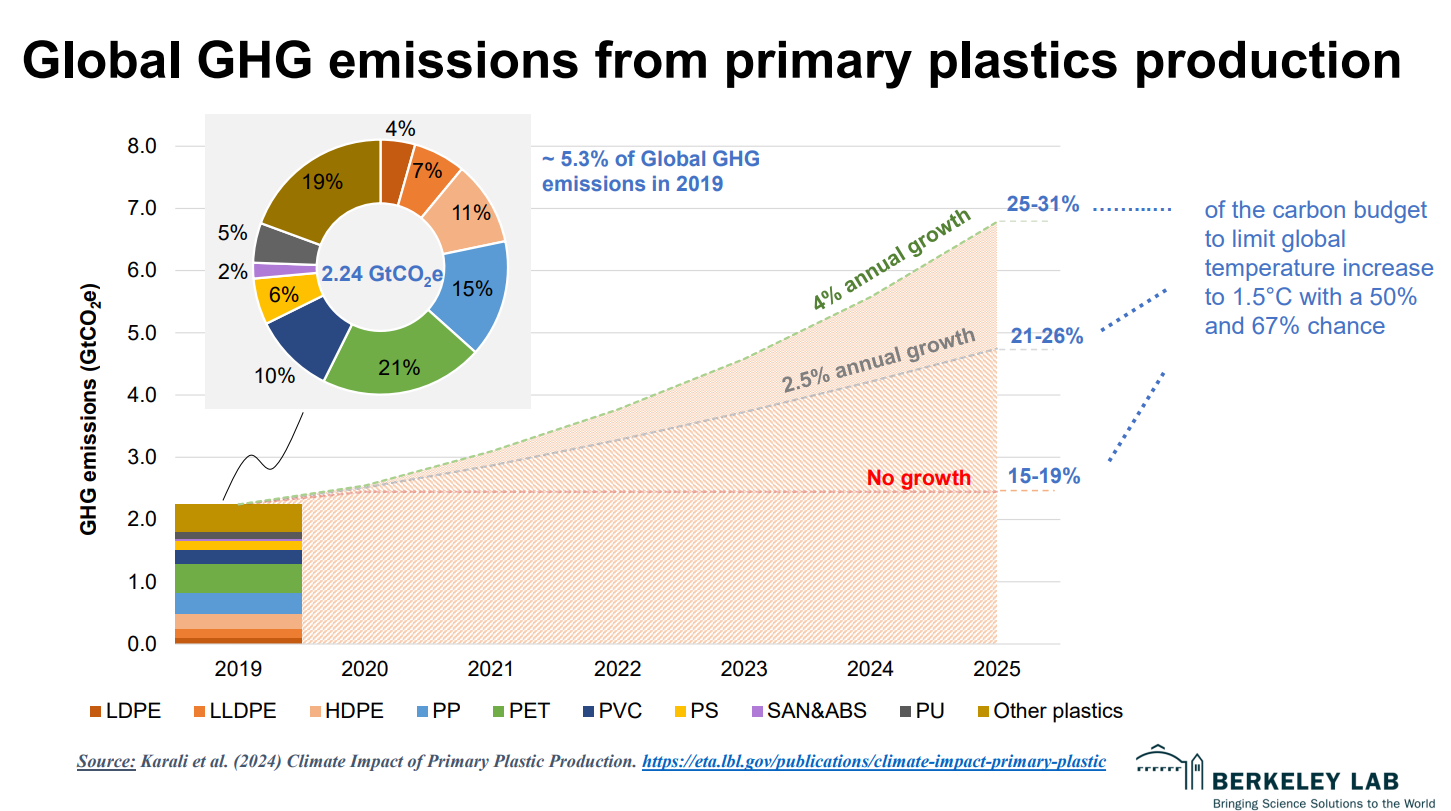
- We developed a very detailed model that takes nine specific polymers in detail. The different polymers have different shares on the carbon footprint because some polymers are more common in the market, so they are produced more and because some of them require more intense production stages and more chemicals, bearing a higher carbon footprints.
- Polypropylene, indicated in light blue and PET in green, have roughly the same amount of production in 2019, around 70 million tons, but polypropylene has a much lower emission share compared to PET as this latter has the intensity of CO2 equivalent is much higher because of a greater use more chemicals.
- Future projections of plastics’ weight on our carbon budget, if production is not abated, will see the primary plastic share. From the analysis of different scenarios based on some industry predictions calculated growth expectations would amount to 2.5 to 4% annual growth for plastics production. Based on these scenarios, plastics production can have 21 to 26% of our remaining carbon budget to stay within the 1.5-degree target. If current plastic production stays as it is, the impact on carbon budget will still be in the range of 15 to 19%. So even freezing the productions at current rates it still has a quite large amount of share for our future.
- The 22.24 GtCO2e from primary plastic production in 2019 is enormous compared to the global aviation sector, which in the same year generated about 0.6 GtCO2e.
- Different stages of the plastic production value contribute to the emissions. Concentrating on different stages allows to see where the bottlenecks are.
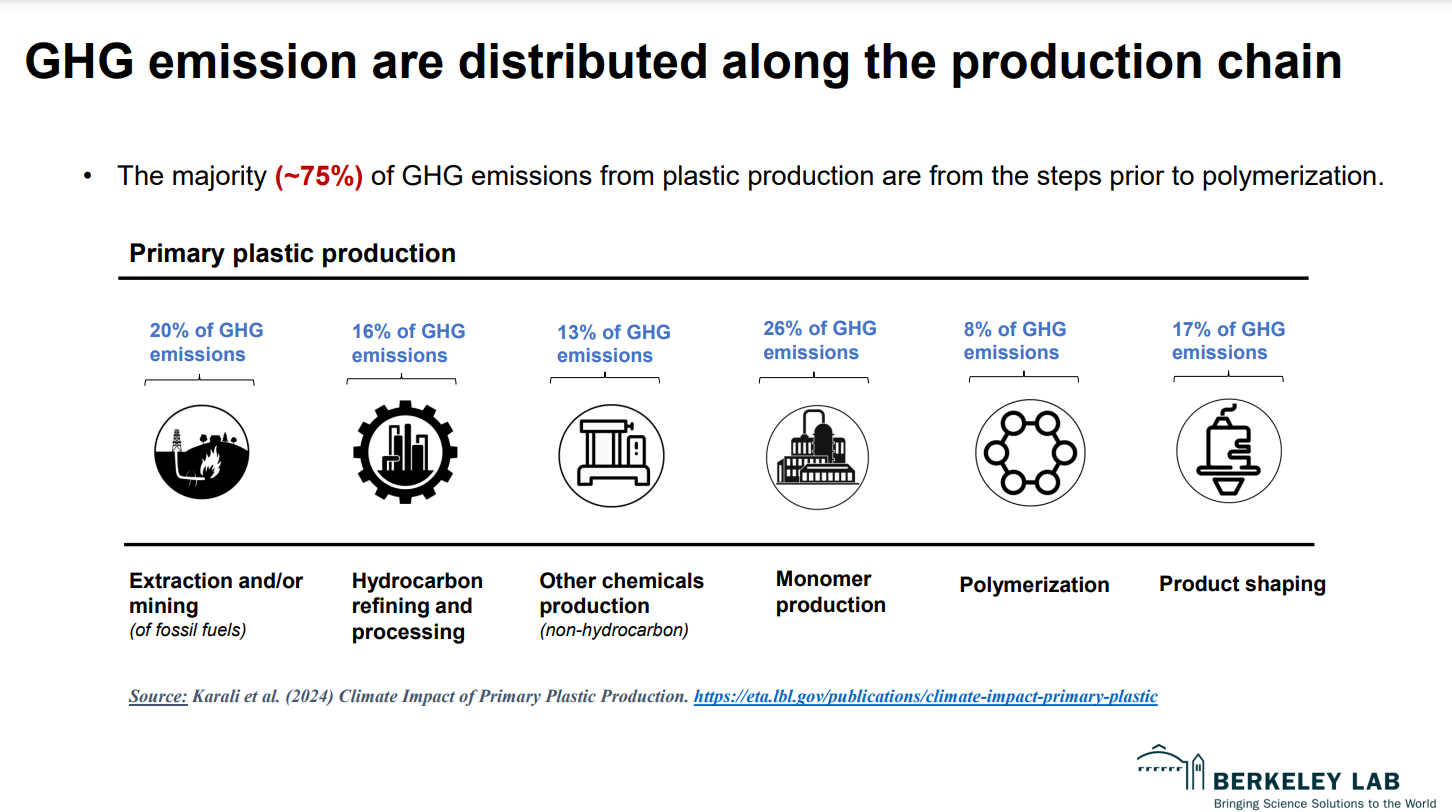
- Most emissions (75%) happen before the polymerization stage, which happens very early. Yet, polymerization is not the beginning of the cycle as monomers and chemicals and the elements used as feedstocks are necessary to create plastic products. Emissions associated with them needs to be accounted as well.
- As much as production is fundamental in the calculations of the total emissions, the end of life of the product, which might include incineration, has an energy intensive and polluting footprint. Recycling also has its own footprint as once landfilled or leaked into the environment various environmental factors like UV rays and heat continue producing emissions.
Avoiding Duplication
How should the future global plastic treaty address plastic waste without duplicating the work of the Basel Convention?
Jim PUCKETT
- The work of the Basel Convention could be improved in many ways. One of the chapters of the book identifies them and highlights all the elements Basel is remiss about, including dealing with hazardous waste.
- While the scope of the Convention is to address hazardous substances, hazardous additives used in plastics are rarely considered as hazardous wastes and fall under another category: Y48 or B3011. Making the shift to treat those as hazardous wastes is one of the ways in which the Basel Convention could help talking the waste stream and its intractable problems. For example, every shipment of mixed plastic should be considered hazardous waste because it is impossible to test every material in each load to determine whether it is hazardous. Basel gives a presumption of hazardousness unless proven otherwise. When the content is unknown, it must be presumed it is hazardous. This will ban all these shipments sent to developing countries.
- When the plastics treaty entered into negotiations, it represented a possibility to fill these gaps in international governance. The process is currently pretty gloomy-looking and it would be best for it to focus on upstream production to complement the BC. The process is gloomy because oil-producing countries with strong intentions and a similar response to the one that allowed the Basel Plastic Waste Amendments to be adopted is necessary to produce an ambitious plastics treaty.
- The plastic crisis represents an existential threat to some countries’ economies and while the politics of the negotiations are bringing down the ambition, it is still important to find an agreement giving the treaty the mandate to work on production.
Q: What are your expectations from the global plastic treaty negotiations?
Sedat GÜNDOĞDU: We should consider the production phase for both its GHG emissions and chemical footprints. The plastics treaty must consider both production reduction and chemicals to tackle the lack of transparency in the plastic industry and the expansion plan for polymer production in the next 15 years. The plastic treaty should cap production reduction otherwise downstream solutions and the technology will not have capacity to fix the problem.
Pui Yi WONG: We must focus on phasing out unnecessary harmful plastics and chemicals. Japan is way ahead in terms of waste management and yet they still cannot manage their own plastic waste and export it to Malaysia. This shows there is a very glaring problem with this material. If we manage to control these things upstream then people in my country will not have to deal with the aftermath of this overconsumption.
Leonardo TRASANDE
- There are multiple steps crucial to a science-based treaty that reflects what we know about human health hazards. All the signs point directly to the need to reduce plastic production and consumption, particularly plastics that we know have t toxicity related to the monomers, the non-intentionally added substances as well as the intentionally added additives. We need to emphasize the removal from the market of plastics with chemicals of concern, prioritizing chemicals of concern including phthalates, bisphenols, PFAS, flame retardants, brominated and organophosphorus varieties in particular. We also need a platform that puts in into motion a much more rigorous and dramatic increase in testing of chemicals used in plastic as well as the plastic materials for their toxicity, thinking about real-life scenarios that address food contact for instance.
- While we know there are 16,000 chemicals used in plastics, there is a substantial gap such that nearly three-quarters of chemicals used in plastic have little or no toxicity testing data as a result of a regulatory environment that presumed chemicals are innocent until proven guilty to a large degree.
- An independent scientific body to support and facilitate the review will be necessary to empower governments with politics-free information about science. I suggest following the mode of the International Agency for Research on Cancer and establishing an International Agency for research on endocrine disruption. That has been a very successful model and we are currently in a similar place with EDCs as we were 60 years ago.
- Recycling can magnify chemical exposures. Alternatives that have been tattered as solutions have been identified to have greater oxidative stress and testosterone antagonist properties suggesting serious and adverse consequences.
What is the likelihood of decarbonizing the plastic sector?
Nihan KARALI: The sector is making the same energy efficiency progress as other heavy industrial sectors. Although numbers include the energy efficiency improvement consider electrification as the only viable option, and it has constraints related to temperatures. Plastic production can reach high-temperature requirements; thus results are not yet certain. There are plenty of ideas for the decarbonization of this sector but practical results are still uncertain. At this point, it is really hard to decarbonize this sector.
What solutions can people put into practice?
Pui Yi WONG
- Every time I come to the Basel Convention I am reminded of the problems that the West created for all of us. Now the West is trying to fix it but all of us have to suffer the consequences.
- In Malaysia, the advocacy to protect our Malayan Tigers is very strong, but although the organizations focus on the tigers the calls is wider as tigers need a habitat and an ecosystem to survive. Tigers are an umbrella species to talk about further protecting the wider natural world, as much as plastics is just one aspect of what is wrong with our modern economy and society. These conversations need to be taken on a larger stage than the plastics treaty as it is already a narrow one.
- We keep slamming our heads against the wall because countries have polar opposite positions in the treaty negotiations, but the issues the treaty would be tapping our are broader than plastics itself. We have wiped out our natural resources for people’s profits and now the only thing left is to monetize waste plastics. While now the availability of oil still offers the possibility to continue producing, when this will be short people will need to consider whether it is acceptable to live in a world where the poor only have waste materials to work with to generate income for themselves. The kind of generation restoration we need is one that restores the natural world and that moves away from industrial capitalism.
- There are many wrong things in the current economic system and plastics is just a part of it for education to bring people on board and break the convictions that plastics is safer and more convenient and to bring them on board to move away from plastics. Besides experts, nobody cares about the plastic treaty and often most people even ignore the dangers and realities about plastics. We need to go out there and teach people about the harms of plastics and other toxics that are often dumped and used without being aware.
David AZOULAY: Plastic is both a symptom and an entry point to start conversations about the real change that we want to see.
Q&A
Q: In developing countries, most plastics are recycled to make various items, which can in turn recycle their hazardous properties. Why can’t we introduce a color code to signal hazardous plastics to avoid converting containers of pesticides into other uses?
Jim PUCKETT: While this idea is useful, it is not only the content with which the plastics comes in contact that makes it hazardous but every piece of plastic is potentially hazardous waste. As long as there is no absolute awareness of what there is plastics, it would be very hard to produce a working alert mechanism.
Q: Tunisia was in a similar situation with regard to illegal waste. While we used the Basel Convention to support the shipment of illegal waste, it was only after two years that we managed to obtain it. Having a structure to rely on in these cases is very important for developing countries that do not rely on a strong structure for dealing with these wastes. Can we use the presented model to calculate the GHG emissions that come from plastic production for a single one and multiply it by the number of industries present in the country?
Nihan KARALI: The report shows different production types. Every region or every country could have a specific type to produce a polymer that differs from others based on the feedstock availability. By looking at the unit, emissions it could be different from one region to another but the numbers in the report are global. It would be useful as the report provides transparent data on the different kinds of production ways for the same material and their related emissions.
Q: Mixed plastics are now collected in developing countries and melted in boards for home and construction. Are there any studies on the use of these materials when used for homes or for buildings in warm climates?
Sedat GÜNDOĞDU: It sounds like a horrible idea to mix plastic with houses or roads because it will contribute to more chemicals and increase the exposure of people to a mixed cocktail of chemicals. These ideas often promoted by Western NGOs to resolve problems in developing countries is also part of colonialist narratives of offering solutions with more toxic chemicals and microplastics.
Jim PUCKETT: These practices are a symptom of people still thinking that plastic is just this benign material and downgrading its dangers. It will not be a technological fix or creativity that will solve the issue, we must think about how people’s lives were possible without plastics around 75 years ago. We have been seduced by convenience and it is killing us.
Q: What would one small positive step that worked for you to change and educate one’s mind?
Nihan KARALI: Before the publication of the report, the evidence that the link between climate impact and plastic is not just production was not documented. The study established the link and then showed the real impact by providing the granularity needed. People really need scientific findings and while plastics is going much faster than science, there is a lot to do in terms of science.
Q: How can consumers how to protect themselves? What should we avoid buying and consuming?
Leonardo TRASANDE: I found it very impactful to see healthcare and scientific organizations putting out scientific statements that document both the shape of the problem but also the safe and simple steps that people can take at the individual level. For instance, the International Federation of Gynecologists and Obstetricians identifies patient guidance for reducing plastic and other EDCs exposures, or the American Academy of Pediatrics documenting the need for advances in food safety at the US Food and Drug Administration level but elsewhere telling families not to microwave or machine dishwashing plastic and ideally reduce their use of plastic substituting with stainless steel and glass, or the Endocrine Society documenting the need for the clinical community that serves patients who are affected by endocrine-related diseases to consider the contribution of plastic related chemicals to these conditions and talking about ways to reduce toxic chemical exposure by way of preventing the worsening of endocrine-related conditions. The scientific and medical communities have stepped up and simultaneously documented the need for policy action together with healthcare provider and patient education.
Pui Yi WONG: A step to change and educate minds is to keep talking about it to people around us, sooner or later you will be able to convert some of them. Individually, going zero waste limits enormously the amount of plastic waste generated.
Jim PUCKETT: Even though the plastics treaty is not going well in terms of coming to terms, the steep learning curve and how quickly people are grasping things that just a few months ago are amazing. The very concept of recycling not working used to be a very controversial thing and in just a few months people’s knowledge is increasing incredibly. We need to harness a good consumer campaign to increase knowledge. Our movement after the INC process may have to shift to a concerted consumer campaign where people feel the heat.
Sedat GÜNDOĞDU: Individually we have a chance to make some change in our lives, deplastifying our existence as much as possible.
David AZOULAY: We should all listen to people telling stories to produce the human-level connection necessary to stir change. Telling stories is not just about challenges but also about possibilities. For instance, going plastic-free does not make one unhappy or feeling deprived. One of the hardest things we have been deprived of is the possibility to imagine a life that is both frugal and happy.
Video
Photo Gallery


