
Événement Conférence
Launch of the Geneva Dialogues on Mineral and Metal Resources

13 Fév 2025
15:30 – 17:00
Lieu: International Environment House I | Room 2 & Online | Webex
Organisation: Geneva Environment Network, Suisse, Sénégal, UNEP Global Resource Information Database Geneva, Commission économique pour l'Europe des Nations Unies, Forum intergouvernemental sur l’exploitation minière, les minéraux, les métaux et le développement durable, Forum on Trade, Environment & the SDGs, World Resources Forum
This event launched the Geneva Dialogues on Mineral and Metal Resources, a series of events to explore interlinkages between the various multilateral debates and negotiations addressing sustainable mineral and metal resources governance in Geneva and beyond.

About this Event
This event launched the Geneva Dialogues on Mineral and Metal Resources, a series of events to explore interlinkages between the various multilateral debates and negotiations addressing mineral and metal resources governance in Geneva and beyond.
The dialogues aim to encourage increased engagement of the international community in the run-up to various global negotiations and conferences addressing the sustainability of minerals and mining sector and intersections with sustainable development priorities:
- 58th Session Human Rights Council | 24 February – 4 April 2025
- 30th Session of the International Seabed Authority (Part I) | 17 – 28 March 2025
- UNECE Resource Management Week (including 16th Session of the Expert Group on Resource Management) | 24 – 28 March 2025
- Trade and Development Commission, fifteenth session | 28 April 2025 – 2 May 2025
- Basel, Rotterdam and Stockholm Conventions 2025 COPs | 28 April – 9 May 2025
- 59th Session Human Rights Council | 16 June – 11 July 2025
- UN Ocean Conference 2025 | 9 – 13 June 2025
- 30th Session of the International Seabed Authority (Part II) | 7 – 25 July 2025
- World Resource Forum 2025 | 2 – 3 September 2025
- 60th Session Human Rights Council | 8 September – 3 October 2025
- 6th meeting of the Conference of the Parties to the Minamata Convention on Mercury (COP-6) | 3 – 7 November 2025
- IGF Annual General Meeting | 3 – 6 November 2025
- 14th UN Forum on Business and Human Rights | November 2025
- UN Climate Change Conference – Belém (COP30) | 10 – 21 November 2025
- 7th session of the United Nations Environment Assembly (UNEA-7) | 8 – 12 December 2025
Leading experts invited to speak at this opening session, provided insights on this timely series of events and the key moments in 2025 that can help moving forward the global efforts towards sustainable resource management and the need for enhanced action to support environmental and sustainable practices in the mineral and metal sector.
About the Geneva Dialogues on Minerals and Metals
The topic of sustainable management of minerals has never been so high on the global political environment agenda and the reason is that minerals are essential for the future. The energy transition, infrastructure and digitalization processes, among others, represent greener solutions. However, unsustainable extraction, manufacturing, use and disposal of resources is having important detrimental impacts on people and the planet. With an expected 500 per cent increase in the demand for minerals (from 2018 production levels), environmental challenges are going to be even more acute.
Various actors in Geneva are engaged in ensuring enhanced action to support the environmental sustainability management of minerals and metals along their full lifecycle. As Geneva is at the center of numerous debates and negotiations in the fields of science, health, human rights, development, trade and green finance, employment, peacebuilding and security, disaster risk reduction, humanitarian response, nature conservation, chemicals and pollution, as well as new technologies and innovation, the dialogues can be a conducive platform to explore interlinkages between these topics and mineral and metal resources governance.
The dialogues are organized by the Geneva Environment Network in partnership with Switzerland, Senegal, UNEP/GRID-Geneva, UNECE, the International Institute for Sustainable Development (IISD), the Intergovernmental Forum on Mining, Minerals, Metals and Sustainable Development (IGF), The Forum on Trade, Environment, & the SDGs (TESS) and the World Resources Forum.
Speakers
By order of intervention.

Arnold KREILHUBER
Director, Europe Office, UN Environment Programme

Laura PLATCHKOV
National Focal Point (UNEA5/12), Federal Office for the Environment, Switzerland

Edouard Henri Manga NDIAYE
Chargé d'affaires a.i., Permanent Mission of the Republic of Senegal to the UN Office and other international organizations in Geneva

Rachid AMUI
Economic Affairs Officer, Commodities Branch, UN Trade and Development

Elisa MORGERA
UN Special Rapporteur on the promotion and protection of human rights in the context of climate change

Sauda JUSSA
Minerals and Metals Specialist, Industry and Economy Division, United Nations Environment Programme

Dario LIGUTI
Director, Sustainable Energy, United Nations Economic Commission for Europe

Grégoire BELLOIS
Senior policy advisor, Intergovernmental Forum on Mining, Minerals, Metals and Sustainable Development

Emanuele DI FRANCESCO
Communications & Events Manager, World Resources Forum

Miguel Eduardo RUIZ BOTERO
Second Secretary, Permanent Mission of Colombia to the UN Office and other international organizations in Geneva

Carolyn DEERE BIRKBECK
Executive Director, Forum on Trade, Environment & the SDGs (TESS), Geneva Graduate Institute | Moderator
Highlights
Video
Summary
Welcome
Carolyn DEERE BIRKBECK | Executive Director, Forum on Trade, Environment & the SDGs (TESS), Geneva Graduate Institute
- The Geneva Dialogues on Mineral and Metal Resources are particularly timely, given the urgent need to address environmental crises and advance sustainable development.
- The environmental, social, and economic challenges and opportunities in relation to minerals and metal resources are deeply intertwined and interconnected. Progress on the sustainable management of these resources and their contribution to the achievement of Sustainable Development Goals will require intensive international cooperation, clear legal frameworks, and partnerships and efforts from a wide range of stakeholders.
Opening Remarks
Arnold KREILHUBER | Director, Europe Office, UN Environment Programme
- The launch of the Geneva Dialogues on Mineral and Metal Resources is a timely and crucial initiative, reflecting the growing global attention on these critical materials. Minerals and metal resources are essential for the future, not only for economic reasons but also for reducing emissions and achieving internationally agreed environmental goals.
- Ensuring a just transition and protecting human rights, including the right to a clean, healthy, and sustainable environment, are increasingly important in the context of resource management. Demand for critical minerals is projected to increase by up to six times by 2040, particularly in the energy sector, making sustainability considerations essential.
- The UN Secretary-General’s panel on critical minerals has emphasized the need for sustainability principles in the energy transition to meet environmental goals and objectives.
- The United Nations Environment Assembly (UNEA) recently adopted a resolution on the environmental aspects of minerals and metals, marking an important step toward global efforts in sustainable resource management.
- Geneva is home to numerous actors engaged in this topic, spanning fields such as science, health, human rights, development, trade, green finance, employment, peacebuilding, security, disaster risk reduction, humanitarian response, nature conservation, chemicals and pollution control, and various others.
- The Geneva Dialogues provide an important platform for international environmental governance, bringing together key stakeholders to collaborate on sustainable resource management.

Laura PLATCHKOV | National Focal Point (UNEA5/12), Federal Office for the Environment, Switzerland
- The Geneva Dialogues on Mineral and Metal Resources will provide an opportunity for all stakeholders to engage in the run-up to global environmental negotiations and events on the governance and sustainability of mineral and metal resources in Geneva.
- The sustainable management of these resources and the urgency of energy transition have never been so high on the global political agenda. In the next 30 years, we may need to produce more metals and minerals than in the whole of human history.
- Switzerland, together with other countries, is playing a key role in this area, including the initialization of three resolutions that were adopted at the UNEA.
- The UNEA resolutions brought the environmental perspective of the resources to the forefront; the resolution 5/12 launched a global intergovernmental process with the participation of 100 countries’ national focal points. One achievement is the development of non-prescriptive proposals, which are measures to foster the environmental sustainability of minerals and metals throughout their lifecycle.
- The latest resolution calls on UNEP to establish a Digital Knowledge Hub on minerals and metals to share best practices, strengthen cooperation between Member States, and support capacity-building. Switzerland has been a strong supporter of the implementation of the resolutions.
- This dialogue also sheds light on an extremely dynamic area, with an ever-increasing number of initiatives and new standards being developed.
- Minerals and metals are also a strategically critical issue for the environment. While these resources are necessary for energy transition, infrastructure, and economic development, they also play a crucial role in achieving environmental goals, given their negative environmental impacts.
- Research published in the Journal “Nature” highlighted that the threats to biodiversity from mining will increase as more mines extract materials for renewable energy. It also shows that without strategic planning, these threats to biodiversity could even exceed those averted by climate change mitigation. Addressing climate change must come together with biodiversity protection and pollution and waste reduction.
- A recent report shows that environmental concerns from civil society and other stakeholders are one of the main factors that delay mining developments.
- These examples show that addressing the environmental impacts is an opportunity for a win-win by incentivizing investments, facilitating transition, and strengthening social benefits. Minerals and metals offer significant opportunities for the population and society if they achieve benefit sharing, added value, and support economic diversification.
- Although Switzerland is not a mining country, we are affected in many ways through the consumption of materials and products that cause environmental impacts abroad, as well as the trade of minerals and metals by companies headquartered in the country.
- Environmental impacts ultimately cross borders. All stakeholders, including international organizations, the industry, civil society, and the scientific community have a shared responsibility and a role to play in strengthening environmental protection. Breaking down silos and catalyzing efforts through these dialogues are essential for advancing the sustainable management of these resources.
The 2025 Roadmap
Edouard Henri Manga NDIAYE | Chargé d’affaires a.i., Permanent Mission of the Republic of Senegal to the UN Office and other international organizations in Geneva
- Africa possesses substantial geological potential, with an immense diversity of mineral resources that play a crucial role in the economies of many nations across the continent.
- Regional organizations such as the African Union, ECOWAS, and WAEMU have developed frameworks and strategies to harmonize policies and drive the sustainable growth of the mining sector.
- The African Ministerial Conference on the Environment has provided a key platform for addressing environmental challenges in the mining sector, focusing on solutions that capitalize on available opportunities.
- Ensuring the sustainable management of minerals and metals is essential to maximizing economic benefits for local communities, but significant challenges remain, including waste management, site rehabilitation, unregulated artisanal mining, and the need for capacity building and technology transfer.
- The Geneva Dialogues serve as an important platform for continued discussions on mineral and metal governance, aligning with ongoing international efforts to improve sustainability and environmental responsibility.
- UNEA resolutions, including 4/19 on Mineral Resource Governance, 5/12, and the latest 6/5 on the Environmental Aspects of Mineral & Metal Management, represent critical steps toward stronger governance and must be actively supported.
- Strengthening the environmental sustainability of minerals and metals throughout their life cycle is a priority, ensuring alignment with global sustainability objectives such as the 2030 Agenda.
- Concrete and lasting proposals must emerge from this dialogue, contributing to international processes such as BRS COP, UNEA-7, COP 30 on Climate, and the World Resources Forum, which will further reinforce the governance of extractive resources.
Rachid AMUI | Economic Affairs Officer, Commodities Branch, UN Trade and Development
- The UN Secretary-General launched the Panel on Critical Energy Transition Minerals in April 2024, supported by a technical secretariat co-led by the Climate Action Team, UNEP, and UNCTAD. The panel completed its work in September 2024, issuing a final report with recommendations to ensure an equitable, just, and sustainable energy transition.
- Since the launch of the report, significant interest has emerged from member states, UN entities, and stakeholders eager to contribute to the implementation of its recommendations. The Secretariat — comprising the Climate Action Team, UNCTAD, and UNEP — has taken steps to advance key actionable recommendations.
- Priority has been given to AR1 on accelerating greater benefit-sharing, value addition, and economic diversification (led by UNCTAD), AR2 on traceability, transparency, and accountability (led by UNCTAD), and AR5 on material efficiency and circularity targets to balance consumption and reduce environmental impacts (led by UNEP), as these can be implemented promptly.
- A governance structure for implementation is in its final stages, pending approval by the UN Secretary-General. This structure will include a high-level expert advisory group composed of UN member states and non-state actors, ensuring balanced representation between mineral-producing and consuming regions.
- The expert advisory group will provide strategic oversight, while technical clusters will focus on specific recommendations, developing work programs, offering technical expertise, and facilitating implementation efforts. UNCTAD and UNEP have mapped UN and non-UN initiatives to identify expertise, knowledge gaps, and needs.
- Engaging a broad range of stakeholders ensures an inclusive approach, allowing the Secretariat to leverage existing platforms, gather insights, and refine implementation strategies based on lessons learned from past initiatives.
- A country support centre is being developed to provide scaled-up capacity-building support to UN member states, leveraging materials and expertise from the technical clusters. Discussions on its final structure are ongoing in New York.
- UNCTAD has long supported resource-rich developing countries in moving up the value chain, creating better jobs, and reducing dependence on raw material exports while mitigating exposure to commodity price volatility.
- Ensuring equity and justice in the growing market for critical minerals is a core priority, alongside advocating for a global framework for traceability, transparency, and accountability across the entire mineral value chain to enhance corporate responsibility, strengthen due diligence, and build a global market for critical energy transition minerals.
- These issues are central to UNCTAD’s work, and have been discussed at a host of events at the Palais des Nations, including its multi-year expert meetings on commodities, the Global Commodities Forum, and research initiatives such as the Critical Energy Transition Minerals Rapid Assessment for selected African countries.
- Minerals are a major focus for UNCTAD’s upcoming quadrennial conference (UNCTAD16) in Vietnam, where they will be at the forefront of concrete policy actions. The Global Commodities Forum, held during UNCTAD16, will provide a platform to address challenges and opportunities for mineral-rich developing countries in the global energy transition.
Elisa MORGERA | UN Special Rapporteur on the promotion and protection of human rights in the context of climate change
- The role of human rights is fundamental to sustainable development, equity, and justice, particularly in the context of mining and critical minerals. The UN Secretary-General’s Panel on Critical Minerals has emphasized this, making human rights the first principle in ensuring responsible mineral value chains—from extraction to disposal.
- States have clear human rights obligations related to mining, and these obligations should guide decision-making. Human rights are interdependent and universal, reinforcing the need to move away from a “winners and losers” framework. Instead, a holistic approach should be taken to ensure benefits do not come at the expense of marginalized communities, as everyone’s right to a healthy environment is at stake.
- Mining’s environmental impacts—including biodiversity loss, water shortages, ocean degradation, climate consequences, and toxic pollution—are deeply intertwined with human rights concerns. These aspects must be addressed collectively, recognizing their interdependence.
- There is growing evidence of human rights violations in the mining sector, particularly in critical minerals. Issues range from involuntary resettlements of Indigenous peoples and local communities without adequate consultation or compensation to lack of public participation in decision-making. Other concerns include environmental degradation, deprivation of livelihoods, restricted access to essential resources like water and clean air, forced labour, and gender-based violence.
- International human rights law mandates the application of the precautionary principle in mining. The private sector and businesses must assess and mitigate human rights risks across their supply chains in accordance with the UN Guiding Principles on Business and Human Rights. They have distinctive responsibilities in identifying risks, taking preventive measures, and ensuring transparency through information-sharing, particularly with affected communities.
- Collaboration with UN Special Rapporteurs is key to addressing mining-related human rights issues. Notably, the UN Special Rapporteur on toxics and human rights, Marcos Orellana, has provided detailed recommendations on ensuring mining technologies support both detoxification and decarbonization. Additionally, the UN Special Rapporteur on the right to a healthy environment, Astrid Puentes Riaño, has highlighted the severe human rights risks associated with deep-sea mining through a thematic report, stressing the fragility of marine ecosystems and their crucial role in climate regulation, the global water cycle, and the preservation of marine biodiversity.
- The UN Working Group on Business and Human Rights has underscored state and corporate responsibilities in deep-sea mining. She and other UN Special Rapporteurs are actively engaged in advising on human rights obligations and participation standards within the International Seabed Authority’s ongoing work.
- Fair and equitable benefit-sharing in mining is not only a policy priority but also a human rights obligation, particularly regarding Indigenous peoples’ rights and the principle of free, prior, and informed consent (FPIC). This principle extends to broader human rights concerns, ensuring participatory processes that align economic models with sustainable and rights-based development.
- The Geneva Dialogues on Mineral and Metal Resources are a crucial platform for advancing these discussions. She and other UN Special Rapporteurs are committed to contributing to these dialogues and related international engagements.
Sauda JUSSA | Minerals and Metals Specialist, Industry and Economy Division, United Nations Environment Programme
- The UNEA adopted resolution 5/12 “Environmental Aspects of Minerals and Metals Management” in March 2022, which focuses on improving the environmental aspects of mining and metals along their full lifecycle, including extraction, processing, refining, and recycling.
- The resolution also requested UNEP to convene transparent and intergovernmental regional consultations with relevant stakeholders to develop non-prescriptive proposals to enhance the environmental sustainability of minerals and metals along their full life cycle, in line with the 2030 Agenda.
- UNEP organized five regional intergovernmental consultations and one global intergovernmental meeting in 2023. Member States nominated 115 national focal points, and a total of 24 non-prescriptive proposals were developed focusing on three thematic areas: policies and tools, value chain aspects, and platforms for international cooperation.
- A report on “Sand and Sustainability: 10 strategic recommendations to avert a crisis” was published by UNEP in 2022, and UNEP/GRID-Geneva launched the Marine Sand Watch, which is the world’s first public data platform that tracks and monitors dredging activities in the marine environment worldwide. Additionally, a report on knowledge gaps related to environmental aspects of tailings management was developed in collaboration with the Geological Survey of Finland.
- Resolution 6/5 “Environmental Aspects of Minerals and Metals Management » sets specific tasks for UNEP, including the establishment of the Digital Knowledge Hub, development of capacity-building opportunities, and support for enhanced cooperation among Member States as well as between UNEP and other stakeholders. The implementation period is set until December 2025.
- The Digital Knowledge Hub, hosted by the Green Growth Knowledge Partnership, aims to provide access to information and best practices on enhancing environmental sustainability of minerals and metals. It will serve as a key platform for bringing together the various strands of UNEA resolutions 4/19, 5/12, and 6/5.
- UNEP collaborated with the African Minerals Development Centre and the Pan African Climate Justice Alliance (PACJA) in November 2024 to convene a regional stakeholder workshop focusing on the environmental and social aspects of mining and capacity building. UNEP presented the outcomes of the UNEA 5/12 consultation process, Strategic Environmental Assessment, and Environmental Impact Assessment for mining, and artisanal small-scale mining in partnership with the PlanetGOLD project.
- Future plans include the development of online platforms and resources for learning and information sharing via the Digital Knowledge Hub, such as the African Mineral and Energy Resources Classification and Management System (AMREC) course, as well as the planning of an in-person event for national focal points and stakeholders in September 2025.
- Online Communities of Practice will be set up as part of the Digital Knowledge Hub to facilitate peer learning, knowledge exchange, and collaboration among stakeholders in the management of environmental aspects of minerals and metals. It will also serve as a discussion and networking platform for stakeholders including policymakers, industry leaders, and the civil society, while providing real-time insights on best practices and policy developments.
- The Communities of Practice aligns with the resolution 6/5 OP 2(c) on the support for enhanced cooperation among Member States to strengthen the policy, technological, technical, and scientific elements of the management of environmental aspects of minerals and metals.
- Collaboration and cooperation have been a major focus for UNEP in the implementation of the resolution. UNEP signed a memorandum of understanding with the Intergovernmental Forum on Mining, Minerals, Metals and Sustainable Development (IGF) in November 2024. It also has continued coordination with the UNECE Industrial Accidents Convention.
- UNEP has contributed to the UN Secretary General’s Panel on Critical Energy Transition Minerals as part of the Secretariat together with the climate action team of the executive office of the Secretary-General, as well as through the technical advisory group.
- The IT development of the Digital Knowledge Hub will be completed by the end of March 2025, with its launch scheduled for mid-April. All functionalities will be fully implemented by November.
- We will continue mobilizing resources for technical assistance and advisory services in collaboration with partners such as UNEP/GRID-Geneva and IGF. UNEP will also strengthen cooperation with other stakeholders by supporting the implementation of actionable recommendations of the UN Secretary General’s Panel on Critical Energy Transition Minerals.
Dario LIGUTI | Director, Sustainable Energy, United Nations Economic Commission for Europe
- The current tools for addressing mining-related issues, such as environmental concerns, human rights, and sustainability, are already in place. The main challenge now is scaling these tools to ensure global deployment and widespread impact across the world.
- The existing business model for mineral extraction is linear, focusing on extraction, trade, consumption, and disposal. A transition is needed towards a more sustainable future-proofed model that integrates circular economy principles, reducing the need for future mineral extraction by reusing existing resources. The aim is to ideally reach a point where mining is no longer necessary. This is the key difference with previous energy systems that rely on continuous extraction of limited minerals and fuel resources.
The ideal future model for minerals should be based on « resource servitization, » transitioning from minerals being owned, to treating minerals as a service. This concept, though new for the mining sector, has been successfully applied in other industries and would represent a significant shift in how minerals are managed globally.
- Over the past 30 years, efforts have focused on developing tools and methodologies aimed at ensuring the security of mineral supply, stabilizing prices, and promoting sustainability. These tools are designed to address environmental, social, and economic challenges while ensuring mineral availability for the energy transition.
- The UNFC and UNRMS provide a framework for managing mineral resources, including critical minerals, with a holistic approach that incorporates environmental, social, and economic perspectives. The UNFC provides a classification for minerals from all these perspectives, while the UNRMS helps operators manage resources sustainably by considering all relevant factors throughout their lifecycle.
- The UNFC and UNRMS are gaining traction globally, with the African Union adopting AMREC (based on UNFC) and the European Union mandating the UNFC framework as law for all its member states. These tools are also being extended to countries outside the EU that sign strategic partnerships on critical minerals. This reflects the growing political importance of minerals, as emphasized by the European Commission’s involvement.
- Efforts are underway to implement these frameworks in real-world projects, with over 140 mineral resource development projects in the EU already using the UNFC framework. The goal is to adopt these tools more widely across businesses, project sponsors, and investors to ensure effective and sustainable mineral resource management.
- The importance of managing risks associated with mineral extraction, processing, and use is emphasized, particularly through tools like the Industrial Accidents Convention. As the demand for minerals grows, the number of mining operations will increase, raising concerns about risks such as accidents, health concerns, economic losses, and environmental damage. This tool has been developed to address, understand, and manage these issues and risks, and ensure safety in mineral extraction and processing.
- The mining industry also faces significant challenges in managing mine tailings, a major environmental concern due to waste produced during mineral processing. The work being done by the Working Group on Tailing Safety and Prevention of Accidental Water Pollution is focused on addressing these challenges.
- The next dialogue on resource management will be hosted in Geneva as part of the UNECE Resource Management Week in March. This event will bring together stakeholders and experts to continue discussions on mineral and resource management. The event will provide a platform to maintain momentum on this critical global issue.
Grégoire BELLOIS | Senior Policy Advisor, Intergovernmental Forum on Mining, Minerals, Metals and Sustainable Development
- The IGF is a global platform consisting of 85 member countries, aimed at improving mining governance to help achieve the United Nations Sustainable Development Goals. It was established in 2005, following the World Summit on Sustainable Development in Johannesburg, and operates as a voluntary initiative to foster good practices and address challenges in mining while promoting sustainability.
- The IGF supports member countries by providing a range of services, including in-country assessments through the Mining Policy Framework (MPF), which evaluates the strengths and gaps in mining regulations. The goal is to ensure that countries can maximize the benefits of their mining sectors while mitigating negative impacts, such as environmental harm. The IGF also provides training, capacity building, technical support, and develops guidance materials and research papers to aid governments in policy implementation.
- A key event hosted by the IGF is the Annual General Meeting (AGM), held every November in Geneva. The AGM brings together UN member countries and various stakeholders to discuss a wide array of mining-related issues, from exploration to mine closure and post-mining transitions. The theme of the most recent AGM focused on balancing the need for minerals with environmental and social responsibility. The next year’s theme has not yet been decided but will be determined by the IGF’s executive committee.
- The IGF’s work is demand-driven, meaning that member countries request specific support, which the Secretariat then works to provide, ensuring a balanced distribution of resources. The IGF’s governance is led by an executive committee, consisting of representatives from six countries across different continents. These representatives guide the IGF’s strategic direction, ensuring that it serves the needs of a diverse range of member countries.
- The IGF’s work focuses on improving mining policies, particularly in areas such as fiscal dimensions, local content, socio-economic benefits for communities, environmental management, and post-mining transition. A significant emphasis is placed on ensuring that countries address the full lifecycle of mining activities, including the challenges of transitioning away from mining once it ceases. Additionally, artisanal and small-scale mining is a critical area of focus for the IGF, which recognizes its importance in many countries’ economies and aims to support its regulation and sustainability.
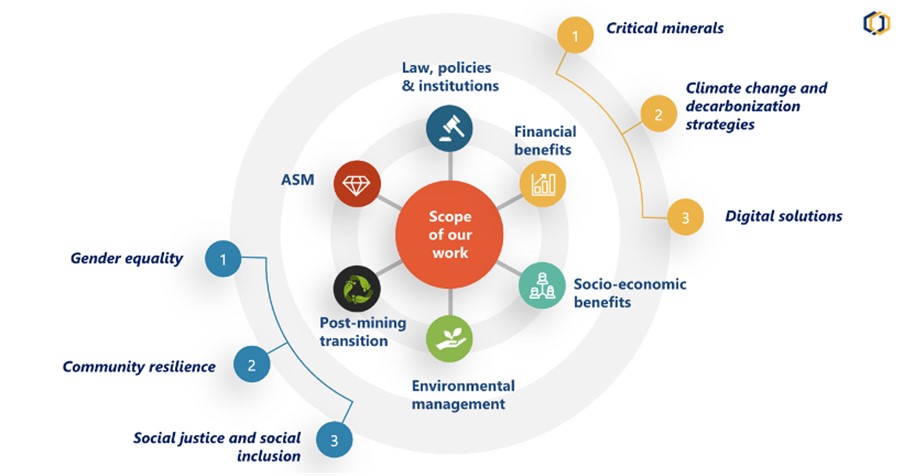
- Transversal issues like climate change, decarbonization strategies, and the pressures brought about by the energy transition are central to the IGF’s agenda. The organization also addresses concerns around gender equality, community resilience, social justice, and inclusion within the mining sector. These cross-cutting issues are increasingly important as the demand for minerals grows, driven by the global push for clean energy and digital technologies.
- The IGF develops practical tools and guidance for governments to help them implement effective mining policies. These tools cover topics such as artisanal and small-scale mining, local content, environmental and social impact assessments, and environmental management. The IGF also conducts research and provides case studies to help governments better understand global trends and adapt best practices to their local contexts.
- Collaboration and partnerships are fundamental to the IGF’s approach. A notable example is the partnership with the United Nations Environment Programme (UNEP), which aims to leverage the strengths and networks of both organizations to promote the implementation of sustainable mining practices. By combining the IGF’s focus on mining and UNEP’s expertise in environmental management, the two organizations work to ensure that mining policies are sustainable and that their tools reach a broader audience.
Emanuele DI FRANCESCO | Communications & Events Manager, World Resources Forum
- The World Resources Forum 2025 titled “New Resource Strategies for a Fair and Sustainable Future” will take place in Geneva in September.
- The World Resources Forum is a multi-stakeholder platform organizing this conference since 2009, bringing together policymakers, businesses, scientists, and civil society to find and implement solutions to achieve sustainable resources.
- We aim to enable the science-policy dialogue, foster international cooperation to disseminate and co-create knowledge, raise awareness of under-discussed topics, and explore synergies for new collaborations.
- The 2025 conference aims to look for new resource strategies, new ways of implementation, and develop strategies that achieve social, environmental, and economic sustainability and deliver well-being for all. The main theme is enhancing public and private governance for the responsible sourcing of minerals and metals.
- It tackles three key sectors with large impacts, which are the extractive sector, the built environment, and consumer and industrial goods.
- The extractive sector involves not only large-scale mining but also artisanal small-scale mining such as critical raw materials and conflict minerals. The Global North-South perspective is crucial in the construction of built environments, city planning, and building design, taking into account the varying contexts, required strategies, and future needs. We also look at key value chains, including plastics and e-waste, and their opportunities for shifting to sustainable production and consumption patterns.
- The World Resources Forum 2025 highlights three drivers of change that we believe to have the potential to reshape resource management and value creation: (1) multilateral governance, (2) innovation, design and digitalization, (3) circular economy, (4) finance and trade, (5) indicators, methods and standards, and (6) sufficiency.
- Effective multilateral governance is crucial in developing shared solutions that are sustainable in the long term, especially in today’s geopolitically fragmented world.
- Reports have pointed out that circularity is decreasing at the global level. We need to be more specific on the actual benefits being delivered from circular solutions.
- In addition to addressing the use of minerals and metals, limiting demand is also important. The World Resources Forum has been working to advance innovation for sufficiency.
- The core objective of the conference is to bring actors together to create a strategic action framework using the six drivers for change that can be applied to all three sectors.
Miguel Eduardo RUIZ BOTERO | Second Secretary, Permanent Mission of Colombia to the UN Office and other international organizations in Geneva
- These dialogues are expected to serve as a productive platform for crucial discussions on the sustainable management of critical minerals and metals.
- The global energy transition to clean and sustainable energy faces a fundamental challenge: the availability of critical minerals such as copper, lithium, nickel, cobalt, and rare earths, which are essential for key technologies like wind turbines, solar panels, and electric vehicles. According to the International Energy Agency (IEA), demand for these minerals for clean energy applications could triple by 2030 to meet the net-zero emission targets by 2050.
- During COP28 in 2023, governments set ambitious targets to triple renewable energy capacity and double energy efficiency by 2030. Achieving these goals requires a stable and sustainable supply of critical minerals. However, the expansion of mineral extraction is already causing significant social, environmental, and economic challenges, particularly in mineral-producing regions of the Global South, where the negative externalities of resource exploitation are acutely felt.
- The UN Secretary-General’s expert panel on critical minerals for the energy transition identified key issues and proposed recommendations that should serve as the foundation for an effective governance framework for these resources. Colombia has demonstrated its commitment to sustainable mineral management through active participation in global forums, including negotiations leading to the adoption of UNEA 5/12 and intergovernmental consultations in Pakistan on the environmentally responsible management of minerals and metals.
- Progress towards an intergovernmentally agreed global framework for critical minerals remains limited, particularly in areas such as transparency, traceability, and due diligence. Recognizing this gap, Colombia proposed an initiative at CBD COP16 in Cali to develop a legally binding international agreement on the traceability of critical mineral supply chains. The initiative aims to ensure that the extraction of essential minerals such as cobalt, nickel, and rare earths is conducted responsibly, minimizing environmental and social harm while supporting the energy transition.
- The launch of this initiative marks the beginning of a roadmap toward the eventual adoption of a legally binding instrument for mineral and metal governance. While discussions are still underway with partners and like-minded countries to determine the most effective form of this instrument, Colombia remains committed to driving progress and ensuring that the energy transition does not impose additional burdens on the Global South or hinder sustainable development.
- To advance this initiative, several key objectives are being prioritized. The first is strengthening transparent and sustainable value chains by implementing sustainability practices across the entire mineral lifecycle, from extraction to recycling. This includes ensuring traceability, applying ESG criteria, and promoting fairness, equity, and responsible mining practices while preventing illicit activities in the supply chain.
- Another key objective is achieving a just energy transition, ensuring that the shift to clean energy not only secures critical mineral supplies but also fosters local economic development, respects community rights, and safeguards ecosystems. Extractive activities must be managed in a way that benefits local populations and mitigates negative social and environmental impacts.
- Critical minerals should be leveraged as catalysts for sustainable development. The mineral wealth of the Global South presents an opportunity for economic transformation, moving towards diversified, high-value, and sustainable industries. Responsible management can drive green job creation, support technological innovation, and directly benefit producer communities, which are often excluded from the profits generated by resource extraction.
- International cooperation is essential in facilitating sustainable financing, technology transfer, and capacity-building for developing countries. Investments in environmentally sustainable mining practices, infrastructure development, and knowledge-sharing are crucial to ensuring that countries with abundant critical mineral resources can participate equitably in the global energy transition while protecting their environments and communities.
- The absence of an internationally agreed regulatory framework for mineral governance remains a significant gap in international environmental law. Given the increasing importance of minerals and metals in addressing environmental challenges, particularly the energy transition, urgent action is needed to establish comprehensive global regulations. The aim is to fill this regulatory void as quickly as possible, ensuring sustainability, transparency, and fairness in the critical mineral sector.
Closing
Carolyn DEERE BIRKBECK | Executive Director, Forum on Trade, Environment & the SDGs (TESS), Geneva Graduate Institute
- Collaboration between international organizations and governments is crucial in addressing this issue and advancing sustainable development goals.
- Trade plays a vital role in the critical mineral sector. TESS is working on this topic and recognizes the necessity of trade cooperation in ensuring environmental outcomes and sustainably managing demand within complex global supply chains in a way that benefits the planet and the people. Beyond extraction, there should also be a strong emphasis on resource circularity and sustainable reuse.
- Financing and investment are crucial in meeting the demand for minerals, ensuring sustainability, and creating employment, particularly in developing countries.
- Discussions on critical minerals should be reframed to balance geopolitical concerns with sustainability and development priorities. Development considerations need to remain at the forefront of the conversation.
Photo Gallery


