Événement Conférence
Innovative Action for the SDGs through Education for Sustainable Development | RFSD 2026

20 Avr 2026
10:00 – 11:15
Lieu: Palais des Nations | S-225-4 & Online | Webex
Organisation: Bureau régional du PNUE pour l'Europe, Geneva Environment Network, Commission économique pour l'Europe des Nations Unies, Chypre, Slovénie
This side event to the 2026 Regional Forum on Sustainable Development was co-organized by UNEP and Geneva Environment Network, UNECE, UNESCO, and the Governments of Cyprus and Slovenia.

About this Event
The 2026 SDGs review will closely examine progress on the implementation of SDGs 6, 7, 9, 11 and 17 (on water and sanitation; energy; industrialization and innovation; sustainable cities and communities; and partnership). We live in a world where water sources are under increasing pressure, and billions still lack safely managed drinking water. While significant efforts are underway to transition to clean energy systems, many countries continue to rely on energy sources that are among the largest contributors to pollution. Our industries release harmful substances that threaten human health and the environment, yet these impacts can be reduced, and even reversed, by shifting toward innovative and sustainable practices. Today more people live in cities with substantial environmental footprint, but we can transform them into low-carbon and resilient urban spaces. These large-scale challenges and the immense opportunities they present, require bold shifts in mindsets, systems and behaviours, and above all strengthen partnerships and collective action.
Transformative change begins with transformed mindsets. Cultivating a culture of sustainability is therefore not optional — it is foundational. Education is the primary vehicle for this transformation. The Sustainable Development Goals cannot be achieved without environmental literacy, systems thinking, civic responsibility, and a deeply embedded sustainable ethos across all sectors of society.
A “glocalized” approach to Education for Sustainable Development (ESD) — connecting global sustainability objectives with local contexts, cultures and needs — can significantly accelerate progress on the SDGs under review. By translating global commitments into locally meaningful learning and action, education empowers communities to move from awareness to implementation.
This side event showcased compelling practical examples and success stories, from Member States in the UNECE Region demonstrating how the four priority strands of the UNECE ESD Strategy 2021-2030 (Quality education; Whole-institution approach; Digital education; and Entrepreneurship) have been impacted in advancing tangible progress towards the five SDGs under review in 2026.
Rather than speaking in general terms about how ESD could contribute to SDG implementation, this side event demonstrated concretely how targeted educational policies, institutional reforms and community-based initiatives are already delivering measurable impact. It illustrated how ESD, as a systemic driver of transformation, helps societies — from global to local frameworks — understand that the SDGs are not abstract commitments, but a practical roadmap towards a more prosperous, peaceful, resilient and equitable world.
2026 Regional Forum for Sustainable Development
The 2026 Regional Forum on Sustainable Development (#RFSD2026) for the ECE region – the region’s official input to the High-level Political Forum on Sustainable Development and the UN’s main platform for global follow-up on the 2030 Agenda –will convene in Geneva on 21-22 April 2026, under the theme Transforming Together: Innovative and Equitable Actions for the SDGs.
As the end date of the 2030 Agenda for Sustainable Development approaches, the Forum aims to accelerate and coordinate actions towards the SDGs and maintain the momentum for innovative policies and solutions.
Speakers
By order of intervention.

Bernard COMBES
Independent Expert

Aravella ZACHARIOU
Head, Unit of Education for Environment and Sustainable Development, Ministry of Education, Sport and Youth, Cyprus

Tina HOČEVAR
Environmental counsellor, Permanent Mission of the Republic of Slovenia to the United Nations Office and other international organizations in Geneva

Elisabeth BERNHARDT
Head, Communication and Awareness, Convention on Biological Diversity (CBD)

Wondwosen ASNAKE KIBRET
Regional Coordinator for Nature Action, Europe Office, UN Environment Programme (UNEP) | Moderator
Highlights
Video
Live on Webex
Summary
Welcome
Wondwosen ASNAKE KIBRET | Regional Coordinator for Nature Action, Europe Office, UN Environment Programme | Moderator
Last year, we had the SDG review process that looked at advancing inclusive science and evidence-based solutions. We found that we are lagging behind in terms of implementation. This triggered something with the Education for Sustainable Development (ESD) leadership of our ESD chair from Cyprus. We talked about what we can do in terms of accelerating the implementation of the 2030 agenda in particular by using different tools. One tool is the Education for Sustainable Development.
What can we do in terms of utilizing ESD to promote the acceleration of the 2030 agenda? With that in mind, we wanted to look at member states, partners, and what they are doing in terms of accelerating the implementation of the 2030 Agenda at the country level.
- Last Monday, the report for our region was published. We are less than 5 years from the 2030 goals, and we are only able to achieve 19 targets from this region. This is really disturbing.
- For 13 targets, we are making process or moving in the right direction.
- For 69 targets, the progress is still inefficient.
- For 26 targets, we are going even further from the baseline of 2015. We need to reverse this trend that goes across several SDGs.
We are lagging behind on sustainable food systems, equitable access to education, improvement of water quality, water efficiency, transboundary water cooperation, share of renewable energy, and the list goes on.
Presentation of ESD Stories Advancing Tangible Progress Towards the Five SDGs Under Review in 2026
Bernard COMBES | Independent Expert
Through the UNECE ESD Committee call for submission of ESD stories on how ESD addresses the 5 SDGs currently under review and to try and get an idea of how ESD helps advance sustainable development.
- The call for submissions was sent out in January with a very tight deadline, but we managed to receive submissions from 22 UNECE member countries and 2 submissions from outside the UNECE region. It sparked interest in other regions because the issue of how ESD addresses SDGs is key everywhere.
- What comes out from these submissions is only the tip of the iceberg. These are the submissions that came in because we had a very short deadline to gather them. For some countries, we know there’s many other examples. There are some countries that did not submit anything, but we know that they actively pursue ESD.
- In terms of the “favorite” SDGs this year, we’ve gotten the most examples of SDG 11 about sustainable cities and communities, followed by SDG 17 on partnership which is high in every year’s review. What I found interesting was the SDG 9 on industry and innovation came in quite strong over water and over energy. This is a good thing because most people often do not associate ESD contributing to SDGs that are about industry and economy.
- In terms of aligning with the four priority areas of the UNECE strategy, the two strong ones are quality education and Whole Institution Approach then followed by entrepreneurship and digital education. A Whole Institution Approach is a concept that has increasingly caught on, not only in the UNECE region, but also in other regions. The idea that educating about sustainable development issues or the SDGs is not just one course for a couple of hours every week, but it has to become a project for the whole school, plus the parents and the community around.
- What was also interesting was the diversity of institutions and organizations that provided and came through in the examples provided. Of course, education institutions, government entities, then civil society, NGOs all came in equal percentages. We also had some examples from local governments and municipalities and a few from the UN system or EU-led projects.
- There was a question about who were the key players involved in the projects illustrated in the stories, and here again we can see there’s quite a diversity. While, yes, the report shows that the UNECE region is lagging behind in many of the SDG targets, at the same time, there are quite a few players getting involved. I will get to why maybe that involvement does not result in more positive interaction or achievement for the SDGs.
- In terms of where the positive impacts are, the one way that comes up most often is the issue of awareness raising. Then the true strong ones that are behind the strengthening of competencies, whether it’s teacher competencies or engineers, local government staff, but then this issue of helping people change their behaviors is quite strong. Then, you can see that changing educational policy comes past because that’s something we see in a number of the projects that were submitted. One of the goals about helping transform education in our region and in our country, but it is more complicated than it appears.
- In terms of impact by stakeholder group, the impact on learners, educators, and community was pretty equal, and there was not as much at the country and government entity level. We need more people informed and enhanced in sustainability.
- “A goal without a plan is just a wish” – Antoine de Saint-Exupery.
Challenges
Regarding the challenges that appeared in the projects submitted, they can help explain why the region is lagging behind on achieving some of the SDGs.
- There is the issue of people not liking change. We like things to stay the way they are and there is a certain intertie within systems and administration and bureaucracy.
- There is also the issue of dealing with urgent needs and challenges that arrive, and saying “sustainability is a long-term thing but right now have this issue we are all facing” for example the issue of prices of petrol.
- There are also legal and regulation barriers because sometimes on paper you can say this will be done but then the legal structure you’re in makes things more complicated.
- For example, at home when your lightbulb goes off, you go and grab one and change it. However, here in France in certain municipalities and in town halls, you cannot just grab any lightbulb they have in stock to replace it. You have to call a certified electrician to do that, which means time but also money, because the electrician has to be paid. Of course, there are also limitations due to infrastructure or technical factors which pose a challenge.
- One of the biggest challenges is that many people think the education system is just one simple thing, but it is actually more diverse and complicated.
- There is also the issue of looking at formal and nonformal education, and in many places, there is still a lack of dialogue between the two, and we need to change that.
- It is also about making sure that when you put in place policies that the objective of those policies resonates and work at the school level or at the community level, because translating policy into action takes time and is more complicated.
- Another big challenge is coordinating with other partners and stakeholders because everyone understands that a multistakeholder approach is the best way to go, but it is easier to write it on paper than to actually do it.
- I put this quote by Robert Kennedy in1966 because it is still current in the UNECE region these days, “Like it or not we live in interesting times. They are times of danger and uncertainty but they are also more open to the creative energy of men than any other time in history.” We are living in a state of uncertainty, complexity, rapidly changing conditions – but one element that comes out is that there are people who want to change, who are dynamic.
Lessons Learnt
The whole-institution approach is clearly something that people are understanding and are putting in place.
- We have great reports about sustainability, but the messages and key elements from those reports need to be translated into simple messages so that people can link them to their daily lives and daily actions, otherwise we will not move forward.
- Education, awareness, and training are key in changing behaviors.
- We need a participatory and inclusive decision-making process.
- Another key element is multistakeholder, interdisciplinary, transdisciplinary, and intersectoral approaches. We have to mix all different disciplines and sectors to move forward. We cannot just say “I’m doing ESD”, “I’m doing education”, “I deal with environmental/sustainability issues”. We have to remember that we also need to talk about social justice, human rights, the issue of economy, and sustainable lifestyles – we have to mix all of that.
- Everybody wants innovation, they want things to change but you need to plan well and to get impact, you need ownership, leadership and it takes time and continuous stable support from everyone involved.
- One of the key lessons that came out from the survey is that we have to focus on the future generation and youth-led action, we have to give youth more voice, more possibility of running projects, and more involvement – not just the usual checklist “ oh, we have two young people on the panel discussion”, we have to really involve them.
- To conclude this overview, I put a quote by Paulo Freire “Education does not transform the world. Education changes people. People change the world.” What does that actually mean in terms of where we stand and where we shall move forward. We have to rethink our education system, the way that ESD is conceived. It is about people and if we forget that, then we will be stuck and not achieve the SDGs.
Specific Country Cases
Aravella ZACHARIOUS | Head, Unit of Education for Environment and Sustainable Development, Ministry of Education, Sport and Youth, Cyprus
It is clear that the transition we need for the SDGs is not only technological, financial, or regulatory – it is also educational, cultural, and societal. If we want to progress on sustainable energy, resilient infrastructure, sustainable communities, and meaningful partnerships, we need transformed mindsets, transformed institutions, and transformed everyday practices. This is exactly where Education for Sustainable Development becomes essential.
The Cyprus case study is the PEDIA project which means transforming schools through energy efficiency and ESD.
- It is not simply a school renovation project, and it is not only an education project. Its added value lies precisely in the way it brings these two dimensions together. The project combines energy efficiency innovation of public-school buildings with a whole school approach to ESD.
- Too often we treat sustainability as if it were divided in separate boxes. One ministry deals with infrastructure, another with education, another with energy. But sustainable development does not happen in siloes.
- PEDIA shows that when we connect the physical environment of the school with learning, governance, participation, and community action, the school becomes a living laboratory of transition.
- The primary SDG that the PEDIA project is elaborating is SDG7 on affordable and clean energy. But the project also contributes in a meaningful way to SDG 9 on resilient infrastructure and innovation, SDG 11 on sustainable communities, and SDG 17 on partnerships.
- On SDG 7, PEDIA improves the energy performance of school buildings through efficiency measures and renewable energy related interventions, while at the same time engaging students and teachers with real data, energy technologies, and responsible use of practices. The projects do not only reduce consumption, they build energy, literacy, systems thinking, and behavioral change
- On SDG 9, schools themselves become example of sustainable infrastructure and innovation through the transformation of buildings to zero energy buildings. Students and educator are exposed to innovation not as an abstract concept but as something they can see, experience and discuss every day.
- On SDG 11, the school is approached not only as an educational institution but as a community. When the environmental quality, safety and efficiency of the school improve, the benefits extend beyond the classroom. Families, parents, associations, and local communities are engaged through awareness activities and dissemination actions. In this way, schools functions as local hubs of sustainability culture
- On SDG 17, PEDIA is built on partnership. It requires the coordinated involvement of education authorities, energy experts, school leaders, teachers, students, local actors, consultants, and contractors. This is not a symbolic partnership. It’s an operational one. It creates shared ownership, shared learning, and shared responsibility.
- The PEDIA project also aligns strongly with the four priority strands of the UNECE strategy for ESD 2021-2030.
- On equality education, PEDIA strengthens learning by connecting curriculum related work with real sustainability challenges. Students engage with authentic problems and teacher use more interdisciplinary and experiential approaches.
- Regarding whole-school approach or whole-institution approach, PEDIA is especially powerful. It shows that sustainability cannot remain only in classroom lessons. It must shape the culture, governance, operation, and infrastructure of the school. In this project, pedagogy participation and the physical environment are aligned.
- On digital education, the project uses monitoring systems and energy performance data to support evidence-based learning and decision making.
- On entrepreneurship employment and innovation, the project opens learners horizon toward towards green careers, green skills, and innovation pathways connected with the labor market and sustainable development.
- PEDIA project has already shown positive impact in changing behaviors, raising awareness, strengthening competences, promoting community actions, involving government and technical actors, and supporting the implementation of broader educational policy for ESD and green transition in Cyprus. This is particularly relevant for countries looking for practical models that connect public investment with educational transformation.
- The broader message from Cyprus is that schools can become catalyst of the green transition when we treat them as integrated spaces of learning, participation, innovation, and sustainable infrastructure.
- In other words, ESD becomes more effective when it is not added as an extra theme but embedded into how institutions function, how public resources are invested and how communities are mobilized.
For Cyprus, this is not only a project outcome. It is also a wider policy direction linked to the strategic framework, national strategic framework for ESD and the green transition I believe this is where our experience may be relevant to the wider region. We need to move from isolated good practices to systemic approaches that connect policy, pedagogy, infrastructure, and partnerships.
Tina HOČEVAR | Environmental counsellor, Permanent Mission of the Republic of Slovenia to the United Nations Office and other international organizations in Geneva
My first message is that education is the primary vehicle for sustainable development. I strongly believe in this statement as environmental counsellor, but at the same time it is not a magical solution. It is not one solution that will solve all challenges. It is a primary vehicle and a crucial element and we can start there, but we need more solutions and we need to bring them together.
- It is a really good idea that we are having this side event today to look at how education and how it contributes to sustainable development because we will not achieve the SDGs without environmental literacy, systems thinking, and responsibility – both our own and as a society and a community.
- We live in a very complex, interconnected world in all spheres. If we look at it, we live in a triple planetary crisis and we need education that also makes us suitable to deal with this kind of world.
- We also believe that education is not, and should not be, just a transfer of knowledge. It should really be about values and attitudes. Attitudes looking how we think, learn and act. It also needs to be also about the capacity to make decisions in this complex interconnected world that we live in. This is exactly where the Education for Sustainable development comes into play.
For Slovenia, we based our strategy, our national priorities and targets on UNESCO framework Education for Sustainable Development: A roadmap for 2030 and we work very closely with UNECE on Education for Sustainable Development.
- I can say that we have made progress in the past years but at the same time I can say it’s still a work in progress because education is not something that you change overnight but it needs a gradual changing.
- The approach we are taking is that rather than adding a new subject to school curricula working and talking specifically about environment and sustainable development – we are integrating this content into existing subjects, and the idea is also start promoting uh critical thinking.
Concrete examples
We have an initiative called Ekošola, which means Eco schools. It’s a program that connects schools across Slovenia, so it’s a network dedicated to sustainable practices. In this program students are really not just passive learners, they don’t just sit and learn but they actively engage in and participate in different kind of projects related to energy efficiency, waste reduction, biodiversity, and climate awareness. The goal is really to create these environmental habits that then extend beyond the classrooms, and these students also bring it back home and to their communities.
- I am starting with this example also because it’s been running for years now which has a very long tradition and it’s widely recognized in Slovenia. Many schools participate in this project and it brings together different players. It’s an NGO that runs this program because it’s a part of a global initiative but they receive financial support from the private sector and then at some point when the schools decide to go for bigger projects like energy efficiency and to renovate the schools and introduce renewable energies to school infrastructure, that’s where the government funding that comes into play. The schools can apply for this funding from the government for these bigger projects.
- Similarly, we have eco kindergartens for children. Here the focus is more on play and exploring nature and building this relationship between children and nature, and from that growing their sense of responsibility towards nature. These projects link to SDG 7 on clean energy, SDG 6on water, and SDG 11 on sustainable cities.
- For example, one of the projects that started to appear during these initiatives are eco gardens. Schools started to have their own garden, and these initiatives started to grow and in recent years we had also government supporting these initiatives.
- With eco gardens, the garden becomes a living classroom for children and students. They go there, they cultivate, they learn about soil health, about water management, and biodiversity. They learn how actually food is produced from where we get all this food and with that also this sense of responsibility starts to grow.
- These three initiatives, eco schools, eco kindergartens and eco gardens, all include young people not to be just passive learners but really participate, engage, and experience this and that’s how we believe the effect can be the biggest.
Another example initiative we have is about innovation. For Slovenia, innovation is also looking at how we can break the silos because we really live in silos, how we do things and how we look at things. We really need to start working on more of a systemic approach. We need to have systemic thinking, which is a very abstract word, and it is very difficult to understand what it actually means.
- A few years ago, Slovenia started a Deep Demonstration project with Climate-KIC. It is about transforming public administration, the way we do things, in a way to implement systemic thinking that leads us then to transition to circular economy and lower our emissions.
- This project developed a couple of portfolios, for examples we had one on agriculture and through that we always also look through educational perspectives. This means bringing together the educational actors, agriculture actors and looking at what is missing when it comes to knowledge, skills and how, and where, our young people can get these skills and knowledge
- There were several workshops implemented during this project which were focused on educators, teaching them what is the systemic thinking and how they can bring it into their teaching, then how to bring this into the reform of our curricula that is still ongoing.
- Because this project is largely about systemic thinking and systemic changes, we have also seen bigger cooperation between the Ministry for the Environment and the Ministry for Higher Education.
- Several projects actually came out of this as well. For example, we developed a e-Guide to the Greening of Higher Education and that looks not just at the content that we are teaching but also the infrastructure of the educational institutions. There was an e-Glossary developed which explains every word like what are greenhouse gas emissions, because that’s where we need to start. We need to actually understand the words that we are talking about.
- We also have a slightly different project example. When we talk about these changes in educational programs, we often think about students or teachers, but we rarely think about others for example, the cooks who are providing food in schools. Slovenia had a project that focused on working with school cooks and preparing recipes together that have a lower environmental footprint. We started by giving them some menus, teaching them how to cook them, and then slowly introduced it to see what the reactions of the students were by having these kinds of menus available. The point we want to make is that we also need to look at some of the people that are involved in the education system but are maybe not always as visible.
CBD Tools on SDGs
Elisabeth BERNHARDT | Head, Communication and Awareness, CBD
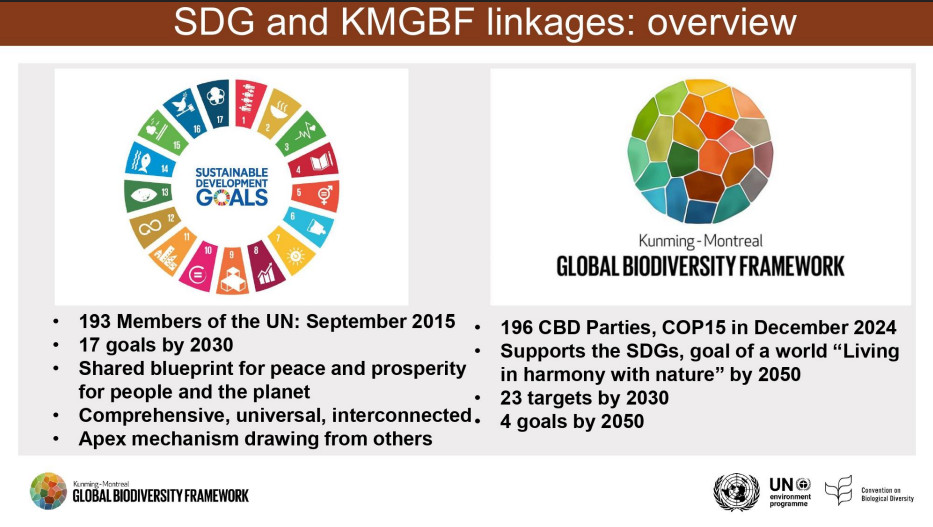
Side-by-side because when you look at the SDGs and the Global Biodiversity Framework (GBF), you can see that they are kind of siblings. The SDGs and GBF have the same color palette, and it’s for a reason; they are meant to be interlinked.
- The SDGs were created in 2015 and the GBF came later in 2022, but they both reference each other quite a lot.
- The 2030 Agenda is an apex mechanism that refers to other agendas, the GBF, the other Rio Conventions, including climate change and desertification, and also refers to the goals of the Sendai Framework.
- The GBF was also explicitly created to achieve the SDGs. The goal of the GBF is to achieve a world where we’re living in harmony with nature by the year 2050 and we have 23 individuals targets each with a different color.
- Both of these agendas are meant to be comprehensive, universal, interconnected, and the world’s shared blueprint for a sustainable world. It’s very interesting that these agendas really are meant to be connected. We’re working hard, and need to work harder, to show that not only are they really intertwined but achieving one should help achieve the other. They’re not meant to be competing agendas but actually quite the opposite.
This diagram highlights how different GBF targets relate to the SDGs.
- There are many similar targets – for example in the GBF we don’t have individual targets on things like freshwater or marine or land ecosystems, but we do have targets that are on protecting and restoring those ecosystems and their biodiversity and their services to people and the planet.
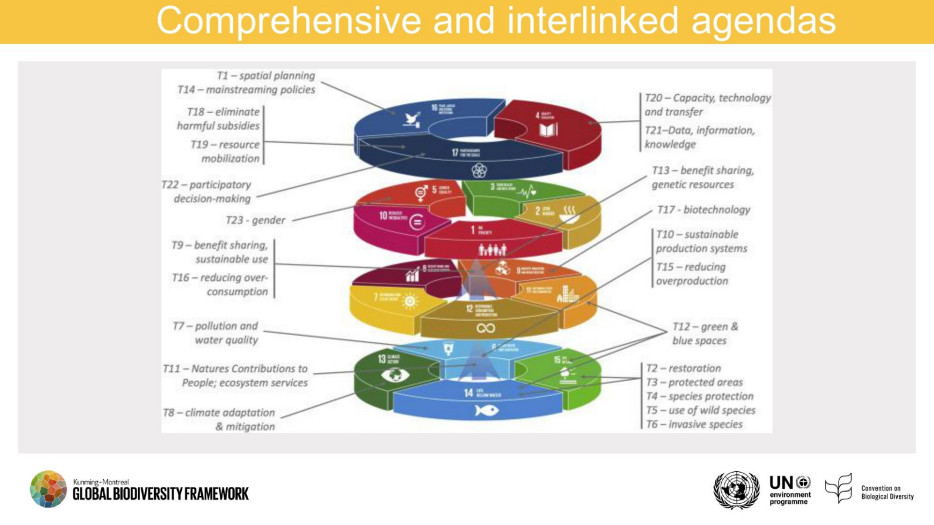
That is all on the bottom layer of what is the foundation of both agendas – the idea that nature is sustaining us all and providing these services. We call it nature’s contribution to people and the planet.
- In the second layer, you see more of the drivers of both unsustainable development and biodiversity loss. This layer looks at things like sustainable consumption and production. In CBD language, we have a target that talks about reducing overproduction and reducing unsustainable drivers. We come at it with slightly different language, but it is extremely similar thinking.
- The second to top layer is where we look at the socio-economic factors. Just like in the SDGs, there is a specific target on gender equality, there are targets on participation at all levels on youth, Indigenous populations, and local communities.
- They also map very similarly at the top of the cake which look at means of implementation and things like capacity, finance, information, data and knowledge systems. We have that in both of the agendas and they link very closely. Education probably is where we put it in the GBF context text in that target but also very much links across the entire agenda in both cases.
Every year our major campaign for biodiversity is International Day for Biological Diversity (IDB) which is on May 22nd every year. Last year we did the campaign on the links between the SDGs and the KMGBF. If you go to last year’s website, all of our former IDBs are all available, we have a tremendous amount of information, toolkits, case studies, examples, video messages, and it talks about those links between the SDGs and the GBF. If you want more information on what countries are doing and what’s happening at local levels, you can check out last year’s website.
- One of the tools I wanted to highlight, which is on the website, is the interactive diagram done with UNEP last year on the links between the SDGs and GBF. It’s an informative tool showing where those interactions can be maximized for the benefit of both.
- In the concept note for this event, it notes that going from global to local scale will be pivotal to the success of connecting global sustainability progress for the SDGs under review, but I would argue, accelerate the progress for all the SDGs. It does so by translating global commitment into locally meaningful learning and action and having education empower communities to move from awareness to implementation. On the GBF side, we see it exactly the same way. We could have taken that verbatim in terms of our thinking and belief in terms of the importance of CEPA (Communications, Education, and Public Awareness) and education for the GBF.
- At the GBF, we talk a lot about whole-of-government and whole-of-society approaches. We know what’s needed to halt biodiversity loss at all levels and the CBD has also acknowledged that CEPA has a pivotal role to play.
- The idea of CEPA being pivotal was put into the original biodiversity conventions Article 13 back in 1992.
- We’ve had a large number of decisions around CEPA, as well ever since COP 4 which happened in the year 2000. There’s been lots of acknowledgements of the area.
- The CBD parties asked us to establish an online reporting tool. It is a tool that collects all contributions from countries from NBS to national reports to national targets. You can see data and information in real time and is either submitted by a CBD focal point of if the actor that’s submitting is not a country, it has then gone through no objection approval by the CBD focal point.
- The reason CBD has done this is that it recognizes that whole-of-society approaches are needed in order to turn the tide on biodiversity loss. National reports make up the most important contribution to our reporting. However, we know that actors need to be involved at all levels. We also know that transparency, dialogue, and exchange of information are critical. All of this has been put into place in order to boost the global review process for the GBF.
- The first review is happening later this year at COP because we are halfway through the year.
- This tool invites explicitly invites indigenous peoples, local communities, subnational governments, cities, local authorities, NOS’s, IGOS, MEAs, women, youth, research organizations, business, and private sector. It invites all of them to submit their own actions on how they’re contributing to the KMGBF.
For this year’s International Day for Biological Diversity Day campaign at the end of next month, we’re focusing the topic on local action. The theme is acting locally for global impact. There will be events all over the world. There will be an official event in South Africa.
- You can see in this logo, with the KMGBF colors, that there’s a link between individual action and a ripple effect on how that can impact others but also how actions from others and the global actions are also waving back rippling back to impact local communities.
- We’ve got three interesting pillars where we’re gathering stories and inviting contributions and events. We’re collaborating with major citizen science platforms to put out some global campaigns for collecting species. We’re collaborating with schools, with cities all over the world. We’re looking to link to what already exists, what’s already working, what networks are out there so that we can promote and invite people to support and joining both online and in person live, real time, out in nature.
This year we are putting the E into CEPA, because for the first time since we’ve had a work program on CEPA for the last 25 years, we are being asked to create a Global Plan of Action on Education for Biodiversity. Education has been like the silent “E” in CEPA all these years. We honestly haven’t done as much on education as we have in communications and public awareness.
- This Global Plan of Action (GPA) is meant to be covering both formal and informal sectors. It is meant to also it will address things like value systems, experiential learning, getting out in nature, and also implementing biodiversity into all areas of curricula.
- I invite you to take a look at that draft that will be coming out for our SBI-7 implementation body meeting, taking place in August in Nairobi. The draft GPA will be a background document for the meetings in Nairobi, and it will be considered by parties in Nairobi to take it further to COP where we hope they will adopt the GPA.
- We are working closely with UNESCO, IPBES, UNEP and several IUCN task forces on this draft plan of action. We have a lot to learn from the ESD community.
Closing Remarks
Bernard COMBES | Independent Expert
We know where we’re coming from, and we need to know where we should go. One key objective is to see ESD as pivotal not only for the SDGs, but all kinds of frameworks that are in place.
- We have to see it as a key way to support the transformative learning processes that influence how people understand and respond to global challenges. We have to see ESD as a lifelong process not just limited to the formal school system.
- Among the entries we have received, we had quite a few examples that show you that it can happen anywhere and everywhere. Some of the examples show us that ESD is also for vulnerable populations in states of poverty or in conflict areas it’s not for regular people.
We have to keep in mind going forward that meaningful change requires the need for action at multiple levels and ensuring that sustainability is embedded across all activities whether they are school activities, policy activities, or other types.
- We have to remember that both bottom-up motivation and top-down support are essential as change driven from only one direction is very likely to not lead to any transformation.
- We have a couple of examples in the stories we received.
- For instance, there’s a story that came from the municipality in Munich showing how municipalities are engaging with their own stakeholders and their own citizens.
- Here in France, we had municipal elections and environment issues where basically every program of most of the candidates that were running for elections with different approaches to making your city more environmentally friendly, but this was really a change from past years.
I would give a different wording to the acronym CEPA – communication but it’s also about coordination, education but it’s also about engagement. We need to engage staff, students, partners will build commitment while cooperation with municipalities, civil society organization, and other institutions will enhance innovation, reduce costs, and increase overall impact.
- We have to go to the multi-partner approach. We need to also support continuous professional development for teachers, school leaders, but also others.
- We tend to forget technical and vocational training, which is key because for most of the jobs we don’t even have the descriptions of what they will be.
- We need some approaches, some education, professional development that will enable people to have the skills, critical thinking and some of the skills that were have been mentioned to be able to move forward. It’s crucial to equip them with these adaptation skills, including social emotional skills to be able to promote sustainability concepts more efficiently inside the classroom, outside the workspace, anywhere.
- We also have to strengthen long-term cross-sector partnerships and foster meaningful community collaboration. This requires ongoing coordination, commitment, and adopting flexible context-sensitive approaches.
- One size does not fit all and it’s also a challenge for governments, local governments, and many municipalities. They have shown it’s possible to do that but it takes time and it’s not something you can say “within two years we’ll achieve that it’s a longer-term vision” because too often we only have this very short-term vision.
Another lesson we learned is that we need to focus on future generations. We have to take the approach of the seven-generation vision. This is something that the native Americans from the East Coast, US used to have. We have to think seven generations down from us and ask “the decision I take now how will that affect them?”.
- We also have to ensure that curricular objectives align with real-world applications. Too often children are being taught in schools and they have these exams at the end of the official mandatory schooling about things that have anything to do with the real conditions around them.
- We have to readjust and create sustained engagement from teachers, government officials, community leaders, local stakeholders. This requires that we have assessment frameworks in place. How do we measure this impact?
- One of the criticisms of both the SDGs and the GBF targets is that these numbers that mean something for some people, but for the general population there they mean nothing. We need to rethink how we assess this.
Finally I think we need to strengthen what we have based on what we’ve learned. We also need to discuss how to rethink the engagement of the committee and how it interacts with the partners and stakeholders and national focal points in the UNECE region to actually move to changing, transforming, and getting to this ecological transition. At the same time it’s a generation transition to see how we live within this constantly changing world and how we ensure that we meet the targets of the SDGs.
Documents
Presentations made during the event
Links
Other RFSD 2026 Side Events

Education for Biodiversity: Accelerating Delivery of the Global Biodiversity Framework | RFSD 2026
20 April 2026 | 11:45 – 13:00 CEST
Cyprus, Slovenia, UNEP Europe Office, United Nations Educational, Scientific and Cultural Organization, United Nations Economic Commission for Europe, Convention on Biological Diversity, Geneva Environment Network