
Événement Virtuel
Implementing Pollutant Release and Transfer Registers (PRTRs) for Fulfilling International and National Commitments to Mitigate Pollution | Escazu COP 4 Side Event

22 Avr 2026
15:00 – 16:30
Lieu: Palais des Nations | S-225.4 & Online | Webex
Organisation: Convention de la CEE-ONU sur l'accès à l'information, la participation du public au processus décisionnel et l'accès à la justice en matière d'environnement, Convention de Minamata sur le Mercure, Geneva Environment Network
This virtual side event to the fourth meeting of the Conference of the Parties to the Escazú Agreement (COP 4) convening from 21 to 24 April 2026, in Nassau, Bahamas, explored how PRTRs and pollution data systems can support the implementation of commitments to mitigate pollution by strengthening transparency and access to environmental information. It brought together the Aarhus and Minamata Convention Secretariats and national and regional experts to share practical experiences and identify opportunities for cooperation.

About this Event
Transparency and access to environmental information are central to effective environmental governance and form core pillars of the Escazú Agreement. In this context, Pollutant Release and Transfer Registers (PRTRs) play a critical role as practical tools to collect, manage and disseminate data on pollution, enabling governments and the public to better understand environmental pressures and trends.
Multilateral environmental agreements (MEAs), including the Minamata Convention on Mercury and the Aarhus Convention along with its Protocol on PRTRs depend on strong data systems and national reporting to assess implementation and measure progress. These agreements rely on accurate, timely information to support compliance, guide policy responses, and strengthen international cooperation.
Enhancing the connections between PRTR systems and MEA reporting frameworks can make environmental data more accessible, reinforce coherence across policy processes, and contribute to more informed decision-making at both national and global levels. Such integration ultimately supports more transparent governance, improved environmental performance, and strengthened accountability.
Leading experts who have joined this side event showcased PRTRs as effective instruments for advancing transparency and public access to environmental information; highlight synergies among the Escazú Agreement, the Aarhus Convention and its Protocol on PRTRs, and the Minamata Convention; present regional and national experiences in establishing and operating PRTR systems; demonstrate how mercury‑related data and national reporting under the Minamata Convention can complement PRTR frameworks; and foster dialogue and knowledge exchange among Parties, experts, and stakeholders.
Speakers
By order of intervention.

Íñigo DE VICENTE-MINGARRO
Administrator, Spanish Register of Emission and Pollutant Sources (PRTR-España), Ministry for the Ecological Transition and the Demographic Challenge, Spain | Chair of the International PRTR Coordinating Group (ICG)

Marcos ORELLANA
UN Special Rapporteur on toxics and human rights

Eisaku TODA
Programme Officer, Minamata Convention on Mercury Secretariat

Anna GARCÍA SANS
Communications and Knowledge Management Officer, Minamata Convention on Mercury Secretariat

Kristof DOUÇOT
Environmental Affairs Officer, Secretariat of the Aarhus Convention and its Protocol on PRTRs, UNECE

Naoko MORITANI
Administrator for PRTRs, Environmental Health and Safety Division, OECD

Matías VERGARA HERRERA
Environmental Data Analyst, Department of Environmental Information, Ministry of the Environment, Chile

Andrina CRNJAK THAVENET
Head, Sectorial Impacts, Waters, Chemicals, Industrial and Integrated Pollutions Impacts, Ministry of Environmental Protection and Green Transition, Croatia

Danica LASSALINE
Science Officer, Pollutant Inventories and Reporting Division, Environment and Climate Change Canada
Highlights
Video
Summary
Opening Remarks
Íñigo DE VICENTE-MINGARRO | Administrator, Spanish Register of Emission and Pollutant Sources (PRTR-España), Ministry for the Ecological Transition and the Demographic Challenge, Spain | Chair of the International PRTR
- I am speaking in my capacity as Chair of the International PRTR Coordinating Group (ICG), and addressing the importance of promoting PRTRs as a useful tool for fulfilling both international and national commitments to mitigate pollution.
- The ICG is an informal and open group, mainly from a technical perspective, where NGOs, governments, and other stakeholders participate to share experiences worldwide in the development and implementation of PRTR systems.
- It also facilitates the exchange of information and supports capacity-building activities in different countries.
- Spain and UNITAR currently serve as the Bureau, and the PRTR Protocol Secretariat also supports the group.
- ICG meetings usually take place annually, back-to-back with the OECD Working Party on PRTRs, and the group also participates in other meetings such as this side event.
- PRTRs are becoming increasingly important worldwide. More than 90 countries are working on PRTRs. Around 73 countries, across different regions, have some form of commitment to developing PRTR systems, although not all have fully implemented them yet.
- PRTRs are online inventories where information is obtained directly from the source. This is a key characteristic.
- They are also an important environmental information tool. They provide data to better understand pollution generated by major sources – not only industrial sources, but all significant emission sources.
- This information is valuable in terms of both quantity and representativeness. It can be used, for example, for reporting under international environmental instruments such as the Minamata Convention.
- While PRTRs do not cover all aspects required under these agreements, they provide an important contribution by collecting, analyzing, and supplying relevant data.
- There is already a significant amount of experience worldwide in the design, development, and implementation of PRTR systems. Countries face similar challenges and problems, and this is one of the main reasons to promote PRTRs globally. Working together allows us to identify common solutions that can be applied across different environmental contexts.
- Groups like the ICG contribute by providing a space where participants can share experiences from a technical perspective, rather than a political one. This allows for more open discussions about real challenges, needs, and practical solutions. Participants can present their experiences, discuss problems, and exchange ideas with colleagues from different parts of the world.
- Working together and sharing experiences is essential. It helps us understand what others are doing and provides ideas for improving our own systems. At the same time, it is important to keep in mind national objectives and contexts, while also valuing the experience gained over time, including the information collected and best practices implemented worldwide.
- Maintaining a proactive approach to international coordination and knowledge exchange is key. It helps us better understand the needs of both the public and governments, particularly in terms of effective use, interpretation, and improvement of PRTR systems as a whole.
PRTRs for Addressing Global Targets and Challenges
Marcos ORELLANA | UN Special Rapporteur on toxics and human rights
- I’m very pleased to have the opportunity to join this side event during the fourth session of the Escazú Agreement Conference of the Parties, which, as we know, includes an obligation on parties to take steps to establish pollutant release and transfer registries.
- In the context of my mandate on toxics and human rights, I presented a thematic report to the UN Human Rights Council in 2024 that addressed PRTRs extensively. This is because these tools are entry points to information that allow users to engage in environmental policy and governance, advance corporate accountability, and contribute to the Sustainable Development Goals.
- The first point I would like to make is that PRTRs are directly linked to the implementation of the right to a clean, healthy and sustainable environment, especially its procedural dimensions. These include the access rights covered by the Escazú Agreement – access to information, participation, and justice – particularly access to information.
- PRTRs allow regulators to assess risks, set priorities, improve regulations, and ensure proper enforcement.
- They are also key tools for individuals and communities to understand actual risks, take preventive action, and seek adequate remedies.
- They are equally relevant for businesses, helping to ensure a level playing field and avoid unfair advantages based on externalized costs.
- There are, however, key challenges in making these tools effective for the implementation of the right to a healthy environment. One of them is transforming information into knowledge. It is not only about collecting and providing data, but also about analysis and engagement with communities.
- The second point is that PRTRs are relevant for all countries.
- Most parties to the Escazú Agreement are developing countries, so this is particularly important. Much of the work on PRTRs has focused on industrial or point sources, such as facilities.
- However, diffuse sources, including those in agriculture, can also be estimated, and methodologies exist to do so.
- PRTRs are therefore a tool for evidence-based decision-making and prioritization.
- This also connects with the Global Framework on Chemicals (GFC) adopted at the fifth session of the International Conference on Chemicals Management, where Target B3 specifically refers to pollutant release and transfer registries.
- The third point is that PRTRs should have clear pollution prevention mandates. The title of this side event refers to pollution mitigation, but I would also emphasize pollution prevention.
- A few weeks ago, I concluded an official country visit to Mexico, where I observed significant efforts to establish a PRTR system. I also observed what appears to be a lack, or at least an insufficient connection, with pollution prevention policies.
- Without such mandates, the benefits of a PRTR system are limited. The investment required to establish these systems may deliver insufficient results, and there is even a risk of creating a false sense of progress –suggesting that issues are being addressed when they are not.
- Measuring pollution is one thing. Addressing it, and securing people’s rights to health, life, and a healthy environment, is another. These are related, but not the same. Without a clear prevention mandate, there is a risk of confusing ends and means.
- A clear focus on pollution prevention is therefore essential. This can include gradual reduction over time – it does not have to happen immediately –but it requires direction. As emphasized in my thematic report, the involvement and engagement of communities is critical in this process.
- To conclude, PRTRs are directly linked to human rights, they are relevant tools for all countries, not only high-income ones; and they should have clear pollution prevention mandates in order to make a toxic-free environment a reality for all.
Pollution Data and MEA Implementation: The Minamata Convention Perspective
Eisaku TODA | Programme Officer, Minamata Convention on Mercury Secretariat
- I will present on PRTRs as a typical example of the synergies between multilateral environmental agreements (MEAs).
- As a reminder, the Minamata Convention addresses the whole life cycle of mercury – from supply and trade to emissions, use, and waste management.
- One of its key features is that it addresses emissions and releases of mercury, which is a hazardous substance. Mercury can travel long distances, is persistent in the environment, and bioaccumulates.
- The group of scientists working under the Convention is assessing mercury emissions to air, as well as releases to land and water, in order to evaluate the effectiveness of the Convention.
- Overall, mercury emissions are relatively stable. There was a slight drop due to COVID-19, but emissions are now increasing again. However, if we look at the breakdown, emissions from coal and other point sources are declining, while emissions from artisanal and small-scale gold mining are increasing significantly. This is a major challenge.
- If we look at regional data, in Latin America and the Caribbean, artisanal and small-scale gold mining is the largest source of mercury emissions. This clearly needs to be addressed.
- The Minamata Convention has several links with PRTR systems.
- Articles 8 and 9 focus on emissions and releases from point sources and require parties to establish emission and release inventories. These inventories form the core basis for taking action.
- The guidance documents under the Convention also mention PRTRs as a valuable source of information for building these inventories.
- Article 7 addresses artisanal and small-scale gold mining and includes an obligation to estimate mercury use in this sector. This is an example of a diffuse source, as mentioned earlier, and it can be incorporated into PRTR systems through estimation of emissions and releases.
- Finally, Article 19 focuses on public information. PRTRs are recognized as a tool to support public access to environmental information. A similar article also exists under the Stockholm Convention on Persistent Organic Pollutants (POPs).
Anna GARCÍA SANS | Communications and Knowledge Management Officer, Minamata Convention on Mercury Secretariat
- I will turn to the regional dimension, focusing on Latin America and the Caribbean. This is a region where both the Minamata Convention on Mercury and the Escazú Agreement are highly relevant and mutually reinforcing in practice.
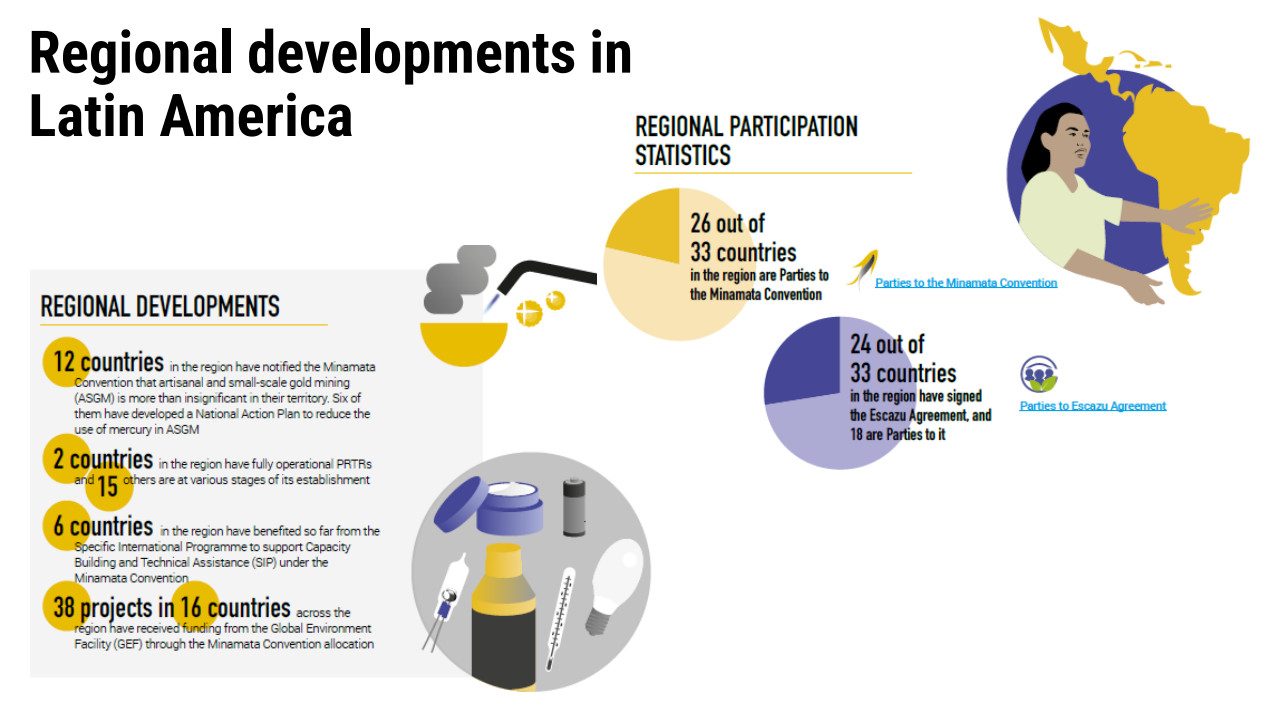
- On the slide, you can see some data and insights resulting from a collaborative effort between the secretariats of the two agreements, reflecting this shared commitment to strengthening environmental governance in the region.
- Both agreements have around 75% participation in the region. In the case of the Escazú Agreement, there are 19 parties, and for the Minamata Convention, around 78-80% of countries in the region have ratified it.
- In terms of PRTRs, there are currently two countries in the region with fully operational systems – one example is Chile. In addition, 15 other countries are at various stages of establishing their systems, in line with obligations under the Minamata Convention.
- We are also supporting capacity-building activities through financial mechanisms, and many countries are working on national action plans, particularly where there is significant artisanal and small-scale gold mining activity.
- I will highlight three common areas of work between the two agreements:
- First, access to information and awareness. Under the Minamata Convention, parties are encouraged to promote public information, education, and awareness. Under the Escazú Agreement, access to environmental information is recognized as a right. Together, these ensure that information on mercury reaches people in a meaningful way.
- Second, data transparency and PRTRs. The Minamata Convention requires parties to develop inventories of emissions and releases and encourages the use of tools such as PRTRs. The Escazú Agreement recognizes PRTRs as a core instrument for transparency.
- Third, participation and the protection of people in vulnerable situations. The Escazú Agreement emphasizes stakeholder engagement in decision-making and ensuring that those most affected by environmental impacts are not left behind.
- These linkages are explained in more detail in a joint infographic developed with the Escazú secretariat, which provides a clear overview of this synergy.
- I will share an example focused on artisanal and small-scale gold mining (ASGM) in the region.
- ASGM is the largest source of mercury emissions and is widespread across Latin America, often in informal contexts, in rural or remote areas. It directly impacts people in vulnerable situations as well as critical ecosystems, including biodiversity.
- This makes it a clear example of where the two agreements intersect. On one hand, the Minamata Convention regulates mercury trade, promotes environmentally sound practices, and requires countries with significant ASGM activity to develop national action plans to reduce and, where feasible, eliminate mercury use.
- On the other hand, the Escazú Agreement strengthens this process by ensuring access to information, participation in environmental decision-making, and access to justice. It also supports regional cooperation and information-sharing to address illegal activities.
- Together, these frameworks enable countries to advance a just, inclusive, and sustainable transition toward responsible gold mining and reduced mercury pollution.
- Finally, I want to highlight the role of Indigenous peoples and their knowledge as an integral part of the solution.
- Mercury pollution affects people in vulnerable situations, and Indigenous peoples are directly impacted – not only near mining sites, but also downstream, where mercury contaminates fish and crops.
- They are often excluded from official monitoring, yet they are among those most affected.
- At the same time, their traditional knowledge complements scientific data. The Convention recognizes their role not only in generating data, but also in developing solutions.
- At COP5, the Minamata Convention encouraged the use of guidance on the effective engagement of Indigenous peoples and local communities in ASGM-related processes. This guidance is available on our website.
- The secretariat has also published mercury monitoring guidance for ASGM sites, which includes Indigenous peoples as active participants, not just subjects, through community-led monitoring.
- The key message is that there is no real solution without their effective engagement. This is not just an opinion, evidence on the ground shows it, and COP decisions support it.
- Finally, just a reminder that today is Earth Day. Data transparency and participation are essential tools to protect both people and the planet. From the Minamata Convention Secretariat, we remain committed to working together to move this forward.
PRTRs and Transparency: International Frameworks
Kristof DOUÇOT | Environmental Affairs Officer, Secretariat of the Aarhus Convention and its Protocol on PRTRs, UNECE
- I will speak about the PRTR protocol, which is the only legally binding international instrument on PRTRs.
- Under the Protocol, a pollutant is defined as a substance or group of substances that may be harmful to the environment or human health due to its properties and its introduction into the environment. As a result, the Protocol covers a wide range of pollutants, including air pollutants, greenhouse gases, heavy metals, POPs, and others.
- The Protocol was adopted in 2003. It is younger than some other chemicals and waste-related multilateral environmental agreements, such as the Basel Convention, the Rotterdam Convention, and the Stockholm Convention on Persistent Organic Pollutants, but it predates the Minamata Convention on Mercury.
- It is interesting to look at the evolution of these agreements and see how, over time, the notion of access to relevant environmental data has become more concrete. PRTRs were first mentioned in the Stockholm Convention and then developed further in the Minamata Convention. We now see similar developments in the objectives and targets of the Global Framework on Chemicals (GFC).
- In this context, implementing the Escazú Agreement and the PRTR Protocol also contributes to the implementation of provisions under the Minamata Convention and the GFC and vice versa.
- PRTRs do not focus on a single aspect of pollution such as air, water, or soil, nor on a single group of pollutants. They aim to provide governments, the public, and other stakeholders with a comprehensive overview of significant sources of pollution.
- They therefore serve as an important infrastructure, based on common international standards, that can be applied globally and across different processes, supporting both action and cooperation.
- The Protocol establishes coordinated reporting systems, including cost-efficient national and international reporting, often based on synergies between different obligations.
- Countries use PRTR systems to support the polluter-pays principle and to inform complex economic, social, and environmental decisions.
- They also provide tools for local governments with specifical tools they can use to make use of the PRTR data, and they support multi-stakeholder dialogue leading to more trust.
- Raising awareness and applying a cohesive and integrated approach to pollution is essential. Context is also very important.
- Sharing knowledge and experience between countries and organizations is key to success. This must be rooted in national policy and legal frameworks, while making active use of tools and guidance developed under different MEAs, including the Minamata Convention and work by the OECD.
- PRTR systems offer governments and stakeholders a coordinated reporting mechanism that can advance the synergistic implementation of different agreements and instruments.
PRTRs and Capacity-building Opportunities
Naoko MORITANI | Administrator for PRTRs, Environmental Health and Safety Division, OECD
- I will introduce OECD activities on PRTRs that support countries in establishing and implementing PRTR systems, with a particular focus on recent regional capacity-building activities in Southeast Asia
- PRTRs have been developing globally for several decades, and the OECD has been actively supporting this trend. OECD work helps countries protect human health and the environment while reducing duplication of efforts and making more effective use of resources.
- The OECD legal instrument on PRTRs, referred to as the OECD Council Act, serves as a critical mechanism for ensuring the establishment and effective implementation of PRTR systems, while also promoting their broader uptake through international outreach.
- OECD activities have evolved to focus on three main areas: harmonization, improving PRTR data, and enhancing the use of PRTR data.
- We have developed a range of materials and tools in these areas. For improving PRTR data, we have produced guidance on release estimation techniques. For enhancing data use, we note that while PRTR systems are now established in more countries, they still vary widely. Therefore, harmonization is a key priority, as it enables global analysis of PRTR data.
- One example of our work is the OECD PRTR Data Explorer.
- It currently brings together data from 39 countries and tracks releases and emissions of 25 pollutants, including mercury and mercury compounds.
- The tool enables cross-country comparisons and analysis of trends over time.
- Importantly, this work contributes to ongoing discussions on high-level indicators of global environmental burden under the global framework on chemicals, highlighting how PRTR data can support tracking progress.
- Another example is a dashboard compiling good practices on PRTR data use.
- This database shows that PRTR data are used for a wide range of purposes, including policymaking, education, research, partnership-building, public trust, and chemicals assessment.
- The dashboard also showcases tools used to present PRTR data – such as mapping, rankings, toxicity weighting, and visualizations – to make the data more accessible and easier to understand. You are welcome to contribute your own good practices to this dashboard.
- In addition, we have developed a number of tools and materials, including the Centre for PRTR Data, net as a global information portal developed in cooperation with UNECE, and step-by-step guidance through the IOMC Toolbox. The webinar series on the IOMC Toolbox is also a useful resource for chemicals management.
- We also carry out capacity-building activities tailored to countries’ needs and available resources.
- This can include awareness-raising, legislative support, and national workshops.
- A key strength of this work is leveraging the experience of OECD member countries and facilitating exchanges between countries at different stages of PRTR development and implementation.
- Last November, the OECD organized a national consultation on PRTRs in Cambodia, followed by a regional workshop with contributions from Japan and the International Council of Chemical Associations.
- Participants included representatives from government, academia, and industry in Cambodia, as well as participants from Indonesia and Laos, with Chile and Japan sharing their experiences.
- Countries in the region are at different stages. Cambodia already has a pilot PRTR system, Laos is at an early stage, and Indonesia has robust monitoring systems that can support PRTR development.
- These activities strengthened technical and institutional capacity, facilitated knowledge exchange, and helped accelerate momentum toward establishing PRTR systems in the region.
- Several Asian countries are working actively toward establishing or further implementing PRTR systems.
- Further information on OECD activities is available on our website. Please feel free to contact us if you have any questions or are interested in collaborating. The OECD looks forward to continuing cooperation with countries and strengthening collaboration with the Escazú Agreement secretariat, the Minamata Convention on Mercury, and the Aarhus Convention and its PRTR Protocol.
Q&A
Question online about the funding under the Escazú Agreement to support countries to implement PRTRs.
Kristof DOUÇOT | Environmental Affairs Officer, Secretariat of the Aarhus Convention and its Protocol on PRTRs, UNECE
- The PRTR Protocol is open globally, so countries from any region can accede to it without being a party to the Aarhus Convention. That is not a requirement. We are very interested in learning about your needs and priorities. If there are specific ideas or areas where support is needed, we would be very happy to hear from you. Please do not hesitate to contact us and discuss this further.
Marcos ORELLANA | UN Special Rapporteur on toxics and human rights
- The Escazú Agreement includes several provisions on international cooperation aimed at supporting its implementation, including South-South cooperation.
- This creates opportunities for state parties that have already made progress on PRTRs to share knowledge, experiences, and good practices within the Escazú framework.
- At the same time, the Escazú Agreement also provides a strong basis for North-South cooperation. Donor countries can use this framework to channel support to the Latin American and Caribbean region, particularly to help establish functional and robust PRTR systems.
National Perspectives
Matías VERGARA HERRERA | Environmental Data Analyst, Department of Environmental Information, Ministry of the Environment, Chile
- I will present some key lessons, particularly on data and its role in supporting policy, in a spirit of cooperation and mutual understanding.
- PRTRs are a central component of environmental information systems. They link access to information with policymaking processes and contribute directly to the implementation of international frameworks, particularly those related to access to information – such as the Escazú Agreement – and to the management of pollutants and chemicals.
- In this context, PRTRs are not only reporting tools but also information instruments. They allow us to systematically link key dimensions of environmental information at a national scale, including emissions to air, emission sources, types of emissions, pollutants, and their locations.
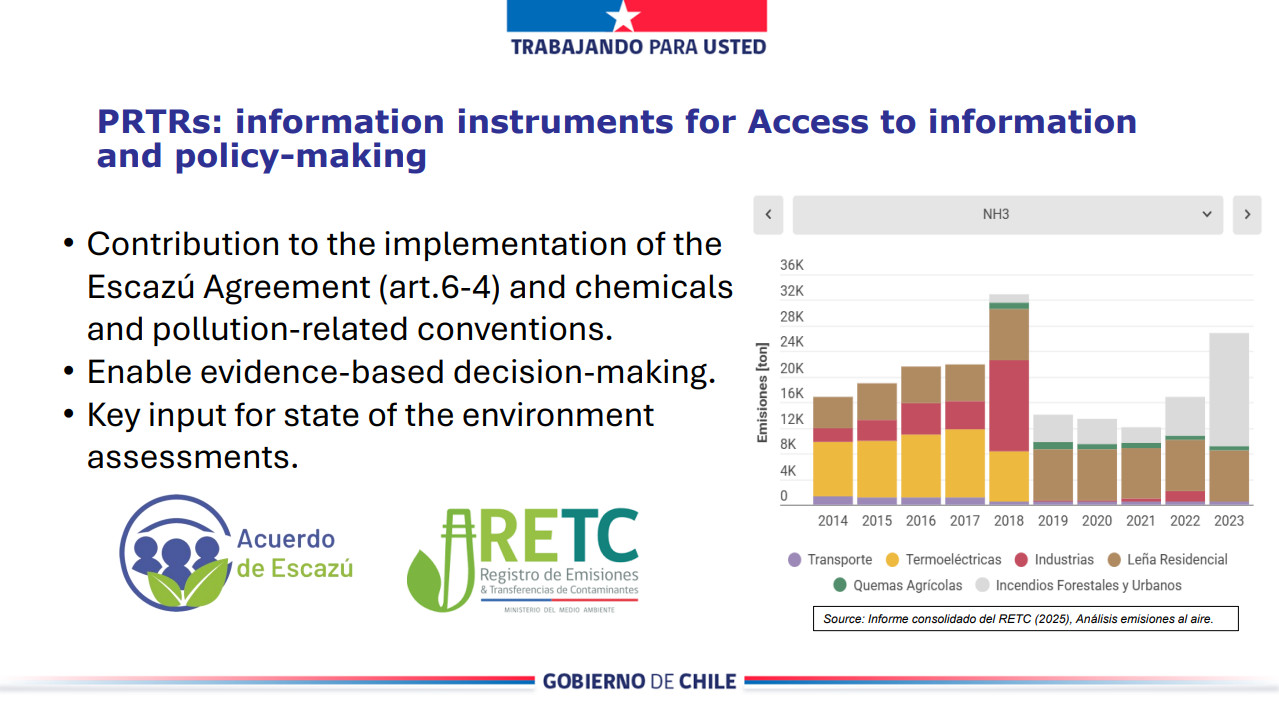
- For example, the figure shown in the slide above presents the evolution and source composition of ammonia emissions to air across sectors from 2014 to 2023 in Chile. This is information that we publish in the State of the Environment Report and in the consolidated PRTR report.
- This structured approach enables a deeper understanding of environmental pressures beyond isolated data points and provides a robust basis for assessing the state of the environment in relation to pollution. It allows us to identify trends, understand sectoral contributions, and support the prioritization of policy actions.
- From our experience in Chile, we have identified key elements necessary to advance PRTRs as instruments for evidence-based decision-making. These elements come from practice, particularly from the ongoing process of updating the PRTR regulatory framework.
- One key element is a structured governance framework capable of supporting the PRTR’s role in collecting, integrating, systematizing, and disseminating information on emissions, waste, and pollution transfers.
- Data quality is also central – not only as a technical requirement but as a condition for strengthening the effective use of the system and building trust. Advancing these elements requires sustained human and technical capacity, including dedicated teams, appropriate infrastructure, and institutional continuity. We often underestimate the IT component of implementing these systems.
- Another important insight is that the value of the system depends on how effectively the data are used. This requires moving beyond reporting and integrating PRTR data into broader environmental decision-making processes.
- In practice, our PRTR operates through an annual data capture process using a single-window system that integrates multiple sectoral reporting obligations. It currently covers more than 50,000 establishments.
- Governance plays a key role, not only in structuring data collection, but also in enabling integration and building institutional ownership. It also supports feedback loops to improve both data quality and data use over time.
- Once data are collected, they go through integration and validation processes. Data quality becomes critical here, as it directly supports the processing of information. In Chile, we are currently advancing the third version of our data quality protocol, which includes business, referential, statistical, and geospatial criteria.
- Sustaining this system requires strong human and technical capacity, including multidisciplinary teams – from IT to data management – capable of operating and continuously improving a system of this scale.
- Access to information is ensured through open data platforms, but its effectiveness depends on all the previous elements – governance, data quality, and operational capacity – to ensure that information is reliable, usable, and relevant for decision-making.
- A clear example of PRTR data use in Chile is its integration into economic instruments.
- This has been a key driver for strengthening both the use of the data and the quality of the system.
- Through this integration, data move beyond reporting and become part of decision-making.
- For example, PRTR data are used in the green tax system for regulatory and fiscal purposes. This creates a feedback loop between reporting, validation, and use, improving the consistency, reliability, and relevance of the data.
- While this does not apply uniformly across all datasets, it illustrates how integrating PRTR data into policy processes can enhance its value, especially in a context of limited resources.
- It also highlights how stronger governance across the environmental information system can mobilize support and improve overall operations.
- Looking ahead, this integration helps move PRTRs toward systems that generate data of clear value. This means expanding from facility-level reporting to a more integrated understanding of pollution and strengthening the role of sectoral regulation and industry in managing and transforming the system.
- This development depends on integrated data governance, allowing information itself to act as a connector across institutions. Ultimately, the value of the system lies not only in the data it contains, but in how those data are managed and used by different stakeholders.
- In the broader context of environmental governance, and particularly under the Escazú Agreement, it is important to recognize that while PRTRs are implemented at the national level, many of the challenges are shared.
- Moving forward requires connecting PRTR development beyond national boundaries, fostering collaboration on scope, substances, sectors, and methodologies. Work under the OECD, the PRTR Protocol, and the ICG can support this process.
- It also requires a degree of interoperability across systems to improve comparability and support a shared understanding of environmental information.
- To conclude, while progress depends on national efforts, implementation can be significantly strengthened by aligning key elements of PRTR management, sharing experiences, and developing common reference points for effective data use.
- Chile remains open to technical collaboration and is willing to contribute to joint efforts to support the development and strengthening of PRTR systems.
- Finally, we have shared links to our PRTR platform, open data portal, and methodological guidance. We welcome feedback, particularly on data quality.
Andrina CRNJAK THAVENET | Head, Sectorial Impacts, Waters, Chemicals, Industrial and Integrated Pollutions Impacts, Ministry of Environmental Protection and Green Transition, Croatia
- I will speak about PRTRs, the Aarhus Convention, and the EPR database in Croatia. I will briefly present the legal basis, the convention and PRTR protocol, and the EPR database, as well as its connection with the Minamata Convention on Mercury and mercury regulation.
Legal basis – Aarhus Convention
- Croatia has been a party to the Aarhus Convention since 2007.
- The Convention is based on three pillars:
- Access to information: This is the responsibility of the Ministry of Environmental Protection and Green Transition, including the development and maintenance of the EPR database.
- Public participation in decision-making: Citizens and NGOs must be informed about projects that may affect the environment and have the right to comment—for example through strategic environmental assessments, environmental impact assessments, and permitting processes. Public hearings are organized at the local level to allow citizens to raise concerns.
- Access to justice: The public has the right to challenge legal decisions. Citizens and environmental NGOs can file lawsuits against administrative acts. Croatia has expanded the definition of legal standing, allowing NGOs to actively act for the environment.
Status of the Aarhus Convention in Croatia (2026)
- As of early 2026, Croatia has around 50,000 registered NGOs. Of these, approximately 400-500 are environmental NGOs, but only around 20-30 are consistently active at the national level in legal advocacy, policymaking, and litigation.
- The Ombudswoman plays an important role in protecting the right to a healthy environment. In the 2024 report to Parliament, the office monitored eight environmental “hotspots” and issued recommendations.
- The highest number of public environmental complaints relate to waste management, noise, and air pollution.
- If you look at pillar-by-pillar implementation analysis:
- Access to information is generally good, but information can be too technical for non-experts and the public to navigate.
- Public participation and consultation are mandatory through online platforms.
- Access to justice remains challenging, as court procedures are long and expensive, though efforts are underway to improve this.
Legal Basis – Industry & Energy Information System, database for PRTR
- Croatia has been a party to the PRTR Protocol since 2008.
- In line with the protocol and EU PRTR regulation, Croatia established its first Environmental Pollution Register (EPR) database in 2008. The legal basis includes the main environmental law and an ordinance on EPR, which transposes the EU regulation.
Environmental Pollution Registry (EPR)
- The EPR database is an online system with multiple tools supporting:
- Industry and facility operators
- Countries responsible for quality assurance and control
- Public access to information
- Each operator has a personal user account where they can view statistics for all facilities or specific locations. The system includes tutorials, manuals, code lists, FAQs, and guidance on data entry.
- The EPR is a source of data on emissions and releases to air, water, and soil, as well as waste management.
- It contains 14 reporting sheets, including eight dedicated to waste.
- It targets users include operators, ministries, counties, experts, and the public.
- Support is provided through help desks, tutorials, and guidance materials.
EPR Database – Quality Assurance and Quality Control
- Quality control is primarily the responsibility of Croatia’s 21 counties, with additional oversight by national experts.
- Custom quality control forms are used to review submitted data. Authorities communicate with counties and facilities to verify or correct information.
- This process is transparent, with all communication recorded in the system.
- Around 400 quality control cases are handled annually.
EPR Database – Connection with other data sets
- The EPR is connected with other databases, including:
- The SEVESO database for major industrial facilities
- EU registries of polluters
- Waste management systems
- Efforts are underway to link waste databases to avoid duplicate data entry by facilities.
EPR Data Base – Minamata Convention and Mercury Regulation
- The EPR database supports more than 30 national and international reporting processes, including:
- The Minamata Convention
- The Stockholm Convention
- Waste statistics and other UN reporting
- EPR data provide information on emissions and releases from point sources, including mercury and mercury compounds, expressed in kilograms per year.
- This data is used for reporting under:
- Article 8 and 9 (emissions and releases)
- Article 21 (waste)
- Additional databases are used for cross-checking, such as those on transboundary waste movement.
Information System for Environment and Nature – Portal ENVI “Atlas of the Environment”
- Croatia’s environmental information system includes the “Environmental Atlas,” which provides public access to data.
- It contains 78 active systems and 95 databases, including the EPR.
- The EPR browser has been available since 2011.
- A public portal was developed in 2012 in line with the PRTR Protocol.
- All data is now accessible through the Environmental Atlas platform.
To conclude, the Croatian EPR system provides comprehensive data on emissions and releases, including mercury, across different activities. This data is publicly available and used in reporting, analysis, and policymaking.
Danica LASSALINE | Science Officer, Pollutant Inventories and Reporting Division, Environment and Climate Change Canada
Overview of Canada’s National Pollutant Release Inventory (NPRI)
- The NPRI is Canada’s inventory of releases, disposals, and transfers. It tracks nearly 500 substances from over 7,800 facilities across the country, including 163 individual PRTR substances.
- It is legally mandated under the Canadian Environmental Protection Act and requires facilities to report if they meet certain criteria, such as the number of hours worked or specific activities carried out on site.
- Reporting requirements are reviewed regularly through a consultative process to ensure that the data continues to meet user needs.
- A fundamental principle of the NPRI is the public’s right to know. The information collected is publicly available and helps set environmental priorities and monitor environmental performance.
- All data is published annually and made available online in multiple formats to support a wide range of users, from non-technical audiences to researchers.
- NPRI data also supports domestic and international priorities, including Canada’s chemicals management plan
Linkages to Other Initiatives
- In Canada, multiple mechanisms exist for tracking pollutants. The NPRI links its dataset with:
- This allows facilities reporting to multiple inventories to be connected across systems.
- At the international level, through the Commission for Environmental Cooperation North American PRTR Initiative, data is compiled for approximately 40,000 industrial facilities across Canada, the United States, and Mexico.
- This initiative strengthens linkages between national PRTR systems and supports the management of pollutants of common concern across borders.
- Under the Minamata Convention on Mercury, the NPRI helps Canada fulfill its reporting obligations. Data on mercury releases, disposals, and transfers are used in national reporting to:
- Demonstrate actions taken to reduce emissions
- Assess domestic implementation measures
- NPRI data also supports analyses to identify sectors or facilities reporting higher-than-expected values and has been submitted for use in scientific assessments for the Convention’s effectiveness evaluation.
NPRI Outreach
- The NPRI works with Indigenous communities, industry, academia, museums, and non-governmental organizations to promote understanding of pollution data in Canada. Outreach activities are tailored to different audiences.
- One key initiative is the NPRI Academic Challenge, a mentoring opportunity for students across Canada.
- Each year, over the course of a semester, students develop projects – such as reports, essays, maps, or data analyses – that explore NPRI data and improve its usability.
- This initiative requires minimal program resources while providing students with real-world experience and giving the NPRI program valuable research insights. To date, over 40 projects have been completed.
- Another initiative is the NPRI Indigenous Series, a set of interactive information products that provide context on industrial pollution near Indigenous communities in selected regions of Canada.
- These products combine maps, text, and data, and are developed in collaboration with regional Indigenous organizations to reflect their specific knowledge, concerns, and priorities.
- Three overviews have been published so far, with another to follow.
NPRI Partnerships
- We recently completed two partnerships with academia that incorporated Indigenous knowledge and NPI data.
- One project assessed potential exposure of Indigenous communities to contaminants by combining:
- NPRI pollutant data
- Contamination levels in traditional foods such as meat and fish
- Dendrochronology
- Traditional knowledge and historical data
- This approach helped identify links between industrial emissions and food contamination.
- A second project, conducted with the University of Toronto and an Indigenous-led environmental data justice lab, focused on communities in Sarnia, Ontario, including Aamjiwnaang First Nation.
- These communities face significant exposure to pollutants from nearby petroleum industries.
- The project assessed how useful NPRI data is for communities living near industrial facilities.
- Feedback highlighted the need for:
- Better representation of cumulative exposure
- Less technical, more accessible formats
- Improved contextualization of pollution data
Indigenous Science
- Engagement with Indigenous peoples remains a priority, including in Canada’s implementation of the Minamata Convention.
- Environment and Climate Change Canada has recently established an Indigenous Science Division to integrate Indigenous and Western knowledge into science, policy, and program development.
- More broadly, since 1991, Canada has worked with Indigenous peoples, northern communities, governments, and scientists through the Northern Contaminants Program (NCP).
- The NCP includes monitoring contaminant levels in the Canadian Arctic, including mercury under the global atmospheric monitoring program. It contributes to the Minamata Convention by:
- Supporting long-term engagement on mercury issues
- Sharing knowledge and data
- Providing long-term monitoring results
- Producing assessment reports
- The NCP includes monitoring contaminant levels in the Canadian Arctic, including mercury under the global atmospheric monitoring program. It contributes to the Minamata Convention by:
Open Discussion
Q: Who can access PRTR data and is it helpful to identify the location and causes of pollution?
Kristof DOUÇOT | Environmental Affairs Officer, Secretariat of the Aarhus Convention and its Protocol on PRTRs, UNECE
Access to PRTR data is defined in the PRTR Protocol as being available to everybody. It is not only about access, but about easy access. Countries need to ensure that the data is accessible, meaningful, and usable for different audiences.
PRTR data is specifically about sources of pollution, which is one of its main strengths. The information comes directly from reporting facilities, meaning from the source itself. In addition, PRTR data includes geographic location, so it allows users to identify where pollution originates and understand its sources.
Q: How much does it cost to set up a typical national PRTR in a small country?
Kristof DOUÇOT | Environmental Affairs Officer, Secretariat of the Aarhus Convention and its Protocol on PRTRs, UNECE
This is a difficult question, and there is no single number that can be provided. However, countries can look at neighboring countries that have already implemented PRTR systems, learn from their experiences and explore shared approaches. For example, in the Western Balkans, projects have used open-source software to reduce costs and improve efficiency by addressing common needs collectively
Q for Chile: Which models or software are you using to carry out the statistical analysis implemented for the PRTRs?
Matías VERGARA HERRERA | Environmental Data Analyst, Department of Environmental Information, Ministry of the Environment, Chile
Chile’s PRTR is built on existing sectoral reporting obligations, so initial data quality depends on how well declarations are made. After data is collected, a data quality protocol is applied using statistical methods such as DBSCAN, Z-score, and we are currently exploring Isolation Forest. These are implemented using open-source tools, mainly PostgreSQL and Python. Scripts are managed through a Git repository. The aim is not to remove data, but to identify potential outliers. Statistical criteria alone are not sufficient – reference criterial and industry knowledge are also important, as industry often understands sector-specific data patterns better.
Q: What has been the biggest success and challenge in PRTR implementation?
Matías VERGARA HERRERA | Environmental Data Analyst, Department of Environmental Information, Ministry of the Environment, Chile
The biggest success has been the implementation of the single-window system. This system allows reporting to be centralized and integrated, meaning that facilities report through the PRTR, not directly to it. This made it possible to build the register quickly and efficiently. The main challenge now is adding an additional layer of data quality and governance and improving the use of data once it is collected.
Andrina CRNJAK THAVENET | Head, Sectorial Impacts, Waters, Chemicals, Industrial and Integrated Pollutions Impacts, Ministry of Environmental Protection and Green Transition, Croatia
The biggest challenge was building the database in the first place. It had to be done within one year and both the team and the vendor were learning from scratch. Another major challenge was data quality. Early data submissions were very low quality and improving quality required significant effort over time. Today, data quality is much better, but maintaining it remains a continuous challenge.
Q: How does PRTR data support environmental justice?
Danica LASSALINE | Science Officer, Pollutant Inventories and Reporting Division, Environment and Climate Change Canada
Canada is preparing a National Environmental Justice Strategy which is going to be released this year and will include the use of NPRI data. More details will be available once it is published.
Closing Reflections
Eisaku TODA | Programme Officer, Minamata Convention on Mercury Secretariat
We know that countries under the Escazú Agreement are in the process of setting up these systems, and we heard a very good practical example of how this can be done. I think this session has been a very good opportunity to connect these countries, and I hope that further communication will continue to move PRTR development forward.
Kristof DOUÇOT | Environmental Affairs Officer, Secretariat of the Aarhus Convention and its Protocol on PRTRs, UNECE
I would highlight two points. First, we have seen the wealth of information and the many issues related to these information systems. A key lesson learned is that implementation happens step by step – you do not need to do everything at once.
Second, as Matías mentioned, the value of a PRTR system really depends on the effective use of the data. Only when policymakers are aware of the tool and understand how to use the data for specific purposes will there be sustainable financing and long-term support.
It is therefore important to think about national priorities related to pollution – what the focus should be – and then build the system progressively from there, including additional pollutants over time.
Documents
Links
- Fourth meeting of the Conference of the Parties to the Regional Agreement on Access to Information, Public Participation and Justice in Environmental Matters in Latin America and the Caribbean (Escazú Agreement COP 4)
- 2025 Fact Sheet on Minamata Convention and Escazú Agreement Linkages
- A/HRC/57/52: Pollution information portals: strengthening access to information on releases of hazardous substances | Report of the UN Special Rapporteur on toxics and human rights