
Événement Conférence
Human Rights and Environmental Impacts of Investors-States Dispute Settlements (ISDS) Mechanisms | Geneva Rights and Environment Talks

05 Mar 2024
13:00 – 14:30
Lieu: Villa Rigot & Online | Webex
Organisation: Procédures spéciales du Conseil des droits de l’homme, Earthjustice, Center for International Environmental Law, International Institute for Sustainable Development, Global Cities Hub - Geneva, Geneva Environment Network
On the sidelines of the 55th session of the Human Rights Council, the Geneva Rights and Environment Talks aimed to harness the opportunity of this moment of the year to reflect on the challenges posed by the rapid decline of nature and biodiversity, and on how Geneva contributes to bringing together the actors working towards ensuring the right to a clean, healthy, and sustainable environment is upheld for all. This session launches the first series of the Geneva Rights and Environment Talks.

About this Session
The UN Special Rapporteur on human rights and the environment, David Boyd, has warned in his 2023 report to the UN General Assembly “Paying polluters: the catastrophic consequences of investor-State dispute settlement for climate and environment action and human rights” (A/78/168), of the devastating effects of Investor-State dispute settlement (ISDS) on a wide range of human rights, environmental and climate consequences.
Investor-State dispute settlement (ISDS), referred to as the “secretive international arbitration process”, has become a major obstacle to urgent actions needed to address the planetary environmental and human rights crises. If security for investments can be legitimate, foreign investors now use the dispute settlement process to seek exorbitant compensation from States that strengthen environmental protection, with the fossil fuel and mining industries already winning over $100 billion in awards. Such cases create regulatory chill, undermining States’ actions and sovereignty, even down to the level of regions and cities.
ISDS arbitration tribunals’ practice over the years shows how they routinely prioritize foreign investment and corporate interests above human rights, human health, the environment and good governance. ISDS claims have then devastating consequences for a wide range of human rights, exacerbating the disproportionate harms suffered by vulnerable and marginalized populations.
The overwhelming majority of fossil fuel and mining ISDS claims are brought by investors from the global North against States in the global South. As a consequence, the ISDS system has especially devastating consequences for the global South, perpetuating extractivism and economic colonialism.
This session discussed the current ISDS impacts, its trends, and the specific actions that States must take to avoid future claims under the Investor-State dispute settlement process and fulfill their human rights obligations that the UN Special Rapporteur has identified in his report to the UN General Assembly.
About the Geneva Rights and Environment Talks
In the face of the three interrelated environmental crises — climate change, loss of biodiversity, and pollution — the recognition of the right to a clean, healthy, and sustainable environment by the UN Human Rights Council and the UN General Assembly is an important milestone that puts environmental issues at the forefront of the human rights agenda.
The Special Rapporteur on human rights and the environment reports to the Human Rights Council during its March session on issues related to his mandate. The Geneva Rights and Environment Talks aim to harness the opportunity of this moment of the year to reflect on the challenges posed by the rapid decline of nature and biodiversity and the intertwined human rights implications. The talks are also an opportunity to discuss how Geneva contributes to bringing together the actors working towards ensuring the right to a clean, healthy, and sustainable environment is upheld for all.

Speakers

David BOYD
UN Special Rapporteur on human rights and environment

Kamelia KEMILEVA
Co-Director, Global Cities Hub

Helionor DE ANZIZU
Staff Attorney, International Trade and Investment Law, Center for International Environmental Law

Josef OSTŘANSKÝ
Policy Adviser, Economic Law and Policy Program, International Institute for Sustainable Development

Yves LADOR
Representative of Earthjustice to the United Nations in Geneva | Moderator

Diana RIZZOLIO
Coordinator, Geneva Environment Network
Highlights
Summary
Welcome
Kamelia KEMILEVA | Co-Director, Global Cities Hub
- The Global Cities Hub is an initiative organization which is co-founded by the City of Geneva, the Canton of Geneva and the Federal Government of Switzerland. Our aim is to find entry points to include local and regional governments or subnational governments into multilateral discussions and processes such as the discussions in the Human Rights Council and others.
- Why? This is because on certain issues, local and regional governments are those who are not only implementing but sometimes are in the driving seat for many issues, two of which are critical issues we face today: the devastating effects of Investor-State Dispute Settlements on human rights, the environment, and climate action, and as highlighted in the report of Dr. Boyd, the fundamental role of cities and regions in leading the charge against climate change, biodiversity loss, and pollution.
- We are aware that the report does not go much further on subnational government, so we wish to recommend in a further interation for this to be tackled. Obviously, this doesn’t diminish the importance of [the said report].
- It is also imperative that States and subnational authorities closer to their residents and the problems on the ground, realize the potential of taking specific joint actions to avoid future claims under ISDS. They must use more available ways to effective, inclusive, and sustainable multilateral climate justice, to use the wording of the UNEA resolution [on environmental justice], and thus fulfill their human rights obligations, to use the wording of your report.
- Empowering local and regional governments through improved governance structures and financial stability are essential steps towards achieving sustainable urban development. To learn more, we had at the UNEA-6 Summit of Cities and Regions which was concentrated on finance and environmental justice.
Yves LADOR, Representative of Earthjustice to the United Nations in Geneva
- It’s great to be at the Global Cities Hub because it’s one of the good places to show the impact of the issue we are discussing today, as ISDS not only has an impact on state policies but also has a strong impact on what can be done on the ground. It deprives and has unfortunately already deprived local authorities of the capacity to act on plans that have been democratically adopted at their level.
- We’re also happy to talk about this because Prof. Boyd, as Special Rapporteur, has presented this report in New York at the last UN General Assembly, and to bring this topic here in Geneva, which is an ocean away. This report is a very important one as it has also been commented on by a number of states both from the Global North and South that are directly affected in their capacity to act under these types of agreements.
Keynote Presentation
David BOYD | UN Special Rapporteur on human rights and environment
It’s great to have this opportunity to talk about a report that was presented to the UNGA because often those reports don’t get traction in Geneva as much as those directly presented to the Human Rights Council.
Some people may that ISDS mechanisms are an obscure topic for the Special Rapporteur who only gets to do two reports a year. However, two years ago, I was on a country mission to Slovenia when I didn’t know much about ISDS mechanisms. There, I learned that the government of Slovenia was being sued for over $500 million simply because they had passed a law that restricted the use of hydraulic fracturing or fracking for natural gas. It struck me as a problematic issue that a foreign investor could use this kind of secretive, poorly known process to challenge the government. I thought $500 million sounded like a lot, but some cases have gone absolutely crazy over the last few years.
- In Panama last October, the government passed a law that renewed the contract of a Canadian mining company for a project that has been extremely controversial in Panama for decades because of its huge impacts on biodiversity, water, the environment and local communities. There were protests on the streets of Panama City every day after that law was passed by the government. There were Court challenges brought seeking to overturn that law. On 28 November, the Supreme Court of Panama ruled that the law that the government had passed was unconstitutional because it violated the right to a healthy environment, the rights of the child, and the rights of Indigenous Peoples. This meant that the mining concession was no longer valid.
- Within 24 hours, First Quantum, the Canadian mining company had announced that they would be filing an Investor-State dispute settlement claim seeking a minimum of $20 billion in compensation from the State of Panama. This is an extraordinary amount of sum for any country, let alone a country like Panama, in the Global South.
- Another example is the historic decision of the Supreme Court of the Netherlands five years ago, that found that the Netherlands had violated the human rights of Dutch people by failing to take adequate climate action to reduce emissions. Though the Supreme Court of the Netherlands ordered the government to take more ambitious accelerated action – one of which was to accelerate the phase out of coal fired electricity, the government of the Netherlands faced Investor-State challenges from the companies that were producing coal-fired electricity and are seeking billions of dollars in compensation.
- Germany has already paid multiple billions of dollars in compensation to coal companies because of the phase out of coal by the year 2038.
These cases are just the tip of the iceberg. ISDS mechanisms were created back in the 1960s at a time when lots of countries in the Global South were becoming independent.
- There was a concern that those governments would expropriate the assets of corporations from the Global North without paying any compensation. It’s really remarkable to learn that it was lawyers from some of the world’s largest oil companies that were involved in the drafting of those provisions back in the 1960s.
- The decades went by and not very much happened: By the year 2000, there had only been 12 cases in total that were challenging environmental actions by government. However, lawyers who represent these big foreign investors are very creative and realized that there was some potential here. As such, the number of cases jumped to 36 in the following decade, then 127 between 2011 and 2021. As the number of cases grows exponentially, the amount of compensation being sought by these foreign investors is also growing exponentially, and the damages being awarded by arbitrators is also growing exponentially.
- One of the most recent decisions was in a case where a foreign investor wanted to build a massive open pit mine in Pakistan. Pakistan did an environmental assessment and determined that there would be huge adverse impacts of this mine on the environment and on local communities and refused to grant a permit to this foreign company. The foreign company brought an Investor-State dispute settlement and was awarded $5.9 billion in damages. To put that some of money in context, that’s more than the total amount that Pakistan received from the international community to support them after the devastating floods in 2021.
This is a problem that has grown by leaps and bounds. Now, when we know that we face this planetary climate and environmental crisis, ISDS cases and the threats of these cases have proven to be one of the biggest obstacles to progress.
- They’re extremely expensive as these governments are paying billions of dollars to these foreign investors. That’s a very high price to pay when you’re taking climate and environmental action. The mere threat of these cases however is probably even more important because it’s created something that experts call “regulatory chill”. Governments when considering climate action or environmental action are being told by their lawyers that if they do action X, they will be subject to potential ISDS claims by foreign investors.
- For example, in Denmark, France, and New Zealand, governments drafted regulations that would have brought about the end of drilling for new oil and gas resources in the offshore regions of those three countries. They went through the regulatory process, and each country, right near the end, pulled back and changed their minds because they were threatened by foreign corporations with Investor-State lawsuits. That’s just the tip of the iceberg of examples of regulatory chill.
- You can imagine when a country like the Republic of Congo that rejected three applications from an Australian company for mining projects because of environmental and human rights concerns. Those three Australian companies are seeking $35 billion in damages from the Republic of Congo. The annual GDP of the Republic of Congo is $13 billion, and it would just be absolutely catastrophic for this developing country that’s trying to fund education and a healthcare system, and that’s trying to deal with the consequences of the climate crisis, to have to pay three times its GDP to three foreign investors simply because it thought these mining projects were problematic.
- The very nature of this Investor-State dispute settlement mechanism has really transmogrified from what was originally intended. It was originally intended to address expropriations of assets where governments took the company’s assets and didn’t compensate for them. However, these crafty lawyers have taken phrases like legitimate expectations, indirect expropriation, and fair and equitable treatment, have made them much broader than they were ever intended, and have used those concepts to be successful in these cases.
- It’s important to understand how these cases work. They do not go through the domestic legal system but go straight to a panel of three arbitrators who are not judges. These lawyers are not bound by domestic law and don’t have to consider human rights law nor environmental law. They don’t have to consider precedence set by other arbitration panels, and have carte blanche to look at the investment agreement and make their decisions based on the facts of that agreement.
- Now, there are more than 2,000 international investment agreements that include ISDS mechanisms. They’re highly problematic because of the way that the arbitration process is structured.
- Arbitration panels have been very reluctant to consider arguments based on human rights, and have been very reluctant to allow local communities to participate in the proceedings. The process itself is highly secretive. There are literally hundreds of cases that we have no information about beyond the fact that the case exists.
- The arbitrators as I mentioned are lawyers and quite often these lawyers work for law firms that also represent foreign investors in these international arbitration proceedings. Even worse, there’s a practice called double handling where a single lawyer acting as an arbitrator can be in one case acting on behalf of an investor, and in another case acting as one of the arbitrators deciding a different case but has the same issues that may arise. This places these arbitrators in a clear conflict of interest.
- Another problem, as in what the Pakistan case illustrates, is that some arbitration panels calculate the damages by looking at what are called the sunk costs: how much did the investor actually invest in a project and then compensating them if there has been a violation of the investment agreement, then compensating them for those sunk costs. In the Pakistan case, and in a growing number of cases, they’re not using sunk cost but are using estimates of future earnings. This is a very speculative procedure, particulary when talking about a mining project or a natural gas project that looks 20 or 30 years into the future, where they make assumptions about commodity prices. This is how they came up with this immense figure of $5.9 billion dollar in the Pakistan case, and how the mining company in Panama came up with $20 billion.
- The most outrageous claim to date — which just illustrates the trend where these things are going — is a case brought by a foreign investor against Australia. Australia turned down an application for a massive iron ore mine, and the foreign investor is seeking $200 billion in damages based on projections of future earnings.
There is some good news. Currently, it sounds pretty bleak with the exponential growth in cases and damage awards. We know that there have been efforts to reform the system, but those efforts are not working. However, there is some good news here.
- The European Union has gotten rid of ISDS between the 27 European Union members. At least 10 European nations have announced they will withdraw or have already withdrawn from an international agreement called the Energy Charter Treaty. Those countries that have announced their intention to withdraw from the energy Charter treaty have said it’s directly because these Investor-State provisions are blocking climate action. There is also the renegotiation of the North American free trade agreement (FTA) between Canada, the United States, and Mexico. This resulted in Canada and the United States saying we don’t want any part of this anymore. Canada’s Deputy Prime Minister said Canada has already paid hundreds of millions of dollars to American corporations and it is blocking our ability to protect people’s health and the environment in Canada. Some countries in the Global South including South Africa and Indonesia refused to sign investment agreements that include ISDS mechanisms, so that’s sign of progress.
- There are ways that countries can get out of the mess that they’re in uh one is to unilaterally withdraw consent to arbitrate so by signing and ratifying these International Investment agreements they are consenting to the arbitration process they can unilaterally withdraw that consent. They can also renegotiate these agreements. There’s a lot of international trade and investment agreements being renegotiated a to get rid of provisions.
- The other option is to unilaterally terminate these agreements or unilaterally withdraw from them. The problem with that is that all of these agreements include a “sunset clause” which means even once you’ve withdrawn formally, the agreement continues to apply for a period of often 20 to 25 years. For example, Italy withdrew from the Energy Charter Treaty in 2016 and then subsequently passed a law that prohibited offshore oil and gas development. Nevertheless, because of the sunset clause, a British company was able to use the ISDS mechanism in the ECT to file a case against Italy and was awarded over 200 million euros in damages.
To summarize the good news is that a growing number of states recognize the fundamental problems with this system. A growing number of states are trying to reduce their exposure to these cases and there are solutions.
Panel Discussion
Helionor DE ANZIZU | Staff Attorney, International Trade and Investment Law, Center for International Environmental Law
What is CIEL?
- CIEL is a legal center specializing in public international law particularly on many different topics related to international environmental and human rights law. Over the past three decades, CIEL has been entrenched in working on international investment law and ISDS-related matters, offering expert insight through Amicus Curae submissions, supporting affected communities to address tribunals when they have cases that are impacting those communities, and also as legal experts on international environmental law and human rights law. We also advise States regarding those matters, as well as negotiating treaties.
ISDS as Legal Barriers to Environmental Action
- What we have seen is that the ISDS system has evolved. We have encountered from the beginning a platter of emerging issues that were previously overlooked possibly due to the infancy of international environmental law around 30 years ago. However, with the pressing triple planetary crisis, it has become clearer that ISDS is exacerbating those crises, and even contributing to them.
- ISDS has presented numerous challenges. For example, we saw 30 years ago in Myers vs. Canada, where the tribunal’s interpretation of the Basel Convention contradicted directly Canada’s efforts to enforce it.
- Furthermore, what we have seen is how what was originally a diplomatic process has transformed into a highly profitable business, inundating the system with cases from foreign investors. Additionally, though the system has always been quite opaque, what we have seen is that it has also increasingly become more opaque, even if there has been reforms or initiatives led by some institutions to try to make it a bit less opaque. It is highly opaque and much more than it was before.
- What we have seen is that there’s also an increase of lack of expertise and direct experience on issues related to public international law, largely, and in particular, in international environmental law and human rights law by the practitioners that address these issues being as tribunal members but also as Council. Many of the lawyers that are coming to those cases come from private law or private international law and have not been dealing with those topics in their own experiences. What we can see now is that in those cases, different issues are not taken into account as they should or they are problematic, or at least wrongful applications of public international law, international environmental and human rights law obligations and treaties.
- Additionally, despite some attempts by some States to address these issues, efforts at plurilateral and multilateral processes have fallen short. This has been witnessed in the context of the Energy Charter Treaty which had undergone a lengthy process to align the treaty with climate obligations. However, even if we carve out and include other mentions such as reinforcing States’ right to regulate, an analysis done by experts demonstrated that it’s still incompatible with climate change obligations and targets at the national level. This why many states have decided to leave such treaty.
- Today, as nations grapple with environmental degradation, ISDS not only puts at risk the implementation of international environmental norms but also erects legal barriers to their development and enforcement. This is very concerning. The SR’s report sheds some light on how ISDS has distorted international human rights and environmental norms including the Polluters Pay Principle, which shifts the burden of environmental measures, economic losses on the States rather than holding polluters accountable.
- Many of the activities related to those cases are highly problematic from a pollution perspective and instead of applying the Polluters Pay Principle, we are paying the polluters instead of making them accountable for the damage that they’re causing to human health, rights, and the environment.
What can we do?
- This report will serve and serves as an urgent call to action, prompting delegates to urgently address this issue. There are actions that States can take to eliminate and completely eradicate any risk of ISDS, to mitigate, as there’s still a risk but we make it a better, or to respond to the risk once the risk arises.
- There are tools that exist. We have just published a toolkit, “Overcoming International Investment Agreements as a Barrier to Climate Action”, with the objective of supporting States officials and UN representatives in navigating the different options that exist for them to come back home and really work hard on this. This is because we need not just national action but plurilateral action in this regard.
- Environmental ministries, in our opinion, must take the lead on thinking that this is an issue, and to discuss with trade ministers and work on this issue effectively. It’s important to consider what will be effective and what will not be effective because as reform have been tested, they have not worked so far. We have to now think about what real effective measures need to be taken.
Josef OSTŘANSKÝ | Policy Adviser, Economic Law and Policy Program, International Institute for Sustainable Development
- As highlighted by other speakers, the reform is ongoing but it’s been very slow and it’s been rather narrow. What I want to talk about briefly is essentially zoning in a little bit on what this regime was for and how it has transformed. I also want to point to some of the directions of how a future international investment regime can look like.
- IISD has been working with mostly developing country governments, tracking some of the reform processes, and publishing various knowledge production materials related to international investment law. If we look at the ISDS system, the regime was originally created to protect investors from the Global North during the time of decolonization. It was and it still is an instrument that insures against political risk. It provides investors with one directional regulatory stability.
- We often hear about the question of policy space and the regulatory chill which was illustrated in the SR’s report. There are many instances of this, but the real problem is – and that is why I think that the system and other people think also that the system is problematic in the 21st century – that it is not only problematic in climate change, but also virtually in all public interest measures. It’s not just climate change nor the protection of the environment, not only the energy transition but virtually any regulatory action from the State.
- This brings me to that notion of one directional regulatory stability in practice of arbitration tribunals. They often invoke this notion of regulatory taking, in that the government has taken a measure which has mounted to an indirect expropriation. As such, it sanctions these kinds of measures that essentially limit the possibility of profit-making or capital accumulation for foreign investors, but it is totally indifferent and, in fact, condones the other part of that regulatory taking that is regulatory giving. It essentially protects any kind of measures that are there for investors to make profit.
- While we often talk about fossil fuels, especially in the context of climate action, I think it is important to mention that investors in renewable energy have been using heavily the ISDS to tackle governmental measures that affect their profits. We have many cases against Spain where Spain also had to pay damages of over a billion euros up to this day, but also cases against Czech Republic, Italy, and, more recently, Romania and Bulgaria. Most of these cases have to do with feeding tariffs for photovoltaic energy for solar power plants.
- In the move towards taking climate action and in the move away from fossil fuels and to support renewable energy, governments often have to support through different means or different tools the market in renewable energy before it is consolidated. They provide various incentives such as feeding tariffs, where the government is subsidizing so that the investors come in. Once the market becomes consolidated, eventually there’s no need to provide this governmental support. This is the whole idea of the energy transition.
- However, the problem is that, at some point, the governmental support is not necessary, and the investors are getting a windfall. This can happen when the energy becomes more efficient or more affordable, which is precisely what happened in these European cases brought by photovoltaic investors. That aspect, when the State is bringing money in, is totally irrelevant because the important thing is that investor invests when the subsidies are in. If the State wants to roll back these incentives and support, then it gets slapped with Investor-State arbitration, and has to pay damages to foreign investors.
- This, of course, seriously impacts policy space not only in climate change space, but in virtually any public health measure. The regime is supportive of regulatory taking, but it’s totally indifferent in on regulatory giving towards regulatory giving.
- In the context of climate change, I think this is extremely important because governments need regulatory flexibility and regulatory experimentation. The regime as it stands and as it operates currently is socializing all the risks that come with investor activity and privatizing the gains. This is why it is very problematic. It’s not only that the damages are extremely exorbitant, in some cases going beyond national health budgets and even the whole GDP. Moreover, the defense of these cases is extremely expensive, and for resource-constrained governments, this can be a real problem because they have to channel serious resources of time and money to defend these cases instead of putting this money to improving the national legal frameworks, including the national judiciary. This is somewhat ironic because one of the rationales for this regime is that this ISDS system or investment treaty system improves domestic good governance, but this is very difficult if the States have to essentially spend more money to create and operate with an apparel system rather than putting this money to improving that national system.
- Empirical studies have also been overwhelming in showing that the regime doesn’t improve domestic governance in any manner. The way it is structured and the remedial structure of the system cannot do this.
- Another problem with this, which the report also mentions, is a problem of transparency and participation. The report speaks about secretive tribunals narrative, and I must say that I have a little bit of problem – not necessarily because tribunals would be open to all participants, especially affected communities – but because the transparency level of the regime over the last 10 years has improved dramatically. The information about the cases and the whole ISDS regime can be sometimes better than in many national judiciaries. In this case, the transparency has improved, but it doesn’t mean that it is fine because we still have many cases which we don’t know whether they exist or don’t have access to. However, it is a sort of disservice a little bit to the regime because the experts of the system and the arbitration community can say but this is not true: it’s been open and transparent, even more transparent than many other judiciaries.
- As such, I think that it’s not a problem of transparency but that of participation and access to the system. Here, we can go to national judiciaries and specifically, affected communities by foreign investors. No one else apart from foreign investors have access to the system: it is between investors and the home State governments. We know that avenues for holding foreign investors accountable for impacts of foreign investor projects are very unsatisfactory. This regime just means that States have to put more money into this specific exclusive system rather than improving the other remedial accountability mechanisms that could be accessed by all and not only to some foreign investors.
- I would just to like to close with what can be done. I think that the report is excellent in pointing to the ways to terminate and exit from the existing regime of ISDS, by either withdrawing the consent or terminating the treaties, or negotiating the treaties either bilaterally, regionally, or at the multilateral level. However, I think that there’s one thing which is necessary for all of us or anyone who is involved in the reform of process and governments specifically. Apart from terminating the regime that doesn’t work, we need to formulate a positive agenda of how the international investment regime should look like, because the problems that this regime is currently trying to resolve are really problems of the 20th century and some its actors.
- There’s many problems however in investment government (sic) that needs international action and international cooperation. Many of them are collective action problems, so multilateral action by many governments is necessary. This could be a question of addressing the high cost of capital in developing countries through a multilateral platform, because terminating the treaties as we have them is certainly not anti-investment. Everyone knows that investment is necessary for climate transition. It is certainly not anti-international law. It rather creates room and space for having a positive agenda: addressing the high cost of capital in developing countries, phasing out of fossil fuel investment, and ending public support for fossil fuels. That again is a typical collective action problem for which multilateral action is necessary. Addressing obstacles and creating incentives for technology transfer to developing countries, regulatory cooperation, technical assistance, and capacity building.
- There are also treaties that can do more in improving the regulatory frameworks for foreign investment: not just facilitating any kind of investment but addressing specifically the sustainability element and sustainable investment. This could be done through frameworks for transparency monitoring and anti-corruption, or it could be governments in treaties that could agree to commit to making government contracts transparent and publicly accessible. Some countries have done it unilaterally, but it would be only better if this were done multilaterally. There could be transparency of national incentives frameworks, common beneficial ownership registries, due diligence reporting, and many other areas where more can be done at the international level. This is where the direction of the reform of an international investment government should go.
Q&A
Q: In this reform process, what is the specific value or what is the specific contribution that the human rights system can bring in these discussions?
We see part of that is linked to other forums where we have the international trade negotiations, which unfortunately usually do not take enough of the human rights aspects. We see how basically this regime is a regime of its own, not regarding the others, and in a way making governance not possible very often. How do you see the possibility of the human rights approach to be able to contribute and change the path we are on with these type of investment rules?
David BOYD | I’ll be forthright in my response and brief because I don’t think that you can effectively incorporate human rights into the ISDS mechanism. I think this mechanism is irreparably broken and there have been some reform efforts, for example, putting references to human rights in the preambles of some more recent international investment agreements. The early evidence is that it doesn’t make a shred of difference in terms of the actual arbitral decisions coming out those controversies. I do think that we need human rights to be a fundamental part of international investment agreements, going forward but in terms of ISDS mechanisms, I think it’s [incomprehensible].
Josef OSTŘANSKÝ | I would I totally agree that human rights must be a fundamental starting point for any new regime of investment governance. I also agree that ISDS is not the place where to invest more to improve in human rights accountability of foreign investment activities, for instance. Where treaties or investment treaties – if we don’t think about them as treaties for the protection of investment – can help or improve or contribute to solving the accountability problems is, for instance, by obliging States making their home courts available and not particularly burdensome for civil and tort liability of their investors. That means making essentially the national judiciaries available where investors can be sued. I think is much better much better solution than trying to somehow retrofit human rights to the system that is between investors and State. Of course there are investment obligations as one option, but if the government is the only party, I don’t think this is sufficient. It needs to be open to everyone. If we’re making an alternative system where we have investors, local communities, and governments, why not improve the existing judiciaries?
Helionor DE ANZIZU | What is important to think about is how governments are going to think about what type of investments that they’re going to accept in their territory. We’re going through a phase in which historically, there’s a lot of change, regulatorily speaking from an environmental perspective (triple planetary crisis). In part, one of the answers is going to be also coming from States at the domestic level to reassess their investment approaches: what type of investments will they agree to support and which ones they don’t.
In terms of ISDS, on the other hand, there have been studies that demonstrate that ISDS itself does not effectively attract or secure foreign investment. An alternative is needed. I’m not going to suggest that what I’m going to say is the alternative, but I think it would be interesting to try to have an analysis, for example, of the WTO system. We know that it has its own problems, and we saw last week at MC13 some issues regarding civil society participation and arbitrary arrest. Besides the fact that right now the dispute settlement system has been blocked for many years, is there something that we can take on board from that experience over the years? Is there any proposal that would work at the international level? I don’t have the answer, but it’s something that I think some countries are thinking about.
Definitely one of the ways forward is to think about how we reinforce domestically the systems that already exist to give access to remedy and to create something that is coherent. For that, it needs local action and domestic action, and some form of harmonization at the plurilateral level. We need to keep having those discussions at the UN or elsewhere.
Q: Indonesian Mission in Geneva | In particular, your paper is important because it provides information to many countries which might not be aware of this big issue. What can we do in a multilateral level in a that is faster and better?
To give a little context Indonesia, is one of the countries who have been facing this issue. We received many ISDS claims even from the ’90s. Lately we’ve been winning those cases fortunately, and we are trying to do what was proposed in your paper, drawing from all models and trying to adopt the new ones including by putting norms that can protect us better. We are also following the discussion in UNCITRAL (UN Commission on International Trade Law) on ISDS reform, We’re trying our best to follow this within our country, and we have to maintain the balance between environmental protection and investor protection. This is not something that is easy as a government, but we are trying our best to do what is best for the environment.
Personally, I was thinking that maybe we should do something about the New York Convention (UN Convention on the Recognition and Enforcement of Foreign Arbitral Awards), because of the sunset clause. Perhaps, the human rights people in Geneva and environmental people in Geneva think of something mutually to address this. I think this is a matter of government versus private – all governments including from the Global North are afraid of this.
Q: Nicolas Alarcon | What can what can local communities in response to ISDS? Participation in investment arbitration proceeding is almost futile; basically, it’s reduced to an Amicus brief which is not real participation but just a contribution. What are the chances that human rights litigation at the domestic or at another level could help to counter the effect of ISDS?
[Answers to the questions are discussed in closing statements by panelists.]
Closing
Helionor DE ANZIZU | At CIEL, we have worked with affected communities for a long time. Many years ago, it was way easier to be accepted as Amicus Curae. Today, it’s nearly impossible, unless those communities have also brought legal claims against the investor, or have in a form been related to the actual claim. Besides those very narrow possibilities, it’s nearly impossible.
However, there are other things that they can do. They can campaign at the domestic level for the governments to change the strategies around how they are approaching these investment agreements. They can also bring those voices here at the UN, for example, and to make those cases unacceptable –not legally because they are still ongoing, but to raise those issues and have them visible at a multilateral level.
In the last section of our toolkit, we provide some ideas and guidance for affected communities that want to take action.
Josef OSTŘANSKÝ | On what can be done and regionally and multilaterally, the framing on the balance between environmental protection and promotion of investment is totally right. Investors want to have some sort of protection, but empirical evidence showing the idea that investment or international treaty protection with arbitration leads to more investment leads to development leads to sustainable development is simply not there. The evidence is overwhelming that these treaties do not help promote investment but it doesn’t mean that the investors are without any protection. They have national legal frameworks, political risk insurance that they can pay as opposed to ISDS. This is something that they bear the risk for their decisions.
Contracts, on the other hand, are a bit tricky because then you can have arbitration still. I think the notion that if there’s no treaty with investment protection, investors are just left there for abuse by government sovereign power. That’s just nonsense, and empirically it’s been proven that it doesn’t work. I don’t think that treaties with investment protection continue to be signed.
How to move this forward? I think that regionalism is probably a segway from the bilateral negotiations. I think that the example of the AFCFTA Protocol on Investment, though we still don’t know how it’s going to be completed exactly, is a modern treaty which has positive elements of investment promotion and investment facilitation with a lot of sustainability elements and limited protection and no ISDS at least for the time being. If one continent can agree on their model, they’re in a much better position than when they negotiated treaties with big powers where the bargaining power might be unequal.
One note on the New York Convention, I’m not sure if this is the best way to tackle it. It sort of tackles the problem of ISDS from the back end, but I think that problem with the New York Convention is that the investor State or the private versus public element for New York Convention is just a tiny part. The majority of users of investment protection are companies in business-to-business arbitration. The New York Convention is a framework that helps Indonesian investors abroad or Indonesian investors in Indonesia or elsewhere as much as foreign investors in Indonesia. That is sort of shooting oneself in the foot by trying to tackle the New York Convention.
If you don’t have access or consent to arbitration in your treaties, you already have a control over the contracts where you know that there’s been tradeoff for access to arbitration. So I think that the consent is more important than the enforcement and recognition.
David BOYD | In terms of what can be done, one of the really interesting follow-ups is I had a request from the Presidency of the G77 after I made my presentation in New York to have a meeting and talk about this. We’ve since had two meetings and I think that is a forum in which countries in the Global South could form a unified position. Probably not the whole G77 because it’s so diverse, but a group of countries within the G77 that could say, “Look, we agree with Canada, the United States, and the European countries that this is a highly problematic system.” Canada right now has said we don’t want to be subject to these cases. That’s why they took it out of the successor to the North American Free Trade Agreement, but Canada’s in the process of renegotiating bilateral agreements for example with Ecuador and they’re insisting that it be in there for Ecuador, which I think is quite a hypocritical position. “We don’t want to be subject to it, but you have to be subject to it.” By getting a group of G77 countries together and saying that if it’s not good enough for the EU or Canada, then it’s not good enough for us either. Those conversations with the G77 are ongoing.
Josef has mentioned several times contracts, and this is something that I didn’t address in my report, but I’m concerned increasingly that even if we solve the ISDS problem with these international agreements, the next thing these tricky corporate lawyers will do is go around that and in negotiating government contracts — whether that’s a mining concession or an oil and gas concession — they’ll include ISDS Provisions in that bilateral contract, which will make things even worse because it’ll be less transparent.
This is happening right now. In 2012, Exon and Shell are fracking for gas in the Netherlands and they cause earthquakes people’s homes are being damaged and destroyed. The Netherlands says that maybe we need to phase this activity out if it’s causing earthquakes. Exon and Shell just sued the Government of the Netherlands for phasing out fracking not using an international investment agreement but a contract that they have with the Government of the Netherlands. That’s a danger that we have to keep our eye on.
I do think there’s momentum here that’s positive in terms of reforming the system, and it’s incumbent upon all of us to use our efforts to push those reforms. When I say reform, I don’t mean just tinkering with the system. What I mean is getting rid of Investor-State Dispute Settlement mechanisms because they are so fundamentally flawed.
Finally, in terms of reforms, there was a free trade agreement between Canada and Colombia which Canada and Colombia both realized was not sufficient to protect those governments interests in protecting things like human rights and the environment. And so they negotiated a new agreement which they thought gave each government regulatory space to protect the environment, to protect human rights. After that new agreement was in place, Colombia turned down a massive open pit gold mine in a rare and endangered ecosystem that provides drinking water to millions of Colombians. The Canadian company filed an ISDS case against Colombia, went to arbitration, and Canada filed an argument in the case that said we agree with Colombia that this second-generation investment agreement is supposed to give us the space to protect the environment. The arbitration panel said we don’t care what Canada thought or what Colombia thought. We think it doesn’t, and so they were in favor of this corporation.
It completely illustrates how crazy the system is that a group of three lawyers can tell two countries that they negotiated a treaty that they don’t understand, and that they can award damages to a foreign investor because their rights were violated under that treaty. To me, that illustrates the problems with trying to reform the system rather than getting rid of it.
Video
Environment @ HRC55
The 55th regular session of the Human Rights Council (HRC55) is taking place in Geneva and online from 26 February to 5 April 2024. This regularly updated page highlights the environmental-related activities of this session.
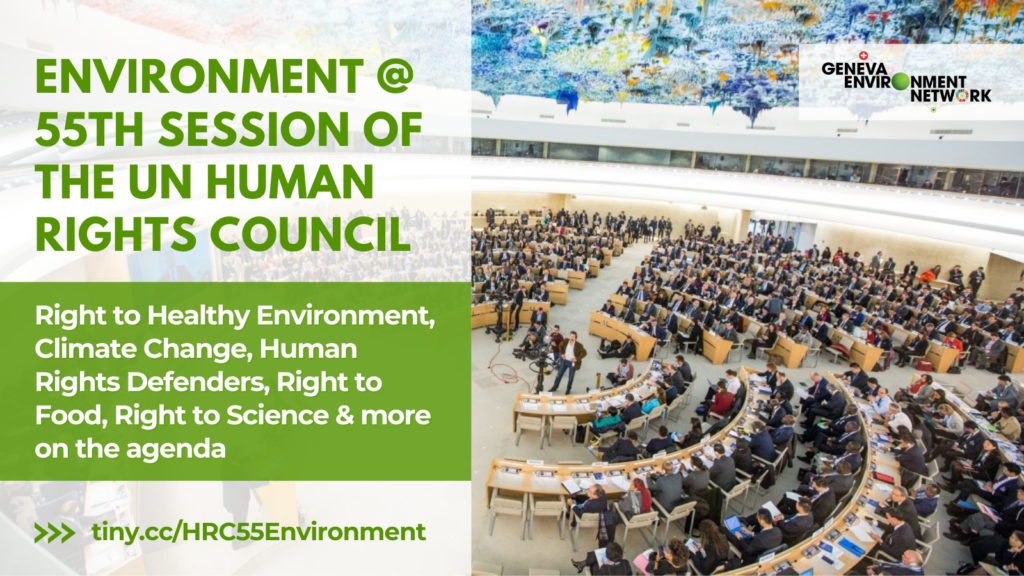
Photo Gallery


