Événement Exposition
Geneva Environment Network Stand @ World Resources Forum 2025

Welcome to the virtual stand hosted by the Geneva Environment Network at the World Resources Forum 2025. Here you will find resources to better understand the linkages between mineral resources governance and the environment, and the international cooperation on issues at this nexus.
About the World Resources Forum 2025
The 2025 World Resources Forum (WRF’25), organized in partnership with the Swiss Federal Office for the Environment, is taking place at Geneva International Conference Center (CICG) from 2-3 September 2025. Organized under the theme, « New Resource Strategies for a Fair and Sustainable Future », the Forum will focus on global challenges, including sustainable resource governance, circular economy transitions, and the role of critical minerals and metals in advancing a fairer and more sustainable future. The event will bring together a wide range of stakeholders—governments, industries, academia and civil society—to foster high-level discussions at the intersection of natural resources, finance, technology and socio-economic development. Key topics include: the extractive sector, construction sector, and consumer and industrial goods.
WRF25’s high-level programme features keynote speeches, panel debates, partner-led sessions and scientific sessions. Amongst others, international experts, policy-makers, businesses and scientists will discuss:
- The contested future of deep-sea mining in light of ecological risks and rising demand;
- The coexistence of supply security and sustainability in the trading of minerals and metals;
- The challenge of sustainable electronics amid rapid digitalization and mounting e-waste;
- The proposal for a binding treaty on energy transition minerals;
- Corporate due diligence in extractive and construction supply chains, and the relationship between mining companies and local communities.
Geneva Environment Network
The Geneva Environment Network (GEN) is a cooperative partnership of more than 100 environmental and sustainable development organizations based at the International Environment House in Geneva and at other locations in the surrounding region. They include United Nations offices and programmes, intergovernmental organizations, NGOs, local governmental authorities and academic institutions.
Established in 1999, GEN organizes and hosts meetings, roundtables, briefings and workshops promoting the dissemination of information and public awareness of environmental issues. In addition, GEN actively promotes increased cooperation and networking among its partners and develops a weekly newsletter highlighting the latest news, resources, events and job opportunities in the region. GEN provides a number of resources for both experts and the wider public on key thematic issues, including on health and the environment.
Mineral Resource Governance and the Environment
Minerals and metals play a central role in the global economy, as they provide the raw materials we need for industrial processes and daily use. Despite enormous efforts to decouple economies from resource use, the extraction of mineral resources has increased markedly in recent decades and, over the last decade, at a faster rate than economic growth. This trend is forecasted to steadily increase in the future, as we struggle to meet the mineral resource needs of a growing global population that is expected to reach 8.5 billion by 2030, 9.8 billion by 2050 and 11.2 billion by the end of the century.
The topic of sustainable management of minerals has never been so high on the global political environment agenda and the reason is that minerals are essential for the future. The energy transition, infrastructure and digitalization processes, among others, represent greener solutions. However, unsustainable extraction, manufacturing, use and disposal of resources is having important detrimental impacts on people and the planet. With an expected 500 per cent increase in the demand for minerals (from 2018 production levels), environmental challenges are going to be even more acute.
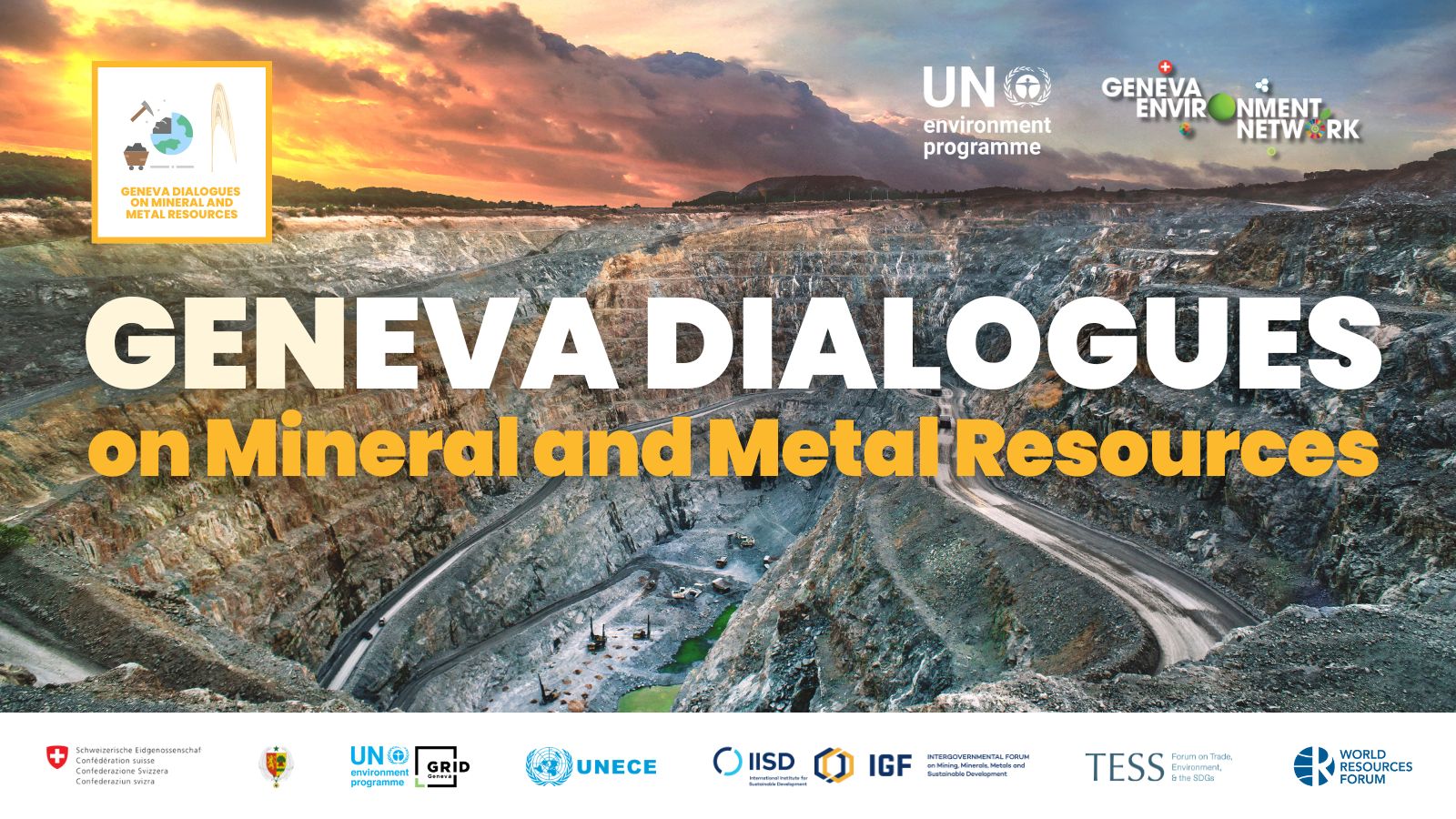
Geneva Dialogues on Mineral and Metal Resources
Minerals and metals play a central role in the global economy, as they provide the raw materials we need for industrial processes and daily use. Despite enormous efforts to decouple economies from resource use, the extraction of mineral resources has increased markedly in recent decades and, over the last decade, at a faster rate than economic growth. This trend is forecasted to steadily increase in the future, as we struggle to meet the mineral resource needs of a growing global population that is expected to reach 8.5 billion by 2030, 9.8 billion by 2050 and 11.2 billion by the end of the century.
The topic of sustainable management of minerals has never been so high on the global political environment agenda and the reason is that minerals are essential for the future. The energy transition, infrastructure and digitalization processes, among others, represent greener solutions. However, unsustainable extraction, manufacturing, use and disposal of resources is having important detrimental impacts on people and the planet. With an expected 500 per cent increase in the demand for minerals (from 2018 production levels), environmental challenges are going to be even more acute.
Key Actors for Resource Governance
Various actors in Geneva are engaged in ensuring enhanced action to support the environmental sustainability management of minerals and metals along their full lifecycle. As Geneva is at the center of numerous debates and negotiations in the fields of science, health, human rights, development, trade and green finance, employment, peacebuilding and security, disaster risk reduction, humanitarian response, nature conservation, chemicals and pollution, as well as new technologies and innovation, the dialogues can be a conducive platform to explore interlinkages between these topics and mineral and metal resources governance.

Aarhus Convention
The Aarhus Convention on access to information, public participation and access to justice in environmental matters, hosted by UN Economic Commission for Europe (UNECE), is also devoting a part of its work on the protection of environmental defenders. The Aarhus Convention grants the public broad and concrete rights of participation in decision-making and imposes obligations regarding access to information on parties and public authorities.

Basel, Rotterdam and Stockholm Conventions | BRS Conventions
The Basel Convention on the Control of Transboundary Movements of Hazardous Wastes and their Disposal since 2023 addresses e-waste issues. It categorizes e-waste as hazardous or non-hazardous and works to ensure its recovery, recycling and use as valuable source of secondary raw materials. In 2019, the Parties decided to establish a new partnership as a follow-up to Partnership for Action on Computing Equipment, launching Partnership for Action on Challenges relating to E-waste (PACE II) which addresses on mobile phones, computing equipment, TV screens including LEDs, LCD, CRTs screens, audio and video equipment and refrigerators, cooling and heating equipment.

Forum on Trade, Environment & the SDGs | TESS
The Forum on Trade, Environment & the SDGs (TESS) produces publications on the role of minerals to the development of a green economy, and organizes rountables and experts gatherings on the topic, notably the Trade in Minerals Critical for Climate Transitions and the Green Economy: Developing Country Perspectives and Pathways for International Cooperation Roundtable held on 12 July 2024 identified issues at the nexus of trade in critical minerals, climate action, and sustainable development, and to explore possible approaches and pathways for enhanced international cooperation.

Geneva Graduate Institute | IHEID
The Geneva Graduate Institute addresses resource governance through research and projects carried out by its multiple research centers. These include assessing resources from environmental, sustainability, anthropological, governance, conflict, and peace perspectives. The Geneva Graduate Institute also hosts important conferences as the May 2023 one on Deep Seabed Mining and the International Seabed Authority.

Geneva Platform for Resilient Value Chains | GPRVC
The Geneva Platform for Resilient Value Chains is a non-partisan, not-for-profit platform of excellence located within the Centre for Trade and Economic Integration at the Geneva Graduate Institute. Anchored in International Geneva’s spirit and in its trade, sustainability, mediation, and human rights expertise, the Platform focuses on supporting resilient and inclusive value chains that are vital to the energy transition and climate change: Solar PV, Wind, Critical Minerals, Batteries, Electric Vehicles, and Grids.

Green Growth Knowledge Partnership | GGKP
The Green Growth Knowledge Partnership advocates and supports green growth policies to reduce the negative impacts of the mining sector on ecosystems and landscapes, including pollution, dangerous waste and carbon emission; they are also critical for reducing the ecological footprint of these materials across their entire life-cycle, from extraction to final user, helping to promote the sustainable growth of the industry and the creation of new jobs.

Intergovernmental Forum on Mining, Minerals, Metals and Sustainable Development | IGF
The Intergovernmental Forum on Mining, Minerals, Metals and Sustainable Development (IGF) is a voluntary initiative that provides opportunities for national governments with an interest in mining to work collectively to advance the priorities identified in the Johannesburg Plan of Implementation and—more recently—the UN’s Sustainable Development Goals (SDGs) and Agenda 2030.

International Institute for Sustainable Development | IISD
The mining sector is one of the areas of focus for the International Institute for Sustainable Development (IISD). Since 2015, the institute has hosted the Secretariat to the Intergovernmental Forum on Mining, Minerals, Metals and Sustainable Development (IGF) with more than 75 member nations committed to leveraging mining for sustainable development to ensure that negative impacts are limited and financial benefits are shared (see above). IISD has also been deeply involved in the development of a Model Mining Development Agreement (MMDA) with the International Bar Association’s (IBA) Mining Law Committee.

International Labour Organization | ILO
ILO recognizes the need for further action and its strategy seeks in to further intensify dissemination of Convention 169, including by promoting dialogue among the key stakeholders, sharing experience of good practices and training. ILO also recognizes that indigenous and tribal women face discrimination on multiple grounds, both outside and within their communities. ILO will seek to develop interventions to address the specific barriers and challenges faced by them.

International Organization for Standardization | ISO
The International Organization for Standardization (ISO) is one of the largest organisation developing standards and is committed to improving resource efficiency and promote the development of a circular economy based on the optimal use of resources. ISO provides a series of voluntary standards for the mining sector. The ISO Technical Committee on mining provides expert insights for the standardization of various practices related to extractive activities, including for reducing the environmental impacts associated with the cessation of mining activities.

International Telecommunication Union | ITU
As part of its commitment to a sustainable future, ITU promotes the creation of a circular economy for electronics and greening digital transformation, and participates in various activities addressing the urgent global issue of E-waste.

International Union for Nature Conservation | IUCN
IUCN Natural Resource Governance Framework (NRGF) provides a robust, inclusive, and credible approach to assessing and strengthening natural resource governance, at multiple levels and in diverse contexts. It sets standards and guidance for decision-makers at all levels to make better and more just decisions on the use of natural resources and the distribution of nature’s benefits.
At the IUCN World Conservation Congress in Marseille (September 2021), IUCN Members adopted Resolution 122 to protect deep-ocean ecosystems and biodiversity through a moratorium on deep-sea mining unless and until a number of conditions are met.

Minamata Convention on Mercury
The Minamata Convention on Mercury is a global treaty to protect human health and the environment from the adverse effects of mercury, addressing the ubiquitous metal throughout its life cycle from its mining to its management as waste. From a ban on new mercury mines, the phase-out of existing ones, the phase-out and phase-down of mercury use in a number of products and processes, control measures on emissions to air and on releases to land and water, the Convention also addresses the regulation of the informal sector of artisanal and small-scale gold mining.

UN Environment Management Group | UN EMG
The UN EMG is a system-wide coordination body on environment and human settlements. It identifies issues on the international environmental agenda that warrant cooperation and finds ways of engaging its collective capacity in coherent management responses to those issues. Since 2020, UN EMG has hosted nexus dialogues on mineral resources and mineral resources governance to build on UNEA resolution and gather UN actors and beyond to collaborate towards implementation.

United Nations Economic Commission for Europe | UNECE
UNECE helps strengthen sustainable resource management in Europe with the key tools such as the United Nations Framework Classification for Resources (UNFC), the first widely accepted and internationally-harmonized system for classifying, managing and reporting natural resources, and the UN Resource Management System (UNRMS) — a dynamic resource management system for sustainable development that can aid stakeholders in the incorporation of a circular economy wherever possible.
UNECE Convention on the Transboundary Effects of Industrial Accidents
The UNECE Industrial Accidents Convention is a legal instrument that helps countries strengthen their tailings safety and governance. Many guidance and materials and tools have been developed under the framework of the Convention and they are available for use by all UN Member States: TMF safety guidelines and good practices to support the practical implementation of these safety guidelines; the TMF Safety Methodology that countries could apply on the ground; policy documents such as the Roadmap and a Decision on strengthening mine tailing safety; and an online toolkit and training on tailing safety.

United Nations Environment Programme | UNEP
The UN Environment Programme (UNEP) provides important work on issues of mineral resources governance. The UN Environment Assembly has been addressing the issue at its various assemblies, adopting resolutions to further international cooperation for sustainable resources management.
In Geneva, the UNEP Resources and Market Branch is striving to decouple economic development from resource use and environmental degradation, while reaping the benefits of this transition to ensure inclusiveness and poverty eradication. Geneva also hosts the UNEP Europe Office which develops projects in the pan-European region, including on green economy and resource efficiency.

UNEP/GRID-Geneva
UNEP/GRID-Geneva is leading the Global Marine Sand Watch, a platform to help countries and stakeholders monitor dredging activities in near real-time towards the goal of capacity building, development of guidelines and best practices for sand extraction. GRID-Geneva was mandated by UNEA to “strengthen scientific, technical and policy knowledge with regard to sand, to support global policies and action regarding its environmentally sound extraction and use” (UNEP/EA.5/Res.12).

UN Trade and Development | UNCTAD
UNCTAD‘s work on trade of critical minerals addresses current and projected trends in critical minerals’ demand and supply as well as social, economic, and environmental impacts of the exploitation of these minerals and offer policy recommendations to facilitate sustainable exploitation, enhanced trade diversification, and domestic resource mobilization for structural transformation to achieve the SDGs. UNCTAD has been active on the topic since 2009 with the Natural Resources Information Exchange (NRIE) initiative, which aimed to create a repository of digital information, focusing on geoscientific historical data. The initiative is currently being revamped to strengthen the capacity of countries to manage their wealth of data.

World Business Council for Sustainable Development | WBCSD
The World Business Council for Sustainable Development (WBCSD) brings together transformational organizations to form a global community that shifts the systems they work within towards a better future. One of WBCSD’s pathways Products & Materials undertakes a full lifecycle approach to help companies optimize resource use to meet society’s needs while allowing the systems that provide resources to regenerate.

World Intellectual Property Organization | WIPO
WIPO is the global forum for intellectual property (IP) services, policy, information and cooperation. WIPO published the report Global Challenges for Innovation in Mining Industries exploring relations between mining innovation and other macro-factors such as commodity prices, transport innovation and environmental policy.

World Economic Forum | WEF
The World Economic Forum (WEF) hosts various initiatives promoting the sustainable use of minerals and collaboration among actors. The Securing Minerals for the Energy Transition (SMET) initiative is a global multistakeholder platform for collaborative coordinated action in the space of critical minerals for the energy transition to facilitate policy dialogue, support investment mobilization, accelerate innovation WEF also provides strategic analysis, trends and research on the matter, including “Nature Positive: Role of the Mining and Metals Sector“, “Securing Minerals for the Energy Transition“, and “Perspectives on Responsible Natural Resource Management in Conflict-affected Countries”.

World Trade Organization | WTO
As the global international organization dealing with the rules of trade between nations, the WTO is concerned with the trade policies of mineral resources and materials, including the rights and obligations of WTO members in relation to its trade. The WTO also provides analyses and research on the matter, including on the trade in natural resources (including mining) in the World Trade Report 2010, and on energy-related critical minerals.

World Wildlife Fund for Nature | WWF
As the world’s leading conservation organization, WWF works in nearly 100 countries to tackle the most pressing issues at the intersection of nature, people, and climate. As resource extraction is often the cause of species decline and biodiversity loss, WWF works actively to stop harming extractive activities. In particular, WWF is campaigning against deep seabed mining, a lucrative activity which could cause irreversible damage on delicately balanced deep ocean ecosystems. → Read more

WWF Switzerland
WWF Switzerland seeks to commit stakeholders from the watch and jewellery industry to finding innovative solutions to protect the environment, in particular forests, fresh water and wildlife that are currently threatened in several points of the sector’s supply chain. WWF also provided an assessment of the impact of gold mining and the role of Switzerland as a global gold hub.
Other Key Actors for Resource Governance

International Resource Panel
The IRP was launched by the UN Environment Programme (UNEP) in 2007 to build and share the knowledge needed to improve our use of resources worldwide. The panel provides advice and connections between policymakers, industry and the community on ways to improve global and local resource management. It includes scientists and governments from both developed and developing regions, civil society, industrial and international organizations.

World Resources Fourm
The WRF is an international non-profit organisation which aims to mobilize action to promote sustainability and fairness in the global use of natural resources. Through various projects, mainly in the global South, its work focuses on resource extraction, circularity and recovery. WRF hosts a yearly multi-stakeholder conference to build knowledge and support for collaborative action on sustainable resources management. It acts as an interactive platform for sharing and discussing the latest research, policies and practices in the field. Several editions were held in Geneva.
Key Publications

UN Guidance for Action on Critical Energy Transition Minerals: A Document of the UN Secretary-General's Working Group on Transforming the Extractive Industries for Sustainable Development
UN Secretary-General’s Working Group on Transforming the Extractive Industries for Sustainable Development under the leadership of UNEP | June 2025

Monitoring mercury in and around artisanal and small-scale gold mining sites
Minamata Convention | January 2025


Resourcing the energy transition: principles to guide critical energy transition minerals towards equity and justice
UN Secretary-General’s Panel on Critical Energy Transition Minerals | September 2024

Digital Economy Report 2024
UN Trade and Development | July 2024

Global Resources Outlook 2024
UNEP | March 2024

United Nations Resource Management System (UNRMS)
UNECE | 2022

Sand and Sustainability: 10 Strategic Recommendations to Avert a Crisis
UNEP/GRID Geneva | 2022


Guidance Document: Developing a National Action Plan to Reduce and, Where Feasible, Eliminate Mercury Use in Artisanal and Small-Scale Gold Mining
UNEP, Global Mercury Partnership, Minamata Convention on Mercury | 2019
