
Événement Conférence
Chemicals and Waste Negotiations Briefing 2024

11 Juin 2024
10:00 – 12:00
Lieu: International Environment House I, Room 3 & Online | Webex
Organisation: Geneva Environment Network, Branche produits chimiques et déchets du PNUE, Conventions de Bâle, Rotterdam et Stockholm, Convention de Minamata sur le Mercure
This briefing, organized within the framework of the Geneva Environment Network, provided an overview of the status of the negotiations related to chemicals and waste and upcoming important conferences.
About this Event
This Chemicals and Waste Negotiations briefing, organized within the framework of the Geneva Environment Network, provided an overview of the work and key activities to advance the sound management of chemicals and waste globally. It reviewed the outcomes of the negotiations related to chemicals and waste that took place in 2023 and in early 2024, and presented the latest information on the important conferences scheduled in 2024, as well as a follow-up on resolutions adopted at the UN Environment Assembly.
The event also presented the new Global Framework on Chemicals, adopted by the 5th International Conference on Chemicals Management in Bonn in 2023, which provides a vision for a planet free of harm from chemicals and waste, for a safe, healthy and sustainable future – where industry and private sectors are strategic actors to foster innovation, move towards sustainable business models and drive change.
In 2024 and 2025, major upcoming negotiations on chemicals and waste include:
- 3rd Session of the Open-Ended Working Group (OEWG 3) of the Science-Policy Panel to contribute further to the sound management of chemicals and waste and to prevent pollution | Geneva, 17-21 June 2024 [dedicated briefing on 6 June]
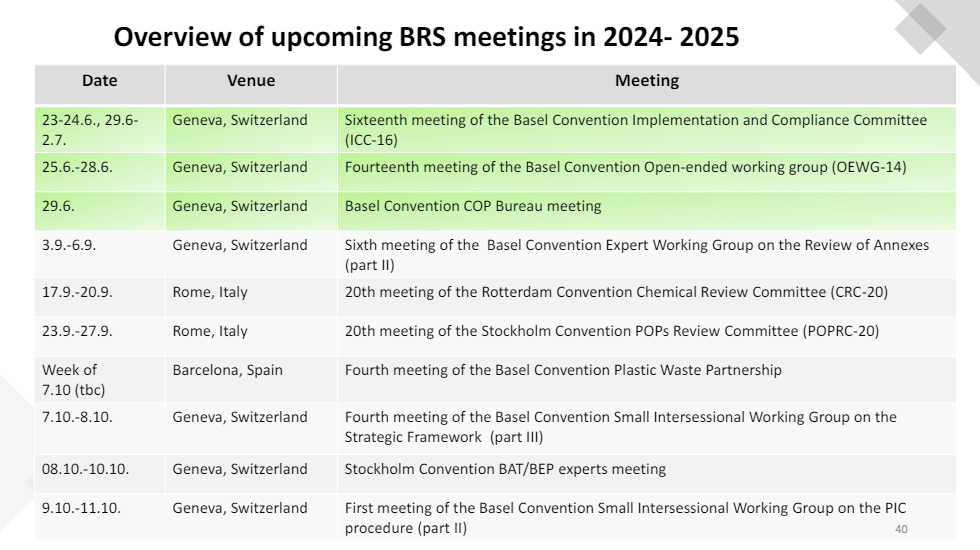
- 14th meeting of the Open-Ended Working Group of the Basel Convention (OEWG-14) | Geneva, 24 – 28 June 2024
- Plastic Pollution INC Ad Hoc Intersessional Open-ended Expert Groups in-person meeting | Bangkok, Thailand, 24 – 28 August 2024
- 20th meeting Chemical Review Committee (CRC.20) of the Rotterdam Convention | Rome, Italy, 17 – 20 September 2024
- 20th meeting of the Persistent Organic Pollutants Review Committee (POPRC.20) of the Stockholm Convention | Rome, Italy, 23 – 27 September 2024
- UN General Assembly High-Level Meeting on antimicrobial resistance 2024 | New York, 26 September 2024
- 4th Global High-Level Ministerial Meeting on Antimicrobial Resistance | Riyadh, Saudi Arabia, 4 – 5 November 2024
- 5th Session of the Intergovernmental Negotiating Committee to develop an international legally binding instrument on plastic pollution (INC-5) | Busan, Republic of Korea, 25 November – 1 December 2024 [dedicated briefings to follow]
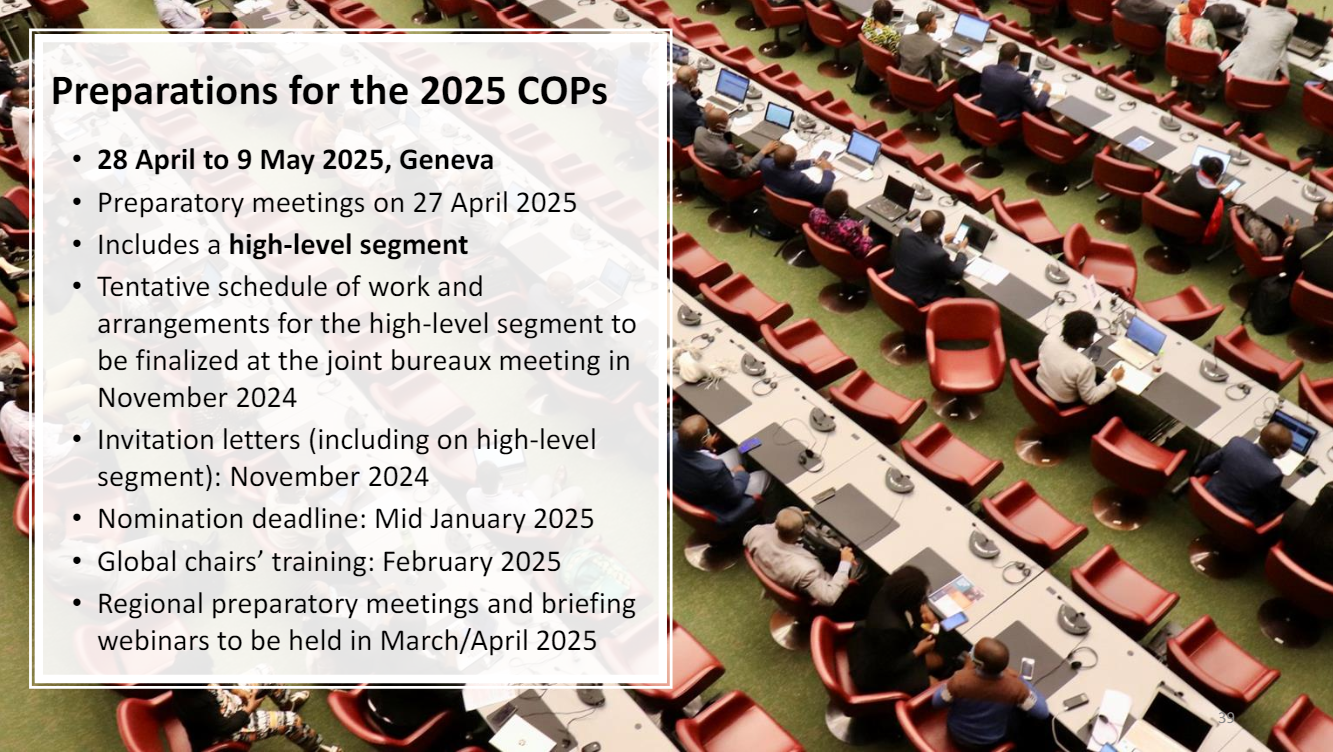
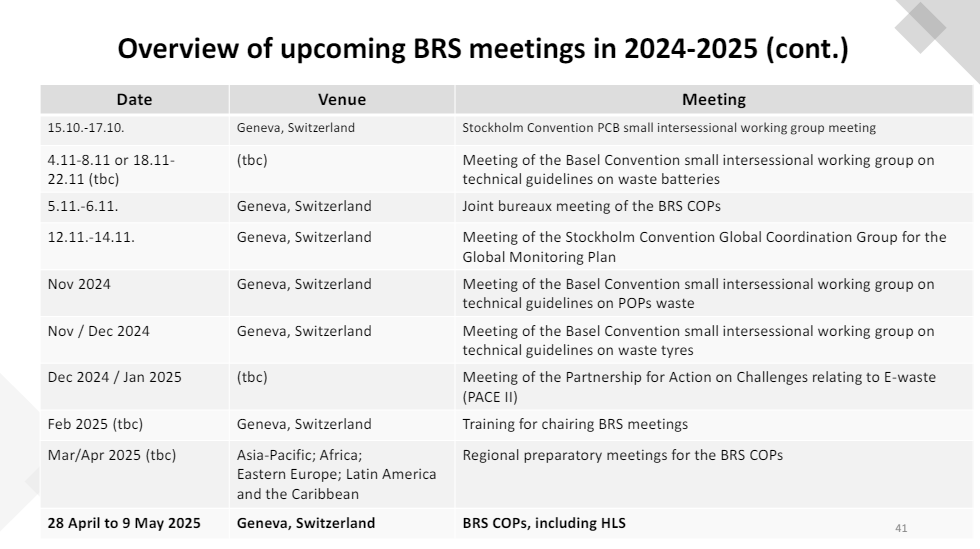
- 2025 Meetings of the conferences of the Parties to the Basel, Rotterdam and Stockholm Conventions | Geneva, 28 April – 9 May 2025
- 6th Meeting of the Conference of the Parties to the Minamata Convention | Geneva, 3-7 November 2025
Speakers
By order of intervention.

Océane DAYER
Waste and Chemicals Focal Point, Federal Office for the Environment, Switzerland

Jacqueline ALVAREZ
Chief, Chemicals and Health Branch, UNEP | Moderator

David OGDEN
Deputy Executive Secretary, Basel, Rotterdam and Stockholm Conventions

Kay WILLIAMS
Head, Global Framework on Chemicals

Juliette KOHLER
Senior Legal Officer and Chief OiC, Governance Branch, Basel, Rotterdam and Stockholm Conventions

Susan WINGFIELD
Programme Officer, Legal and Policy Unit, Basel, Rotterdam and Stockholm Conventions

Marianne BAILEY
Senior Coordination Officer, Minamata Convention on Mercury

Ludovic BERNAUDAT
Head, Knowledge and Risk Unit, Chemicals and Health Branch, UNEP
Highlights
Summary
Opening Remarks
Océane DAYER | Switzerland
- 2023 was a busy year for chemicals and waste negotiations, culminating in September with the adoption of the global framework on chemicals. This new framework, as a successor to the Strategic Approach to International Chemicals Management (SAICM) will play a decisive role for the sound management of chemicals and waste globally.
- 2024 is no different, with key milestones around the establishment of a science-policy panel on chemicals and the new legally binding instrument on plastic pollution.
- We also are working for important preparations for the Basel, Rotterdam and Stockholm Conventions COPs, as well as the Minamata COP which will all happen next year in 2025. Preparatory exchanges will also take place this year.
- The international chemicals and waste governance is a fantastic toolbox. Some instruments are being forged, some perationalized and others are having their first stones to be laid. All play a crucial role in building a home where chemicals and waste are managed soundly.
- We should all take care of our toolbox and continue to oil it regularly. Those briefings are important for us to all have the information, the knowledge and the expertise sharing to take care of this toolbox.
Welcome and Introduction
David OGDEN | Basel, Rotterdam and Stockholm Conventions
- Collective efforts in addressing pressing issues related to the management of chemicals and waste are ever more evident.
- The BRS Secretariat has a full calendar of meetings scheduled for 2024 and 2025, June being a particularly busy month with the intersection of:
- the third session of the open-ended working group on the science-policy panel (OEWG 3),
- the 16th meeting of the Basel convention implementation and compliance committee;
- the 14th meeting of the open-ended working group of the Basel Convention;
- the annual meeting of the directors of the Basel and Stockholm Convention regional centers;and
- the Basel Convention COP Bureau meeting.
- In September we will have annual meetings of the Chemicals Review Committee under the Rotterdam Convention and the POPs Review Committee under the Stockholm Convention, which are the key meetings for proposing chemicals to be added to those conventions.
- While other processes and meetings will also be taking place in the upcoming months, these will feed into the subsidiary body meetings and into the next meeting of the conference of the parties of the BRS Conventions which will take place from 28 April to 9 May 2025.
- I would like to offer my profound thanks to the donors of the upcoming meetings: the European Union and the governments of France, Finland, Germany, Japan, Norway and Switzerland. Their generous support for the travel of participants to these meetings has ensured that 120 developing country delegates and other parties with economies in transition receive support to attend these meetings. This inclusivity is vital for the success of our deliberations and the effective implementation of the conventions.
- We look forward to your active engagement in today’s discussions. These are opportunities to meet with representatives of the permanent missions here in Geneva, and to not only keep us informed of the busy calendar particularly as it relates to chemicals and waste but also the broader context within which our work continues.
Global Framework on Chemicals
Kay WILLIAMS | Global Framework on Chemicals
- The Global Framework on Chemicals was negotiated for many years until an agreement on three aspects of the framework was finally agreed in September 2023.
- A framework text that will hopefully mobilize different actors for the safe and sustainable management of chemicals globally.
- A political declaration – the Bonn Declaration – which allowed us to raise the profile of pollution to make it as visible as biodiversity and climate change.
- A Chemicals Fund in which the German government very kindly put a substantial donation and which we are currently trying to put into operation.
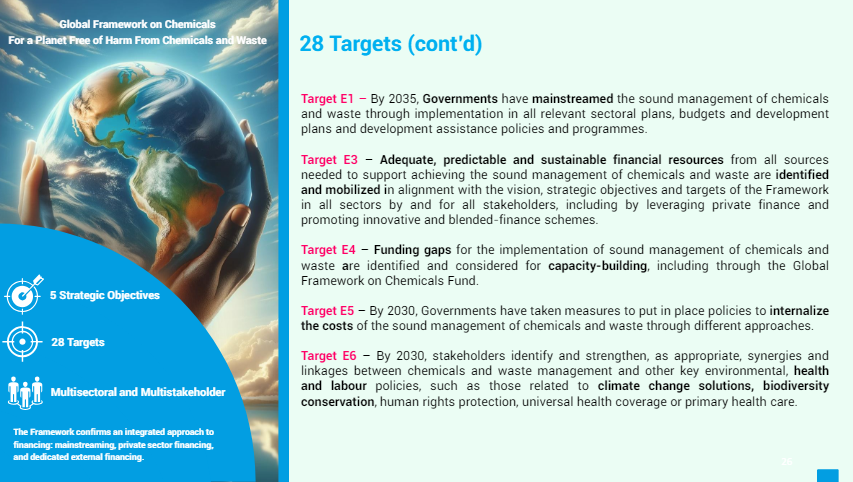
- The framework contains five strategic objectives and 20 targets that we must achieve.
- This framework is voluntary but also multi-stakeholder and multi-sectoral, which allows it to mobilize many different actors.
- We are working closely with international organizations including the World Health Organization, the Food and Agriculture Organization and the International Labor Organization. These are important in being able to implement the framework.
- Our vision for the framework is a planet free of harm from chemicals and waste, to create this safe, healthy and sustainable future. The framework has a very broad scope as chemicals are everywhere. They’re essential to 21st-century living, and we need to manage them so that we can reduce any exposures to those that are averse to our health or the environment.
Strategic Objectives of the GFC:
- Strengthening the Legal Frameworks’ institutional mechanisms and capacities. Being multi-stakeholder, we need to look at the legal businesses frameworks. It will help create sustainable and safer chemicals, as well as try to encourage incentives for innovation and to mobilize greater transparency in the private sector.
- Data and information are key. There are opportunities in this objective to be able to see how we can make data more transparent, and use new technologies such as artificial intelligence to use data more effectively and enhance decision-making.
- Assess how the Global Framework of Chemicals can interface with science-policy panels, to be able to identify, prioritize, and eventually address global issues.
- Ensuring that we have safe alternatives and sustainable solutions across the value chain. This is a stronger emphasis on how we need to work with different types of stakeholders, moving with the chemical industry but also down the supply chain, to work with retailers and those involved in using chemicals in products.
- Enhancing implementation is also important. We need to look at how we can ensure greater responsibility for actors using chemicals and putting them on the market, but also at how we can deliver through partnerships, cooperation and capacity building.
- The GFC comprises 28 targets, some are very specific, some more generic.

Juliette KOHLER | Basel, Rotterdam and Stockholm Conventions
- The 16th meeting of the Basel Convention COP, the 11th meeting of the Rotterdam COP and the 11th meeting of the Stockholm COP took place in May 2023.
- Fifty-two decisions were adopted, including eight joint decisions.
- Among follow-up calls for information one was a call for information on technical assistance needs, which still accepts submissions from parties on their technical assistant needs, and one call for information on enhancing the effectiveness of the Rotterdam convention, which deadline is 30 June 2024.
- Since May 2023 we have dived into the intersessional work mandated by the COPs. This includes supporting a range of bodies under the conventions, initiating preparations of reports and other documents that would feed into the next COPs in 2025. We have followed up on our mandates to deliver on International cooperation activities, for instance through participation in UNEA, the negotiations on the INC on plastic pollution, the SPP, the Minamata Convention or the Montreal Protocol. We have also been delivering on our technical assistance mandates and supporting the work of the partnerships, which are platforms under the Basel convention to bring together non-state actors.
Basel Convention
- The Implmentation and Compliance Committee (ICC) assists parties to comply with their obligations under the convention. It facilitates, promotes, monitors and aims to secure implementation and compliance.
- The 16th meeting of the committee will start on the 24 June 2024 with dialogues with a range of actors (Regional Centers, representatives of the UN system, etc.).
- The second part of the meeting will take place from the 29 June to 2 July. The committee, in addition to the dialogues, will consider 13 specific submissions concerning individual parties and then review a range of general issues of compliance and implementation : classification of compliance performance with national reporting, scoping report on illegal traffic, Parties’ legislative implementation of the convention, guidance on how to integrate implementation needs in cooperation frameworks, enhanced cooperation with the compliance committee of the Rotterdam convention.
Rotterdam Convention
- The Chemical Review Committee (CRC) aims at reviewing chemicals and pesticide formulations according to criteria. Its mandate is to make recommendations to the COP, for possible listing in Annex 3 to the Convention.
- The 20th meeting will be held in September in Rome. The CRC is expected to finalize the draft decision guidance documents on chlorpyrifos and mercury. These two chemicals would then be considered for listing by COP12, along with eight other returning chemicals. CRC is also to review notifications of final regulatory actions for 19 chemicals and four proposals for SHPFs.
- The compliance committe is the other standing subsidiary body under the Rotterdam Convention, which has a similar mandate to that of the Basel Convention, to assist individual parties in resolving their compliance difficulties and to review general or systemic issues of compliance.
- The second meeting of the committee took place in March in Rome. The committee adopted eight decisions: one on specific submission and the others on systemic issues of General compliance.
- The Secretariat, on behalf of the committee, will be reaching out to parties shortly with some calls for information. Several webinars, the second of which will take place on June 13, present the outcomes of the meeting. The meeting was suspended on the 21 March and will resume this fall, to continue the work of the committee and prepare additional recommendations for consideration by the COP.
Stockholm Convention
- The POPRC (Persistent Organic Pollutants Review Committee) reviews chemicals proposed for listing in annexes A, B or C to the Convention. It also carries out other tasks as mandated by the COP.
- POPRC-20 (the 20th meeting of the committee) will be held on 23-27 September in Rome, back-to-back with CRC 20. Its objectives are :
- Specify the chemical identity of long-chain perfluorocarboxylicacids, their salts and related compounds (PFCAs) and medium-chain chlorinated paraffins(MCCPs) and to further strengthen the recommendations for their listing in Annex A with specific exemptions at COPs 2025;
- Review the draft risk management evaluation for chlorpyrifos;
- Consider a proposal to list polyhalogenated dibenzo-p dioxins and dibenzofurans in Annex C;
- Discuss activities undertaken on POPs in stockpiles, products and articles in use and in wastes; and
- Review progress made by Parties towards eliminating brominated diphenyl ethers.
Preparations for the 2025 BRS COPs
Basel OEWG-14
Susan WINGFIELD | Basel, Rotterdam and Stockholm Conventions
- For OEWG14, we currently have 369 delegates registered from 130 parties and 52 observer entities.
- The meeting takes place back-to-back with the other BRS meetings:
o 21-22 June: Annual joint meeting of BC-SC Regional Centres
o 23-24 June: Sixteenth meeting of the Basel Convention Implementation and Compliance Committee (ICC-16) (part I)
o 29 June: Basel Convention COP Bureau meeting
o 29 June -2 July: Sixteenth meeting of the Basel Convention Implementation and Compliance Committee (ICC-16) (part II)
Schedule
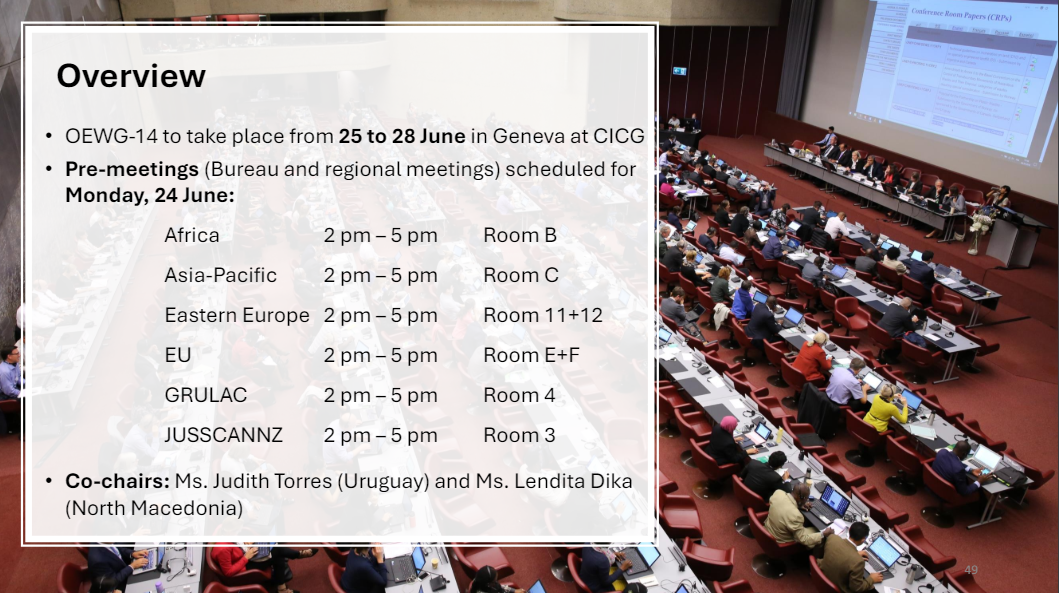
- During the first day and a half of the meeting, we will be in plenary session where the items to be further discussed in contact groups will be introduced. They include:
- strategic matters (discussion of a new strategic framework for the convention, the work to improve the PRI inform consent procedure). On the technical side, many technical guidelines under development will be discussed and progressed during the meeting, as well as discussion on plastic waste (what further activities could be recommended to COP?), discussion of national reporting, etc. Finally, we will discuss legal matters including work on the review of the annexes to the convention, work of the implementation and compliance committee and discussion of partnerships.
- Later, there will be work progressing in three contact groups: Strategic, Technical and Legal contact groups. No more than two contact groups will run in parallel.
- We will meet back in the plenary session on tFriday, when oral reports will be given of remaining agenda items, the contact groups will report back, and the outcomes will be agreed for the meeting in the form of a draft decision adoption.
Expected outcomes
- This meeting is a midpoint review, a time at which intersessional groups will be able to report to OEWG which will be able to consider and provide advice for moving forward.
- We hope to have the work progressed for these Strategic, Technical and Legal matters, to prepare for the COP next year. Work will be continued in intersessions after OEWG14, aided by calls for information coming out of OEWG to provide more information to the groups.
Preparations for the meeting
Tentative schedule and scenario note for the meeting are online.
- Suggested basis for OEWG-14 work are documents INF/1 and INF/2: the scenario note and tentative schedule for the meeting.
- OEWG-14 documents are available on the website of the meeting: basel.int/OEWG.14.
- Additional information is also available on side events schedule, logistics note, and greening the meeting.
- Briefing webinars on 12 June (AM and PM)
Minamata Convention on Mercury
Marianne BAILEY | Minamata Convention on Mercury
Minamata COP5 Outcomes
- At Minamata COP5, held in Geneva in November 2023, 21 decisions were adopted.
- Stakeholder engagement in the Minamata Convention is always very high, including through the UNEP Global Mercury Partnership. We keep striving for even more robust engagement of stakeholders in the implementation of work, in particular Indigenous Peoples, as well as local communities, youth and women.
- The first decision reached at COP5 was on Indigenous Peoples and the effects of mercury pollution, recognizing that Indigenous Peoples, as well as local communities, are particularly vulnerable to mercury exposure and they’re also among the first to face the serious health and environmental effects that result because of their close relationship with the environment and the resources. They are also essential for the sound implementation and full implementation of the Minamata convention and the SDG. They are key to the solution, so we were very pleased that this was a highlight of our COP5.
- There will be an invitation from the Secretariat to Indigenous Peoples as well as local communities to provide views on their needs and priorities regarding the effect of mercury on their health, livelihoods, culture and knowledge, a view to future work on identifying possible solutions. Separately, there would also be further work on the engagement of Indigenous Peoples as well as local communities in the work on artisanal and small-scale gold mining and in the national action plans that select parties submit to us on ASGM. That supplemental guidance will be available for consideration by COP6.
- Another highlight from COP5 which will be carried through in our intersessional work and into COP6 and beyond, is the connection between mercury and the Kunming-Montreal Global Biodiversity Framework. They can be implemented in a mutually supportive manner to generate co-benefits and lift them both up in terms of implementation. The decision taken by Minamata COP encourages parties, through their operational focal point of the global environment facility, to integrate mercury action into projects developed under the biodiversity focal area and throughout the eighth and ninth replenishment of the GEF (Global Environment Facility) trust fund. Parties are invited to coordinate, through their experts’ input, to the CBD COP, and other intercessional processes under the CBD, to facilitate the consideration of additional indicators in the monitoring framework of the Kunming-Montreal Global biodiversity framework and especially under Target 7 on highly hazardous chemicals and mercury.
- We are also going to be compiling views and experiences from parties and other stakeholders to prepare a road map on this mutually supportive implementation. We are working closely within the chemicals and waste family of Conventions.
Highlights from intersessional work
- COP5 agreed on amendments to Annexes A and B on mercury-added products and industrial processes using mercury, and those amendments will enter into force on 25 April 2025, for parties that have not opted out and do not need to opt in.
- These amendments are notable because they show the Convention is a living instrument that considers new information, new data, and new abilities of our parties to take on and expand their obligation. Several product categories which were already partially phased out will be completely phased out. It completes by 2025 the phase-out of all types of batteries, all switches and release, all fluorescent lamps, in addition to those that phased out in 2020. It was also notable in terms of mercury content in cosmetics, with a zero threshold (no mercury intentionally added to cosmetics) rather than the previous threshold of one part per million. It also contains measures on dental amalgam.
- New measures on two industrial processes: polyurethane in mercury-containing catalysts to be phased out by 2025 completely and some additional details in the Annex B picture.
- The Effectiveness Evaluation Group has been established by decision at COP5 and will meet on 25 June 2024 for its first meeting. It has 25 members nominated by regions and representing all five regions.
- Our implementation and compliance committee will also be meeting. We have a heavy intersessional work with a set of reports that will be focusing on issues which will be taken up at both COP 6 and 7. They will benefit from submissions from parties and other stakeholders

- On implementation, we have launched our fourth round of applications to the specific international program and the round of applications to the special program. We are trying to steer potential applicants to the most appropriate fund for them to benefit from.
- Aside from this first part of our financial mechanism, the Global Environment Facility (GEF) provides a very healthy allocation (GEF8) for the Minamata Convention. The GEF8 period being already half over, we are trying to remind parties to work with GEF agencies to develop strong projects, to use that allocation fully.
- UNEA 6 resolution on the sound management of chemicals and waste talks about the cooperation that we are to do with the related funds, which we are happy to be engaged in.
- Tools and training materials are available to support implementation by our parties and other stakeholders, some of which are in process or have just been launched; the Minamata tools platform on UNSSC and the training materials on mercury-added products and waste and training for customs and trade officials on the World Customs Organization platform will be coming soon. There is also the InforMEA training platform that includes a mercury introductory module as well as a mercury and gender module and a UNITAR Mercury training platform.
UNEP Chemicals and Health
Ludovic BERNAUDAT | UNEP Chemicals and Health Branch
Supporting MEAs
- In support of the implementation of MEAs, especially chemicals agreements, UNEP has been working with support from the GEF with 74 countries to work within the context of these conventions to develop their national implementation plans (NIP) and their subsequent updates. It demands constant updates for countries’ NIPs.
- Together with BRS, UNEP has been working closely in developing a toolkit allowing us to digitalize this information and thereby make it more broadly available, but also allowing future updates in an easier manner.
- Regarding the Minamata Convention, UNEP has worked directly with 67 countries for Minamata initial assessments. These are important projects because they allow Parties to the Convention to identify the priorities in implementing the Convention (32 countries for the development of their national action plan focused on the use of mercury in artisanal and small-scale gold mining).
- The Chemicals and Health Branch hosts the global mercury partnership. UNEP has been involved in the implementation of the Minamata Convention and working on the Planet Gold Program and working with WHO on the use of mercury in skin-lightening products as well as medical devices such as measuring devices and dental amalgam.
- With the Stockholm Convention, UNEP has also been implementing projects that are addressing chemicals by chemicals, issues such as DDT and PCB, but also more recently going through a sectoral approach to the management of POPs in products and other chemicals, and we are implementing a global project of the GEF integrated program on removing hazardous chemicals from the fashion and the construction value chains.
- UNEP is also working on the sound management of lead acid battery waste with the Basel Convention Secretariat in several countries.
- The Knowledge and Risk Unit within the Chemicals and Health branch generates lot of data used by the Convention and the Parties to these conventions. Of note is the global monitoring plan projects, supported by the GEF. The current series of projects is ending, and it is a good time for us to take stock of what we have achieved. We have worked with 42 countries to generate information on 30 POPs. More POPs have been added since then, and we will have to work on measuring these new POPs.
- UNEP is working with training laboratories in regions and ensuring quality through interlaboratory assessments. UNEP has worked with WHO to collect 20 years of human milk data covering 80 countries. A lot of information provided on the POPs coming from developing countries have been produced by this project for the work of the effectiveness evaluation of the Convention. We have designed a new series of projects that will be more focused on providing regional support to laboratories so that a lot of this work can be led from the regions in a sense of capacity building. In this new project, we also include some aspects of mercury monitoring, together with the Minamata Convention Secretariat. It has been submitted for this work program at the GEF, and we will start within the next year.
Follow-up on past UNEA’s resolutions
- UNEA 3 included a resolution on the work on lead paint management. We are hosting with WHO the Global Alliance to Eliminate Lead in Paint, and this is a big success, with 94 countries that have passed legislation to regulate it. We are working with the private sector in these projects and at the World Economic Forum Davos meeting this year, US Aid has made some declarations on furthering the work on lead. Together with USCPA, the intention is to have a partnership including countries, private sector and actors of the lead work that will largely be based on what we have done and the successes of the Global Alliance to eliminate lead paint.
- UNEA 5 Resolution 5/7. Most of what was asked of UNEP in this resolution has been achieved. We have submitted a report on the management of asbestos and its waste before UNEA 6 and published a summary of views from the stakeholders on issues of concern. With support from the European Commission, WHO and OECD, we are currently working on updating a report on Endocrine Disrupting Chemicals.
- 19 issues of concern were identified in a combination of the work of the Global Chemical Outlook and SAICM. Working chemicals by chemicals or issue by issues will not achieve the results that we need to achieve in terms of chemicals and waste management in the limited time that we have. It was therefore suggested to work by group or characteristics of issues. For pesticides, some are picked up by the Global Framework on Chemicals, others not. For chemicals in products, it is important to work on value chain life cycle analysis, to make sure that the use of chemicals in products is needed and to ensure the recyclability of the product at the end of its life. The environmentally persistent pharmaceuticals are a big issue, closely linked to the antimicrobial resistance issue.
- The issue of metals and metalloids has been picked up at UNEA 6. We need a holistic and coordinated approach to manage these 19 issues correctly and in a timely manner.
- UNEA 6 Resolutions 6/9: We will continue with IOMC the work started with the adoption of the Global Framework on Chemicals. This follows two lines of work:
- the development of implementation programs which IOMC is leading together with other stakeholders to ensure that the framework is implemented in a timely manner and that the targets are achieved ;
- working on the measurability structure from the framework because the targets need identified and agreed indicators, to measure success and report on these targets which have timelines of 2030 or 2035.
- In this resolution, we also develop options to address lead, cadmium, arsenic and organotin issues identified in the issues of concerns report. We plan to develop a report on these measures to help countries make the right decisions.
- UNEA 6 Resolution 6/11: supported by IPEN and the Africa group on the highly hazardous pesticides. We work closely with ILO, FAO and WHO to operationalize the Global Alliance on highly hazardous pesticides, in the context of the framework and to initiate actions under this Alliance.
Antimicrobial resistance
- AMR is a very political issue this year with the high-level segment negotiations of text at the UN General Assembly in September. We are collaborate with UNEP New York office and organizations to make sure that the urgent action needed to work on AMR is taken on board by member states.
- This is an important milestone, as it is the first time that such work is being done at the General Assembly since UNEP joined the tripartite partnership on AMR (quadripartite now). UNEP is fully involved with this work and this meeting is our chance to bring forward the environmental dimensions of AMR, as a lot of these issues are being created in the environment, resulting from agriculture and pharmaceutical uncontrolled releases of wastewater.
- We need to bring forward the environmental dimensions and we are working closely with member states on making sure the Declaration takes this into account.
Q&A
Q: How are the different secretariats that took the floor today contributing to the ad hoc open-ended working group on the science-policy panel to contribute further to the sound management of chemicals and waste and to prevent pollution?
Kay WILLIAMS: The negotiations for the science-policy panel began in the SAICM community when we were starting to look at what the interface might look like. Then, those negotiations were taken forward at an intergovernmental level. I think it is really important that our community look at the negotiations closely, see how they’re developing and also understand how the Global Framework on Chemicals can make sure that that independent body is supporting us in the implementation of our work.
David OGDEN: On a practical level, we are providing a staff person to help out with the meeting next week. On the bigger science-policy interface level, we have the POPs Review Committee, which really looks at the science and then proposes recommendations for the COP. The Rotterdam Convention also has a Chemicals Review Committee, which has similar work. There is also a lot of scientific work under the Basel convention.
For example, the 2023 BRS COPs welcomed the cooperation already there under the agenda item on international cooperation. Parties also recognize the importance in participating in these meetings from BRS focal points, and from the community of Basel, Rotterdam and Stockholm conventions, as the science-policy panel could benefit the work of the Conventions. In terms of cooperation, BRS has a longstanding scientific and technical committee, and we have been providing information and sharing experiences, for example how we are treating confidential business information or the procedure for conflict of interest been treated under the POPs Review Committee and other technical bodies.
Marianne BAILEY: For the Minamata Convention, we follow the work of the SPP discussions closely, and we would participate as observers in the meeting. Similarly to BRS, we provide input as requested or as appropriate on what our needs are, with respect to what a science-policy panel could do. We do that in very close relationship with our ongoing processes that bring to the forefront data science and information, including work that has been keyed up for example for amending our annexes on mercury-added products, or on the relationship between mercury and biodiversity, and particularly our work on effectiveness evaluation. We want to make sure that these processes, going forward, will be very complimentary.
Jacqueline ALVAREZ: Next week will be pivotal, as final negotiations on the foundational document will happen. Next February, the intergovernmental meeting will take place and member states Governments will adopt the conditions and the way to work.
Q: When is the first round of applications for the fund expected to happen?
Q: How do you think the GFC Secretariat will be able to support this upcoming chemicals and waste negotiations?
Kay WILLIAMS: In terms of the fund, this has been one of our priorities moving forward. This week, we have an executive board meeting of the global framework on chemicals fund, at which we aim to finalize the scope of the fund, the types of projects that we wish to be funding and some of the documentation that we will need to be launching the first round of applications. With that in mind we aim to have the first round open in October of this year, with the window being around four months (closing in January), and then we hope to conclude and gain approval by the Executive Board of projects around March. It is an ambitious timetable, but we really hope that we’ll be able to progress that, and we are looking forward to getting some of the money out of the door and to supporting the developing countries and others that need to have this funding.
In terms of working with the other MEAs, it is critical that we work with them as they are integral and delivering towards many of our targets. I understand that there is an internal task force that brings the secretariats together, and we will be using that at the Forum by which we will be letting each other know in little more detail how we can support each other and recognize the deliverables that we’re contributing to each other’s work.
Q: Can UNEP or the GFC Secretariat identify who at IOMC and/or UNEP is the main focal point for implementation programs, and how stakeholders can engage? And who, at FAO and UNEP, is the main focal point for the establishment of the Global Alliance on HHPS?
Ludovic BERNAUDAT: The work on the implementation program is the work of IOMC as a whole. We do work under the current chairman of the IOMC, the World Bank, but all organizations have identified an interest in leading or being part of the work on the various sectors we will work. There will be a briefing in early July to stakeholders, so more information will be available then. We call on all the interested stakeholders to work with the IOMC organizations in the various work streams. For the HHP alliance, the focal point for UNEP it would be me.
Kay WILLIAMS: On the Global Alliance on HHP, there are a number of non-governmental organizations that are very keen to progress that work, and I think it will be critical to get that off the ground, to make sure that we are getting some delivery and action in that space.
As for the implementation programs, the Global Framework is working as the Secretariat and UNEP is acting as its interested party, as part of the IOMC. There is a split in our responsibilities here. It will be incredibly important, when we implement these programs, to have all stakeholders engaged and around the table and that there’s a degree of governance over those programs. We certainly are engaged with the project, and we need to make sure that we can have good structures in place and that we know and understand what is happening across what is potentially a complicated program to put in place.
Jacqueline ALVAREZ: UNEP’s member states adopted two resolutions: the one on chemicals in general and they requested the executive director to put an eye on the implementation of the framework, not only providing the Secretariat but also working towards the different objectives and targets of the framework. There is also a specific request on the HHP, which is for UNEP to be involved. In this case, because of the ICCM resolution, FAO is taking the lead, which doesn’t mean that we are not working together with the BRS Secretariat. There is a huge amount of chemicals listed under the annexes of the BRS conventions which are HHPs and need to be addressed correctly. Mercury luckily is no longer usable as a pesticide.
Video
Photo Gallery


Documents
Links
- Geneva addressing Hazardous Substances | GEN
- International Environmental Negotiations Agenda | GEN
- Road to OEWG 3 | Science-Policy Panel to Contribute Further to the Sound Management of Chemicals and Waste and to Prevent Pollution | GEN
- Collection of technical assistance needs (deadline 31 May 2024)
- Information collection on enhancing the effectiveness of the Rotterdam Convention ( deadline 30 June 2024)
- Intersessional work and Submissions for Minamata COP-6
- Call for expression of interest to participate in the update of the EDCs State of the Science Report (deadline 28 June 2024)
- UNEA Resolution 6/9 (UNEP/EA.6/Res.9) on Sound management of chemicals and waste
- UNEA resolution 6/11 (UNEP/EA.6/Res.11) on Highly hazardous pesticides
- Global Framework on Chemicals for a Planet Free of Harm from Chemicals and Waste