
Événement Conférence
Briefing on the Seventy-Eighth Meeting of CITES Standing Committee | CITES SC78

28 Jan 2025
10:00 – 12:00
Lieu: International Environment House II
Organisation: Convention sur le commerce international des espèces de faune et de flore sauvages menacées d'extinction, Geneva Environment Network
This briefing focused on the preparations of the upcoming 78th meeting of the Standing Committee of the Convention on International Trade in Endangered Species of Wild Fauna and Flora (CITES SC78), to be held in Geneva, from 3 to 8 February 2025.

About the Event
The upcoming meeting of the CITES Standing Committee will bring together Members of the Committee and other Parties to the Convention as well as observer organizations to review strategic, policy and species-specific matters affecting the implementation of the Convention. This will be the last meeting before the 20th meeting of the CITES Conference of the Parties (CITES CoP20), to be held in Samarkand, Uzbekistan in November 2025, and some of the draft resolutions and decisions to be tabled for adoption at CoP20 will be discussed.
Amongst many others matters that will require careful consideration, the CITES Standing Committee will discuss the following issues, some of which will be further explained at the briefing:
- Compliance Matters: How have Parties progressed in their efforts to meet various compliance challenges under CITES Article XIII, Review of Significant Trade, National Legislation Project, National Ivory Action Plans (NIAPs), etc.?
- Trade in Captive-bred and Ranched Specimens: How can we better regulate trade in animals of species included in CITES Appendices that have been bred in captivity and traded for commercial purposes?
- Introduction from the Sea: What challenges exist in regulating trade in CITES marine species particularly from areas beyond national jurisdiction, and how can these be addressed?
- Sharks and Rays: How can we enhance the sustainability and traceability of the harvest and trade of shark and ray species?
- Tree Species: What progress and challenges have Parties faced in the trade of tree species listed under CITES, and how can sustainable practices be promoted?
- Big Cats: How have Parties progressed in the conservation, sustainable trade, traceability, and prevention of illegal trade in big cats, including tigers and jaguars?
- Elephants: What successes have been achieved and what challenges remain for elephant conservation and management, including combating illegal wildlife trade? What insights can be gained from the new Monitoring the Illegal Killing of Elephants (MIKE) data and the outcomes of the recent African elephant dialogue meeting?
- CITES and people: How can we better engage indigenous peoples, local communities, women and youth in CITES processes at national and international levels?
Speakers
By order of intervention.

Ivonne HIGUERO
Secretary-General, CITES

Haruko OKUSU
Chief, Governing Bodies Unit, CITES

Salehin KHAN
Acting Chief, Outreach and Projects Unit, CITES

Sofie H. FLENSBORG
Chief, Legal Unit, CITES

Ben Van RENSBURG
Chief, Enforcement Unit, CITES

Karen GAYNOR
Scientific Support Officer, Science Unit, CITES
Highlights
Video
Summary
Ivonne HIGUERO | Secretary-General, CITES
- Environmental concerns often compete with other global crises, highlighting the importance of reinforcing the role of CITES in balancing conservation with trade, economy and people. CITES, with its aim for a world where wildlife trade is sustainable, legal and traceable, aligning with the Kunming-Montreal Global Biodiversity Framework (KMGBF), contributes to addressing the triple planetary crisis.
- The CITES Standing Committee (SC) plays a crucial role in guiding the implementation of the convention, including policy guidance, budget management, and coordination of committees and working groups. COP20 will take place from November to December 2025, in Samarkand, Uzbekistan.
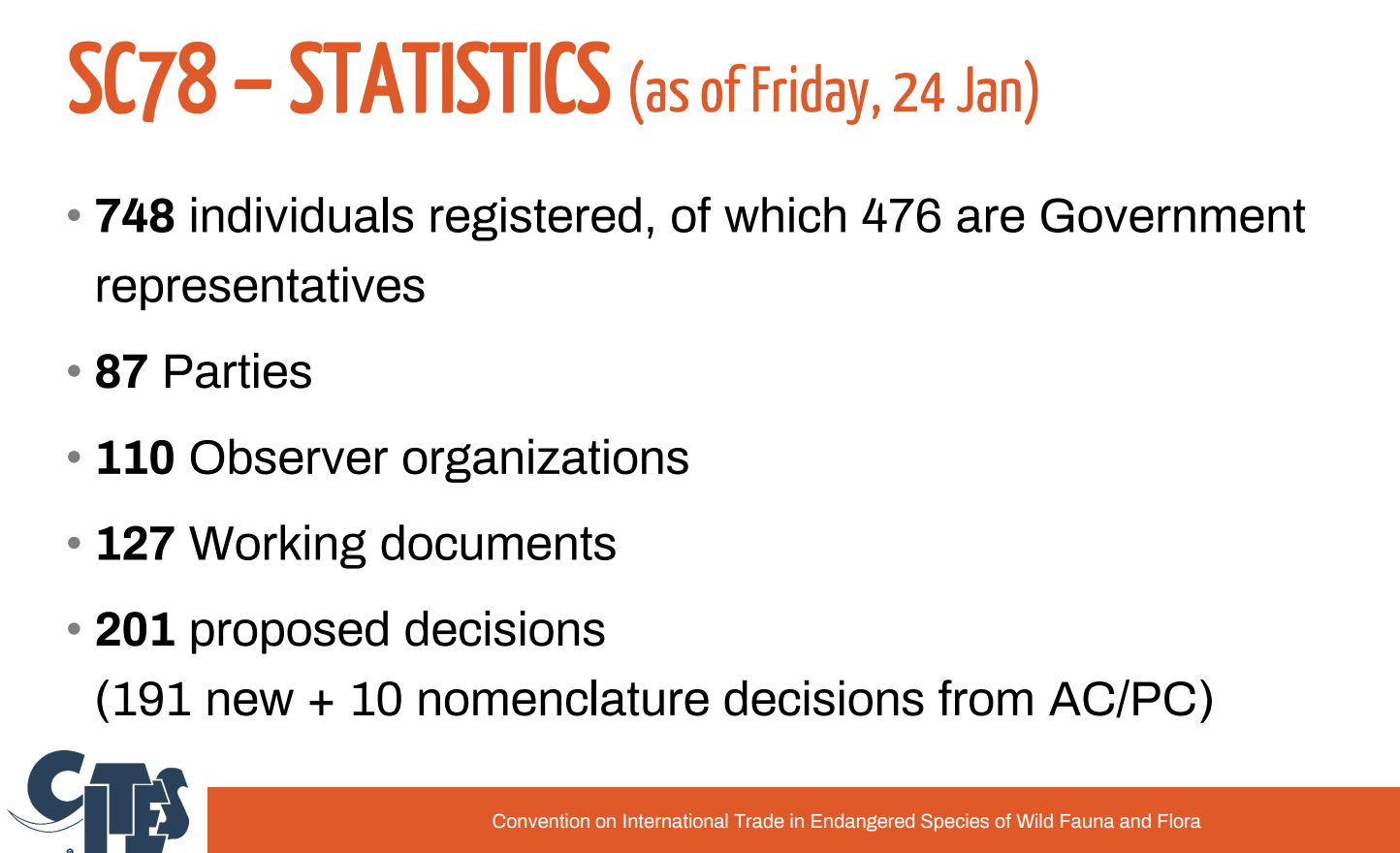
- The agenda for SC78 covers 120 working documents and 191 proposed new decisions. As CITES issues complexifies with the growing number of species listings, trade measures and compliance matters, increased support from the secretariat is required.
- SC78 marks the final step where the committee will review the progress made during the intersessional period and make recommendations to COP20. With 185 Parties and covering over 41,000 species of wild plants and animals, strong collaboration and collective commitment is crucial. To make SC78 as impactful and efficient as possible, discussions must be solution-oriented with a clear emphasis on well-founded recommendations.
Haruko OKUSU | Chief, Governing Bodies Unit, CITES
To better understand the intervention, consulting slides 16 – 21 is suggested.
- CITES 78th Meeting of the Standing Committee will take place from 3 to 8 February 2025 at CICG in Geneva.
- The agenda and all working documents are available on the CITES website. The annotated agenda with recommendations (SC78 Inf. 16) and new proposed decisions are also available.
Statistics
Time Efficiency Measures
- Time limits of intervention have been set: three minutes for SC members and two minutes for Observer Parties and organizations.
- In addition, we have published a consolidated agenda item on the subject matters, which will be introduced by the Animals and Plants Committee Chairs and reviewed by the SC.
- Impromptu changes to the working programme may be expected.
Agenda Item 10. Emerging Operational Matters of the Committees
- Document 10 on Emerging Operational Matters of the Committees deals with handling operational challenges such as disruptions in holding CITES committee meetings.
- We have proposed a structured risk assessment approach with a risk matrix for holding online or hybrid meetings and meeting arrangement guidelines.
- The document also considers ways to address the increased workload of the Committees.
Agenda item 14. CITES Strategic Vision
- Document 14 on CITES Strategic Vision highlights the linkages between the CITES strategic vision and the KMGBF.
- It proposes amendments regarding global policy developments (Res. Conf. 18.3) and cooperation of CITES with other biodiversity-related conventions (Res. Conf. 16.4).
- We also need to continue developing new or revised indicators for objective 1.4 of the CITES Strategic Vision, with a focus on aligning CITES appendices with species conservation needs.
Agenda item 16 on Cooperation with Multilateral Environmental Agreements (MEAs) and other international organizations
- Document 16 on Cooperation with Multilateral Environmental Agreements (MEAs) and other international organizations highlights some existing partnerships, including:
- Bern III Conference on Synergies,
- Convention on Migratory Species COP14;
- UNEA-6;
- Convention on Biological Diversity COP16;
- Collaborative Partnership on Sustainable Wildlife Management (CPW),
- Collaborative Partnership on Forests (CPF); and
- World Organization for Animal Health (WOAH); among others.
- It also discusses the draft partnership strategy, with a focus on a higher strategic level. It also includes the revised draft with comments from Parties and observers, and the recommendation to submit the Strategy for approval by COP20.
Salehin KHAN | Acting Chief, Outreach and Projects Unit, CITES
To better understand the intervention, consulting slides 22 – 26 is suggested.
- The Outreach and Projects Unit combines several cross-cutting issues, including project management and issue of elephants.
Elephants
- Document 65.1 on the Implementation on Resolution Conf. 10.10 mentions the implementation of the Monitoring the Illegal Killing of Elephants (MIKE) Programme which identifies hotspots for illegal killing of elephants in Africa and Asia. Although there is a decline in the illegal killing of elephants, the conservation status still remains a concern. International cooperation and partnerships are crucial, such as the African Elephant Action Plan which plays a key role in mobilizing resources and driving conservation actions.
- A new MIKE project started in January 2025, funded by the European Union, with extended scope and addressing other CITES-listed species. There are possible challenges in financial and operational sustainability of the programme, given that human resources will remain the same.
- Document 65.8 on CITES Dialogue meeting for African range states provides updates on the dialogue, following the meeting in Botswana in 2024, covering topics such as sustainable financing for conservation and harmonization of conditions for African elephant trading.
Access to Funding and Capacity-building
- Document 11 on Access to funding presents an update on extra-budgetary funding that CITES receives, mainly for capacity-building purposes of its Parties, which is crucial for CITES initiatives. In this document a resource mobilization strategy is presented for the first time, which aims to create sustainable funding mechanisms to ensure continuity of the work of CITES.
- Document 21 on Capacity-building Framework aligns with the framework for capacity-building and development of the KMGBF. This work is still in progress, with regional technical consultations to be organized by the Secretariat.
- Document 22 on Implementation of Resolution conf. 19.2 on Capacity-building provides updates on the capacity-building activities at national and regional levels organized by CITES since COP19.
Electronic Systems, Risk Assessment, Transport of Live Specimens
- Document 51 on Electronic systems and information technology is on guidelines being developed for Parties to apply or implement electronic CITES permitting procedures. A guideline on the use of two barcodes on CITES permits and certificates will be submitted at SC78.
- Document 52 covers the work-in-progress guideline on risk assessment and analysis for border control of CITES-listed species.
- Document 55 on the Transport of live specimens includes updates on digital licenses acquired by the Secretariat for developing country Parties, which is the International Air Transport Association (IATA) Live Animal Regulations (LAR).
CITES Tree Species Programme, Youth and Gender
- Document 24 on the CITES Tree Species Programme provides updates on implementation and guidance from Plants and Standing Committee about the permanent Tree Species Programme.
- There is growing interest globally on youth participation in CITES issues, and the CITES Global Youth Summit will be held in May 2025 in Singapore, as mentioned in Document 25 on CITES Global Youth Network.
- Updates on revisions and comments received on the CITES Gender Action Plan are listed in Document 26.
Karen GAYNOR | Scientific Support Officer, Science Unit, CITES
To better understand the intervention, consulting slides 28 – 36 is suggested.
Report of the Chairs of the Animals and Plants Committees
- Document 6 Report of the Chairs of the Animals and Plants Committees presents 27 agenda items on activities carried out by the scientific committees, focusing on items that are not reported in the separate agenda item.
- Items on plants include:
- Resolution Conf. 16.5 Cooperation with the Global Strategy for Plant Conservation of the Convention on Biological Diversity which the Plants Committee agreed to submit draft revisions to the COP
- Proposed revisions to Resolution Conf. 16.10 (Implementation of the Convention for agarwood-producing taxa).
- Consideration of a report on global conservation and trade of rosewood tree species.
- Items on animals include:
- Joint CITES-CMS (Convention on the Conservation of Migratory Species of Wild Animals) African Carnivores Initiative
- Reflection on reports of workshops organized by the Secretariat during the intersessional period: Aquatic species listed in the Appendices, Songbird trade and conservation management; and Conservation of amphibians.
- Items on animals and plants include preliminary guidance on non-detriment findings (NDF) developed through a collaborative process between Parties, NGOs and other experts.
CITES and Forests
- The SC will consider progress made in the implementation of decisions related to CITES and forests (Agenda item 19).
Review of Significant Trade (RST) in specimens of Appendix-II species
As one of the two review processes initiated by the Animals and Plants Committees, the SC will consider three documents on Significant Trade in specimens of Appendix-II species (RST):
- Overview of the 90 cases subject to the review (Document 34.1),
- Implementation of the recommendations of the Animals Committee (Document 34.2), and
- Implementation of the recommendations of the Plants Committee (Document 34.3).
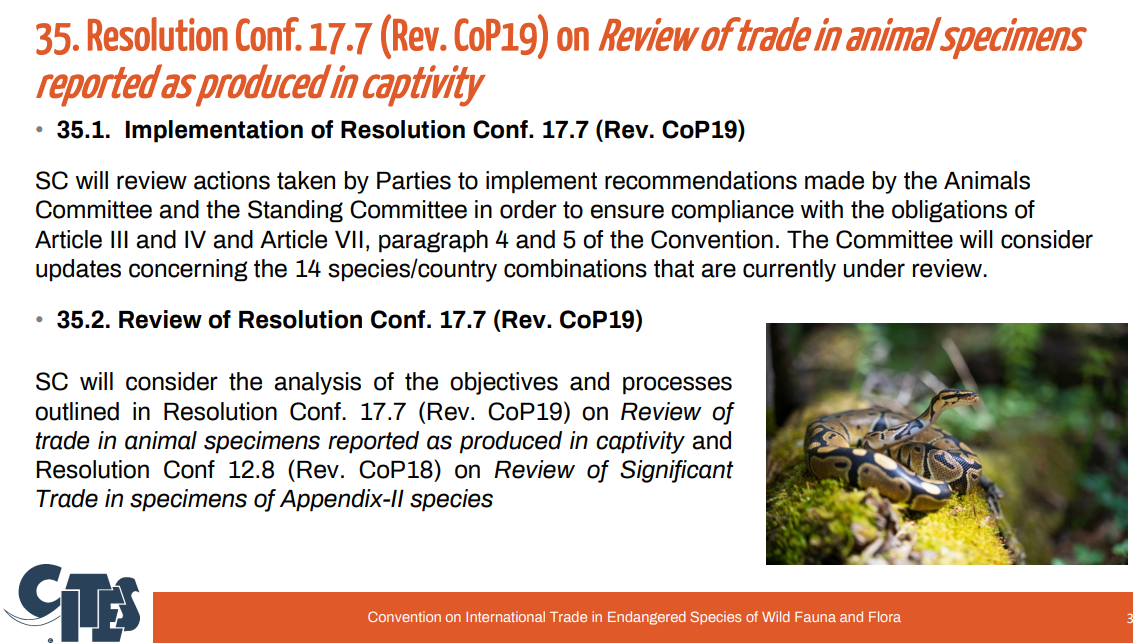
Resolution Conf. 17.7 (Rev. CoP19) on Review of trade in animal specimens reported as produced in captivity
- The second review process is the Resolution Conf. 17.7 on Review of trade in animal specimens reported as produced in captivity. Two documents for the SC to consider are the Implementation of Resolution Conf. 17.7 (Document 35.1) and Review of the Resolution Conf. 17.7 (Document 35.2).
Eels (Anguilla spp.)
Two documents will be considered on eels (Anguilla spp):
- Report on the intersessional working group (Document 69.1) on new draft decisions and potential new resolution, and Report of the Secretariat (Document 69.2) on illegal trade in European eel (Anguilla anguilla).
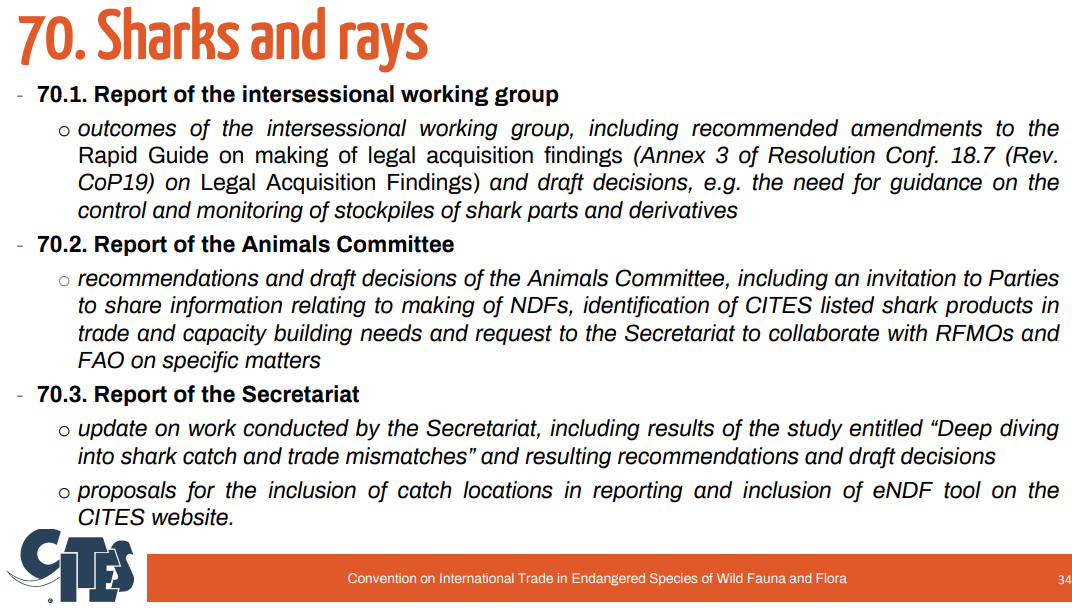
Sharks and Rays
- The SC will consider three documents: Report of the intersessional working group (Document 70.1) on recommended amendments to the Rapid Guide on making of legal acquisition findings, Report of the Animals Committee (Document 70.2), and Report of the Secretariat (Document 70.3).
Brazil wood (Paubrasiliaechinata)
- Document73 on Brazil wood will consider the draft report “Paubrasilia echinata bows: Fine tuning traceability solutions”, including its key outputs such as the establishment of a traceability system, identification of enforcement efforts, and pathway for coordinated efforts to ensure legal, sustainable trade.
Annotation #15
- Under Document 77 (Annotation #15), the SC will consider the Secretariat’s draft report on the evaluation of the conservation impacts of CITES exemptions for rosewood tree species, highlighting its effectiveness in trade regulation and persisting gaps in traceability.
Sofie H. FLENSBORG | Chief, Legal Unit, CITES
To better understand the intervention, consulting slides 38 – 45 is suggested.
CITES and People
- CITES is at the intersection of trade, environment and development; our work is deeply connected to sustainable development and contribution to sustainable livelihoods to people and communities.
- Efforts have been made during the intersessional period to enhance the engagement of Indigenous peoples and local communities in the works of the Convention, as described in Document 27. A short non-binding guidance would be presented to the SC by a working group led by Canada.
- Document 28 on livelihoods proposes six strategies aimed at maximizing the benefits of trade in CITES-listed species for Indigenous peoples and local communities. The use of certification and labeling system for products from such communities is also to be considered by the SC.
- The Secretariat is reporting its work on the CITES guidance on demand reduction strategies to combat illegal trade (Document 29), focusing on targeted campaigns to achieve behavior change.
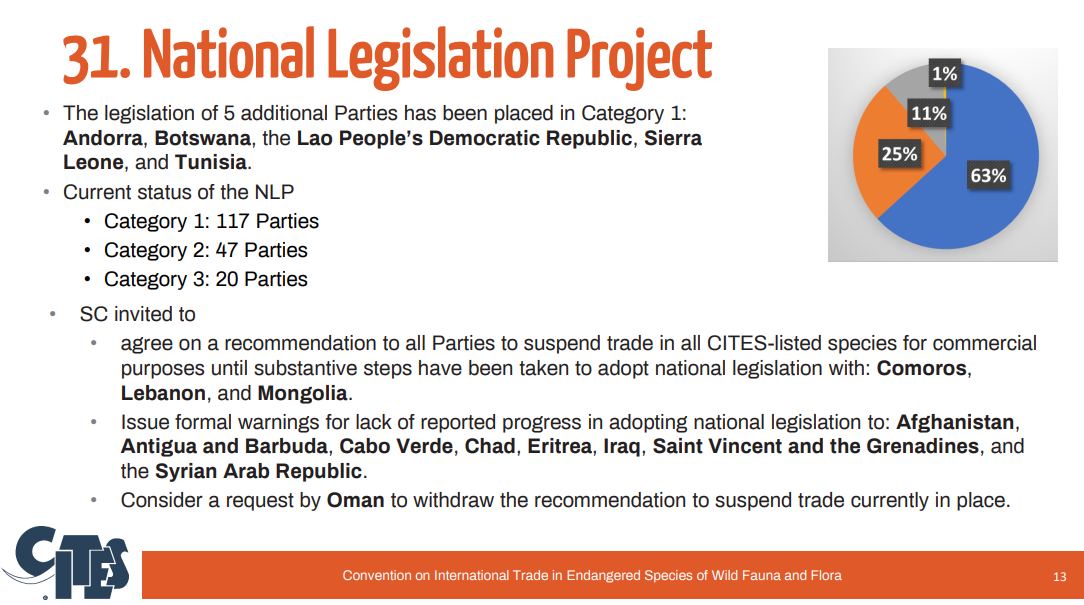
National Legislation Project
- The National Legislation project (Document 31.1), which started in 1992, involves the review of legislation and an assessment by the SC whether the national legislation of Parties complies with requirements established by the COP. Five additional Parties (Andorra, Botswana, the Lao People’s Democratic Republic, Sierra Leone, and Tunisia) have been added to Category 1, indicating the existence of adequate legislation.
Submission of Annual Reports
- Document 32.1 states that all Parties are required to submit their annual reports on trade in CITES-listed species, and trade is unauthorized for Parties that have failed to submit their reports for three consecutive years.
- Parties that have failed to submit annual reports for three consecutive years without having provided adequate justification are Bahamas, Guinea Bissau, Liberia, Malawi, Mali,
Paraguay and Samoa. - The Conference of the Parties recommends that Parties not authorize trade in specimens of CITES-listed species with those Parties until they have provided the missing reports.
- This will come into effect 60 days after the meeting unless the missing reports
are provided
Compliance matters – Application of Article XIII
- CITES takes a supportive and non-adversarial approach towards non-compliance in order to achieve long-term compliance.

- The overview document (Document 33.1) reports on implementations of recommendations adopted last year, including Appendix I on captive facilities, trade in three parrots between Brazil, Dominica and Germany, and the development of guidance on the scope and application of recommendations to suspend trade.
- Document 33.2 provides updates on progress made by range States in the implementation of Article XIII and suggestions to renew recommendations for West African rosewood (Pterocarpus erinaceus).
- Updates on efforts taken by Bangladesh, Guinea, Lao PDR, Nigeria, Democratic Republic of Congo, as well as reports on its technical compliance missions to Cameroon, Ecuador/Peru, and Viet Nam are provided by the Secretariat (Agenda items 33.3 to 33.10 on CITES SC78 documents webpage).
- Document 33.11 covers the update provided by Madagascar on the management of Malagasy palisanders and rosewoods (Dalbergia spp.) and ebonies (Diospyros spp.), following COP 19 decisions.
National Ivory Action Plans (NIAP)
- In National Ivory Action Plans (NIAP), countries are requested to develop action plans to focus efforts to combat illegal trade on ivory (Documents 33.13.1, and 33.13.2). All 13 Parties involved in this process have submitted progress reports on NIAP implementation, which the Secretariat will report to the SC.
- Document 78 mentions the taxonomy and nomenclature of African elephants, including how to reflect the two African elephant species in the CITES Appendices.
Other Legal Matters
- Other legal matters include Rules of Procedure of the Conference of the Parties (Document 12.4), Legal acquisition findings (Document 47) and Introduction from the sea (Document 49).
Ben Van RENSBURG | Chief, Enforcement Unit, CITES
To better understand the intervention, consulting slides 47 – 58 is suggested.
Enforcement Matters
- Document 38 on Enforcement matters covers issues such as:
- corruption, which continues to pose a significant challenge in addressing wildlife crime,
- illicit financial flows from wildlife crime,
- CITES Illegal Trade Database with approximately 130,000 seizure records reported by Parties as of November 2024 which requires sustainable funding for its maintenance, and
- Wildlife crime linked to the Internet.
Totoabas (Totoaba macdonaldi)
Documents under this agenda item include:
- The Report of the Secretariat (Document 33.12.1) on missions to China, Mexico and the United States of America, a comprehensive study on totoaba and vaquita, and progress of Mexico’s implementation of its compliance action plans.
- Report of the Trilateral Enforcement Contact Group (TECG) (Document 33.12.2), elaborating on activities conducted to date related to and by the contact group.
Task Force on illegal trade in specimens of CITES-listed tree species
- In 2022, the Secretariat convened the Task Force on illegal trade in specimens of CITES-listed tree species (Document 38.3), which the outcomes of the meeting provided Parties a strong basis for addressing illegal trade. The SC is invited to propose the renewal of Decision 19.89, adopted at COP19 to encourage Parties to fully implement measures and activities outlined in the Task Force outcome document, to COP20.
Wildlife crime enforcement support in West and Central Africa
Two documents were submitted on Wildlife crime enforcement support in West and Central Africa:
- The report of the intersessional working group (Document 39.1) is on its work regarding the provision of sustainable financial support, including the potential establishment of CITES enforcement fund.
- The report of the Secretariat (Document 39.2) addresses updates on the implementation of COP 19 decisions regarding Western and Central Africa.
Marine Turtles (Cheloniidae spp. and Dermochelyidaespp.)
- Document 41 on marine turtles was submitted by the SC intersessional working group on marine turtles, focusing on the compliance and enforcement aspects and amendments proposed to resolution 19.5 on conservation of and trade in marine turtles.
Asian big cats (Felidae spp.)
- Document 43.1 on Asian big cats provides reporting on the implementation of Resolution Conf. 12.5 on Conservation of and trade in tigers and other Appendix-1 Asian big cat species, and Document 43.2 on work undertaken by the Secretariat regarding Asian big cats in captivity and findings of missions to China and the United States of America.
Rhinoceroses (Rhinocerotidaespp.)
- Document 45 on Rhinoceroses focuses on Parties most affected by rhinoceros horn trafficking, as well as those affected by emerging issues of concern, and highlights the need for Parties to scale up efforts to collect samples from seized rhinoceros horns for forensic analysis. Arrangements are being made for the CITES Rhinoceros Enforcement Task Force to be convened in the first half of 2025.
International Consortium on Combatting Wildlife Crime (ICCWC)
- Document 38.2 is on the International Consortium on Combatting Wildlife Crime (ICCWC), which is a collaborative effort of five intergovernmental organizations: CITES Secretariat, the International Criminal Police Organization (INTERPOL), the United Nations Office on Drugs and Crime (UNODC), the World Bank, and the World Customs Organization (WCO). The ICCWC vision 2030 has been implemented from 2023, with strategic action plans to address wildlife crime in a holistic and comprehensive manner. SC is invited to encourage Parties to actively engage in ICCWC activities and reach out for support.
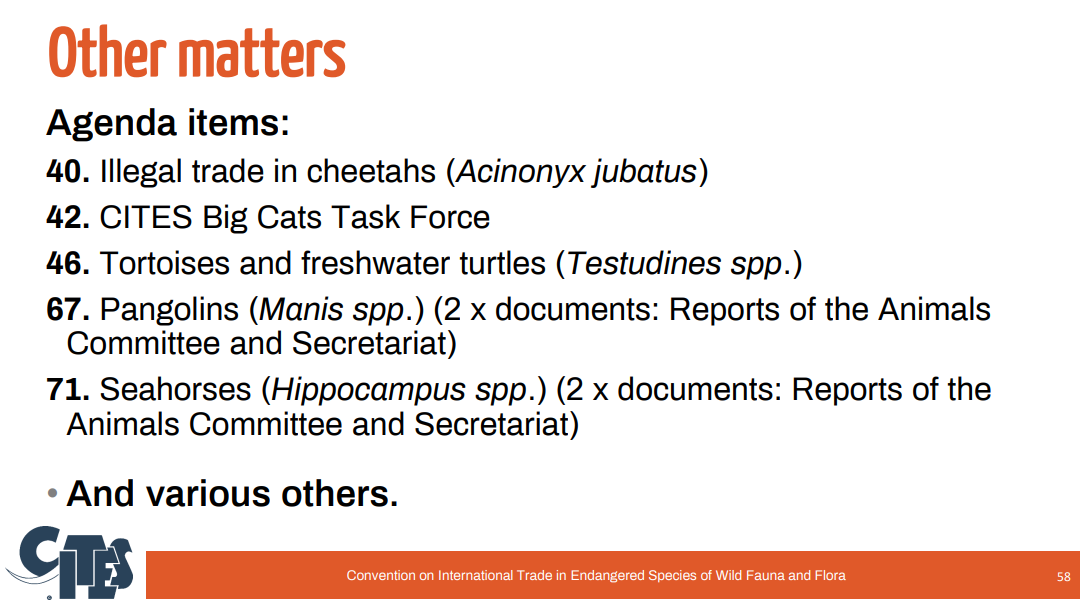
Photo Gallery


