
Événement Conférence
Briefing on the 7th Session of the United Nations Environment Assembly | GENeva UNEA Briefing

25 Nov 2025
10:30 – 12:00
Lieu: International Environment House I | Room 2 & Online | Webex
Organisation: Geneva Environment Network
This briefing focused on the preparations for the 7th Session of the UN Environment Assembly (UNEA-7), which will take place in Nairobi, Kenya, from 8 to 12 December 2025.
About the UN Environment Assembly
The United Nations Environment Assembly is the world’s highest-level decision-making body on the environment. It addresses the critical environmental challenges facing the world today.
The Environment Assembly meets biennially to set priorities for global environmental policies and develop international environmental law. Through its resolutions and calls to action, the Assembly provides leadership and catalyzes intergovernmental action on the environment. Decision-making requires broad participation, which is why the Assembly provides an opportunity for all to help design solutions for our planet’s health.
About the 7th session of the UN Environment Assembly (UNEA-7)
The seventh session of the United Nations Environment Assembly (UNEA-7) will take place from 8 to 12 December 2025 at the United Nations Environment Programme (UNEP) headquarters in Nairobi, Kenya, under the presidency of H.E. Abdullah Bin Ali Al-Amri, President of the Environment Authority of Oman. The theme of this session, « Advancing sustainable solutions for a resilient planet”, sends a strong message to accelerate sustainable solutions and effective responses for a safer and more resilient planet.
UNEA-7 will be preceded by the seventh meeting of the Open-ended Committee of Permanent Representatives (OECPR-7) which will be held from 1 to 5 December 2025.
While the environmental agenda is defined together with the member States at UNEA in Nairobi, Geneva as a global hub for international environmental governance is highly involved in implementing this agenda and in making it cross-cutting for the United Nations body.
Speakers
By order of intervention.

Arnold KREILHUBER
Director, Europe Office, UNEP | Chair

Jonas PASQUIER
Minister, Global Affairs, Permanent Mission of Switzerland to the UN Office and other international organizations in Geneva

H.E. Amb. Idris Abdul Rahman AL KHANJARI
Permanent Representative of the Sultanate of Oman to the United Nations Office and other international organizations in Geneva

Carlota ESTALELLA ALBA
UNEA Coordinator, Governance Affairs Office, UNEP

Andrea RIZZO
Programme Management Officer, UNEP

Elisa TONDA
Chief, Resources and Markets Branch, UNEP

Jacqueline ALVAREZ
Head, Chemicals and Health Branch, UNEP

Angela KARIUKI
Legal Officer and Head of InforMEA a.i., Collective Intelligence Unit, Law Division, UNEP

Francesca BERNARDINI
Chief, Transboundary Cooperation Section, UNECE

Kamelia KEMILEVA
Co-Director, Global Cities Hub

Patrizia HEIDEGGER
Deputy Secretary General and Director for EU Governance, Sustainability and Global Policies, European Environmental Bureau
Highlights
Video
Summary
Opening Remarks
Arnold KREILHUBER | Director, Europe Office, UNEP | Chair
- The theme for UNEA 7, the world’s highest-level decision-making body on environmental governance, is “Advancing Sustainable Solutions for a Resilient Planet”. The goal and objectives are very clear and send a strong message to accelerate sustainable solutions and effective responses for a safer and more resilient planet.
- The assembly will be preceded next week by the Open-ended Committee of the Permanent Representatives (OECPR-7) in Nairobi. The OECPR intends to renegotiate and deliberate the content and wording of the proposed resolutions, declarations and decisions for endorsement and approval of the assembly.
- It is timely that these briefings are conducted before every UNEA to showcase the footprint of international Geneva in the context of the UN Environment Assembly.
- In this briefing, guests will be discussing the resolutions, side events, associated events, launches, and multistakeholder dialogues that are taking place to lay a strong foundation to deliver high-impact multilateral actions once UNEA 7 concludes.
- The Executive Director of UNEP, Inger Andersen, has submitted her report to UNEA, which this year was delivered in two parts.
- The first part (UNEP/EA.7/2(I) – Advancing sustainable solutions for a resilient planet: part I) highlighted thematic and substantive issues of concern to the membership. These included water resource management, nutrient pollution, mineral governance, stratospheric protection and the environmental footprint of AI. The second part of the report (UNEP/EA.7/2(II) – Advancing sustainable solutions for a resilient planet: part II) focused on the evolution of UNEA. With the first UNEA taking place in 2014, the environmental assembly is still a young governing body in the international setting. Therefore, as UNEA evolves, member states and different stakeholders have the opportunity to shape this evolution.
- Important context for this UNEA session is the UN80 reform process launched by the Secretary General. These reforms will require us to shape the OEPCR, UNEA and ultimately UNEP and the environment in this context to emerge stronger, sharper and better able to support member states and the UN system in dealing with climate change, restoring nature, land and biodiversity and tackling the triple planetary crisis.
Jonas PASQUIER | Minister, Global Affairs, Permanent Mission of Switzerland to the UN Office and other international organizations in Geneva
- This year’s theme sends a powerful message on the need to accelerate the implementation of concrete sustainable solutions to make our planet safer and more resilient. To achieve this, it is crucial that dialogue remains open, inclusive and efficient, enabling UNEA to set priorities for global environmental policy and to deliver meaningful and timely outcomes.
- As a strong advocate of multilateralism, Switzerland is committed to strengthening an effective global environmental governance system. This ambition must be reconciled with the context of strains on global resources and some development and policy trends that are going against this collective ambition.
- In this context, where ambition must prevail but at the same time have the chance to be implemented, we do not need to create new structures, nor do we have the means to, but there are two key important things for Switzerland:
- 1) Using existing assets, building on what is there, what works and not breeding unnecessary fragmentation. There is a need for unity and collective ambition, working together towards this end.
- 2) Enhancing synergies within clusters, between clusters, within hubs and between hubs. This is how Switzerland is approaching the UN80 process, in particular in the human-environmental cluster.
- A good example of both using existing assets and enhancing synergies is the chemicals and waste cluster. Through coordinated work and joint programs among the Basel, Rotterdam and Stockholm Conventions and the Minamata Convention, and now with the Global Framework on Chemicals, there is the opportunity for better and aligned implementation, sharing of knowledge and reduction of duplication.
- This approach enables the achievement of greater impact with fewer resources, a strategy that would benefit other environmental clusters and is needed as resources keep shrinking.
- Through collaborative structures and built-up expertise in various regions, there is the opportunity to leverage each other’s strengths, improve diversity and efficiency and deliver more coherent results together.
- Switzerland is looking forward to UNEA-7 not only being successful but truly transformative, demonstrative, demonstrating the world’s and Switzerland’s readiness to meet urgent challenges in an efficient, result-oriented and pragmatic manner.
UNEA-7 and the Presidency Priorities
H.E. Amb. Idris Abdul Rahman AL KHANJARI | Permanent Representative of the Sultanate of Oman to the United Nations Office and other international organizations in Geneva
- The United Nations Environmental Assembly is the world’s highest decision-making body on environmental matters, bringing together all 193 member states of the UN, to strengthen multilateral environmental action under UNEP.
- Since it was elected president of UNEA-7, Oman has been working closely with the UNEP secretariat, and CPR in Nairobi and with regional groups to ensure an inclusive, transparent, consensus-based preparatory process.
- This 7th session is particularly significant as several important documents guiding international environmental actions are expected to be adopted. This includes the medium-term strategy of UNEP for 2026-2029, the program of work and the seventh edition of Global Environmental Outlook (GEO7).
- This year’s theme, advancing sustainable solutions for a resilient planet, reflects the collective view of member states on the urgent need to advance practical science-based solutions to strengthen global environmental resilience.
- Concerning the vision and road map, a zero draft of the ministerial declaration has been prepared on the basis of member states’ input. Four intergovernmental consultations have already been held, focusing on ensuring that the draft is action-oriented, inclusive and ambitious.
- The president, His Excellency Abdullah bin Ali Al-Amri, supported by the members of his bureau, has overseen a series of information consultations on the draft ministerial declaration and on preparation for the multilateral environmental agreements (MEAs), ensuring broad participation and transparency through the process.
- With regards to the UNEA-7 structure, the assembly will take place from 8 to 12 December at the UN office in Nairobi. It will include the opening plenary, the formation of committee of the whole, the high-level segment, an MEA day, multistakeholder dialogues, 19 approved side events, a closing plenary, and events associated with UNEP.
- Prior to this, the Seventh Session of the OECPR will take place from 1 to 5 December to negotiate draft resolutions submitted to the assembly. Sixteen draft resolutions and three draft decisions have been submitted to date and are classified into four clusters:
- Nature and climate
- Governance and law
- Circular economy, chemical, waste and pollution
- Strategic, budgetary and governing bodies matters
- The president has launched broad outreach and engagement with all regional groups to ensure collective ownership of the process.
- He has also participated in regional environmental forums across all regions to ensure inclusive participation in the preparatory process.
- The presidency has conducted four formal intergovernmental consultations on the ministerial declaration and three informational consultations on issues such as language, terminology and areas of concern for member states.
- Further informal consultations are planned during the upcoming session of the OECPR in December.
- Oman will also take an active role in the associated side event program of the session. Oman will host an event titled “Sustainability in Action, Oman’s Experience and Innovation towards a resilient planet”.
- UNEA 7 represents an important opportunity to reaffirm collective commitment to multilateral environmental cooperation and under Oman’s presidency, Oman aims to guide the assembly towards balancing practical and forward-looking outcomes that strengthen the role of UNEP and promote effective implementation on the ground.
Introduction to UNEA-7
Carlota ESTALELLA ALBA | UNEA Coordinador, Governance Affairs Office, UNEP
- There are 3,293 total approved registrations for UNEA 7 (excluding UNEP staff). This includes:
- 1,157 Member States (60 Ministers) from 164 Member States.
- 98 IGOs
- 1537 NGOs
- 1113 UN entities (including UNEP staff)
- Thanks to the government of Kenya, the electronic travel authorization has been waived for participants coming to UNEA. There is a step-by-step guide on how to apply for this courtesy here.
- There is a UNEA website and app with practical and easily accessible pieces of information where people can find the latest on preparing for their participation. It is encouraged to visit the website and download the app, especially if organizing an event or planning to come.
- There is also a “living document” information note with key practical information for participants.
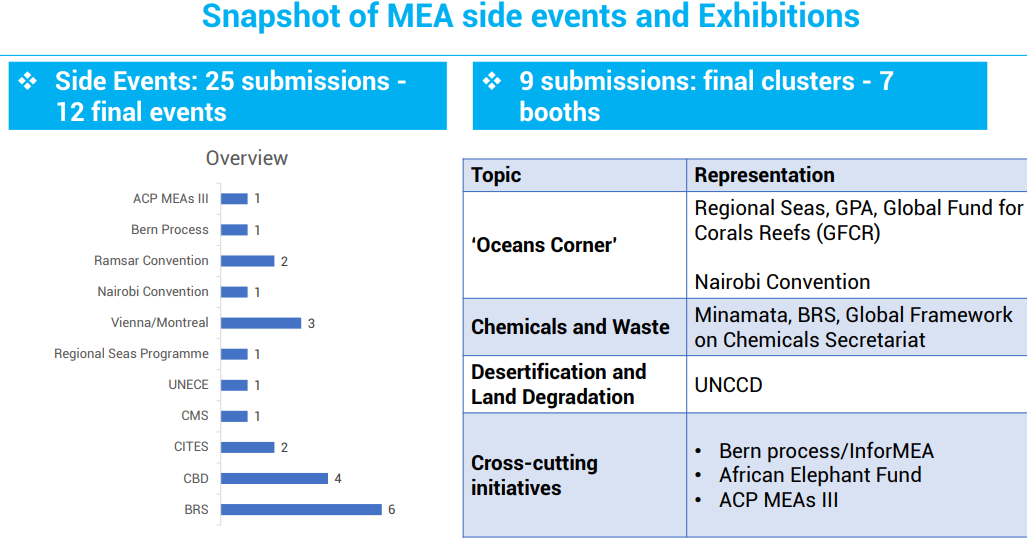
- The UNEA app and website have information on all the side events happening on the margins of the assembly. There are over 100 side events, the four main types of events include:
- 19 official side events (member state-led)
- 33 associated events (UNEP-led)
- 38 green room events (NGO led)
- 12 MEAs events (MEAs led)
- UNEP’s secretariat of the governing bodies has moved to the e-deleGATE platform, which is widely used to manage the correspondence with member states and to process different activities for UNEA and the OECPR.
- Delegates and member states must request access to the platform through their own administrators in the ministries and missions.
- Access to e-speaker, e-proposals and e-credentials is not active by default. Delegates must ask their administrator to activate it.
- Major groups and other stakeholders do not have access to this platform, but will receive the same information through emails.
UNEA-7 Structure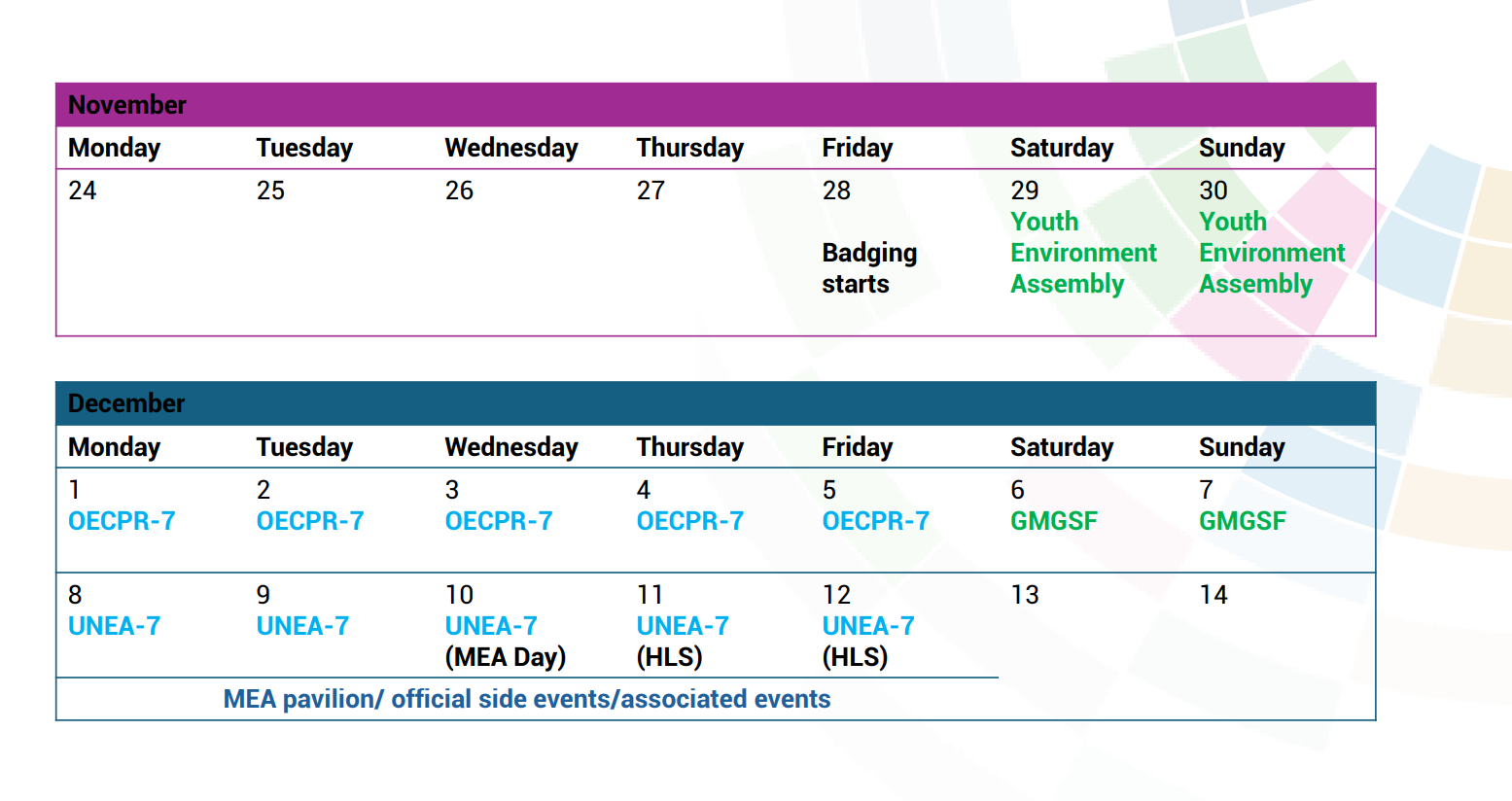
- The structure for OECPR-7 has been approved by the committee.
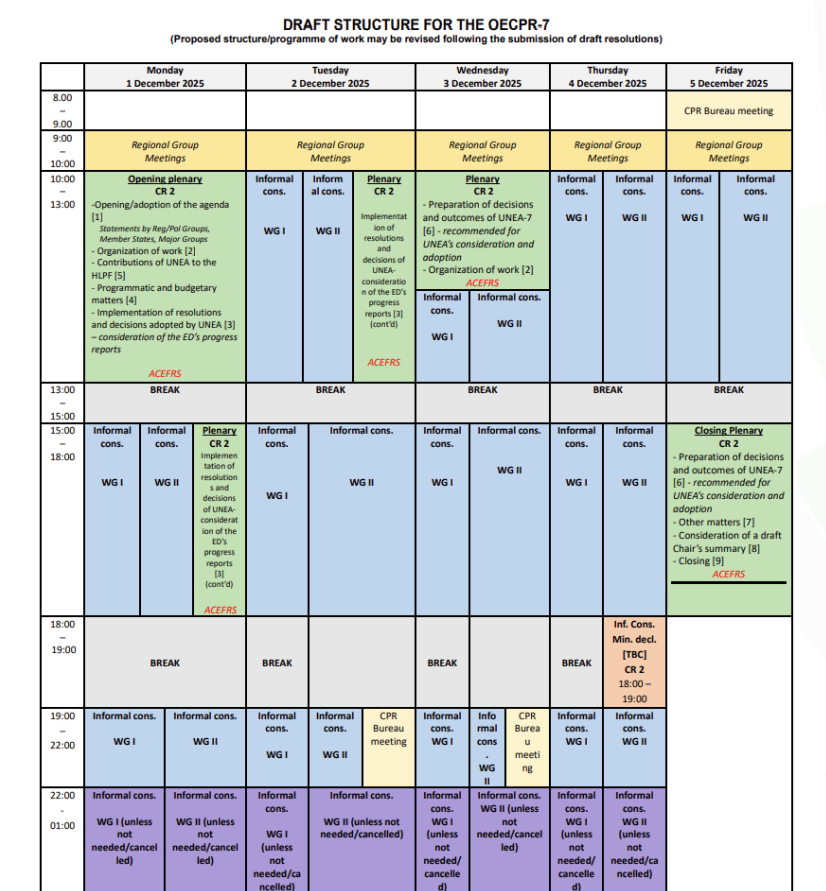
- UNEA-7 structure includes three main plenary sessions – the opening, the stock taking and the closing plenary.
- There are three plenaries dedicated to item 3 of the agenda, looking at the implementation of resolutions and decisions adopted by UNEA previous sessions.
- It also includes two parallel working groups, regional meetings and bureau meetings. The two working groups will meet to negotiate the 16 draft resolutions, and the three decisions clustered in four clusters, as detailed in the next presentation.
5 Days of UNEA Structure & Scenario Notes
-
- The structure for the 5 days along with the scenario note which provides detailed information on what is expected throughout the week.
- Before the opening plenary at 10 a.m. on Monday, 8 December, there will be a cultural opening from 9:30 to 10 a.m. Delegates will be asked to be seated in the plenary hall by 9:30. The seating plan is available on the website.
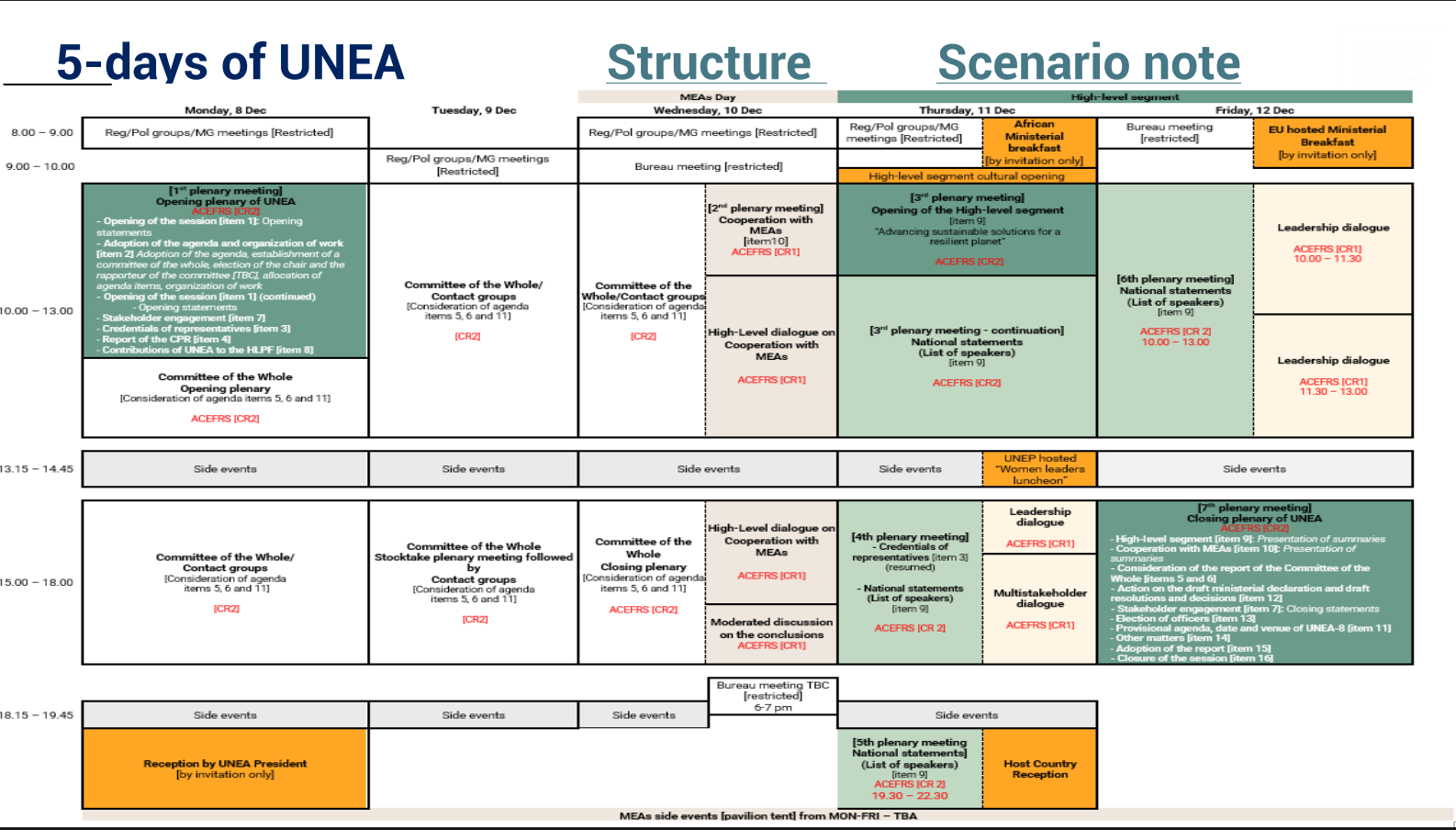
- In parallel to the Committee of the Whole on Wednesday, there are the MEAs days. These will be discussed in more detail later in the briefing.
- The opening of the High-Level Segment will take place on Thursday, 11 December at 10 a.m. Opening statements will be made by the President of UNEA, there will be video messages from the Secretary General of the UN and the President of the General Assembly, followed by statements from the Executive Director of UNEP and President of the Republic of Kenya.
- Following the High-Level Segment, the national statements by heads of state, vice ministers and heads of government and ministers will take place. A provisional list of speakers will be available on Friday, 28 November.
- There will be three leadership dialogues:
- Leadership Dialogue 1: An Ounce of Prevention Beats a Tonne of Cure – Why addressing environmental crises is essential for human health.
- Leadership Dialogue 2: Round and Round – Why circularity and sustainability are critical to the future of global industry.
- Leadership Dialogue 3: The Bottom Line – Why tackling environmental degradation is critical to the future of the global financial system.
- There will be a multistakeholder dialogue, organized by global major groups accredited by UNEP. This presents an opportunity to convene different sectors on a high-level discussion on how to address the theme of UNEA.
- Other events led by civil society include:
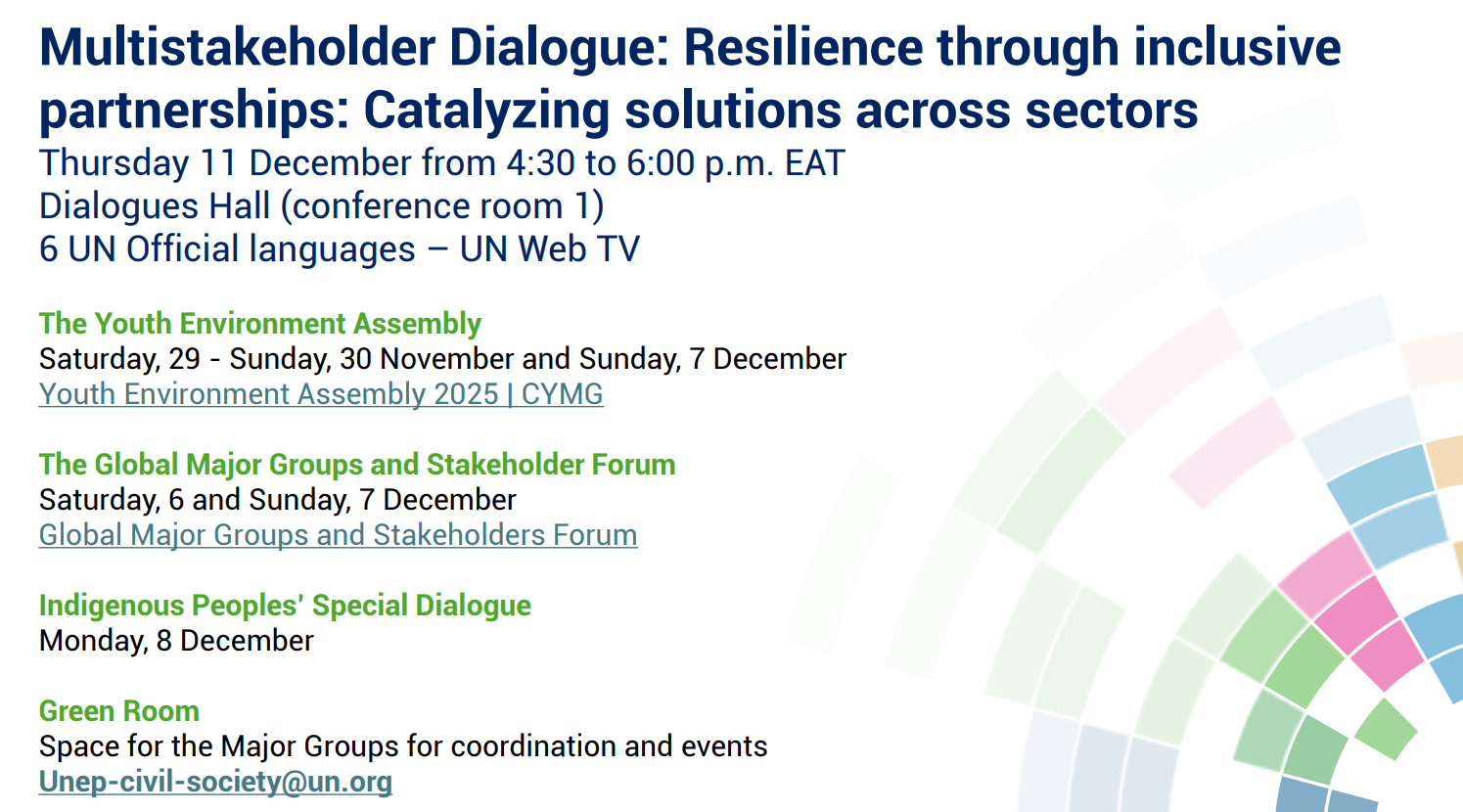
- The closing plenary will be held at 3pm on Friday, 12 December. The closing plenary includes:
- Presentations of the summaries of leadership and multistakeholder dialogues
- Consideration of the draft ministerial declaration.
- Presentation of the summaries of the MEAs days.
- Presentation of the work of the committee of the whole by its chair
- Consideration of all draft resolutions and decisions, including those finalized during the OCPR
- Closing statements by major groups and stakeholders
- Election of the UNEA 8 bureau and adoption of draft decisions on dates and provisional agenda of UNEA 8
- Adoption of the report of the session and closing statements.
Spotlight on Draft Resolutions and Key Engagements of Interest for International Geneva at UNEА-7
Andrea RIZZO | Programme Management Officer, UNEP
Cluster A: Draft resolutions relating to Nature – Climate
- L.13 – Strengthening global response on the management of fires. Submitter: India.
Asking UNEP to continue its strong partnership with the FAO under the Global Fire Management Hub to take that work further. - L.15 – Strengthening global response on the massive influx of sargassum seaweed blooms. Submitter: Dominican Republic.
This draft resolution recognizes the implications on the climate, on the pollution sphere, aiming to enhance cooperation, sharing knowledge and technologies and asks UNEP to assist member states upon request in tackling this issue from a national and regional perspective and potentially establish a specific working group that will be dedicated to this issue. - L.8 – Active protection of Deep-Sea Ecosystems. Submitter: Vanuatu.
This is where UNEP’s science-policy role comes into play, asking UNEP to compile a global assessment that will put together all the scientific knowledge on this complex issue and facilitate access to data for countries. - L.5 – Accelerating global action to promote the climate resilience of coral reefs. Submitter: Fiji.
This event asks how to integrate this issue into NDCs and NAPs and how UNEP can assist countries with methodology tools and guidelines to tackle this issue holistically. - L.7 – Preservation of glaciers and the broader cryosphere. Submitter: Tajikistan.
Asking UNEP to include impacts on the cryosphere in their scientific work on the global and regional level to bridge the science-policy gap. - L.6 – Karst ecosystem for Global Water, Biodiversity, Climate Resilience, and Economic Development. Submitter: Indonesia.
Asking UNEP to strengthen the governance, the legal, institutional aspects and frameworks to ensure protection and land use planning and promoting the exchange of knowledge. - L.19 – Mother Earth-Centric actions for living well in balance and harmony with Mother Earth. Submitter: Bolivia.
Cluster B: Draft Resolutions Relating to Governance and Law
- L.14 – Environmental sustainability of Artificial Intelligence systems. Submitter: Kenya.
Asking UNEP to convene an expert dialogue looking into this issue. - L.9 – Enhancing the meaningful participation of Children and Youth in environmental governance. Submitter: Sri Lanka.
Asking UNEP to support the establishment of dedicated mechanisms to ensure that children and youth can engage in governance issues at the national level. - L.10 – Promoting sustainable solutions through sport for a resilient planet. Submitter: Kenya.
Asking UNEP to look more deeply into this issue and perhaps try to provide capacity building support to countries and establish some standards that could be useful for countries going forward. - L.16 – Enhancing international response to address crimes that affect the environment. Submitters: Peru + Kenya.
Asking UNEP to work closely with UNODC, an existing partner, and the MEAs to further strengthen cooperation in this area. - L.20 – Maximizing existing resources through enhanced coherence and synergies in multilateral environmental agreements and implementation. Submitters: Japan + Panama.
Asking UNEP to follow up on a resolution submitted at the previous UNEA to continue meaningfully working in cooperation with MEAs.
Cluster C: Draft Resolutions Relating to Circular Economy, Chemical, Waste and Pollution
- L.11 – Environmental dimensions of Antimicrobial Resistance. Submitter: Kenya.The role of UNEP in tackling antimicrobial resistance will be developed further, strengthening UNEP’s convening role and science-policy broker and knowledge holder in partnership with other entities.
- L.17 – Advancing Options for International Instruments on the Environmentally Sound Management of Minerals and Metals and guidance for mineral resources circularity. Submitters: Colombia + Oman.
Links to UNEP’s role in facilitating multistakeholder, multi-country processes and a technical platform on this issue. - L.12 – Sound management of chemicals and waste. Submitter: Switzerland.
Looking at the science-policy interface and the synergies with panels, the GFC and other processes.
Cluster D: Draft Decisions Relating to Strategic, Budgetary, and Governing Bodies Matters
- L.4 – Draft decision on MTS 2026-2029 and PoW and budget for the biennium 2026-2027.
UNEP will need UNEA to approve the MTS and PoW to continue its work going forward.
- L.3 – Draft decision on Provisional agenda, dates and venue of UNEA-8.
- L.2 – Draft decision on Management of trust funds and earmarked contributions.
- L.18 – Strengthening the role of the United Nations Environment Programme Headquarters in Nairobi to address environmental challenges and enhance multilateral cooperation to address effective multilateral governance. Submitter: Mexico.
Focus on Topics of Interest to the Economic Cluster
Elisa TONDA | Chief, Resources and Markets Branch, UNEP
- The draft resolutions of interest to the economic cluster are contained in Cluster C.
- Draft resolution L.17 is the result of a process of compromise as it stems from two different ones previously separately submitted, respectively by Colombia and Oman and finally combined into a single one.
- The one proposed by the Republic of Colombia and co-sponsored by Armenia, Ecuador and Zambia had a strong focus on assessing options for international instruments on environmentally sound management of minerals and metals.
- At the beginning of the informal consultation, there was a proposal for a second concept note – put forward by the Sultanate of Oman – on a related issue with a strong focus on the recovery of mine tailings, including through circularity.
- Following recommendations to group these closely connected issues, there ended up being a draft resolution that consolidated the perspectives of both proponents. These showcases joint leadership in coming together and exploring how a joint effort could mobilize interest across different member states on the agenda of mining and metals.
- This combined draft resolution will be on the table for discussion next week at the OECPR.
UNEA-7 agenda will largely discuss economic aspects, the circular economy and its application across different sectors. To highlight a few:
- On 7 December, a strategic dialogue focusing on data, science and knowledge networks for the circular economy.
- On 8 December, the agenda of public finance and sustainable public finance as an engine for circularity, competitiveness and inclusive economic growth as part of associated event.
- On 9 December,– two events that focus on critical energy transition minerals that count on support of UNEP, the International Resource Panel and the MEAs.
- On 10 December, an associated event on digital product information systems and another event hosted by the Republic of Colombia on sustainable minerals and metals.
- On 11 December, two high-level events on minerals and metals and an in-person convening of the Global Policy Dialogue on Textiles will take plce, preceded by several online sessions. There will be another event looking at circular solutions applied across several sectors, where both governments and stakeholders will put solutions on the table.
- These are all essential to build momentum toward the second leadership dialogue, “Round and Round – Why circularity and sustainability are critical to the future of global industry”, which will focus on the materials flow in our economies and the opportunities associated with circularity. Discussions will build on the findings from the Global Resources Outlook published by the International Resource Panel and delve into sector-specific implications, including on the mining and textile sectors. The dialogue will also touch upon the digital transformation and on the need to accelerate the shift to circularity will also be part of the leadership dialogue.
- The third leadership dialogue “The bottom line while tackling environmental degradation is critical to the future of the global financial system” will bring the public and private finance angle. It will help see how an alignment from both public and private finance can accelerate the conversation on circularity and broadly on resilience of the economy and society.
Spotlight on Topics of Interest to the Chemicals and Pollution Cluster
Jacqueline ALVAREZ | Head, Chemicals and Health Branch, UNEP
- Resolutions regarding chemicals and antimicrobial resistance are also grouped under Cluster C. Those topics have historically been part of UNEP’s core mandate: since the governing council, UNEP has had chemicals and waste resolutions.
- Despite decades of working on these issues, some of them are still not dealt with in the right manner.
- The chemicals resolution that was put forward to UNEA-7 by Switzerland on sound management of chemicals and waste refers to those aspects.
- In preparation to UNEA-7, UNEP has prepared two reports, including UNEP/EA.7/13 – « Progress in the implementation of resolution 6/9 on sound management of chemicals and waste to address lead, cadmium, arsenic and organotins ». While the consequences of lead poisoning, especially for children, as it affects their IQ, this issue has not yet been solved. Lately, lead exposure has also been recognized as a trigger of heart disease. Therefore, this issue is very relevant to the health agenda.
- The resolution proposed by Switzerland reiterates the need to learn and investigate where action can be undertaken at the national level to deal with these topics.
- This resolution also talks about the newly established science-policy panel, the Intergovernmental Science-Policy Panel for Chemicals, Waste and Pollution (ISP-CWP), adopted in Punta del Este, Uruguay in June 2025.
- The panel completes the trifecta of panels to tackle the triple planetary crisis, brining the chemicals and waste pillar to the same level of climate change with the IPCC and biodiversity loss with IPBES. The panel is still under discussion and documents requiring finalization. The first plenary will take place in February 2026 in Geneva, which has historically been a hub for chemicals and waste discussions.
- A UNEP side event taking place on 11 December will discuss areas and elements that need to be developed. For example, the panel needs to urgently start working on programmatic aspects and the resolution is talking about the synergies of this panel with the MEAs.
- In addition to Switzerland’s resolution on chemicals, it is important to highlight Kenya’s resolution on antimicrobial resistance (AMR) as there is mounting evidence on how the environment triggers, spreads, and disseminates AMR.
- The resolution refers to global surveillance systems and the importance of knowing what’s going on in our environment, an area that needs to be strengthened. There is a need to bring clarifications on the science, the knowledge, and risk-based activities.
- AMR also relates to the triple planetary crisis.
- Changes in the microbes in our biodiversity affect the carbon and methane cycle. Both contribute to the heating of the climate. If temperatures rise, diseases are more likely to affect people and lead to an increase in antibiotic use.
- Waste management can be a trigger for anything related to antimicrobial resistance and not just manufacturing processes. Changes in land use affect the microbes in the soil and can affect the productivity of ecosystems and their services.
- Pollution is also critical to consider, as heavy metals have a catalytic effect in helping microbes that are essential for life, but that will also survive after us. If we do not deal with sewage systems and sanitation, we will never be able to deal with this topic.
- At the United Nations General Assembly in September 2024, a political declaration on AMR was adopted to boost this agenda item.
- If we don’t act now, by 2050 (25 years), we might come back to the era before Fleming, meaning that no antibiotic will be effective to treat disease. This is why the one health approach and leadership dialogues on health are critical.
- UNEP is supporting an event on 10 December with the other quadripartite organizations, FAO, WHO, and WHOA to Launch the Independent Panel on Evidence for Action against Antimicrobial Resistance (IPEA).
- This resolution is getting a lot of attention from member states who are facing many different challenges in dealing with AMR and for addressing the triple planetary crisis holistically.
- More work is needed at both the global and national levels
Multilateral Environmental Agreements Day at UNEA-7
Angela KARIUKI | Legal Officer and Head of InforMEA, Law Division, UNEP
- The MEAs Day aims to bring the conventions into one shared spotlight and highlight how their mandates, their decisions, and implementation efforts directly support countries in accelerating environmental action.
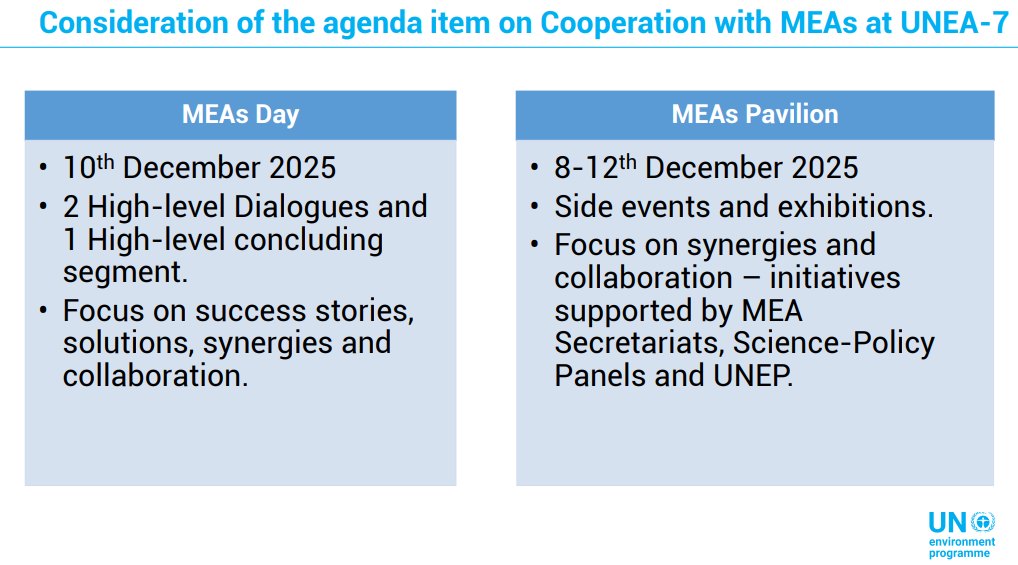
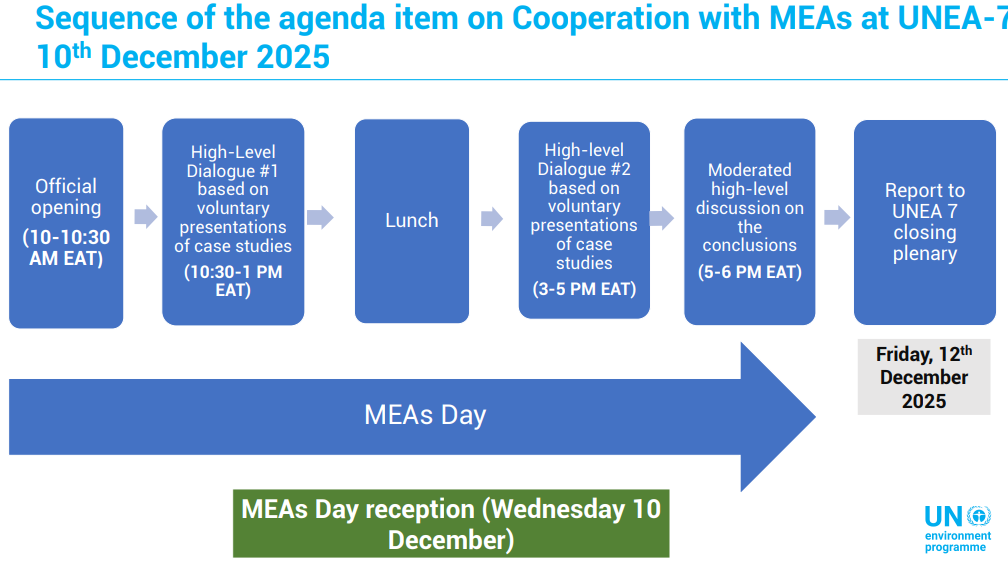
- One of the central inputs supporting MEAs Day is an information document (UNEP/EA.7/INF/6) that analyzes 20 national case studies across all UN regions, covering 31 MEAs and sharing good practices on how countries are creating synergies in implementation. It is a key resource to help ensure that lessons reflect the realities that parties face in implementing multiple conventions.
- The high-level dialogue will bring together a group of high-level representatives across various MEAs.
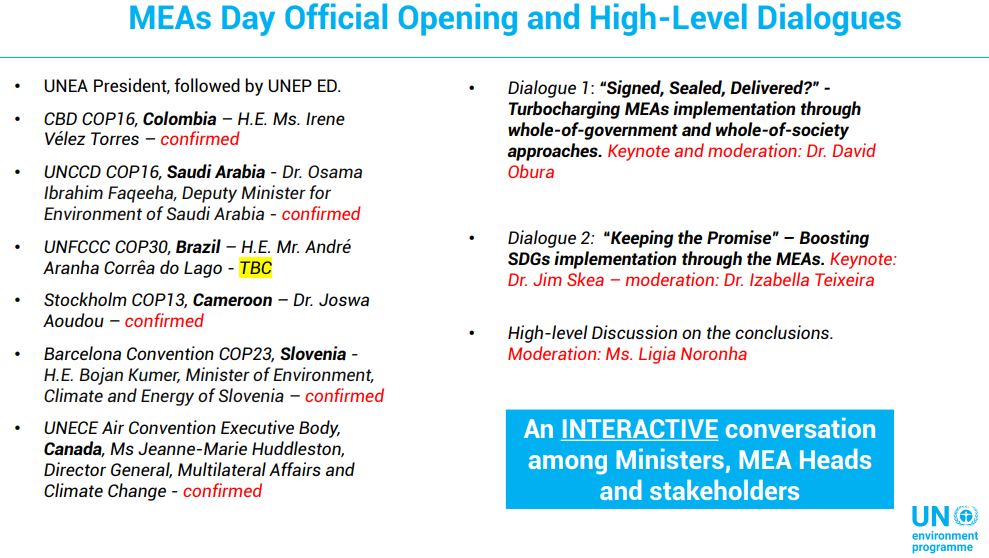
- Besides the official MEAs day, the MEAs will participate in various side events throughout UNEA-7.
Francesca BERNARDINI | Chief, Transboundary Cooperation Section, UNECE
- It’s almost surprising that the focus on MEAs only began at UNEA-6. MEAs are the backbone of environmental governance as they support the need for a clear, strong, legally binding commitment to drive collective action towards common objectives.
- At UNEA-6, there was the first MEAs day but MEAs were not segregated into that occasion alone. There was a very strong political attention on MEAs. Many statements made by countries and regional groups all underlined the importance of MEAs to drive environmental action and their implementation.
- In the outcome document, in the ministerial declaration, there was a strong reference to MEAs.
- MEAs have also been strongly referenced in several UNEA-6 resolutions:
- Resolution 6/9. Sound management of chemicals and waste, with clear reference to the Basel, Rotterdam and Stockholm (BRS) convention and the Minamata Convention.
- Resolution 6/11. Highly hazardous pesticides, with reference to the Rotterdam Convention
- The two dedicated resolutions on synergies, MEAs and UNEP’s cooperation with MEAs
- Talking about the Geneva UNEA footprint, the BRS and Minamata Conventions were very much front and center of the discussions on chemicals and waste. Unfortunately, other Geneva-based instruments, such as the Ramsar Convention on Wetlands, CITES and UNECE instruments, were far less visible and used in the outcome document.
- There was a very important first resolution on promoting regional cooperation on air pollution to improve air quality globally (UNEP/EA.6/Res.10) in which there was a reference to the Convention on Long-Range Transboundary Air Pollution.
- However, looking at other resolutions like the ones on chemical and waste, there are no references to the Convention on the Transboundary Effects of Industrial Action. The resolution on an effective and inclusive solution for strengthening water policies also does not mention the Water Convention, which is the only UN instrument at a global level promoting the management of transboundary water resources.
- UNEA needs to build even more on what’s existing, and on regional and global instruments beyond UNEP.
- Building on UNEA-6, UNEA-7 will focus on synergies. The ambition of UNECE is to bring the powerful stories on the five UNECE managed instruments – the air convention, water convention, Espoo, Aarhus and industrial accidents conventions. This is a package of instruments that UNECE supports in an integrated manner.
- All these instruments also have common topics for example, focus on pollution prevention, risk-management prevention, transparency, access to information, exchange of information, and transboundary cooperation.
- Therefore, they are naturally built to promote common standards across these MEAs, which are mutually reinforcing. The work in close cooperation with UNEP, promoting the implementation of these instruments as a package.
- It is important to promote strengthening capacity in member states to build synergies for their implementation.
- UNECE consistently promotes a strong common governance approach and cross-references in tools and guidance documents that are developed under individual conventions so that they also support the implementation of the others.
- For example, the Espoo and Aarhus conventions both promote public participation and environmental impact assessment across instruments.
- There is also a story of cooperation beyond UNECE, as they work in close cooperation with other conventions, including in Geneva. For example, UNECE will be hosting a side event at UNEA 7 on Industrial Accidents Convention with the BRS secretariat, UNEP and the Office of the High Commissioner of Human Rights.
- We need to be careful of the “synergies-mania”, convincing ourselves that synergies will solve the problem. Whilst they are fundamental, the implementation of individual instruments still requires dedicated resources.
- We must be careful in the environmental sector not to restrict synergies between MEAs only.
- Environmental issues clearly go beyond the environmental sector and MEAs need to talk about synergies with other sectors.
- UNECE works closely with the energy, transport and trade division.
- This could be useful for UNEA to build on dynamics and processes that are happening in other sectors and build on what’s happening in UNECE’s Energy Division and the UN Classification Framework for Materials. This framework allows to highlight environmental and social dimensions. If the environmental community does not use this framework, they loses the opportunity to highlight this and to interact with the energy sector.
- Similarly, UNECE is working on traceability, which is very important in the trade sector and critical for raw materials.
- If the environmental sector doesn’t engage with the trade sector and use and promote these tools, it loses the opportunity to advance environmental discourse outside the sector.
Local Government and Cities at UNEA-7
Kamelia KEMILEVA | Co-Director, Global Cities Hub
- Being effective at local and regional government levels is at the heart of environmental governance this year. Almost all the resolutions at UNEA-7 and the ministerial declaration and the midterm strategy of UNEP, reflect the growing role of local and regional governments in environmental policy across climate, plastic waste management and the broader environmental agenda.
- The message coming strongly from local authorities is that there is a need for greater inclusion and more structured cooperation with local and regional governments in all policy processes.
- If member states want a strong ally on all levels of government, as things are happening closer to the ground, such as waste management, recycling policy, AMR etc., this is all in the hands of local governments. They will be looking at them with the right lens on the ground and implementing policies more efficiently.
- Local and regional governments are uniquely positioned because they are closest to the citizens.
- Ahead of UNEA-7, the fourth consecutive edition of the Summit of Cities and Regions will take place as an official associated all-day event on 5 December.
- There will be strong participation from local authorities, mayors, governors, municipal experts and major groups in close cooperation with different secretariats of UNEP.
- Local leaders will come with concrete problems, solutions, examples and expertise.
- There will be discussions on climate finance, food waste, cooperation on all levels of governments etc.
- It is a true dialogue with member states. The President of UNEA is confirmed, as well as Brazil, Switzerland, as key partners in several UNEP cities and regional projects, and India, Somalia and Kenya, as well as other states that will participate in this dialogue with a whole level of government exchanges.
- The Global Cities Hub will also have an official side event called “Beat the Heat: Local and Regional Action for a resilient planet”. It will focus on the issue of heat in cities, which, due to infrastructure, density of population and other phenomena, makes it more dangerous.
- This is a follow up of the Brazil initiative at COP30 “Mutirão contra a Calor Extremo”/ Beat the Heat.
- There will be participants from states and cities affected by heat: the Nairobi city county deputy governor and the Republic of Kenya, the Mayor of Lusaka (Zambia), the Mayor of Turbat (Pakistan), the fourth hottest city in the world, and others.
Major Groups and Other Stakeholders Perspectives
Patrizia HEIDEGGER | Deputy Secretary General and Director for EU Governance, Sustainability and Global Policies, European Environmental Bureau
- Stakeholders in the region and at the international level have gone through a series of regional and international consultations to prepare and contribute to UNEA-7.
- The Major Groups and Stakeholders the support for all these meaningful engagements of stakeholders at UNEA-7 in line with international obligations and principles for international fora.
- There will be an interesting series of Green Room stakeholder-organized events during UNEA-7, which provide a smaller setup where people can directly engage with stakeholders from around the world with interesting experiences and expertise on various issues.
- The Major Groups and Stakeholders have been following the substantial work of UNEP in the lead up to UNEA, with particular interest in the development of the draft ministerial declaration and the opportunity to contribute ideas and thoughts on this is much appreciated.
- The current situation requires strong commitment to environmental multilateralism and strong global governance to tackle joint problems, which is why it is important that the draft ministerial declaration moves forward.
- Regarding resolutions, the EEB appreciates the various initiatives supporting stakeholder engagement, such as the initiative by Sri Lanka regarding the meaningful engagement of youth and children in climate and environmental action.
- Another important initiative is on AI as a key emerging topic and the EEB appreciates the approach to look at both the benefits and challenges of AI in terms of environmental footprint, resource, equitable access to AI, and ownership of AI tools, which may eventually deepen existing imbalances globally.
- The work on metals and minerals is another topic stakeholders are following closely, given discussions in the wider European region about critical raw materials, metals and mineral sourcing which is a top political priority.
- Some novel initiatives on specific aspects of nature protection and climate resilience around glaciers, karst and geodiversity and questions of the underground environment are also important for UNEA to consider, as they are often underappreciated.
- The MGS hopes UNEA is successful in its negotiations and achieves strong outcomes to address the pressing environmental issues that we face collectively and that we can work together to restore faith in the possibility of ambitious and accelerated multilateralism.
- We ppreciates the support of UNEP and UNEA for stakeholder engagement and stakeholders are always open and happy to engage and communicate with them.
Closing Remarks
Arnold KREILHUBER | Director, Europe Office, UNEP | Chair
- The world needs a strong UNEA, a strong outcome from UNEA 7 that is apt in terms of advancing sustainable solutions for the environmental challenges we face and grounded in collective ambition.
- Today’s briefing looked at the various resolutions being tabled, the ministerial declaration, the different events, MEAs day, and all of these elements coming together at UNEA-7 will hopefully translate into a meaningful outcome.
Photo Gallery


