
Événement Conférence
Briefing on the 6th Meeting of the Conference of the Parties to the Minamata Convention on Mercury

02 Oct 2025
13:00 – 14:30
Lieu: International Environment House I | Room 3 & Online | Webex
Organisation: Convention de Minamata sur le Mercure, Geneva Environment Network
This briefing on the sixth meeting of the Conference of the Parties to the Minamata Convention on Mercury, which will take place in Geneva, from 3 to 7 November 2025, is organized within the framework of the Geneva Environment Network.
About this Event
The sixth meeting of the Conference of the Parties to the Minamata Convention on Mercury (COP-6) will take place in Geneva from 3 to 7 November 2025. During COP-5, the Conference of the Parties elected Osvaldo Álvarez (Chile) as the President of COP-6. As part of the preparation for the meeting, online events will take place from 13 to 17 October 2025.
While naturally occurring, mercury has broad uses in everyday objects and is released to the atmosphere, soil and water from a variety of sources. Controlling the anthropogenic releases of mercury throughout its lifecycle has been a key factor in shaping the obligations under the Convention.
At this briefing, opened by the President of the Conference, the Minamata Convention secretariat provided updates on preparations for COP-6, including an overview of logistical aspects and the online events. Invited stakeholders’ also provided their perspectives on the process.
Speakers
By order of intervention.

Osvaldo ÁLVAREZ
President, 6th Conference of the Parties to the Minamata Convention on Mercury | Chile

Monika STANKIEWICZ
Executive Secretary, Minamata Convention on Mercury

Brenda KOEKKOEK
Senior Coordination Officer, Minamata Convention on Mercury

Anna GARCÍA SANS
Communications and Knowledge Management Officer, Minamata Convention on Mercury

Richard GUTIERREZ
Programme Management Officer, Minamata Convention on Mercury

Michael BENDER
Director, Mercury Policy Project , Co-coordinator of Zero Mercury Working Group

Alexyss McCLELLAN-UFUGUSUKU
Member, Chemicals and Waste Youth Platform and Global Indigenous Youth Caucus & Co-Lead of the Mercury Youth Task Force

Thomas VERBAERE
Junior Mercury Expert, UNEP Global Mercury Partnership Secretariat

Océane DAYER
Waste and Chemicals Focal Point, Federal Office for the Environment, Switzerland
Highlights
Video
Live on Webex.
Summary
Opening
Osvaldo ÁLVAREZ | President, 6th Conference of the Parties to the Minamata Convention on Mercury | Chile
- Mercury is a dangerous toxin, and the Minamata Convention is our global promise to tackle it.
- The Convention entered into force in 2017, with a clear goal: to protect human health and the environment from mercury pollution caused by activities like mining, manufacturing, and waste. It’s built on three main strategies: cutting mercury supply at the source, eliminating mercury-added products, and reducing or eliminating unintentional releases into air, water, and soil.
- Articles 3, 4, and 5 of the Convention set timelines for these actions—covering supply, mercury-added products, and industrial processes. Progress is measurable, and we should hold ourselves accountable.
- Looking ahead, for countries where updates from COP-4 and COP-5 are in effect, by 2037, mercury use will be extremely limited—mainly to small-scale gold mining (ASGM), dental amalgam, and a few industrial processes listed in Annex B. For countries where those updates haven’t yet taken effect, certain uses can continue under Article 35(5), but with restrictions.
- Article 3 also bans new primary mercury mines and requires existing ones to close within 15 years after the convention starts in a country. Excess mercury from decommissioned chlor-alkali plants must go to safe disposal unless designated for allowed uses.
- Still, challenges remain—especially the uncontrolled growth of ASGM, informal mining, and ongoing trade in mercury-added products. The phase-out of dental amalgam and tightening control of unintentional emissions and releases must also be addressed.
- As the ninth funding round of the Global Environment Facility is in preparation, we should connect the dots across these issues—review financing, evaluate effectiveness, track progress on phasing out mercury in products and processes, and develop solid performance indicators.
- It is important to build on what has been achieved, confront the challenges ahead, and continue pushing for a mercury-free world.
Monika STANKIEWICZ | Executive Secretary, Minamata Convention on Mercury
- I remain optimistic about the Minamata Convention’s continued positive impact and its role as a model for effective multilateral environmental action.
- The Convention keeps growing—eight new countries have joined since the last COP, bringing the total to 153 parties. This progress is closely linked to the enabling support provided by the GEF, which began even before the Convention entered into force in 2017.
- Parties have maintained high ambition and reached agreements on key issues at every COP, keeping vulnerable groups, Indigenous peoples, local communities, women, and youth, at the center of attention. Switzerland’s financial and programmatic support has also been crucial, enabling full participation of delegates despite financial constraints.
- GEF funding for Minamata has reached record levels, now covering a wider range of obligations, including emissions from major industries and mercury trade. Hopefully, this support continues and expands in the upcoming GEF-9 The Specific International Programme (SIP), another funding arm, has also been very successful, supporting 35 country-led projects and serving as a best-practice model for other MEAs.
- The Convention’s governance is lean and efficient, avoiding duplication and relying on strong partnerships with organizations like WHO, ILO, UNEP, and the Basel, Rotterdam, and Stockholm Conventions. Cooperation with these and other multilateral agreements continues to deepen, particularly on issues like waste, trade, and monitoring. The Rotterdam Convention, for example, could complement Minamata’s work through its prior informed consent procedures.
- The Secretariat also shares services and staff with other MEA secretariats and UNEP to enhance efficiency, reduce costs, and share best practices—showing that Minamata is well-prepared for the future and capable of addressing new challenges.
- One such urgent challenge is the rise of artisanal and small-scale gold mining using mercury, driven by soaring gold prices. Emissions from this sector are increasing, undermining progress made elsewhere. All countries and stakeholders are urged to treat this as a top priority for human health and the environment.
Update on Preparations
Anna GARCÍA SANS | Communications and Knowledge Management Officer, Minamata Convention on Mercury
- The regional preparatory meetings are currently ongoing.
- Meetings have already taken place in the past week for the GRULAC region in Santiago, Chile, for the Eastern European Region in Geneva, and for the Asia-Pacific region in Bangkok, Thailand.
- The final regional preparatory meeting will be held in Nairobi for the African region from 7 to 9 October 2025.
- These meetings are essential for parties to coordinate positions and prepare the work ahead the COP.
Tentative Schedule
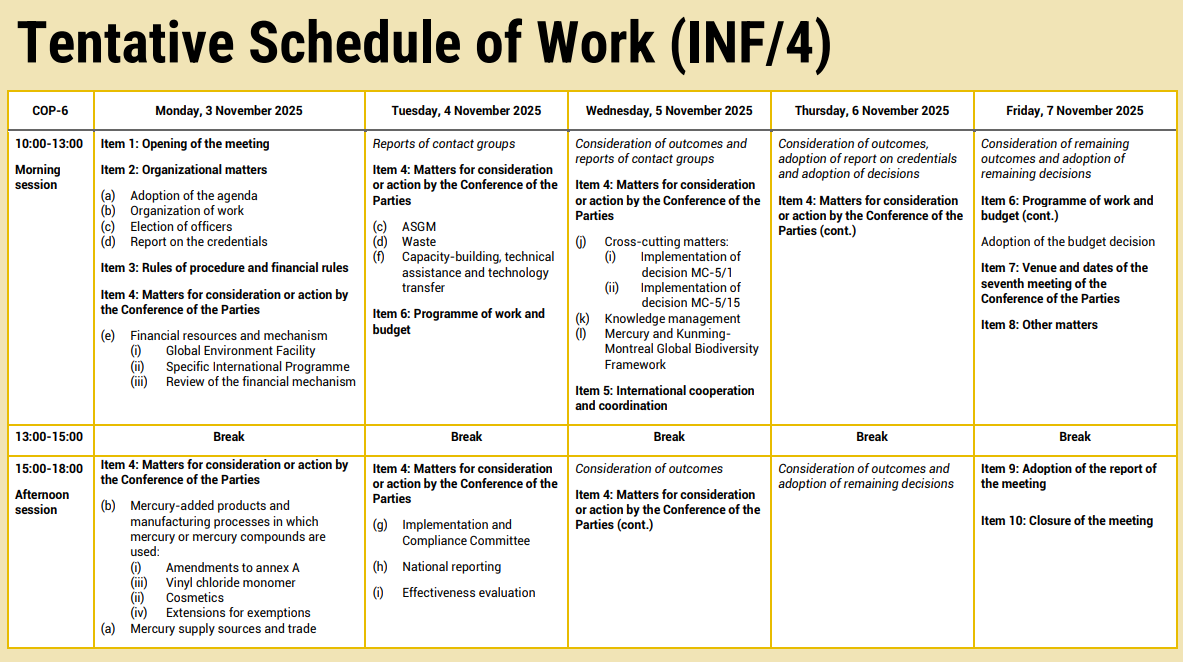
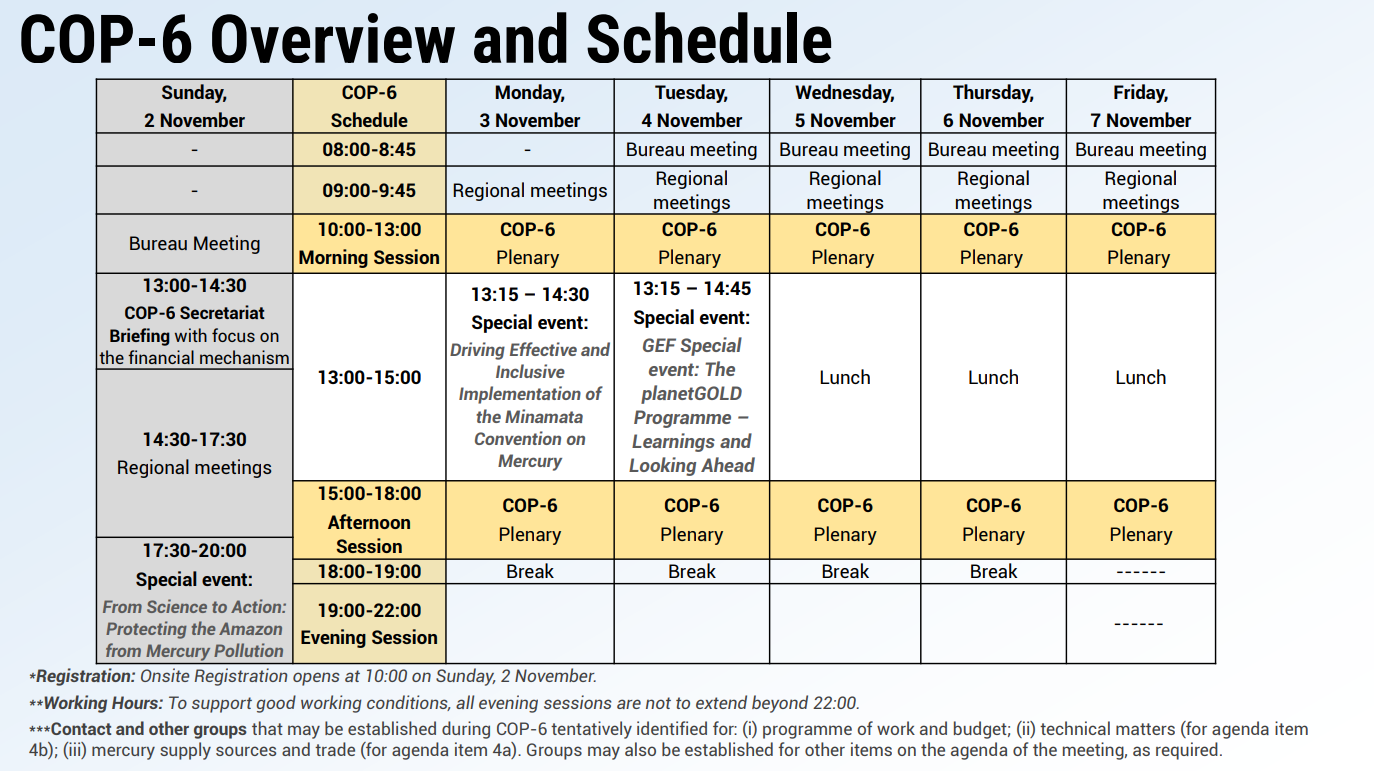
- The tentative schedule is contained in UNEP/MC/COP.6/INF/4 and it is designed to allow maximum time for the plenary to deliberate and adopt items.
- Interpretation will be provided for plenary sessions in all six UN languages and will be live-streamed in the six UN languages.
- The tentative schedule includes potential time required to meet in smaller groups and ensure that no more than one group works alongside with plenary or two groups to work at the same time concurrently once the plenary is adjourned. It will also be important to ensure draft decisions are finalized on time for the program of work and budget group to consider them before the adoption of the budget on the Friday of the meeting.
Documents
- The COP-6 webpage will be the essential hub for any COP-6 information. All documents are now posted.
-
The COP 6 webpage also hosts practical information, media updates and the live blog tabs and links to the special events and other online events happening already in October.
-
Closer to the COP, the live streaming and the dynamic schedule tab will be displayed.
-
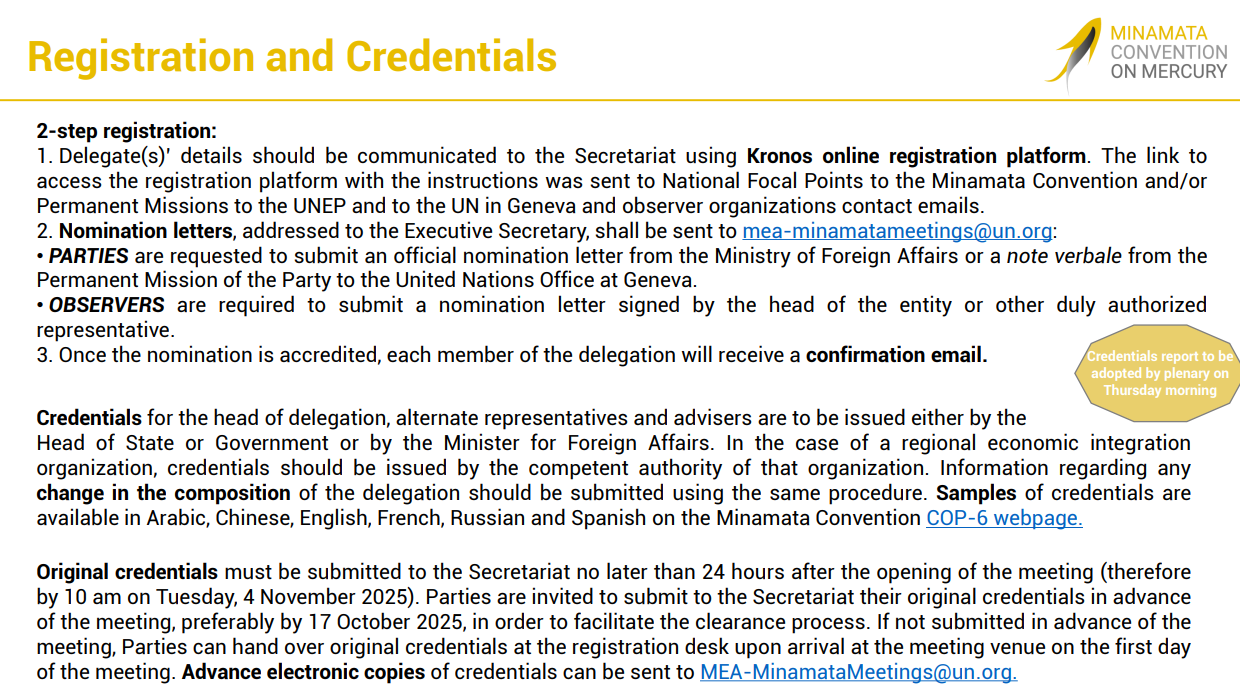
Once the COP starts, it will host password-protected areas for statements, conference room papers and contact groups.
Brenda KOEKKOEK | Senior Coordination Officer, Minamata
- Below are the substantive agenda points at COP 6:
COP-6 will be invited to consider two working documents under item 4(a) Mercury Supply Sources and Trade: on mercury supply sources and trade:
- UNEP/MC/COP.6/5 – Implementation of decision MC-5/2 on mercury supply sources and trade
- UNEP/MC/COP.6/5/Add.1 – Study of the global supply, production, trade and use of mercury compounds
Information documents:
- INF/6: Experiences and challenges in the implementation of Article 3, and activities undertaken in relation to the Bali Declaration
- INF/7: Additional information on types of actions that could be taken to identify individual stocks and sources of mercury and mercury compounds
- INF/5: Study of the global supply, production, trade and use of mercury compounds
COP-6 will be invited to consider the following documents under item 4(b) Mercury-added products and manufacturing processes in which mercury or mercury compounds are used:
- Item 4(b)(i): Amendments to annex A
- Item 4(b)(ii): Cosmetics listed in part I of annex A
- Item 4(b)(iii): Consideration of the feasibility of mercury-free alternatives for manufacturing vinyl chloride monomer
- Item 4(b)(iv): Extensions for exemptions
- 6/6/Add.3: Extension of exemptions pursuant to article 6 of the Convention
- Requests for an extension of the exemption for mercury-added products listed in Annex A of the Convention, for COP consideration: July 2025: Thailand (INF/42); Sept 2025: Bangladesh
COP-6 will be invited to consider the following documents under item 4(c) Artisanal and Small-Scale Gold Mining (ASGM):
- 6/7: Matters for consideration by the Conference of the Parties pursuant to decision MC-5/7 on artisanal and small-scale gold mining
Details the implementation status of the mandates established in Decision MC5/7: a) Progress made with respect to the implementation of Article 7; b) Effective engagement and participation of Indigenous Peoples, local communities and other stakeholders; c) Further efforts to advance implementation of Article 7; d)
Identified challenges from national reporting (2nd short national report).
COP-6 will be invited to consider the following documents under item 4(d) Waste
- 6/8: Mercury waste COP-5
Decision MC-5/10, invited Parties to submit information regarding waste management regulations and programmes as mentioned in Article 11(3)(a), requested the Secretariat to compile the information, and invited Parties to review the compiled information in preparation for COP-6. Doc 6/8 provides an overview of the information submitted by 8 Parties. - INF/12: Information submitted by parties regarding their waste management regulations and programmes
COP-6 will be invited to consider the following documents under item 4(e) Financial Resources and Mechanism
- 6/9: Matters for consideration by the COP pursuant to decision MC-5/11 on the review of the financial mechanism (includes a draft decision)
- 6/10: Update on matters related to the Global Environment Facility
- 6/10/Add.1: Executive summary of the report of GEF Council to COP-6
- 6/11: Overall report on the Specific International Programme to Support Capacity-Building and Technical Assistance
- 6/12: Draft terms of reference for the third review of the financial mechanism (includes a draft decision)
Information Documents: - INF/13: Report of the GEF Council to COP-6
- INF/14: The ninth replenishment of the GEF trust fund: draft strategic positioning and programming directions
- INF/15: Reports of the 9th and 10th meetings of the SIP Governing Board
- INF/16: Activities of the Special Programme
- INF/17: Information on the Global Framework on Chemicals fund
- INF/39: Compilation of obligations and deadlines under the Minamata Convention as per the Convention text
- INF/40: Draft analysis of expected SIP funding & related staffing needs
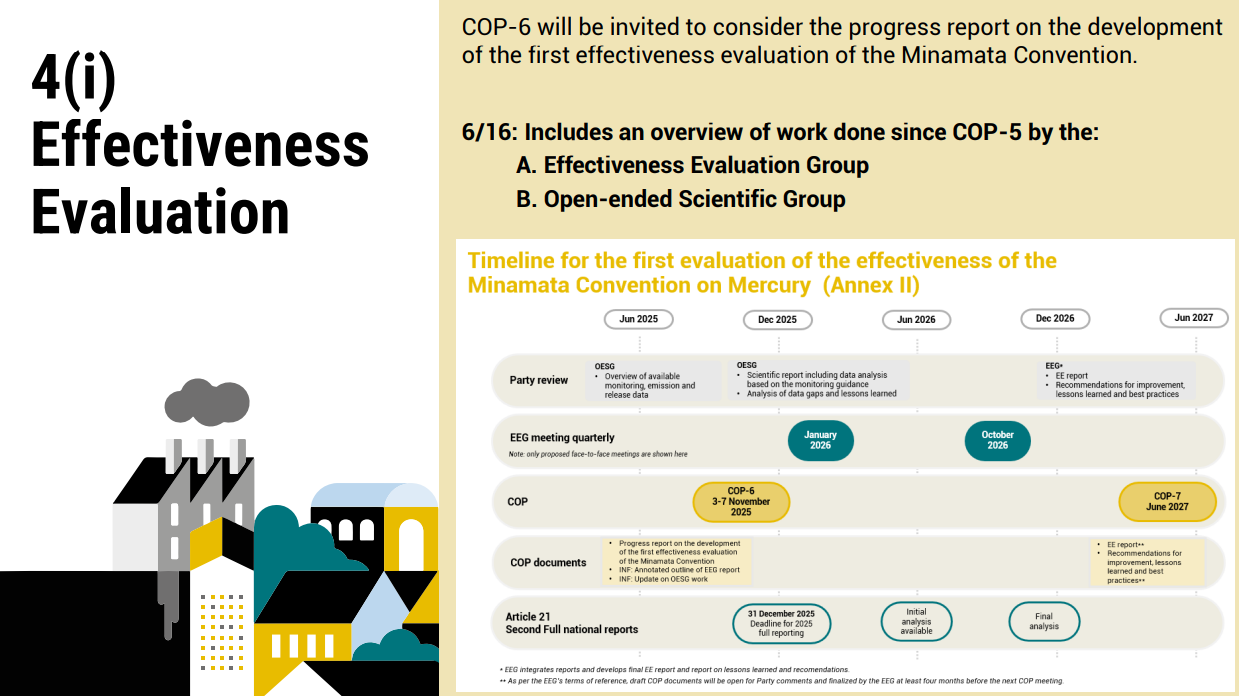
COP-6 will be invited to consider the progress report on the development of the first effectiveness evaluation of the Minamata Convention 4(i) Effectiveness Evaluation
4(j) Cross-cutting matters:
- (i) Implementation of decision MC-5/1
- (ii) Implementation of decision MC-5/15
4(k) Knowledge Management
- 6/19: Knowledge management and digitalization to support parties
- INF/26: Minamata Convention Exchange Platform
4(l) Mercury and the Kunming-Montreal Global Biodiversity Framework
- 6/20: Road map for enhancing co-benefits from implementation of the Minamata Convention and the KMGBF
- INF/27: Technical document on integrating action to reduce mercury pollution from ASGM into NBSAPs (funded by the Netherlands)
- INF/41: Key decisions of the CBD COP relevant to Minamata Convention
5 International Cooperation and Coordination
- 6/21: International cooperation and coordination
- 6/22: Cooperation and coordination between the secretariats of the Minamata Convention on Mercury and of the Basel, Rotterdam and Stockholm conventions
- INF/28: Information on activities undertaken by the Secretariat of the Minamata Convention to cooperate and coordinate with other entities: February 2024 to June 2025
- INF/29: Cooperation and coordination between the secretariats of the Minamata Convention and of the BRS conventions: joint report of past activities and framework for cooperation on planned activities
- INF/30: Report by the UNEP Executive Director to COP-6
- INF/31: Report by World Health Organisation and International Labour Organisation
- INF/32: Report on the mercury-related activities of relevant international bodies
- INF/33: Report on activities undertaken within the Global Mercury Partnership of UNEP
- INF/34: Report by the Global Framework on Chemicals
- INF/35: Report by the Secretariat of the Ad hoc open-ended working group on a science-policy panel on chemicals, waste and pollution prevention
6 Programme of Work and Budget
- 6/23: Programme of work and budget: proposed operational budgets for the two funding scenarios for the biennium 2026‒2027 Process
- It is expected that a budget contact group will be formed at COB-6 to have significant deliberations on this issue.
- A Minamata Online Session held on 30 September 2025 has delved deep into this issue. Member States that have not participated are invited to rewatch the session that tackles important details.
Anna GARCÍA SANS | Communications and Knowledge Management Officer, Minamata Convention on Mercury
Information on events that took or will take place in the lead-up to COP-6 can be found on the dedicated section of the Minamata Convention website.
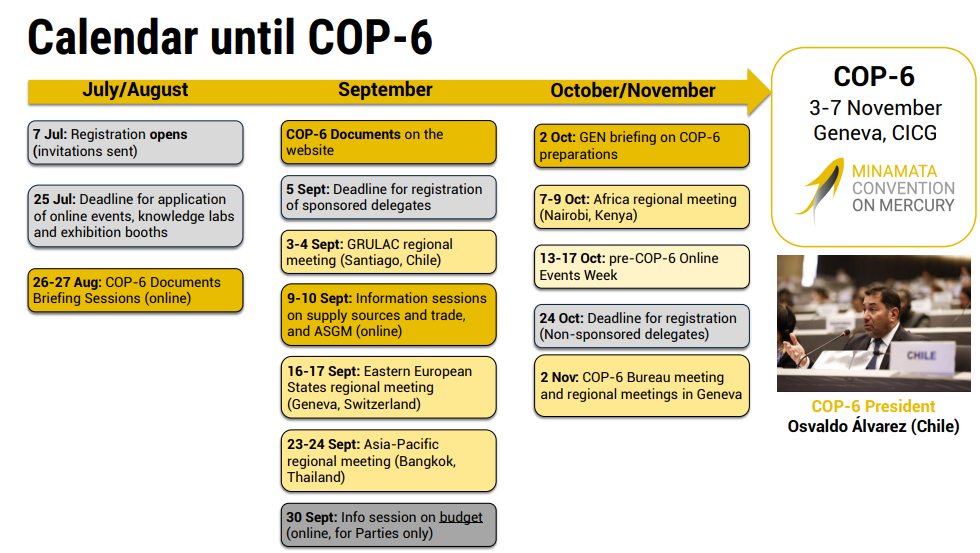
- Minamata Online Events took place right after the summer to prepare for COP-6.
- Minamata Online remains a key platform for engagement with parties and key stakeholders.
- Since the end of August, we have conducted two deep dive information sessions on COP 6 documents and specific sessions on mercury supply sources and trade, ASGM and the program of work and budget.
- All these preparatory sessions and thematic briefings are recorded and made available on the website. → Watch the recordings

Richard GUTIERREZ | Programme Management Officer, Minamata Convention on Mercury
COP-6 events are special events generally organized by the Minamata Convention Secretariat together with other partners to bring voices to add further context to the substantive issues that the parties will be discussing. These will include:
- Secretariat briefing on financial resources and mechanism | 2 November 2025 | 13:00 to 14:30 CET | International Conference Centre Geneva (CICG)
This in-person briefing will provide detailed information in accordance with Article 13 of the Convention. The purpose of the briefing is to provide an overview on financial resources and mechanisms of the Minamata Convention on Mercury, including:
(a) Status of the Specific International Programme from First through to Fourth Round of applications;
(b) GEF support to eligible Parties from GEF-6 through to GEF-8, and the status on GEF-9 replenishment process; and
(c) Third review of the financial mechanism. - From Science to Action: Protecting the Amazon from Mercury Pollution | Minamata COP-6 Special Event | 2 November 2025 | 17:30–20:00 CET | CICG
To amplify the human stories behind mercury pollution and to bring hope, science, and meaningful dialogue to the forefront of the COP-6 agenda, the Secretariat, in coordination with the Geneva Environment Network, is organizing special events featuring globally recognized voices in nature conservation, policy, and science. - Driving Effective and Inclusive Implementation of the Minamata Convention on Mercury | 3 November 2025 | 13:15 to 14:30 CET | CICG
This special event with special guests will facilitate the exchange of experiences and feature actions to implement the Minamata Convention that also bring other socioeconomic, human and environmental benefits. The event will feature diverse voices, including high-level representatives from Parties, IGOs and MEA secretariats, NGOs, Indigenous Peoples, youth and scientists engaged in environmental causes.
Other COP-6 Event
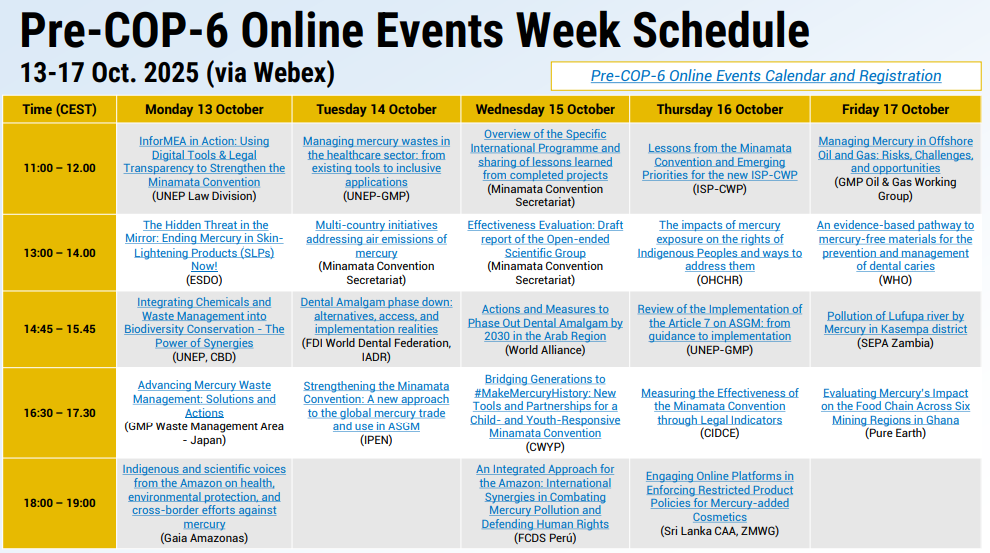
- Pre-COP-6 Online Events will take place from 13–17 October 2025 online and are an informal platform for Parties and observers to share knowledge on technology, research, and policy ahead of COP-6.
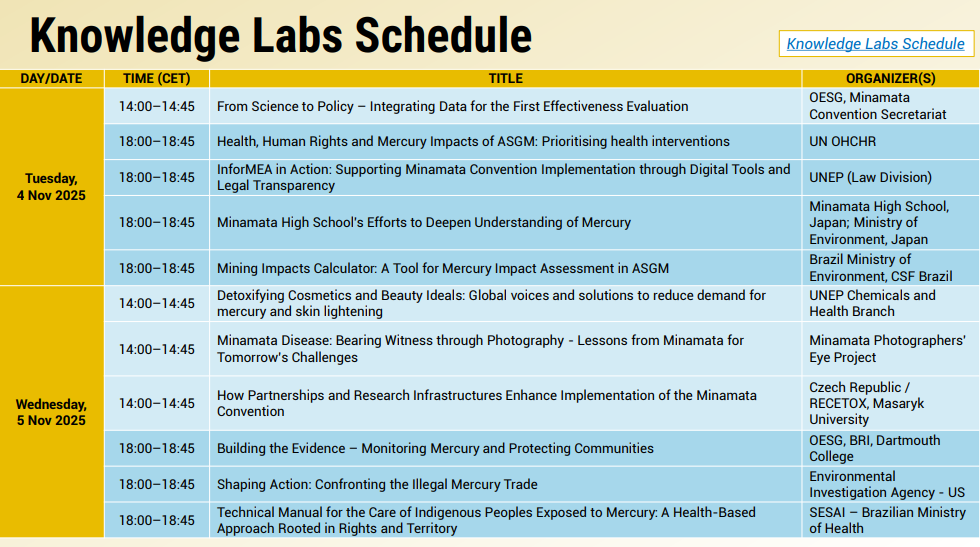
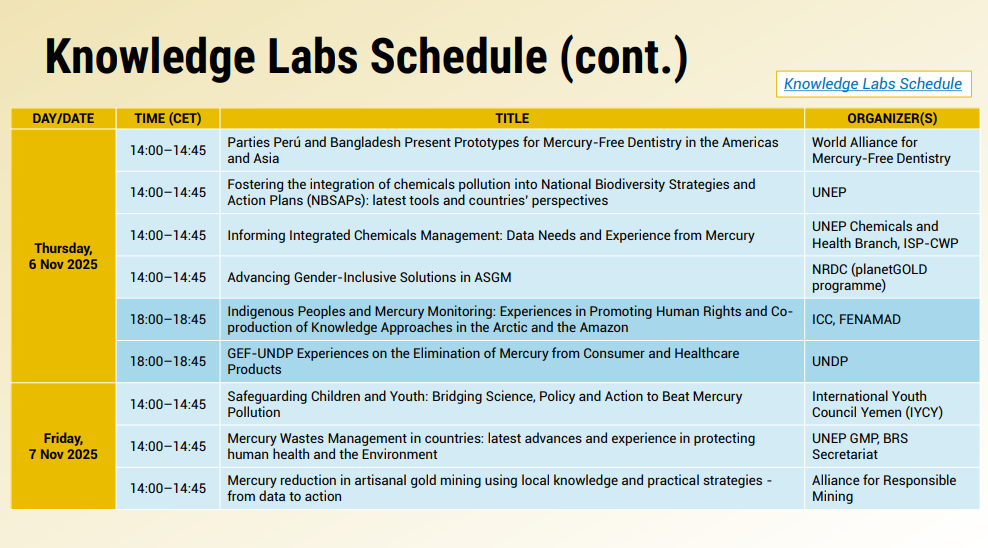
- Knowledge Lab Sessions are 45-minute interactive sessions during COP-6 for showcasing technical, policy and awareness-raising work on mercury, and engaging with COP-6 participants in an open-space format.
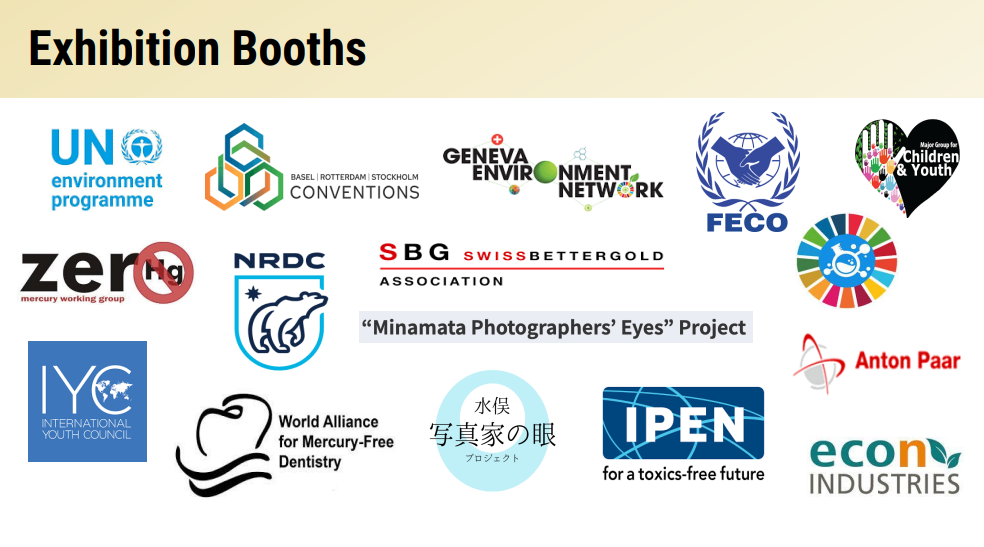
- Exhibition Booths will be available throughout COP-6 at CICG to display initiatives and for exhibitors to connect with COP-6 participants.
- There will be 15 exhibition booths, including a special photo exhibit from the Minamata Photographer’s Eye Project, featuring nine photographers showcasing work on the issue of Minamata.
- An important deadline to keep in mind is 31 December 2025, for submitting the second full national reports. This comprehensive 43-question report covers many of the topics discussed at COP-6 and is crucial for the Convention’s work. These national reports provide the core information used by the Conference of the Parties, the Implementation and Compliance Committee, and the Effectiveness Evaluation Group. Submitting complete and accurate data from as many parties as possible helps these bodies understand each country’s context and progress toward achieving the Convention’s objectives.
Stakeholders’ Perspectives
Michael BENDER | Director, Mercury Policy Project , Co-coordinator of Zero Mercury Working Group
- Zero Mercury proudly celebrates 20 years of engagement in UN mercury meetings and has prepared a dedicated document sharing its views on COP6 Decisions.
- Starting with Annexes A and B, the Zero Mercury Working Group supports phasing out dental amalgam by 2030, as safe and effective alternatives exist. They also back phasing out mercury use in VCM production, and support Gabon’s proposal to strengthen Article 4 by reducing both the supply and demand of mercury-added skin-lightening products (SLPs).
- Since 2017, ZMWG has led a global campaign to eliminate toxic SLPs, tracking their online sales and publishing reports — including coverage in CNN — all available on their website.
- A 2023 global review showed that two-thirds of SLP users had mercury levels more than six times higher than background levels. Researchers estimate tens or even hundreds of millions of users worldwide.
- At the 2023 International Conference on Mercury in Cape Town, they presented the first global estimates of SLP production. Findings suggest that Pakistan accounts for about 17% of global production, using 22.5 tons of mercury compounds. Extrapolating globally, roughly 66 million SLP units containing about 112.5 metric tons of mercury compounds are sold annually.
- While the Convention’s goal is to protect human health and the environment from mercury and its compounds, mercury compounds have not yet been thoroughly addressed. Under Article 3, paragraph 13, the COP must evaluate compounds that undermine the Convention’s objectives. Therefore, the Zero Mercury Working Group recommends COP-6 establish:
- An open-ended working group to address mercury compounds, especially in SLPs and other uses; and
- A second group to accelerate the closure of primary mercury mining supplying the illegal ASGM sector, eliminate loopholes aiding traffickers, and improve trade reporting and enforcement.
- The Secretariat should work with parties and experts to harmonize data collection for the effectiveness evaluation.
- Finally, more details and a database of over 1,000 tested products are available on the Mercury-Added Skin-Lightening Creams Campaign. Everyone is invited to their pre-COP webinar in mid-October, co-hosted with Sri Lanka’s Consumer Affairs Authority, to discuss cooperation with online platforms in restricting mercury-added SLPs.
Alexyss McCLELLAN-UFUGUSUKU | Member, Chemicals and Waste Youth Platform and Global Indigenous Youth Caucus & Co-Lead of the Mercury Youth Task Force
- As member of the Global Indigenous Youth Caucus (GIYC) and the Chemicals and Waste Youth Platform (CWYP), I serve as an Indigenous youth liaison between the two for Minamata COP-6.
- The youth mobilization for COP-6 is being co-led by GIYC and CWYP, engaging a broad coalition of youth-led organizations and UN youth constituencies such as YOUNGO (UNFCCC), the UNCCD Youth Caucus, and the Global Youth Health Caucus.
- The Global Indigenous Youth Caucus includes Indigenous youth from diverse regions and backgrounds who have participated in UN processes since the first UN Permanent Forum on Indigenous Issues, advocating for Indigenous rights and youth voices. The Chemicals and Waste Youth Platform, now over 3,000 members from 150 countries, coordinates global youth action on chemicals, waste, and pollution and has played an active role in key meetings like ICCM5 and the BRS COPs.
- In 2023, youth presented the Global Youth Declaration on Chemicals and Waste, outlining 14 core demands for a sustainable, equitable, and toxic-free world—such as protecting children from hazardous waste and integrating chemicals and waste education. This declaration now guides youth engagement with the Global Framework on Chemicals. Youth have also organized the first-ever youth-led forums on chemicals and waste governance, and they aim to make youth participation a permanent part of the Minamata Convention.
- Ahead of COP-6, regional virtual youth workshops are being held across all six UN regions, plus sessions for Indigenous youth and youth facing discrimination based on work and descent (e.g., waste pickers). These workshops will shape the Global Youth Declaration on Mercury and regional statements, while a worldwide call is open for youth delegates to join the in-person COP.
- However, financial barriers remain a major challenge—especially for youth from least developed countries, small island states, Indigenous communities, and marginalized groups. The CWYP and GIYC have circulated travel grant applications, receiving a record number of Indigenous applicants, many directly affected by mercury pollution in their communities.
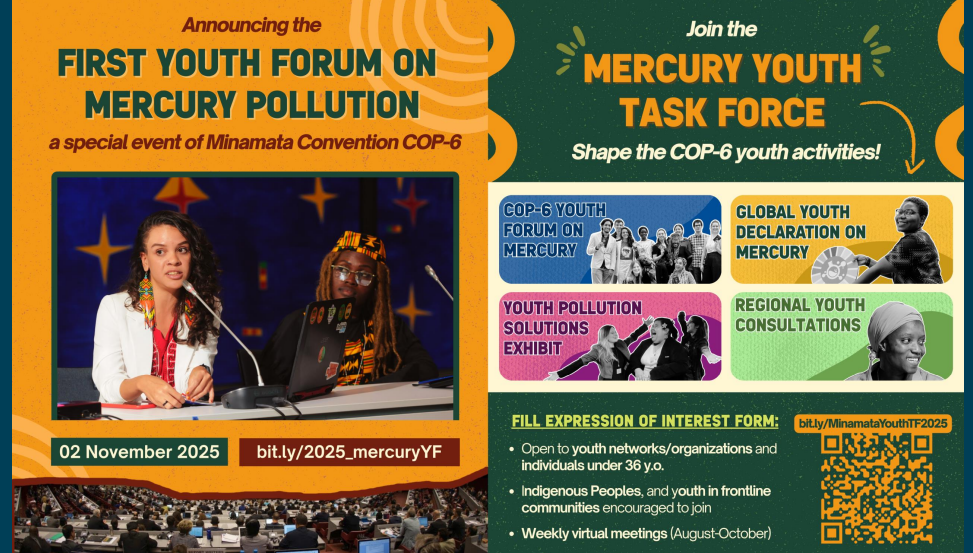
- At COP-6 in Geneva, a hybrid Youth Forum on Mercury Pollution will take place on 2 November, supported by the Minamata Secretariat and partners. It will focus on youth and children’s exposure to mercury and their participation in achieving the Convention’s goals. This aligns with broader UN youth engagement efforts such as the Pact for the Future, the UN Youth Office, and Youth2030 Phase II.
- The forum has three main goals:
- Highlight the health and rights impacts of mercury on children and youth, and strengthen their role in the Convention’s work.
- Showcase youth-led initiatives, including the new Mercury Youth Task Force (bringing together over 60 youth organizations) and the Youth Action Hub on Toxic Metals, sharing stories and solutions.
- Launch the first Global Youth Declaration on Mercury and the Minamata Convention Youth Guidebook, a toolkit created by youth to help others engage in the process.
- Children and youth are among the most harmed but least heard in mercury policy. Chemical pollution now poses a global threat comparable to climate change, yet lags behind in awareness and action. To make “Mercury history,” youth must be part of the solution.
Thomas VERBAERE | Junior Mercury Expert, UNEP Global Mercury Partnership Secretariat
- The Global Mercury Partnership, established in 2005 under UNEP, is a network of 276 partners from governments, IGOs, NGOs, academia, the private sector, and the scientific community, working to reduce mercury pollution. The partnership operates through eight focus areas covering sectors such as extractives, energy, health, industry, and electronics.
- Its main functions include knowledge management via its website and dashboards (e.g., on ASGM national action plans), organizing webinars, communication campaigns, and supporting emerging issues like non-ferrous metals, oil and gas, youth, indigenous communities, diversity, and gender.
- Upcoming events include two virtual pre-COP sessions—one on Article 7 implementation (ASGM) and another on mercury in offshore oil and gas. During COP, the partnership will host a UNEP PlanetGOLD side event, two knowledge hubs (on ASGM, biodiversity, and cosmetics). Finally, there will be a public “green zone” exhibition featuring the Humanæ Project by artist Angélica Dass to raise awareness on the matter of colorism skin products, and a public screening and debate on the Senegalese film Timpi Tampa from the Senegalese director on skin-lightning products.
- UNEP Global Mercury Partnership launched the “Detoxifying Cosmetics and Beauty Ideals” global campaign, beginning in Addis Ababa in Ethiopia with 13 African countries committing to tackle the exposure of mercury in skin-lightening products.
- New working groups have been established to address mercury emissions from oil, gas, and non-ferrous metal mining and smelting.
Q&A
Mexico Representative
- First, regarding the password-protected area of the website — what is the process for accrediting and providing credentials to access it?
- Second, regarding the new Women’s Caucus of the Minamata Convention on Mercury — Mexico is very pleased and supportive of this initiative. What is its purpose, agenda, and how delegations can best engage with it?
Anna GARCÍA SANS | Communications and Knowledge Management Officer, Minamata Convention on Mercury
- Once COP begins, all registered participants will receive an email with a unique username and a generic password to access the password-protected area of the main website.
- Unlike other systems that use separate sites or intranets, everything is integrated into one platform. This protected section includes key materials such as conference room papers, contact group information, budget tables, and delegates’ statements—documents meant to support participants’ work during the COP.
- These items will be clearly marked with a small icon on the COP-6 webpage, and users can log in by entering their provided username and password in the pop-up boxes that appear.
Lara Ognibene | Legal Officer and gender focal point, Minamata Convention on Mercury
- COP-6 will be the first conference to feature a Women’s Caucus. Invitations to join were circulated to organizations active on women and mercury issues, and over 90 organizations have requested to participate.
- The caucus is a self-organized group, coordinated by the MSP Institute and Women for Biodiversity, with both organizations and other representatives attending COP-6. The Secretariat will provide logistical support, including a meeting room, a posted schedule, and a nameplate in plenary so the caucus can deliver statements on relevant agenda items—such as the implementation of Decision 5/15 on the Gender Action Plan, ASGM, and biodiversity.
- Additionally, there are plans to promote the caucus’s visibility through media coverage, interviews, and a dedicated booth. The Secretariat welcomes collaboration and support from parties interested in contributing to this initiative.
Closing Remarks
Océane DAYER | Waste and Chemicals Focal Point, Federal Office for the Environment, Switzerland
- The Minamata Convention was a historic milestone for global environmental governance, addressing mercury pollution through a life-cycle approach—from mining to disposal—to minimize harm. Countries must continue strengthening this framework and closing legal loopholes to “make mercury history.”
- Looking ahead to COP-6, key agenda items include proposed amendments to Annex A (such as setting a phase-out date for dental amalgam), preventing circumvention of mercury trade rules, ensuring the Convention’s financial stability, and deepening cooperation with the Basel, Rotterdam, and Stockholm (BRS) Conventions and the broader chemicals and waste cluster.
- Synergy and collaboration are really important both with the BRS Conventions and with new initiatives like the Intergovernmental Science-Policy Panel on Chemicals, Waste, and Pollution.
- Geneva, as the global hub for chemicals and waste governance, plays a central role in bringing together expertise, dialogue, and innovation.
- There is an ongoing need for continued vision, cooperation, and commitment to protect human health and the environment from mercury
Documents
Links
- Sixth Meeting of the Conferences of the Parties to the Minamata Convention
- Towards the Sixth Meeting of the Conference of the Parties to the Minamata Convention on Mercury (COP-6)
- Geneva addressing Hazardous Substances
- Eliminating Mercury Skin Lightening Products | UNEP Global Mercury Partnership
- Phasing-down the Use of Dental Amalgam | UNEP Global Mercury Partnership
- Insights from ASGM National Action Plans | UNEP Global Mercury Partnership