
Événement Conférence
Road to OEWG 3 Series | Briefing on the Preparations for the 3rd Session of the Ad Hoc Open-Ended Working Group on a Science-Policy Panel to Contribute Further to the Sound Management of Chemicals and Waste and to Prevent Pollution

06 Juin 2024
14:00 – 15:30
Lieu: International Environment House II & Online | Webex
Organisation: Groupe de travail spécial à composition non limitée chargé d’examiner la création d’un groupe d’experts sur l’interface science-politiques au service de la gestion rationnelle des produits chimiques et des déchets et de la prévention de la pollution, Geneva Environment Network
This briefing on the third session of the Ad Hoc Open-Ended Working Group on the Science-Policy Panel to contribute further to the sound management of chemicals and waste and to prevent pollution (OEWG 3) taking place in Geneva, from 17 to 21 June 2024, was held within the framework of the Geneva Environment Network, and concluded a series of events organized in preparations for OEWG 3.

About this Session
In its resolution 5/8, the United Nations Environment Assembly (UNEA) decided that a science-policy panel should be established to contribute further to the sound management of chemicals and waste and to prevent pollution. UNEA further decided to convene an OEWG to prepare proposals for the science-policy panel, to begin work in 2022 with the ambition of completing it by the end of 2024.
The second session of the Ad hoc Open-Ended Working Group (OEWG 2) took place in December 2023 in Nairobi, achieving significant progress. Discussions on institutional arrangements, operating principles, conflict of interest, and other work-related processes and procedures allowed governments to have a better idea of the future instrument’s structure and functioning, and they agreed on a clear roadmap for intersessional work towards the third session.
This briefing provided updates on the preparations for the third session of the OEWG (OEWG 3), that will take place at the International Conference Center in Geneva (CICG) from 17 to 21 June 2024 and was preceded by informal, regional and stakeholder consultations on 16 June 2024. The event will also bring regional and stakeholders’ perspectives on the process.
Road to OEWG 3 Series
In March 2022, the United Nations Environment Assembly at its resumed fifth session (UNEA-5.2) agreed to establish an independent, intergovernmental science-policy panel to contribute further to the sound management of chemicals and waste and to prevent pollution. An ad hoc open-ended working group (OEWG) process has been initiated to prepare proposals for the panel.
As set out in UNEA resolution 5/8, the panel will support countries in their decision-making on chemicals, waste and pollution prevention, including in relation to various international instruments such as multilateral environmental agreements (MEAs), by providing policy-relevant scientific knowledge and information. The panel will also promote coordination and cooperation with relevant MEAs other international instruments and intergovernmental bodies, and relevant stakeholders, whilst avoiding overlap and duplication of work.
The OEWG concluded its second session in December 2023 in Nairobi, and will hold its third session in June 2024, in Geneva.
In preparation for the third session, the Road to OEWG 3 | Science-Policy Panel to Contribute Further to the Sound Management of Chemicals and Waste and to Prevent Pollution webinar and event series, co-organized by the OEWG Secretariat and Geneva Environment Network aims to build bridges between and among stakeholders, and promote collaboration and knowledge sharing in preparation for OEWG 3, taking place in Geneva, in June 2024.
Speakers
By order of intervention.

Gudi ALKEMADE
Chair, SPP OEWG | Deputy Permanent Representative to UNEP, Kingdom of the Netherlands

Tessa GOVERSE
Principal Coordinator, SPP OEWG Secretariat

Maria NEIRA
Director, Department of Environment, Climate Change and Health, WHO

Lesley ONYON
Head, Chemical Safety and Health Unit, WHO

Judith TORRES
Officer, Ministry of Environment, Uruguay

Jinhui LI
Executive director, Basel Convention Regional Center for Asia and the Pacific |Professor, School of Environment, Tsinghua University, China

Heidi MORKA
Specialist Director, Department for Marine Management and Pollution Control, Ministry of Climate and Environment, Norway

Oumar Diaouré CISSE
Ministry of the Environment, Sanitation and Sustainable Development, Mali

Aseel ABO-TALEB
Thematic Facilitator Chemicals, Waste and Pollution, Children and Youth Major Group to UNEP

Shannon LISA
Chemicals & Waste Youth Platform, Major Group for Children and Youth

Camilla ALEXANDER-WHITE
Lead Policy Advisor, International Chemicals Policy, Royal Society of Chemistry

Maria RUIZ-CUEVAS
International Council of Chemical Associations (ICCA)

David AZOULAY
Director of the Geneva Office and of the Environmental Health Program, CIEL

Michel TSCHIRREN
Head, Global Affairs Section, Federal Office for the Environment, Switzerland

Jacqueline ALVAREZ
Chief, Chemicals and Health Branch, UNEP | Moderator
Highlights
Summary
Opening Remarks
Gudi ALKEMADE – Chair, SPP OEWG | Deputy Permanent Representative to UNEP, Kingdom of the Netherlands
- We are coming at the end of our mandate established by UNEA resolution 5/8 in March 2022 to prepare proposals for a science-policy panel to be established to contribute further to the sound management of chemicals and waste and to prevent pollution, to be subsequently considered for adoption by the intergovernmental meeting to establish the panel.
- At the second session, the working group, following substantive discussions, laid the foundations to develop proposals for the establishment of the panel based issues outlined in paragraphs five and six of the resolution 5/8. A skeleton outline has been agreed upon, including the results of discussions on the proposals for the panel. It includes the scope of the panel, its functions, its operating principles, institutional arrangements, evaluation, as well as relevant processes and procedures for the panel to function. Together with resolution 5/8 that guides our mandate, these proposals provide the basis for our continued negotiations at the third session.
- In addition, the working group requested the Secretariat to provide draft texts, including on rules of procedure, financial procedures, the processes for determining the work program, procedures for the panel’s deliverables and an updated conflict of interest form.
- The working group also requested proposals to be considered by the intergovernmental meeting to prepare proposals on interim arrangements as a basis for our discussions at the third session. All documents are available on the website.
- There is a lot of work ahead to finalize the proposals on the foundational document, the decisions for the intergovernmental meeting, as well as the annexes to be forwarded and considered by the panel itself, in particular annexes 1,3 and 5.
- To make efficient use of time at the third session, it will be important to come prepared and focus negotiations to set the foundations of the future panel. We should not underestimate the task ahead and the opportunity to build upon the foundations laid in the previous meetings. The panel will have enormous potential to provide sound scientific evidence relevant to policymakers. We should take advantage of the commitment and engagement of the relevant stakeholders that present their views.
- This briefing will help member states and stakeholders to assess necessary information and to come prepared to finalize proposals that are required to establish the panel, which also entails flexibility to align on the purpose and the format of a future panel.
Update on Preparations For the Third Session of The Ad Hoc Open-Ended Working Group on A Science-Policy Panel to Contribute Further to the Sound Management of Chemicals and Waste and to Prevent Pollution (OEWG 3)
Tessa GOVERSE | Principal Coordinator, SPP OEWG Secretariat
- After calls for more than a decade to strengthen the science-policy interface for chemicals, waste and pollution, the UNEA decided in 2022 that a science-policy panel should be established to contribute further to the sound management of chemicals and waste and to prevent pollution.
- With details to be specified as outlined in the resolution, UNEA further decided to convene an open-ended working group to prepare proposals for a science-policy panel to begin its work in 2022, with the ambition of completing it by the end of 2024.

- It was envisaged that the OEWG would hold three sessions.
- Ahead of OEWG 3, the Secretariat has been preparing for the third session based on requests by OEWG 2, in close collaboration with the Bureau.
- In the intersessionational period, several webinars were held. → Rewatch the sessions and access summaries
Practical Information
- OEWG 3 will take place at the International Conference Center in Geneva and will be hosted by the government of Switzerland. Regional and stakeholder consultations will start on Sunday, 16 June 2024.
- Registration starts on Sunday from 9:00 a.m.
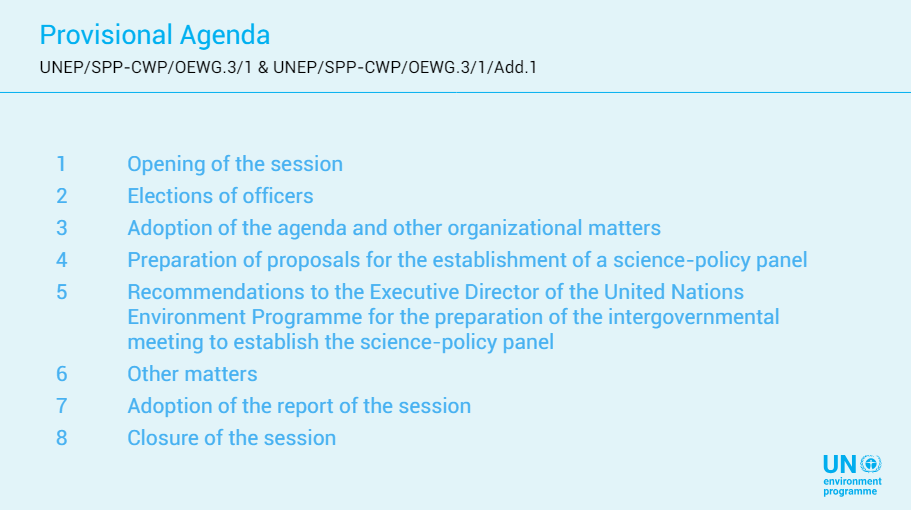
Provisional Agenda
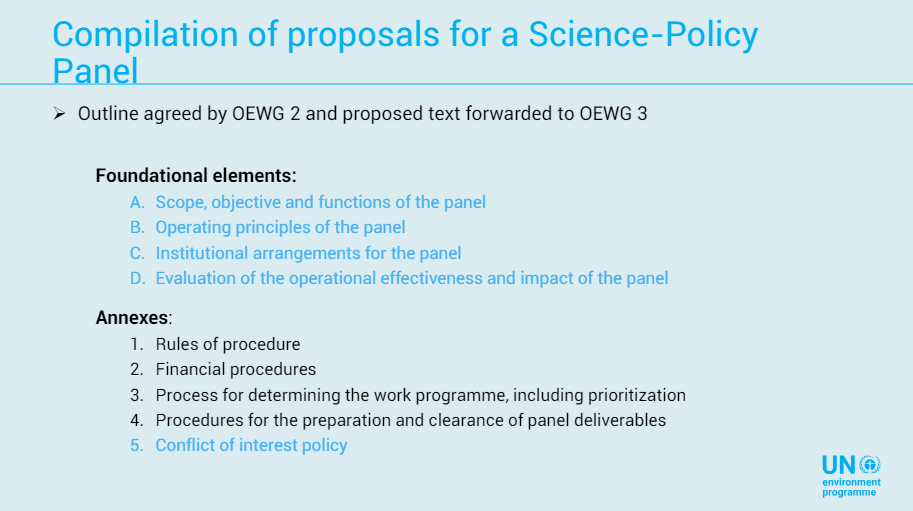
- OEWG 2 agreed to work towards populating an agreed outline with these proposals, which consists of foundational elements required for the establishment of the panel, as well as annexes that would constitute rules procedures, policies, and guidance for the panel itself. The work on the proposal started during OEWG 2 and the outcome of OEWG 2 (blue highlight) as well as the annex on conflict of interest have been directly forwarded to OEWG 3. The compilation of proposals that can be found as document OEWG3/2 is in the list of working documents and does contain the outcome of OEWG 2.
Working and Information Documents:
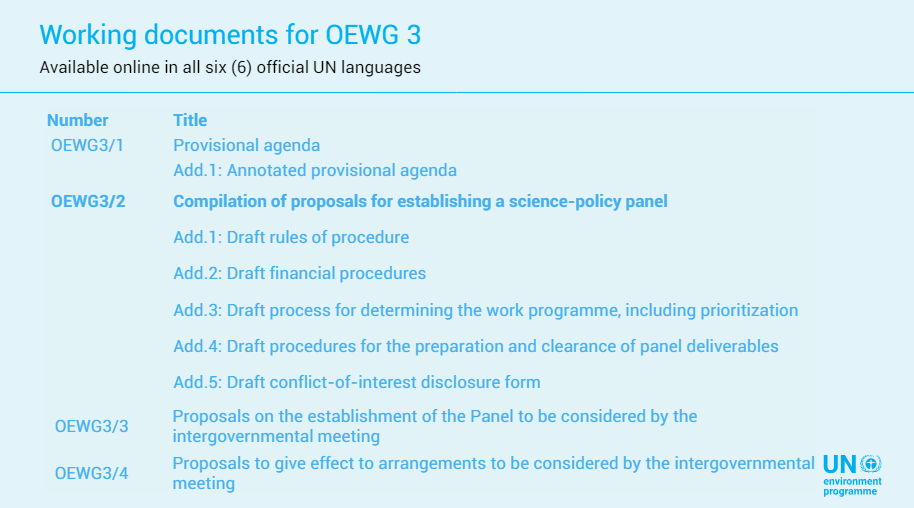
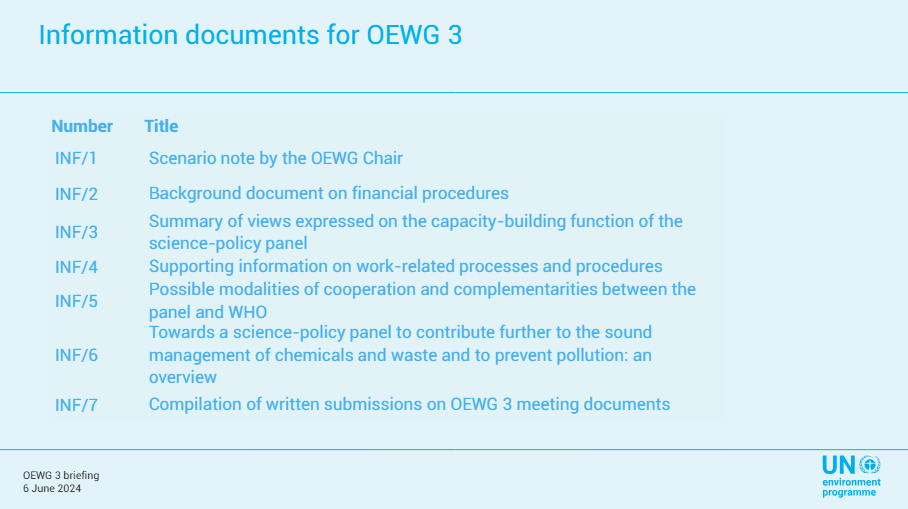
Proposed modalities for OEWG 3:
- No opening statements expected under Agenda Item 1 (opening of the session), while general statements might be allowed under Agenda Item 4 and 5. Participants are encouraged to provide such statements through regional and political groups and the group of stakeholders.
- Under Agenda item 4 and 5, the Secretariat will give a brief presentation of the working documents. For each working document, the working group may wish to invite governments to consider the specific topics and proposals outlined in the documents (including relevant information documents).
- Views on the working documents can be expressed by governments, then stakeholders may also be invited to provide their views.
- Contact groups and informal groups will be established as needed. Contact groups are open to participation by all governments and stakeholders, unless otherwise decided by the Chair or the co-facilitators of contact groups.
- Contact group meetings may be held in parallel, while avoiding, to the extent possible, parallel meetings on closely related issues. Efforts will be made to ensure that no contact group meets concurrently with a plenary meeting and that no more than two contact group meetings are held concurrently.
- Given the anticipated limited time available and the limited size of delegations, OEWG may wish to facilitate an iterative process and limit contact group sessions for working on specific issues to 90 minutes.
- Contact groups and informal groups will be provided with a clear and concise mandate.
- Contact groups will continue to build upon what was already agreed, including in UNEA resolution 5/8 and previous sessions of the OEWG.
- These modalities are very similar to those adopted in previous sessions.
Contact groups:

Tentative Schedule
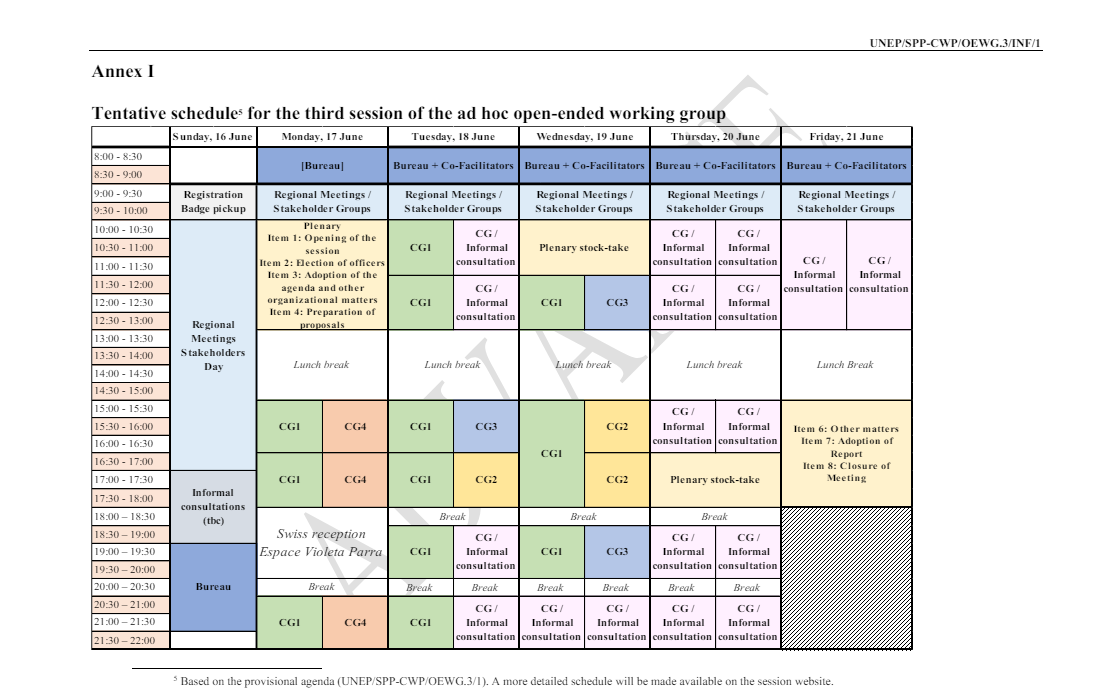
Plenaries will be livestreamed.
Expected Outcomes
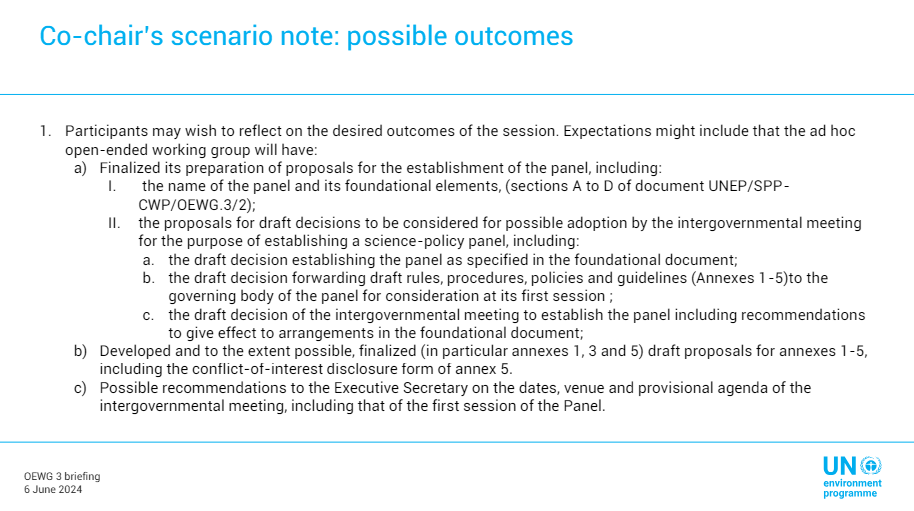
→ For further information, read the Scenario note by the OEWG Chair (UNEP/SPP-CWP/OEWG.3/INF/1)
Expected Participation
Over 800 people are currently registered from over 141 governments.
Maria NEIRA – Director, Department of Environment, Climate Change and Health, WHO
- Environmental factors have long been recognized to contribute significantly to poor health outcomes. According to our estimates, one-quarter of all global deaths are linked to the environment, which includes chemicals, waste and pollution. The evidence shows that those impacts are not decreasing despite the improvement in the scientific evidence and awareness by member states. Therefore, we are facing catastrophic consequences of inaction.
- WHO supports the establishment of a science-policy panel to accelerate and foster actions needed to reverse the current trends and to be able to implement evidence-based solutions. This panel must be holistic in its approach and find multisectoral solutions. This is the only way we can be effective and engage with other sectors.
- WHO is a science-based organization and science and evidence should remain at the core of the global decision-making processes, normative instruments and policies affecting the health of our population. The SPP should therefore complement the work of relevant international instruments and the work of international organizations.
- As mandated by our World Health Assembly, WHO is committed to exploring all options for its future engagement in the panel, including the provision of a joint Secretariat with UNEP.
- There is wide support for such an engagement among our Ministers of Health as voiced at the 77th World Health Assembly.
- We look forward to the outcomes of the OEWG 3 and the settling of the design and foundations of the panel.
- WHO will support and consider the best configuration for building the panel and seeing it become operational and successful for the good of our planet, our environment, and our health.
Regional Perspectives
Judith TORRES – Officer, Ministry of Environment, Uruguay
- When we gather in regional settings, we try to give everyone the same level of information, especially when new colleagues are coming to the process at this latest stage.
- The Secretariat, the Bureau and our president have done excellent work in considering the issue of small-sized delegations when organizing the contact groups and the timetables for the discussions.
- GRULAC’s main requests for the negotiation include:
- Not reopening UNEA resolution 5/8, which serves as a guide.
- Having an efficient and strong Secretariat to support us.
- Further strengthening the capacity-building function. There currently are two proposals on this new function of the panel, and we are developing a text for these agreements.
- Discussions on the policy committee and the possible overlapping functions with the governing body, and other bodies that are inside the institutional arrangements text for the discussions in June.
- Developing a strong policy on conflicts of interest, and potentially a committee that could address this task.
Heidi MORKA – Specialist Director, Department for Marine Management and Pollution Control, Ministry of Climate and Environment, Norway
- A strong and comprehensive science-policy interface to tackle the pollution pillar of the triple planetary crisis is needed, in line with the decision made at UNEA 5 in 2022.
- The new panel will play an essential role by producing a global knowledge base for new policies and regulations. There is a lot of information data and knowledge to build on. This gives an adequate basis for synthesis and analysis. Indeed, a previous UNEP report assessing different options for strengthening the science-policy interface at the international level for sound management of chemicals and waste, points out that the main challenge is to activate the knowledge in a way that leads to useful action and solutions.
- Once operational, the panel will complete the role of similar scientific bodies for climate change, and nature and biodiversity loss. The opportunity is unique to us, and the expectations are very high. We must complete our work now.
- e now have the complete text proposal for the foundation and for the panels’ processes and procedures, and this enables us to see the full picture of what we are creating.
- We must prioritize discussions on the texts necessary for the establishment of the panel. The meeting documents gives clear guidance on which elements are to be finalized and adopted by the intergovernmental meeting, and what could or must be left to the panel itself to decide.
- The Secretariat’s proposal for the panel’s processes and procedures fills out the picture and clarifies the role of the different bodies of the panel, for example, the governing body and the IEC. We think it would be beneficial to finalize the rules of procedure at OEWG 3 to facilitate the first session of the panel to be organized back-to-back with the intergovernmental meeting planned for February 2025.
- At the intergovernmental meeting in 2025, we are expected to start the preparations for the first work program and determining a work program in 2026.
- We have agreed on some texts, thus reopening those for discussion could result in a waste of precious time.
- The agreed scope is wide, which is an advantage in order not to exclude any topics that may prove to be important to assess in the future. It also gives flexibility when establishing the panels’ work programs and identifying deliverables that are needed.
- At our meeting in June, the focus should be from day one on streamlining the texts to facilitate agreement at that meeting. There is a need for simplification to produce a clear and concise text and already existing text from IPBES and IPCC should inspire us as much as possible with the necessary adaptations to the chemicals and waste cluster. It will also ensure that the new panel is recognizable to a wide audience.
Jinhui LI – Executive director, Basel Convention Regional Center for Asia and the Pacific | Professor, School of Environment, Tsinghua University, China
- The Asia Pacific regional meeting were held in Hangzhou, China. The 37 participants included 16 countries.
- Representatives discussed all documents and expressed concerns over some issues such as the objectives, capacity building, operational principles, membership, policy committee, and decision-making of the governance of the Panel.
- Although a common understanding hasn’t been reached on all topics, we do have a document that is a skeleton of the key points.
- The regional group believes that the operational principles and the scope should be fully aligned with the principles stated in UNEA Resolution 5/8, any expansion in these principles at this stage of the process could be counterproductive to our discussions and delay the needed consensus on finalizing our work.
- Many countries in the Asia-Pacific group are developing countries, thus we recognize the importance of capacity-building including providing financial resources, technical assistance and transfer of technology to support these countries in achieving the mandate of the SPP on chemicals and waste and to prevent pollution. We emphasize the importance of expanding the capacities of scientists in developing countries across all relevant areas for facilitating cooperation with the Panel.
- The Panel should avoid duplication with other existing intergovernmental settings, multilateral agreements, regional bodies, and mechanisms related to chemicals and waste and to prevent pollution. Moreover, the subsidiary bodies under the Panel should avoid overlapping or duplication of work with each other and encourage the engagement of developing countries.
- It is of paramount importance to attain consensus-based decision-making throughout the work of this OEWG as well as throughout the institutional arrangements of the SPP.
Stakeholders Perspectives
Aseel ABO-TALEB – Thematic Facilitator Chemicals, Waste and Pollution, Children and Youth Major Group to UNEP
- Major milestones and sessions over the past few months have showcased the Children and Youth caucus preparations and efforts. These included online consultations and preparations for the establishment of the future science-policy panel, as well as webinars and a series of coordination calls for the policy position and the regional meeting.
- CYMG attended the in-person regional meetings delivering the youth’s global demands and perspectives along with highlighting regional context and youth’s priorities.
- Intersessional work was also carried out. The webinar held on 31 May showcased youth’s priorities for the future panel and highlighted why children and youth are particularly impacted by the failures in preventing pollution and the unsound management of chemicals and waste.
Youth Consultative Meeting
- Taking place on 16 June from 09:30 CEST at the International Conference Center in Geneva, the consultation will provide a platform for youth delegates to prepare for their week, finalize their position, and engage in a high-level round table discussion focused on the engagement options with a future panel.
Key messages
- Establishing a Youth Experts Advisory Group can make the new panel more inclusive, responsive, and impactful, bridging the gap between the scientific community and the lived realities of young people.
- The new panel should learn from the best practices of youth engagement adopted by existing interfaces while being innovative in its approach to addressing the persistent barriers, including limited knowledge, awareness, accessibility, inclusivity and participation.
- The stakeholder engagement strategy for the new panel should be developed through a public consultation process that actively engages young people.
Priorities
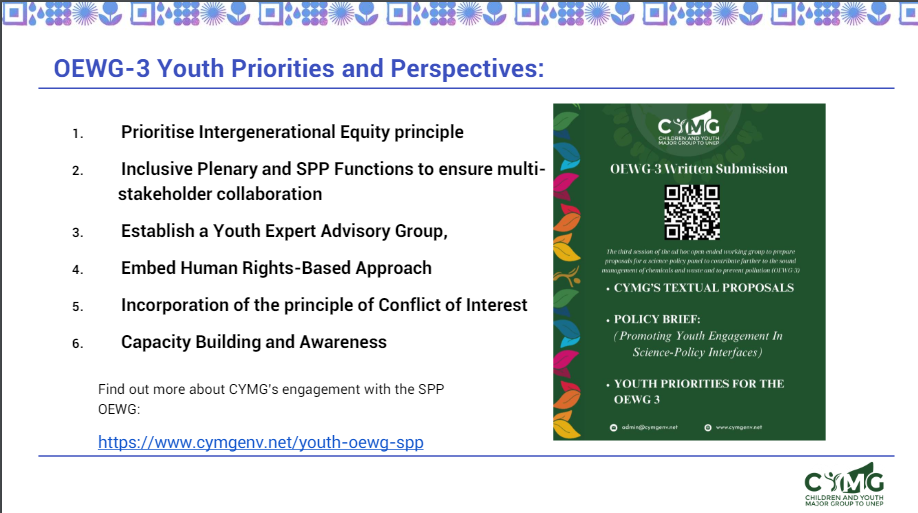
Shannon LISA – Chemicals & Waste Youth Platform, Major Group for Children and Youth
- Children and youth are the most harmed but least heard population group when it comes to the unsound management of chemicals and waste.
- Specific roots of exposure and health impacts to children and adolescents have only been evaluated intensively for a very small portion of chemicals.
- The longtime neglect of the specific risks to children and youth, and of global chemicals and waste science and policy processes is now starting to shift.
- Differentiated impacts on children and other vulnerable population groups are now explicitly recognized within the text and targets of the Global Framework on Chemicals. The Children and Youth constituency originally proposed Target B7, which was adopted in the final text focused on expanding the collection of environmental and human health data on toxic chemicals and hazardous waste and looks at the differences of impact across ages, genders and geographic regions.
- Further children’s right to access to information related to their health and environmental effects are referenced in article 10 of the Stockholm Convention and emerging children’s environmental health prior priorities about chemicals, waste and pollution are also consistently being raised by WHO and UNICEF.
- The SPP must meet the moment in advancing youth engagement outreach and capacity building and prioritize within its work program the differentiated health impacts of younger generations to toxic chemicals and hazardous waste.
Civil Society’s Role in the Future Panel and its Associated Subsidiary Bodies
- We must not only bring to the table the traditionally recognized experts, scientists, technical specialists, government agencies and negotiators, but what we like to call “experts of the lived experience”.
- Who knows exactly where waste is being disposed or what the market value of that waste is? That is informal workers. Who recognizes the human cost of the improper management of chemicals? The frontline communities who are exposed to those chemicals. We would like to see this extended to designated seats for youth being provided across the panel’s Committees and working groups.
- The 2023 Global Youth Declaration on Chemicals and Waste, presented by youth delegates during the high-level segment of ICCM5 presents fourteen policy priorities that fed into the adopted language of the global framework on chemicals, and which will be a foundation of our advocacy across the SPP and other chemicals and waste processes this year.
Camilla ALEXANDER-WHITE – Lead Policy Advisor, International Chemicals Policy, Royal Society of Chemistry
- I was part of the production of three pre-session written submissions from the scientific community:
- The Royal Society of Chemistry (RSC),
- A Science & Technology Major Group (S&TMG) focused on conflict of interests;
- Science & Technology Major Group (S&TMG), proposing a new SPP Science Alliance.
Institutional Arrangements
- The current text about a policy committee is in brackets and has raised concern among scientists. The ambition of having a science-policy panel comes from the wish to have a strengthened science-policy interface. However, having a policy committee would serve to weaken the science-policy interface. We therefore urge member states to consider the impact of having a separate policy committee in finding sectorial solutions.
- A policy working group within the interdisciplinary expert committee is suggested as an alternative to having a policy committee so that those separate policy discussions can be discussed in a policy working group after the dialogue takes place between scientists and policy makers.
- The interdisciplinary expert committee has mentioned five civil society seats. In paper 2, paragraphs 17 and 18 raised some discussion, especially with footnote 6. It contains a proposal grandfathered over previous agreements, looking at five Civil Society seats for this panel, human health, environment, industry, trade union, and public interest being covered.
- After discussions with the wide community and the RSC, the Science and Technology major group is supportive of having nine civil society experts at official seats in the interdisciplinary expert committee. These seats are representative of the nine major group communities. A balance is, of course, to be struck. We recognize that certain scientific and technological disciplines need covering in such a complex panel. There should be some discussions about the relevant knowledge and expertise that we feel is relevant to include there, and the number of seats that would be sensible to have.
- Many experts and scientists would also like to be involved in the work of the SPP over the years, not necessarily in assessment working groups but also in other contexts. A proposal from the S&T major group is the concept of the SPP Science Alliance. A paper included INF7 (UNEP/SPP-CWP/OEWG.3/INF/7) explains some of the detail. In principle, it would act as a focal point for accessing scientific networks and scientific experts independent of government, giving the benefit of developing evidence briefs, possibly training materials, and if funded adequately aspects of capacity building from such a group.
- All of those experts strongly felt that the conflicts of interest process is an absolute must. All participants should declare interest in the work in the panel and have a separate third-party conflict of interest committee that reviews those interests and decides whether there’s a conflict.
Maria RUIZ-CUEVAS – International Council of Chemical Associations (ICCA)
- Industry is a strong supporter of the science-policy panel.
- Negotiations are challenging but we must be open-minded and try to collaborate to reach a consensus in the future.
- This panel should be focusing on relevant scientific assessments, identifying knowledge gaps stimulating new research, strengthening capacity-building, as well as raising awareness and education across society.
- We understand that governments are the ones in charge of negotiating the structure of this future science policy panel, but we think that other stakeholders have unique views and unique information that can be very useful. We are asking them to reach out to the different stakeholders when there is a need to.
- Industry is the producer and the handler of chemicals. Because of different reasons such as current regulations like REACH, we have to provide and conduct studies to know more about substances, how to use them, their impact on the environment and the human health. We will be happy to provide all this information to this panel as we strive for more transparency in discussions.
- As in the case of the Global Framework on Chemicals, it would be very important to reach out to other value chains. Collaborating with different bodies or frameworks will be instrumental to avoid a duplication of work.
- We suggest keeping the scope of the panel broad to include potential future breakthroughs and new agreements like the international legally binding instrument on plastic pollution.
- We recognize the importance of conflicts of interest, thus a strong policy will be necessary. Those developed by IPBES and IPCC are very valuable and will be adapted to the scope of the new panel.
David AZOULAY – Director of the Geneva Office and of the Environmental Health Program, CIEL
Elements of Interest for Civil Society:
- Multisectoriality and multidisciplinarity will be key to effectively support better policies to reduce the impact.
- Issues that are currently either in bracket or being discussed that are absolutely essential to ensure the future success, trust and effectiveness of the panel include:
- Inclusivity in the work and participation and ensuring the panelthe work of its subsidiary body are participatory. It will be very important to include representative and perspective that are gender, regional and balanced from a sectorial perspective.
- Recognition of indigenous and traditional knowledge system as well as citizen science is missing. We believe that it will be very important for the text to recognize those elements.
- Transparency will also be key to ensure the effectiveness and the trust that the panel will need to deliver useful processes and to support strong policy. It would be very important that the whole process, the prioritization of issues, the sources of information and decision-making are traceable, and the publicly available and accessible. It will be particularly important that no information or data that is submitted to or used by the panel and its subsidiary bodies is treated as confidential. It will allow to safeguard the integrity and align with other science-policy panels.
- Conflicts of interest policy will be at the heart of the discussions. There are some specificities to this panel that will need to be considered. Beyond the notion of transparency and full declaration of elements relating to potential conflicts of interest, past and present, it will be very important that the panel is empowered to deal with those in a more straightforward or deliberate way than what we’re some sometimes seeing in other spaces where transparency is considered adequate management. Transparency is an essential part of it but may not be sufficient in that case.
- Means of implementation and financial resources for the functioning of the panel need to be closely monitored. There is a real gap of funding and a lack of financial resources to finance the sound management of chemicals and resources, and there is a risk that the operation of this panel either be underfunded or that the resources used for the panel will be taken away from existing instrument and existing measures to reduce the impact on the ground.
Q&A
Q: How realistic is it that all items will be finished in open-ended working group three?
David AZOULAY: We are on track to advance to set up everything that is needed to start the operation of the panel. My inclination to believe it, is based on the amount of work that has been done so far and the excellent preparation that has been done by the chair and the Secretariat.
Jacqueline ALVAREZ: We will make it at OEWG 3. We have seen the convergence of the different positions in the regional meetings. Negotiations are never easy but that does not mean we do not want to achieve the same results, so we will get to conclusions.
Q: What is the plan for the undeveloped countries in regard to managing chemical wastes?
Jacqueline ALVAREZ: This question can be addressed by the panel itself. That implies social analysis, economic analysis, understanding of the pollution agenda, understanding of the behaviors. That could come for the first program of work of the panel.
David AZOULAY: This is a science panel and a large part of the answer to that question rests in other existing processes, such as the GFC, the BRS Convention and Minamata Convention. Those already provide some clear guidance of what needs to be done. For many of those issues, that have a lot of detrimental impacts on health, the environment or human rights, the science is already established, and we shouldn’t be waiting for the panel to deliver specific scientific advice on this. The science is already quite clear, and we do have some instrument. What is missing in a lot of the cases is financial resources, political will and collaboration, and cooperation rather than new science. It does not mean that this panel is not going to deliver elements that are going to be useful to look at the future and to strengthen existing plans and policy perspective.
Q: What external communication is foreseen after the completion of the open-ended working group three?
Q: Is there any chance that Civil Society will not be allowed into the contact groups? This could destroy the positive contributions made so far. Reassurance from the chair would be helpful.
Tessa GOVERSE: We hope that we have a good outcome of OEWG 3. I think it’s important that the work and the deliverable by the OEWG is widely communicated. It’s been a process that was time bound, but it is now the time to sensitize all kind of relevant key stakeholders, all sectors that are relevant to the outcomes of the OEWG and make sure that we get the exposure that the panel would need to step up its role. We certainly will work towards that. We can start really looking at the establishment of the panel and that will be the big moment to reach out on the science-policy panel.
Gudi ALKEMADE: We have formulated this in the scenario note, and the second session of the open-ended working group provided a good example. We allowed stakeholders, during plenary, to make interventions on the different items after the governments had spoken. We also allowed, within the contact groups, to have all stakeholders participate during group meetings and even make proposals that could be taken forward (if supported by member states). We want to keep on with this practice for the plenary but also in the contacts group meetings, to have active participation of stakeholders. We do expect that they will be very wise with their contributions to make sure not to delay the process and to focus their interventions on the course of the discussions. The same applies to informal meetings. For the sake of the negotiations, and most likely in the end phase of some of the discussions, there could be small groups of member states who would need to come together to see whether there is a possibility to overcome some of the differences between. However, in the continuity of OEWG2, all stakeholders will have the possibility to express their views.
Q: Is there thinking around WHO co-hosting the Secretariat with UNEP as it happened in IPCC (WMO and UNEP)?
Q: What processes for managing potential conflicts of interest are useful, applicable (such as through WHO guideline review, framework convention on Tobacco Control, WHO’s International agencies for research on cancer)?
Lesley ONYON: WHO is developing a proposal with UNEP to co-host the Secretariat or to provide a co-Secretariat or a joint Secretariat. There are precedents of this in the IPCC and IPBES where there’s engagement with other authorities, but WHO also has experience with FAO for example around pesticide residues and contaminants of food in the Codex commission. We are drawing on those to get a good configuration.
However, document UNEP/SPP-CWP/OEWG.3/INF/5 – Possible modalities of cooperation and complementarities between the panel and WHO, which contains the options put forward for consideration by the WHO executive board and health assembly also indicate a number of other areas where WHO feels that it could make a contribution to the panel, such as expert involvement, capacity building and so on. We would also be seeking standing in the panel to be able to nominate experts and to review proposals for instance. Those set of issues are separate to the role of WHO in the Secretariat. The Secretariat would be doing some things but WHO would also have its own interest to put forward, representing its constituency of ministries of health. There are therefore two distinct roles. There were two areas of proposals: one for providing a joint Secretariat and the second for giving WHO standing to participate in the panel in some capacity, not as a member of the panel which is a member State driven process, but as more than an observer.
We have made a submission in relation to the conflicts of interest, contained in UNEP/SPP-CWP/OEWG.3/INF/7 – Compilation of written submissions on OEWG 3 meeting documents, where we have analyzed the conflicts of interest proposals on the table and compared them to the practices used for years across WHO. We have identified several areas where they could be strengthened. They are set out in the paper, so I would encourage participants to read it to get a good understanding. We shouldn’t be reinventing the wheel, and we think that if there are a set of very strong conflicts of interest procedures that automatically govern all of WHO activities, that could also be considered a good start for the panel.
Closing
Michel TSCHIRREN – Head, Global Affairs Section, Federal Office for the Environment, Switzerland
Key elements from today’s briefings
- As echoed by several today including Professor Li, Judith Torres and Heidi Morka, UNEA resolution 5/8, together with the work already done by the OEWG process are the basis and the guidance for us to finalize this last session. This importance of the 5/8 resolution was.
- Points that need clarification include capacity-building, and financial questions. There needs to be a small and efficient Secretariat and the panel needs sufficient means in order to be functioning well and be effective.
- To finalize the open points, we have all the elements on the table (in the documents). We must strive for clarity and simplicity, with regard to finalizing the documents. That can be done by following examples such as IPCC and IPBES: let us not reinvent the wheel.
- A holistic panel with a broad scope is important. The panel will be relevant for international institutions, member states, science, the private sector, youth and others, and this is telling of something about the potential of this new panel.
- The private sector is welcoming this new panel and more assessment and transparency. As producers of chemicals, of solutions, they have complex value chains, making it important to take a holistic approach.
- The new panel needs to have a good conflict of interest policy and look at how we can institutionally ensure that scientists are involved and that we can take and access scientific networks.
- Chemicals and waste have long-term effects on vulnerable groups, and the panel must look at such issues. It also means that information needs to be accessible to everyone and that the panel can have a fundamental role in this institutional strength.
- It’s remarkable to hear remarks about a strong panel from different sectors, not only from UNEP but also from WHO and this expertise is to be used and not duplicated. A joint Secretariat by UNEP and WHO is possible, there is wide support for it and we can certainly count on WHO to help ensure that the panel is effective and overall successful.
Video
Live on Webex
Documents
Links
- Ad hoc open-ended working group on a science-policy panel on chemicals, waste and pollution prevention | UNEP
- Road to OEWG 3 | Science-Policy Panel to Contribute Further to the Sound Management of Chemicals and Waste and to Prevent Pollution
- Developing a Global Science-Policy Panel on Chemicals, Waste and Pollution Prevention
- Geneva addressing Hazardous Substances