
Événement Conférence
A Future We Choose | Advancing Science-Policy Dialogue for System Transformations Based on the GEO-7 Report

27 Août 2026
09:00 – 12:30
Lieu: Campus Biotech
Organisation: Programme des Nations Unies pour l'Environnement, Université de Genève, Geneva Science-Policy Interface, Geneva Environment Network, Centre for Development and Environment (Uni Bern), Wyss Academy for Nature at the University of Bern, Alliance of Biodiversity International and International Center for Tropical Agriculture (CGIAR)
This event fostered a high‑level, inclusive science-policy dialogue on the findings of the 7th edition of the Global Environment Outlook, known as GEO-7, with a focus on translating global evidence into actionable insights and policy‑relevant pathways.

About this Event
Launched in 1995, the Global Environment Outlook (GEO) is UNEP’s flagship environmental assessment, and the only report providing periodic updates on the state, trends, and projections of the global environment. This independent scientific assessment on the state of the environment also looks at the effectiveness of the policy response to address today’s environmental challenges, and possible pathways to achieve various internationally agreed environmental goals.
The seventh edition of the Global Environment Outlook (GEO-7), launched at the Seventh United Nations Environment Assembly (UNEA-7), in December 2025, continues the tradition of delivering comprehensive, science-based information critical to guiding policy and action towards sustainability, addressing the complex environmental challenges of our time. The findings of GEO-7 aim to guide future environmental policies and strategies, helping countries take informed action toward sustainability.
The resolution adopted in 2022 on the future of the Global Environment Outlook also mentions the core function the process should undertake every four years: tracking trends, evaluating the effectiveness of the global policy response, including the future perspectives for all five environmental themes addressed in previous assessments, the drivers of environmental change and the interactions across these environmental themes, while benefitting from but not duplicating existing assessments.
Developed through a rigorous, inclusive review process between 2024 and 2025, GEO-7 reflects broad scientific credibility and global representation. The process brought together 287 experts from 82 countries and input from more than 800 reviewers. The report compares the current path – towards the triple planetary crisis of climate change, nature loss, and pollution – with an alternative, sustainable future, exploring the transformations needed to achieve it.
For the first time, Indigenous Peoples and traditional knowledge holders directly shaped the assessment, enriching scientific findings with place-based knowledge on resilience and stewardship.
Its findings show that while the risks of inaction are severe, integrated and transformative policies across energy, food, waste, and finance systems can still deliver major social, environmental, and economic benefits. Rapid Investments in sustainability could save millions of lives annually with long-term economic gains from transformation reaching up to US$20 trillion per year by 2070 and boom thereafter to US$100 trillion per year. The cost of inaction far outweighs the cost of transformation
The report calls on governments, non-governmental and multilateral organizations, the private sector, civil society, academia, professional organizations, the public and Indigenous Peoples to acknowledge the urgency of the global environmental crises, build on progress made in recent decades, and collaborate in the co-design and implementation of integrated policies, strategies and actions grounded in equity and justice to deliver a better future for all.
This special event presented the key findings and transformative messages of GEO‑7, highlighting systems transformation and future pathways, while examining their science‑policy implications for decision‑making, governance, and implementation. It also explored how civil society and Indigenous and local communities enrich and operationalize the report’s transformative pathways by bridging scientific evidence with lived experience and policy action. Through keynotes, panel discussions, and an interactive workshop, the programme sparked active dialogue among Member States, academia, policy practitioners, and civil society on the role of science‑policy partnerships in driving system transformation, and identify key takeaways to inform future policy processes, partnerships, and actions.
This event was organized by the United Nations Environment Programme, University of Geneva, Geneva Science-Policy Interface, Geneva Environment Network, Centre for Development and Environment (Uni Bern), Wyss Academy for Nature at the University of Bern, Alliance of Biodiversity International and International Center for Tropical Agriculture (CGIAR).
Following the high-level public event, an interactive workshop, « Partnering for Change: Science-Policy Pathways for Systemic Transformation » will bring together practitioners from Swiss-based research institutions and Geneva-based multilateral and civil society entities to reflect on the role science can play to support just system transformations and the operationalization of GEO-7. The workshop is only by invitation. For more information, kindly contact melissa.gomis@unige.ch.
Speakers
Opening

Steven STONE
Deputy Director, Industry and Economy Division & Acting Director for the Office of Science, UN Environment Programme

Sébastien CASTELLTORT
Vice Rector for Research and Sustainability, University of Geneva

Sebastian KÖNIG
Chief Scientist Environment International & IPCC and IPBES National Focal Point, International Affairs Division, Swiss Federal Office for the Environment
Summary
Nicolas SEIDLER | Executive Director, Geneva Science-Policy Interface (GSPI)
- The Global Environment Outlook, published by the UN Environment Programme, is one of the world’s most comprehensive assessments of the state of our planet and of the relationship between human societies and the environment.
- The 7th edition results from the contribution of hundreds of scientists and knowledge holders from more than 80 countries around the world. For the first time, it also brings Indigenous and traditional knowledge into the assessment as a pathway towards more transformative and holistic change.
- The key message from the report is clear and quite alarming. The threats that we face are taking us into uncharted territory. And if we do not act with urgency, the consequences will not only affect our planet, but also our societies, our economies, and our way of life.
- But GEO is not simply a warning. It is also a call to action. There is still agency. There are still choices that we can make and actions that we can take. But the willingness, creativity, and spirit of cooperation that we bring to these challenges must rise to the level of the urgency we face.
- Incremental change will not be enough. We need transformation. And there is also reason for optimism.
- GEO shows that investing in a stable climate, healthy nature, and a pollution-free planet could generate trillions of dollars in additional GDP, save millions of lives, and lift hundreds of millions of people out of poverty and hunger. So, in short, the benefits of action are much greater than the costs of transformation.
- But there is a challenge. We know that evidence and knowledge, however robust, do not create change on their own. And so the question before us, and the question that will keep us busy this morning, is really: how do we turn transformative knowledge into meaningful policies, partnerships, and action?
- That is why we are here today: to hear ideas from people with direct experience and reflect together on new spaces we need for researchers, policymakers and practitioners, industry, civil society, and communities to come together, build trust, and develop joint solutions.
Steven STONE | Deputy Director, Industry and Economy Division & Acting Director for the Office of Science, UN Environment Programme
- For over 30 years, UNEP has been working on the science, but we do not do it alone. The challenge before us is so huge that no one institution, no one person, no one group can solve it. It is really about systems.
- It is the systems that provide for our human well-being, and that create liabilities and risks that are mounting and that we see manifest every day.
- This summer was a shocker for Europe. Those of us who live here, we have not seen these kinds of fires. We have seen them before, but not quite to the extent that we saw them this summer. And it is not just in Europe with extreme temperatures.
- Yesterday, a glacier fell in the Himalayas, causing huge amounts of damage. The Earth is changing in ways that are exponentially unfolding, and they are rapidly unfolding. So, the window that we have to actually address them is shorter and shorter.
- Now, that is not a reason to panic. It is a reason to focus. Those of us who are in the room here with a science background, we have an additional burden because we have access to the knowledge and the information that can actually shift the decisions that are required to steer toward a sustainable future.
- That is why the title of the Global Environment Outlook 7 is so important: The Future We Choose.
- In 2012, the Rio+20 Conference came up with a document called The Future We Want. But 14 years ago, we realized that wanting it is not enough. We have to choose.
- We have to decide. That is not easy, but that is where science comes in, because that tough decision needs to be informed. Science is so important because it helps us look at the trade-offs.
- In the Global Environment Outlook 7, there are five different provisioning systems: energy, materials and waste, circularity, finance, environment, buildings and construction, and food.
- These are the systems that bring us human well-being. But they are poorly configured right now. GEO-7 tried to identify their problems and challenges, but also the solutions.
- Our challenge is compounded by the rate of technological change.
- Artificial intelligence can be a tool that can help us, but downside risks are huge because it is evolving much faster than the governance that can shape and channel the forces that it is unleashing, particularly when it comes to employment, robotics, and decisions, frankly, daily decisions. Artificial intelligence also brings the challenge of integrity, the integrity of the science.
- These are things that we do not have an easy answer for, but it is exactly discussions like today that can help us sort them out.
Sébastien CASTELLTORT | Vice Rector for Research and Sustainability, University of Geneva
- The work of GEO, and GEO-7 in particular, confronts us with an uncomfortable paradox. Never before have we known so much about the pressures we are placing on our planet, and yet the distance between what we know, what we know we should do, and what we collectively actually do, and individually do, remains far too great.
- So the question is not how do we produce more knowledge, but how do we make that knowledge matter.
- Charles Keeling, for instance, at the University of Hawaii, began, of his own free initiative, measuring atmospheric CO2 at the Mauna Loa Observatory in Hawaii in 1958, quite a long time ago, with extraordinary precision and extraordinary persistence.
- That is a reminder that we cannot predict where curiosity-driven research will lead. And those fundamental measurements, as you all know, became the Keeling Curve and transformed our understanding of humanity’s impact on the planet.
- So when we are increasingly confronted with a false choice between academic freedom, curiosity-driven research, and research that serves society, or applied research, the opposite is true. We need all of them.
- And there are few places better suited than Geneva for such a conversation as you will have today. Here you have scientists, diplomats, UN organizations, NGOs, universities, policymakers, and they all can actually meet.
- The Geneva Science-Policy Interface embodies this situation. It exists not simply to transmit scientific results to policymakers, but to allow scientists and policymakers to formulate questions together, understand each other’s constraints, and build trust.
- GEO-7 is not only a warning. We do not need more warnings or another catalogue of environmental catastrophes.
- GEO-7 is interesting because it tells us that pathways exist and that transformation is possible.
- As citizens, we might sometimes feel resigned in the face of the lack of action over the years. But as academics, for instance, we must take this proposition that transformation is possible as a possibility that we must address. We must consider it. We must take it seriously and work with it.
- No institution, no political party, no individual, however powerful, can solve these challenges alone.
- This is the added value of being in this room, of organizing these types of events.
- So my hope for this day is: do not only exchange information, exchange your questions. Tell one another what you do not know. Challenge the boundaries between disciplines, institutions, and professional cultures, and identify where knowledge can actually make a difference as quickly as possible.
Sebastian KÖNIG | Chief Scientist Environment International & IPCC and IPBES National Focal Point, International Affairs Division, Swiss Federal Office for the Environment
- Policy-relevant information does not change the world. Decisions and actions that are based on policy-relevant information, they do change the world.
- The value of an assessment is not measured by the pages it publishes, and it is about 1,200 pages in the GEO-7 report. It is measured by the decisions it creates and their implementation, and for me, this is the essence of GEO.
- GEO-7 gives us policy-relevant information on the state of the global environment. But information alone does not create a better future. It is valued; it is realized when governments, businesses, researchers, and societies use that knowledge to make better decisions. That is exactly why GEO matters.
- It fulfills one of UNEP’s founding mandates, which is to keep the world environmental situation under review and to strengthen the science-policy interface that helps governments act on the best available science.
- What makes GEO particularly valuable is not only the report itself; it is the process behind it.
- From Switzerland’s perspective, there are three moments in time which determine whether an assessment will ultimately make a difference or not.
- Asking the right questions. Governments should be involved from the beginning of the process, and if you ask the right policy questions from the outset, the assessment becomes relevant to real decisions at the end of the process, and not only to scientific debates.
- Building trust throughout the process itself. Scientific independence and integrity are essential, but policy relevance also requires continuous dialogue between governments and experts throughout the assessment process. That interaction strengthens both credibility and legitimacy.
- Creating ownership at the end. This is a crucial element. The Summary for Policymakers is much more than an approval exercise. When governments approve it line by line, they create ownership of a scientifically robust product that can travel directly into international decision-making.
- This is also why GEO occupies a unique place in this assessment landscape. It does not replace the IPCC or IPBES. It connects the broader environmental picture across climate, biodiversity, pollution, and resource use, while avoiding duplication with thematic assessments.
- The new buzzword that has already emerged in the IPCC and is also pertinent to the GEO process: it is going to be uptake.
- Governments and other stakeholders want to see how these assessments are being used for decision-making. And now it is important that we create that ownership from a policy perspective during the process, so that it enables better use of that policy-relevant information.
- We are sure to debate more about this and what it means to do the uptake and to use these assessments for decision-making further on, but because the value of an assessment is measured by the decisions and actions it finally enables.
GEO-7 – A Future We Choose

Sir Robert WATSON
Co-Chair, GEO-7

Henri RUEFF
Principal Scientist, The Alliance of Bioversity International and the International Centre for Tropical Agriculture (CIAT), and Associated Senior Research Scientist, Centre for Development and Environment, University of Bern | Coordinating Lead Author of GEO-7, Chapter 13

Sarah-Lan MATHEZ-STIEFEL
Senior Research Scientist, Centre for Development and Environment, University of Bern and Associated Senior Researcher, Wyss Academy for Nature at the University of Bern | Coordinating Lead Author of GEO-7, Indigenous Knowledge and Local Knowledge Chapeaux A - E
GEO-7 – A Future We Choose
Sir Robert WATSON | Co-Chair, GEO-7
- In the seventh edition of the Global Environment Outlook, we focus not just on the state of the environment, but on what needs to be done and how we can do it and why it is absolutely critical.
- For GEO-7, 230 experts from 82 countries, so truly a global perspective.
- Part One of GEO discusses the state and trends for the environment, setting the stage.
- The second part, which was how do we transform our energy systems, our finance, our agricultural systems, and how do we look at the issue of materials, is really the most important.
- Today, we are going to look at what is the current state of climate, biodiversity, and land degradation is; what the implications of these environmental crises; and what is causing them.
- It is a very simple situation. We do have a crisis. Climate change is occurring at an unprecedented rate. The loss of biodiversity is occurring at an unprecedented rate, and so are land degradation and pollution.
- But fundamentally, they are all undermining human well-being and causing both economic and social damage. These are no longer just environmental issues. They are economic issues, development issues, security, ethical and moral issues as well. And we need to address them together.
- These are not simply environmental issues. They are undermining poverty alleviation, food and water security, human health, and livelihoods. They are already causing local and regional conflicts. They actually include increasing social inequities, exactly the opposite of what we need, where we need a world where no one was left behind.
- While they are predominantly caused by the high-income countries, it is primarily poor people and developing countries that are the most sensitive.
- This is no longer an environmental issue. It is a development issue, it is an economic issue, a security issue.
- We have four global environmental issues. The key message is that they are totally interconnected. You cannot think of biodiversity loss without thinking about what is happening to the climate, what is happening to land degradation, what is happening to pollution and waste. All of these issues affect biodiversity. Equally, when you are thinking about climate change, you have to understand again what is happening to the other three systems.
- The key message is simply that we can no longer think of these four issues as separable. They must be thought of together, which is why GEO brings all four issues together.
- We need politicians around the world to understand that you cannot look at these issues one at a time, and the conventions cannot look at these issues one at a time. They have to be looked at together.
- Which means the Climate Convention, the Biodiversity Convention, the Land Degradation Convention and the Multilateral Environmental Agreements all have to work together.
- The world has already warmed by 1.3 degrees, and is now 1.4 degrees warmer than pre-industrial. One million species out of eight million are threatened with extinction, and we see significant land degradation every year.
- None of the internationally agreed targets in climate, biodiversity, and land degradation are likely to be met. We are going totally in the wrong direction.
Climate Change
- We can see that the world’s climate is warming. The 10 hottest years on record are the last 10 years. This year is likely to be hotter than last year, and next year is likely to be even hotter, as we have a major El Niño, possibly a super El Niño, now starting to occur.
- So there is no question the Earth is warming. We are also seeing changes in precipitation. We are seeing changes in sea level and in extreme weather events, all affecting human well-being.
- We have a whole series of climate tipping points. We potentially could see major changes: a collapse in the Greenland ice sheet, a collapse in the West Antarctic ice sheet, a complete loss of tropical coral reefs, major disruptions of permafrost leading to emissions of methane, further exacerbating human-induced climate change, and a major change in ocean currents.
- This is likely to occur in the next few decades. Some of these tipping points will occur almost immediately.
- With warming of 1.3, 1.4 degrees, even if we could meet the Paris Agreement, many of these tipping points will be reached between 1.5 and 2 degrees.
- The problem is, as we found in GEO, consistent with the IPCC and IPBES, we are likely to see climate change potentially as great as 2.4 to 3.9 degrees.
- Our 3.9 is higher than the IPCC number, but it is still plausible. If we see change at 2.4 to 3.9, many of these climate tipping points will be met.
- Corals will die almost immediately. The boreal forest will die within 50 to 100 years. We will not see the collapse of Greenland or the West Antarctic ice sheet for hundreds of years. But we will put in place the processes needed to see a collapse of both ice sheets. In fact, one of our conclusions is that the rate of warming is likely greater than the estimated central number of the IPCC.
- This shows we are not on target to meet the Paris Agreement.
- To meet the Paris Agreement by 2030, we need emissions to be 15% less than they basically are now and a few years ago. Unfortunately, emissions in 2030–2035 are likely to be comparable to or greater than today’s.
- Governments are not taking the actions needed to reduce emissions by 50% by 2030 and even a greater amount by 2035. We are on a pathway of 2.4 to 3.9°C, not on a pathway of 1.5 to 2°C.
Biodiversity
- One million out of eight million species are threatened with extinction.
- The underlying indirect drivers are our demographic and socio-cultural system, our economic and technological system, our institutions and governance, and conflicts and endeavours. All of them are actually, unfortunately, not suitable for a sustainable, environmentally secure world.
- Because of changes in these indirect drivers, there are major changes in land use and the direct exploitation of fauna and flora. There is climate change, pollution, and invasive alien species, and they are all affecting terrestrial, freshwater, and marine ecosystems.
- The biggest drivers to date are land and sea use change and direct exploitation. But if we do not deal with climate change within the coming decades, climate change may be the biggest driver of biodiversity loss in terrestrial, freshwater, and marine ecosystems.
- Implications include the loss of ecosystem extent. Major changes in ecological communities and major changes in biomass and species abundance, all with adverse consequences for Indigenous people and local communities.
Land Degradation and Desertification
- The impacts on land productivity are felt all over the globe. It does not matter whether it is North or South America, Africa, Asia, or Australia; all of them are starting to show significant early signs of a decline in global land productivity.
- Soil erosion rates is increasing, affecting things such as agricultural productivity and the viability of different biological systems.
- This is connected to an increase in pesticide use, becoming a serious issue throughout many parts of the world.
- Plastic use in agriculture and agrochemicals is also a key issue.
Emissions
- With current trends, emissions of greenhouse gases would go up significantly by 2050, not down. Current policies and current government commitments are not on a pathway towards net zero.
- All of the governments of the world are promising net zero, but none of them are putting the policies, the technologies, or the financing in place to have any chance of getting net zero by 2050, which is what is required under the Paris Agreement.
- Current trends show a significant loss of soil, biodiversity, degradation of ecological systems, and major changes in land conversion.
- Two possible scenarios in front of us are:
- How do we change behaviour in transformation?
- How do you use technology more wisely?
- Obviously, the real world needs to be a combination of behaviour-focused transformation, technology-focused transformation, and, critically important, major changes in governance.
- The world is not being governed in a way that will lead to sustainability. All governments have departments that do not talk to each other, and it is not well managed at the international level.
- Transformation is possible. It is cost-effective, but it is not occurring. It is achievable, but it would require unprecedented, integrated, rapid, and radical transformation of the economic, finance, materials, energy, and food systems.
- These are all interconnected, in the same way the four environmental issues are strongly coupled.
- It will require a combination of technological, behavioural, and governance changes, in a whole-of-government and whole-of-society approach. Governments need to get their government departments to work together, and they need to work together with society.
- These environmental issues need to become the backbone of economic, national security, and social justice strategies.
- The window to achieve the goals is narrowing rapidly. The Paris Agreement will not be achieved, based on the evidence we have today and the lack of action by governments. We need to act, and we need to act now.
- We have to congratulate different governments, the European Union, Canada, Norway, the Netherlands, etc., for funding GEO-7. We have to recognize the 200 to 300 experts who prepared the report, the governments and the experts who peer-reviewed the report.
- We are on a pathway to disaster, but change is possible. We have demonstrated not only what needs to be done in GEO, but how to do it: how to transform the economic and financing systems, how to transform energy, food, and materials, and how to manage our environment in a much more sustainable way.
Henri RUEFF | Principal Scientist, The Alliance of Bioversity International and the International Centre for Tropical Agriculture (CIAT), and Associated Senior Research Scientist, Centre for Development and Environment, University of Bern | Coordinating Lead Author of GEO-7, Chapter 13
- GEO-7, and GEOs in general, cover the environmental spectrum of the Rio Conventions and beyond.
- We live in a complex world where environmental agendas are increasingly being hijacked. They pose a problem to governments and actors, and we are also living in a world with increasing instability and conflict.
- What is the priority of the environment when trillions of dollars are invested in military weaponry?
- Environmental issues are the root cause of conflict. These are compounding effects across conflicts, livelihoods, people, biodiversity, and all kinds of environmental issues.
- The reality in which we live today is really confirming the need and the relevance of such a report. And again, GEO-7 covers the whole spectrum of environmental agendas.
- GEO-7 is not only ringing the alarm nor making just an assessment. It is also attempting to provide solutions through solution pathways, and this is very much the first attempt across the seven GEOs to do so.
- We have tried to set the scene for how some prerequisite policies should be respected and followed to achieve a certain goal that takes a certain form towards transforming five systems: economy and finance, energy, food, materials and waste, and the environment.
- We have also put forward very important concepts where whole-of-government and whole-of-society are absolutely central to these solutions.
- For example, repurposing subsidies, where about $7 trillion annually is invested in very nature-negative activities. These can be redirected into nature-positive activities to support climate change, biodiversity, and land degradation, and therefore sustain economies, livelihoods, and people.
- There are solutions that are rather straightforward and clear, and the knowledge exists. The problem is how to put it into action.
- The cost of inaction is by far higher than the benefit of action.
Theoretical and Practical Approaches to Transformation
- When we started the GEO-7 process, we were very clear about two things: there are sustainable systems that are desirable systems that we would like to first push to existence through levers to accelerate and then to stabilize. But just as important, there are also unsustainable systems that we would like to destabilize, break down, and phase out.
- Exiting fossil fuel energy, for example, is one of them. Entering renewable energy is one of them as well.
- This has to be done through innovations that have to intervene. We would like to go from unsustainable to sustainable situations by, first of all, avoiding, developing, but also phasing out and preserving. We end up with two parallel systems that feed each other.
- The prerequisites – a number of principles that we have identified and listed here for this transformation of systems to happen – include the target of policies at whole systems. We combine innovations with phase-outs. We align present prospects with future perspectives. We handle uncertainty and do not avoid it. We mobilize actors, and we do not ignore the political nature of transformation.
- This comes in several steps towards the final transformation that we aim at.
- There is identification of goals and key issues, prior solutions that existed and how we make use of them, a set of solution pathways, evaluations of these solutions, combination of levers, short- and medium-term actions, and key actors and their interactions.
- The key actors are absolutely central in the sense that we need to, of course, create ownership for these transformations to exist.
- There are a number of interactions across these systems to be transformed. The five systems to be transformed also feed each other and are interdependent.
- A number of levers for transformation have to be activated, and these levers are the result of the Global Sustainable Development Report, which is published every four years, informing the Secretary-General of the UN and showing how science can support accelerating the Agenda 2030.
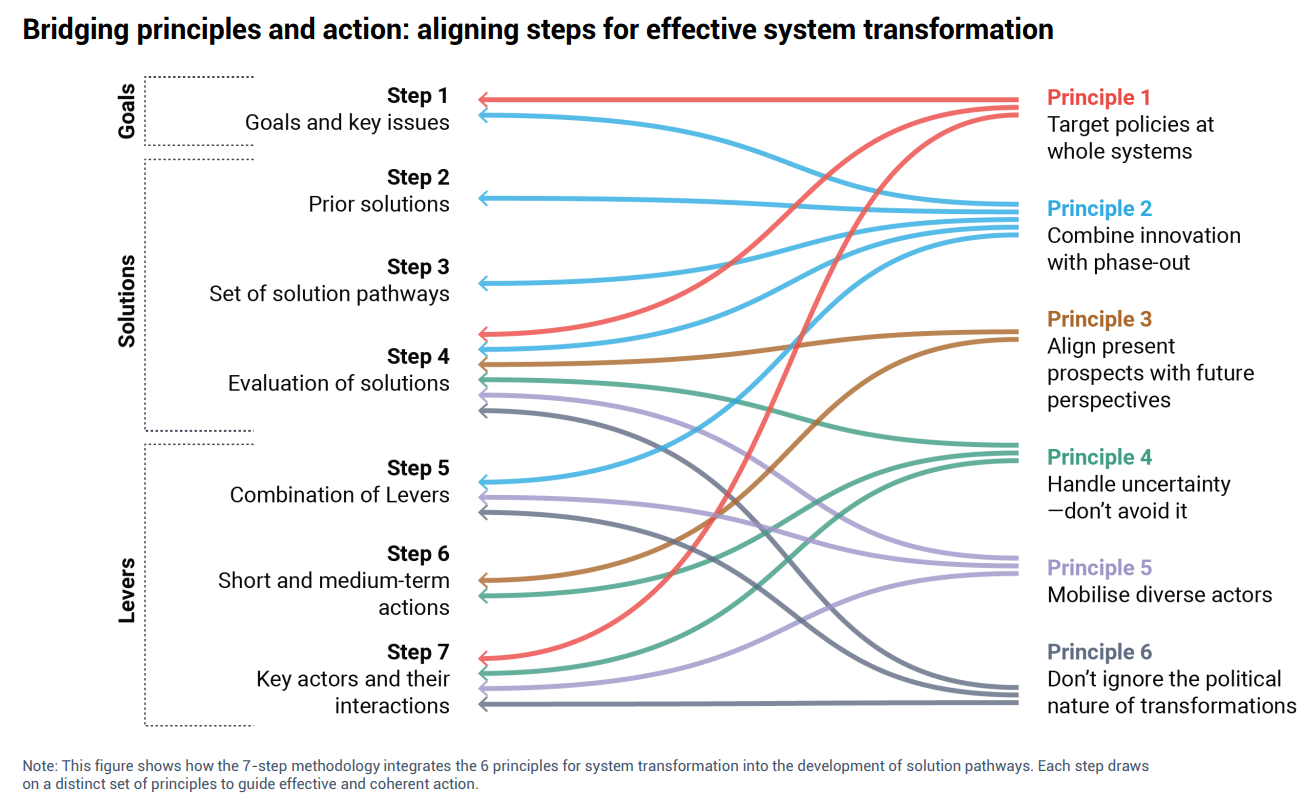
- In the last two editions of the Global Sustainable Development Report (GSDR), it was clearly identified that economy and finance, capability, knowledge and innovation, individual and collective actions, and governance are absolutely necessary levers to activate those transformations.
- Just as well, we need some dimension of an accelerated, sustainable, and just transformation. This is supported by whole-of-government and whole-of-society approaches.
- There are several motivators in the sectors of health, economic, regulatory, and cultural. Harness synergies, minimize trade-offs, and address lock-ins, depth and scale of transformation, as well as urgency and speed of action.
- Key aspects of what can be transformed within the systems we are addressing.
- Economic and finance: internalize environmental and social costs. It has already been discussed for several decades; it is very hard to activate, but absolutely central. Reform subsidies to support sustainability. Reflect long-term goals in economic planning. Incentivize equitable and green economic activity. Enhance inclusive and participatory decision-making.
- Materials and waste: design out waste and pollution and enable material recovery. Create fair and effective markets for circular goods and services. Redirect finance from linear to circular. Enable a fair global trade in circular goods and services. And translate circularity into societal goals.
- Energy: ensure universal access to clean energy, expand energy efficiency and demand-side measures, decarbonize energy systems, achieve environmental sustainability in the critical mineral value chain, phase out fossil fuel, and support just and inclusive energy transitions.
- Food systems: shift to environmentally sustainable and healthy diets. Improve crop, livestock, and aquatic food production systems. Reduce food loss and waste and increase circularity. Develop novel foods and production processes. Restructure food industry market structures and trade.
- Environmental system: protect and restore ecosystem biodiversity. Strengthen resilience and governance of socio-ecological systems. Capitalize on Indigenous and local knowledge systems, which my colleague will talk about. Restoration and adaptation. Promote sustainable bioeconomy and its infrastructure.
- Elements of potential acceleration of this transformation include the mobilization of actors such as government, intergovernmental organizations, the public, civil society, the private sector, academia, and nature.
- Policy responses must be tailored nationally and regionally. We have totally different dynamics across regions in terms of level of industrialization, poverty, environmental threats, and all these have to be tailored within the various steps and principles that we would like to apply for the transformation of systems within those regions.
- This also has several telecoupling effects. Transforming one system in one region can have dire or positive impacts on the system transformation of another region, and this has to be accounted for and captured in the transformation.
- The science-policy challenge is that scientific rigor is not the subject of political negotiations.
- Impact is getting harder. Environmental agendas are increasingly politicized.
- We know about the Geneva Plastic Treaty talks, which collapsed over consensus deadlock. A few delegations blocked the GEO-7 Summary for Policymakers.
- Without government endorsement, robust science loses the legitimacy to drive collective action.
- GEO’s edge, unlike IPCC or IPBES, is that it sees the environment as a whole.
- So we really need to have a deep reflection on what the future of environmental agendas is.
Sarah-Lan MATHEZ-STIEFEL | Senior Research Scientist, Centre for Development and Environment, University of Bern and Associated Senior Researcher, Wyss Academy for Nature at the University of Bern | Coordinating Lead Author of GEO-7, Indigenous Knowledge and Local Knowledge Chapeaux A – E
- GEO-7 is the first edition of GEO where Indigenous Knowledge and Local Knowledge are considered and included.
- Over the last decades, there has been an increasing recognition of the importance and the potential of Indigenous knowledge and local knowledge to contribute to sustainability transformations in various global arenas, from the Rio Declarations, the Convention on Biological Diversity, IPBES, and now, with the seventh edition, also the Global Environment Outlook.
- First of all, finding solutions to the planetary crisis requires the best available knowledge. So, not only scientific knowledge, but also other types of knowledge systems, including those of communities and peoples who have established a very long relationship with their environment, as well as strategies to address the changes they are facing.
- On the other hand, beyond addressing and harnessing the best available knowledge, there are also equity and inclusion concerns that justify the need for recognizing these types of knowledge systems.
- Principle number five that was presented for systems transformation was about considering and including diverse actors. But this also means including their diverse perspectives, the plurality of views, perspectives, and knowledge they have about their environment, and also the solutions that we can jointly develop.
- It is the first time that GEO-7 has received the mandate from its member states to include and consider Indigenous knowledge and local knowledge in the report and this was done through three mechanisms:
- A dedicated task force, which included 19 both Indigenous and non-Indigenous experts from 17 countries. This task force guided the process of including Indigenous knowledge and local knowledge perspectives into the report, in close collaboration with the GEO-7 co-chairs. They also contributed to the development of text as lead authors and fellows.
- Four dialogues with Indigenous knowledge and local knowledge holders throughout the process of GEO-7, to collect their views and to review the report that was being developed. The outcome of these dialogues is a report that served as a key reference for Indigenous knowledge and local knowledge content in the report, in addition to existing peer-reviewed and grey literature.
- The inclusion of Indigenous knowledge and local knowledge-related issues itself in the text, and this occurred in different ways: five standalone chapter texts, one for each of the main sections of the GEO-7 report; the inclusion throughout all of the chapters of the report, when appropriate, of Indigenous knowledge and local knowledge, but also issues related to Indigenous peoples in all the chapters of the report; and a dedicated section in the executive summary, where key messages were elaborated to the attention of policymakers.
Content of Indigenous knowledge and local knowledge perspectives in the report
- In the executive summary, the main message is that Indigenous knowledge and local knowledge contribute to transformation towards sustainable and equitable futures, and that sustainability transformations can be better served by reparative actions which give greater space to Indigenous people’s perspectives in policy formulation and decision-making processes.
- Concrete guidance on actions from Indigenous knowledge and local knowledge includes:
- Enhancing ecosystem functions and regeneration.
- Transforming food systems through Indigenous regenerative agroecological practices.
- Climate change adaptation through the application of combined inclusive conservation measures.
- Moving away from extractivism and consumerism through ethical human-nature relations.
- Another key message in the executive summary for policymakers is that Indigenous peoples’ traditional lands and territories support a large portion of the world’s biological and cultural diversity, which means that it is essential to revitalize Indigenous cultures and languages in their traditional territories for the recovery of lands, waters, and the protection of biodiversity.
- To ensure a just transformation of the economic, material and waste, energy, and food systems, it is thus crucial to co-create, co-design, and implement actions with Indigenous peoples.
- As well as complying with the rights of Indigenous peoples, including the right to free, prior and informed consent, informing policy with Indigenous-led research.
- In the GEO-7 report itself, as mentioned before, we were able to have five standalone chapter texts, one for each of the main sections of the report.
- For the first section, we present the importance of Indigenous people’s perspectives and how these, often based on a different way of relating to nature and ethics of care, are crucial to understanding the current global environmental crisis, but also to inform sustainability pathways.
- In this chapter, we also highlight that the avenue for future sustainability is to center Indigenous biocultural perspectives, governance, and science.
- In the second chapter, we focus on the impacts of the planetary crisis on Indigenous peoples and local communities. We highlight the fact that Indigenous territories and cultures are threatened by the expansion of resource extraction, pollution, and appropriation that prevent traditional land-use practices. What is important also in this chapter is to recognize that biological and cultural diversity are intertwined, and that those threats also threaten the livelihoods of Indigenous peoples, as well as their cultural and spiritual practices.
- In the third chapter, we focus on the importance of knowledge co-creation and explore some of the approaches to do so.
- So this approach can inform high-level policy decisions based on different types of knowledge and experiences, and it is an approach that values multiple knowledge systems, promoting equity between knowledge holders.
- It is essential to include Indigenous people’s participation in co-creation processes to ensure that the outcomes are culturally appropriate, but also minimize the risk of potential harm that can be attached to these solutions.
- In the fourth section of the report, which focuses on transformation pathways, we show that Indigenous peoples can shape entirely new transformation pathways that are detached from the idea of sustainable development with its reliance on economic growth. It is really important to give greater space in decision-making processes and to provide to Indigenous ontologies, values, and practices.
- So what are the main perspectives on desired futures that were identified in the Indigenous knowledge and local knowledge dialogues?
-
- Care for Indigenous territories and life.
- A focus on responsible and just energy transformation.
- Revitalization and intergenerational transmission of knowledge.
- Strengthening of Indigenous political organization.
- Sustainable social and solidarity economy.
- In the fifth section of the report, which focuses on driving the transformation, we show that it is crucial to have Indigenous perspectives in environmental assessments to recognize the underlying causes of unsustainability; with these very different perspectives on these causes, to enhance Indigenous insights and strategies for sustainability, to inform future scenarios and stewardship through co-creation processes and to foster adaptation at meaningful biocultural scales.
- For this endeavor, international governance organizations can assist by partnering with Indigenous peoples to address the environmental crisis and just sustainability transitions in biocultural approaches.
Lessons Learned About the Process of Including Indigenous Knowledge and Local Knowledge into GEO-7
- What worked well?
- It was the first time that the UNEP report addressed this type of knowledge. This was made possible thanks to a very close collaboration between the task force, the co-chairs, and the other lead authors throughout the process.
- The text, the content related to Indigenous knowledge and local knowledge, was widely appreciated, and the voices collected during the dialogues influenced the global environmental assessment.
- But what are some of the challenges that we faced, and some recommendations?
- First of all, the task force was only created later in the process, after the scoping document was developed, which means that the structure of the report, the main concepts, and approaches of the report were already defined, and it was very difficult to influence them to really reflect different perspectives, different ways of understanding their relationship with nature.
- We would thus recommend moving from a perspective of inclusion to one that fosters compensation, mutuality, and equal collaboration from the start of such a report.
- And it means that these types of approaches have to be institutionalized early in the assessment cycle.
- A second challenge that we faced is that there was a low representation and low diversity of Indigenous peoples as authors.
- And we would thus recommend that more Indigenous people should be included not only as authors, but also in the different advisory bodies, and also as members and reviewers of the report.
- A third challenge was a difficulty in transmitting Indigenous knowledge perspectives into a conventional assessment format, and we would thus recommend to promote different formats.
- So this is already being done in some way by IPBES, which includes more visual materials and others, but this has to be further developed.
- But also, we suggest that mechanisms should be put in place to support Indigenous knowledge holders, for instance, with assistance of fellows or Indigenous scholars who can help bridge these ways of communicating knowledge into an assessment.
- And lastly, there was a lack of sufficient budget for Indigenous knowledge and local knowledge activities, which include very different needs than conventional authors’ meetings.
- For instance, the dialogues had to be conducted in specific places and also included visits to different places where Indigenous knowledge is actually put into practice.
Open Discussion
Q: Traditional knowledge has its merits, but those who have been accused by a shaman of being responsible for the eruption of a volcano and executed may have different feelings about traditional knowledge?
Q: We mostly agree about the situation of the planet and about the cause. We disagree about the solution. To put it in a very blunt, exaggerated way, you can very easily fix the problem: you cut all wages by half, so you decrease consumption. You drop a bomb and create a nuclear winter.
I take this unrealistic and exaggerated example just to exemplify what disagreeing about solutions means and why there is a stumbling block. Teaching will not be the answer. Do you not think so?
Q: It is great to see that GEO has moved much more to this kind of action agenda in terms of solutions, creating scenarios where we want to get to and working backwards. Specifically within there, in the work I have done in the past, a lot of the issues are caused by the transfer of environmental wealth from Indigenous communities to businesses, and therefore their shareholders, and the transfer of risk going the other way.
Is there anything within the sort of solutions agenda that focuses specifically on tackling that divide, that transfer of natural wealth to shareholder value? Because needing to split that and make that sort of internalized externality is super important in terms of tackling the problem.
Q: The gender lens could be a leverage, and I wonder what you think about that.
Q: How about the ABS principle, ABS, Access and Benefit-Sharing, which is a tool for the United Nations Convention on Biological Diversity? It is an additional protocol. Why both the World Intellectual Property Organization adopt a legal treaty on cultural expression and traditional knowledge?
Sarah-Lan MATHEZ-STIEFEL | Senior Research Scientist, Centre for Development and Environment, University of Bern and Associated Senior Researcher, Wyss Academy for Nature at the University of Bern | Coordinating Lead Author of GEO-7, Indigenous Knowledge and Local Knowledge Chapeaux A – E
- It is important to highlight that in the GEO-7 report, if we recognize the importance of Indigenous knowledge and local knowledge, this does not mean that we have to idealize it and that it is always, in all contexts, appropriate, and that all knowledge holders, Indigenous knowledge holders, have the same perspectives.
- It is important to recognize the different perspectives and include these different knowledge holders in the process of creating an understanding of the environmental problems that we are facing, but also in developing solutions. But it is not about all types of traditional knowledge.
- Regarding the second comment, yes, these different laws and instruments are fundamental, and this is something that was highlighted throughout the process, in all the dialogues and also in the literature that we found.
- It is the importance of recognizing Indigenous people’s rights, but also putting in place such types of tools and safeguards to ensure that not only their rights are protected, but also their access to the territories and their traditional and ancestral territories.
- And essentially, to make sure that no harm is done through the solutions that are proposed, because a lot of these solutions will often have an impact on these lands. So, it is essential to have these different tools and mechanisms in place to help safeguard these rights.
Henri RUEFF | Principal Scientist, The Alliance of Bioversity International and the International Centre for Tropical Agriculture (CIAT), and Associated Senior Research Scientist, Centre for Development and Environment, University of Bern | Coordinating Lead Author of GEO-7, Chapter 13
- The solution pathways we offer and the methodology we offer are not a recipe. It is very much a sort of framing to guide how processes can be implemented for actions.
- Within those processes, there is a great deal of consultation, engagement with actors, ownership, and this is how we envision the development of these transformation system solution pathways.
- So, yes, actors are within the process. They contribute to the process. There is a co-creation of the process with actors, and therefore we are not in a situation where we would recommend any other of your provocative solutions.
- So, yes, beyond the local knowledge and traditional knowledge, also the engagement with actors is absolutely important in this consultative process.
Sarah-Lan MATHEZ-STIEFEL | Senior Research Scientist, Centre for Development and Environment, University of Bern and Associated Senior Researcher, Wyss Academy for Nature at the University of Bern | Coordinating Lead Author of GEO-7, Indigenous Knowledge and Local Knowledge Chapeaux A – E
- Concerning the comments regarding traditional knowledge.
- We focus a lot on Indigenous peoples’ knowledge in the report because this is also an important element of supporting their rights and the very specific concerns that they are facing.
- But we also recognize the importance of local, other local communities and traditional communities. The term will vary depending on the context, and these communities have a long history of interaction with their environment.
- So, what we call Indigenous and local knowledge somewhere can also be found and called traditional knowledge in other places.
- What is important is to recognize this long history of interaction with the land, which is often associated with very different perspectives, more relational perspectives with the environment, and a set of management practices and also governance practices.
Tailoring Solution Pathways for System Transformations | Panel Discussion

Miguel LUÍS
Counsellor, Permanent Mission of Portugal to the UN Office and other international organizations in Geneva

Eva-Marie MEEMKEN
Assistant Professor, Department of Environmental Systems Science, ETH Zürich

Isabel MARTÍNEZ
Deputy Executive Secretary, Basel, Rotterdam and Stockholm Conventions

Maximilian MARTIN
Global Head of Philanthropy, Lombard Odier

Dario LIGUTI
Director of the Energy, Housing & Land Management Division, United Nations Economic Commission for Europe

Sabin BIERI
Director, Centre for Development and Environment, University of Bern | Panel Moderator
Summary
Sabin BIERI | Director, Centre for Development and Environment, University of Bern | Panel Moderator
- Even if it might be a bit hard after some of the things we have heard this morning, it is a time of celebration because this report is out and it contains some really strong messages. The celebration might be a bit difficult against the background of governments trying to downsize some of the important reference frameworks that were in place and would be in place to put forward some of these pathways.
- It is a big responsibility to, against these trends and against the noise in the background, still hold up the fire and to continue struggling for what we not only believe but what we know is so necessary to safeguard the resources that guarantee our very existence and, not least, our well-being.
- The definition of transformation, or the transformative systemic change that is so highlighted and emphasized in GEO-7.
- It is not a new concept, of course. It draws on previous reports or on sister reports, like from IPBES or IPCC, or earlier UNEP reports. But what we are talking about, and it has been flagged this morning, is really a change deep in scale and high in scope.
- So it is not about incremental change. It is really about change that is more radical, more towards the structure, and not just changing a few parameters and a few design features. Not that that is wrong, but what we are talking about here is really something that goes beyond that.
- It is all in the report. On page 17, you find an extensive definition on what transformative change means, so you are invited to go back there.
- One aspect of this change, which also has been named, is really that it recommends certain types of changes as ways forward, such as economic system transformations, moving away from growth, and structural and sociocultural worldviews and values, shifting from domination to care.
Miguel LUÍS | Counsellor, Permanent Mission of Portugal to the UN Office and other international organizations in Geneva
- We already heard there is a lack of good governance around the world.
- If I were speaking as an employee of the Portuguese state, I would have to disagree. At a personal level, as a citizen, I would say that there is for sure a lot of room for improvement.
- The central message in GEO is that a whole-of-government is needed.
- But focusing on what I would see as a solution, first, we speak a lot of translating evidence into policy, but is also paramount to protect the integrity of this evidence itself.
- I participated in the negotiation of the Summary for Policymakers for GEO-7, and a group of countries spent a lot of energy trying to defend the wonderful work that the authors did throughout three years.
- Because we see throughout the Summary for Policymakers negotiations on all these science-policy bodies, more and more scientific considerations are challenged, not because they are uncertain, or they are wrong, but because they are politically and economically uncomfortable.
- It is very important to maintain this distinction: as governments, we can and we should negotiate and make political choices, but we should not negotiate scientific facts.
- We need to continue to defend the importance of science.
- GEO-7 tells us that the systems are all interconnected. But the truth is that in my national example, there is a conversation, but the truth is that the specific agency for the environment, for the protection, for the conservation of nature, does not speak with our Finance Ministry or with our Territorial Cohesion. They speak more and more with agriculture. Those direct links are established more and more.
- But if you look at where the money is coming from, who decides the long-term policies, there is still this disconnection with the sustainability portfolio that is not considered.
- And on this, GEO gives us some good inputs. Maybe they are less visible than phasing out fossil fuels, but it speaks about the change of macroeconomic policies, the institutional capacity that is needed not only in developed countries, high-income countries, as GEO speaks about, but mainly in the rest of the world, in the Global South.
- Coordination across public agencies and public procurement is a gigantic problem not only in national governments but also at the UN.
- There are a lot of things that GEO says are not secondary implementation details, but they are fundamental for the transformation that we need.
- When we negotiated the resolution at the fifth resumed session of the UN Environment Assembly in 2022 (UNEA-5.2), we hoped that GEO-7 would be something different.
- For GEO itself, for the next iteration, if it comes, this is an important point that we should have in mind.
- We have to be politically realistic about what transformation means.
- For us that work on the environment, phasing out harmful incentives is an obvious choice. If we are at the Finance Ministry or Economics Ministry back at home, with your companies making pressure, probably it has budgetary implications.
- Elected politicians are often not willing to take decicisions that have short-term costs, and this can be further exacerbated when we look to countries that have higher or other development challenges.
- When we continue these discussions about how to transform science and policy, it is fundamental to look at how, in the shorter term, we can point to governments what they can do in the short term that does not put in jeopardy their continuation in the government.
- But also, how can we translate this to the ones that can really put the pressure on governments to do the long-term transformations, at least with the economic system that we have, that is the business, that is society itself.
Sabin BIERI | Director, Centre for Development and Environment, University of Bern | Panel Moderator
- The cost of inaction will be greater than the cost of transformation. But we need to look at the cost because it will not be the same for everyone and not everywhere.
- Then, the very challenge of defending the integrity of scientific knowledge, of this way of offering also inconvenient truth and then having the attack on the truth. So that is certainly something that we need to have a closer look at..
Eva-Marie MEEMKEN | Assistant Professor, Department of Environmental Systems Science, ETH Zürich
- Zooming in a bit into the food system aspects, at first glance the GEO-7 report does not read very radical or transformative because much of what the core message is what our students learn if they take an introduction to economics course.
- In our case, we have supply and demand. We have food producers, for example farmers, and then we have consumers, for example all of us eating here. And both of these groups produce positive and negative externalities.
- If you want to make people behave more sustainably or promote public health, one option is to punish the unsustainable behavior, tax it, to make it less attractive and therefore less prevalent, and also to promote the sustainable, the healthy behaviors on both sides.
- So that is not really radical. That is very intuitive. But, of course, the problem starts when we think about the cost and the distribution and the resistance that we see to some of these suggestions.
- For example, in Europe over the last few years we had massive farmer protests, which block progress in policy, like sustainable policies, or even going steps back.
- The resistance is not only from farmers but also from industry; if you think about, for example, sugar taxes, you find lots of resistance, of course, from many different actors who currently benefit from the way the system is structured.
- So while the suggestions sound quite intuitive and every student who takes an economics course would agree, the implementation of that is very different because of the lobbying structures, because of the diverse interests, and because costs and benefits are not equally distributed.
- One big point in the report is also the true cost of food. So here the idea is really to calculate, like, monetize the negative externalities, the negative effects of food systems, which are enormous.
- That was a big initiative also by FAO a couple of years ago, and this is extremely useful because you get this shocking number that is really impressive and can be really alarming. But using that as a policy tool, we still need a lot of research and, more importantly, we need a lot of data.
- Because, of course, the risk is always that you focus on monitoring and improving what you can measure, where you have data. For global food systems, we lack data on gender issues. Labor issues, all the social sustainability areas beyond health, indigenous knowledge or knowledge in general, cultural aspects. For all of this, we do not have data.
- There is a risk that if we focus too much on monetizing effects, we miss out on these crucial aspects.
- What is really great in the report is this big focus on fruits and vegetables. We need, we have a long history in agricultural research and breeding, focusing on wheat and rice and staple crops.
- So it is really timely to focus more on fruits and vegetables, because that is what everyone can really agree on. It would be better for everyone to eat more fruits and vegetables.
- So somebody has to produce them sustainably. That is also highlighted in the report. We need more sustainable farming practices. And one issue I see there is that many of these practices really are very labor-intensive.
- Whereas especially rich countries really are in the middle of demographic change, so it is unclear where all the labor for more sustainable farming should come from.
- Especially as we also do not want more migrants, or at least in several countries we see really anti-migration sentiments on the rise. And if you do not want to import workers, then we have to invest in technology, which also may come a bit too short.
- Public procurement has also an important role to play. Public cantines can do a lot, as well as school feeding programs and school gardens.
- We should start with the next generation, so they really appreciate sustainable agriculture and sustainable food systems.
- A point that is not so much highlighted is the need for more investment in local innovations.
- We have two projects where we focus on agri-food tech startups in Africa showcasing the ingenuity of amazing entrepreneurs from Africa and other regions in the world.
- These positive examples are what we really need. The GEO-7 report also makes you feel very frustrated. So we also need positive examples and more local innovations.
Isabel MARTÍNEZ | Deputy Executive Secretary, Basel, Rotterdam and Stockholm Conventions
- We are positive about the things we can do together.
- From the BRS perspective, the chemicals and waste multilateral agreements address the triple planetary crisis: pollution and waste, biodiversity, nature, land loss and climate change.
- All these require such a transformation in the way we produce, use and manage materials.
- GEO-7 situates circularity within a broader economic, social, environmental and analytical framework.
- The concept of circularity has evolved beyond the waste management or recycling agenda. GEO-7 frames it as a wide system transformation that includes product design, finance, trade, governance and consumer behavior.
- The report reminds us that waste is often a symptom of how materials are designed, produced, and valued throughout their life cycle.
- The focus, therefore, needs to move upstream towards preventing waste before it happens and before it is created, and keeping resources in use longer.
- The second message that we would like to highlight is that the transition to a circular economy offers immense opportunities, but we also need to be vigilant.
- GEO-7 highlights that a circular economy can contribute simultaneously to the crises we heard, and circularity is more than improving waste management. It is about reshaping how economies use resources.
- From the perspective of the chemicals and waste agenda, there is a critical warning. Perhaps not as bad as climate change, but circularity must also be safe circularity.
- As we keep materials in circulation for longer, we must ensure that we do not also keep hazardous chemicals in circulation.
- This is particularly important for sectors such as plastic, electronics and textiles.
- In this regard, we would like to emphasize here that circularity is not simply about closing the loops, but about closing the right loops.
- The GEO report shows that we know where action is needed; the pathways are there.
- We need better product design, stronger producer responsibility, so that products are durable, repairable, reusable, safe and safe to recycle.
- We need effective governance and international cooperation, because materials, chemicals and waste move across global supply chains.
- We need investment, infrastructure, and public engagement to make circular solutions accessible and scalable.
- From the BRS perspective, we support these efforts by helping countries manage hazardous chemicals and waste in ways that protect human health and the environment.
- GEO-7 reminds us that the transition to a circular economy is not only a technological challenge. That was also mentioned a number of times in the previous presentations. It is also a governance challenge and a societal choice.
- The question is not whether we can keep resources in circulation longer. The question is whether we can do so in ways that protect both people and the planet.
- From the perspective of the Basel, Rotterdam and Stockholm Conventions, one principle should guide us: we should circulate resources and value, but we should not circulate pollution.
Maximilian MARTIN | Global Head of Philanthropy, Lombard Odier
- GEO-7 is a scientific report and it is very well done.
- The challenge here is: a future we choose is really a lot more provocative than it seems because there is a bill attached to it, right?
- So we are being asked collectively to invest $8 trillion a year for benefits that will start materializing in 2050 and then will become very substantial later.
- The challenge is, if you look at it purely from a financial perspective, we do not have instruments that do that. A venture fund has a 10-year time frame. Infrastructure has 20 years. Pension funds have 30-year liabilities.
- It does not mean it is not possible to mobilize the resources, but clearly it is not something that any sector can do on its own. It clearly requires collaboration.
- From a scientific point of view, for bringing everything together in such a clear way. It is fantastically well done.
- But the challenge that we have now is to say, “ we know planet Earth is blue”, we know sort of what is going on it, to now land the spaceship. And there is a resource implication to that.
- Looking at it analytically, there are seven things concretely that the financial industry, together with others, can do.
- One challenge that we have is that we need definable assets. Without these, it is difficult to actually allocate resources to their preservation.
- Natural asset companies are one such emerging idea. This is one field of action.
- We have seen the carbon markets, with all the problems that they have. The compliance markets, compliance-anchored units, help. So this is something that we need to work on together as well, where governments really have a role to play.
- Sovereign outcome facilities are an interesting idea, but it is not as prevalent as it should be.
- Nature-based infrastructure. If we think about utilities, municipalities, basically anything relating to ecosystem services that we can price, where you avoid a cost in ways that are empirically demonstrable, and then structure payments against that.
- Agriculture is the field that draws the most negative subsidies today, but we want to make progress together.
- We cannot come up with schemes where farm supply chain outcomes also factor in non-product outcomes, such as water, soil, habitat. Water, that is all doable. The impact industry can help you price that.
- We need government to help build the length of the runway, basically, so the instruments work.
- We need portfolios. If we want investors to allocate capital, we cannot just say, please do all the same thing. No, we need platforms.
- Here DFIs, for example, are already doing that to some extent, but we need to take this to a next scale.
- This also brings me back to the piece on philanthropy. Clearly, philanthropy, in a minor way, can help provide catalytic capital to build such platforms, to seed-fund them.
- But it is the job of governments as well to come in, creating the compliance demand, the regulations around that, the long-term frameworks, so that we can then actually act and structure and allocate capital.
Dario LIGUTI | Director of the Energy, Housing & Land Management Division, United Nations Economic Commission for Europe
- The good news is a lot of the recommendations of the GEO-7 report are actually taking place already. The bad news is they not taking place at scale.
- We are very slowly transitioning energy. If you look at the percentages of fossil fuel usage as a percentage of total energy consumption, we are down from 85% to around 80%, but of a much bigger pie.
- Since energy is directly linked to welfare, there is a one-to-one direct connection between our livelihood, welfare, material wealth, etc., with the use of energy, and that has been since the first energy, or since the first axial revolution.
- There are transformation pathways in the energy sector:
- Why is energy transformation not happening at scale?
- Scaling up technologies, processes, business models has consequences. As long as they are marginal, then they are lost in the complexity and the impact is small and can be absorbed by the system. Going above a certain scale has a system impact, and that is the problem that we are facing today with renewable energy.
- For example, in certain countries, we have gone above certain thresholds of renewable energy and electricity production, and this has engendered a number of other consequences: grid instability, just to talk about very concrete actions.
- What happened in Spain in 2025, what happened in Central Asia in August 2026, is a consequence, particularly in Spain, of the level of renewable energy that has grown from the power generation side. The power transmission and distribution side, they have not taken into consideration the consequences of that, and that is the reason why they had blackouts for 24 hours a year ago.
- This is the problem around – we are not system thinking. We are not looking at the energy transformation as a system transformation, but we have been looking at energy generation individually, we are looking at energy transmission and distribution individually, etc. I will come back to that point in a minute.
2. Embedded economic structures. Energy is cheap, and the cheap energy has been fueling economic growth, welfare, our material wealth, etc.
- The economic structure today, take away cheap energy and you have social consequences. When you work for a government, you see what happened when we have tried to change those economic structures, those underlying economic structures around energy.
- When you break an economic structure, it has consequences again, and those consequences need to be addressed.
3. Technologies. We have to be conscious that in the energy space, there has not been a technology revolution like in some other areas, like communications technologies, for example.
- Our technologies – the so-famous transition technologies of today – have been invented decades ago. The first electric car was built at the beginning of the 1900s. Solar panels have been around for 70 years.
- These are technologies which are mature. They have set the limits. The technologies for a real change in our system are still to be developed and invented.
- So, we are in the transition phase. There is a famous graph about the three networks: the current system, which is going down; the system and the new system that needs to grow.
- Well, in the transition technology, we are only now starting to look at what the current system has been around with us for about 2,000 years, since we discovered burning fire.
- All the time we have been adding new energy sources, but the principle is the same.
- These three, among many others, are issues which are, impeding a radical transformational pathway in the energy sector, which is addressing the question that you ask: why is there not a radical transformation in the energy sector?
- How do we tackle this complexity around that? How can you measure this and which metrics? The financial world works with metrics, including assets. Defining an asset means putting metrics on that asset, which needs to be valued and assessed over time.
- In terms of energy, the metrics that we are using today are metrics which drive the decisions.
- What we are working on is transforming those metric-focused approaches to an approach to embrace the complexity of changing the energy system, which is embedded across all of our lives.
- Another tool to drive transformation would be pricing of CO₂. A price of CO₂ which reflects the negative externalities of CO₂.
- But that will have economic consequences or social consequences of cataclysmic dimensions.
- Because if you price the CO₂ where it should be, that means that you are going away with about 80% of our economic system.
Miguel LUÍS | Counsellor, Permanent Mission of Portugal to the UN Office and other international organizations in Geneva
- We cannot run away from the fact that there is a need for decisions today with social and economic implications. That is necessarily connected with those political implications.
- Governments have a very important role when it comes to regulations.
- There is a need for a shift in the way that governments do policies. Normally, we do policies to answer to challenges of today. There is not this long-term transition period where industries can adapt, where business can foster this innovation.
- At least my experience, in negotiations, speaking with a lot of business, tells me that normally the stick approach is difficult to have results if it is done alone, because there is indeed a lot of backlash.
- We have to combine, as governments, we have to find this way of long-term planning with short-term gains on the political level, with the creation of jobs.
- For example, Portugal was affected by the blackout. There was not systemic change. There was not enough training for this to be avoided. It was a human mistake and not a direct consequence of the use of renewable energies, but the lack of preparation of the people that were working at that central station to avoid it.
- And then, since we are so interconnected, Portugal also was without energy for 48, 72 hours in some cases.
- But we have good examples. Probably 80% of the energy mix in Portugal is already renewable energies. Some days, our energy production from renewable energies is enough for the consumption that we have around the country.
- This is the case of our biggest energy facility transformed from a fossil-fuel-driven facility to a renewable energy infrastructure.
- It was a 10-years process that required re-skilling of people that worked there for 30 years, changes in national policy, involvement of the local municipalities because they were afraid they were going to lose, and it is a bit in the interior.
- This is a small example of what we need to do at scale.
- Governments have a role, but it was only possible because our national energy company was ready to take that jump.
- Governments have a lot of responsibility, but indeed, when we have transnational companies that have profits and economic power that is bigger than most of the countries, reducing it to governments can be a problem.
- We really need to look at the other actors, with the responsibility that governments need to have.
Maximilian MARTIN | Global Head of Philanthropy, Lombard Odier
- The issue here is the complexity. We are all, fairly engineered, scientifically minded people. So we tend to look at things technically, and what you said is 100% correct: you need to also win people’s hearts and minds.
- You need to build coalitions, and the opportunity that I see here is to reflect about the division of labor.
- Anyone in their industry can be a leader, doing things, taking things a bit further, for sure. But you cannot do it if convergent action does not happen elsewhere.
- If we talk a second about the financial industry, one of the things we see is that there are not enough intermediaries and aggregators.
- I have worked investing for over 20 years. Clearly, this is something that can be built. This is where the financial industry actually can play a role.
- Catalytic capital, work with family offices, work with philanthropies. Some of them express the desire to do things that are innovative. It is going to be small-scale, and pilots where basically we have a couple of pieces of the puzzle.
- In general, with anything that relates to product shelf, the competence resides in the financial industry. The execution, so we can take the execution risk, but we cannot take the fundamental long-term risk.
- Because the challenge is all the recommendations here function in what I would call ecological time. The problem is we work on financial time. It is a different time frame.
- And if this is understood, and everyone chips in their part, then you can unlock these amazing pieces of competence.
- In our industry as well, we want to change the world for better. People are professionals, they have skills, but they also are citizens.
- People should not be placed in different boxes. Let us rather find the right people who want to do things, move them forward, and connect them so that they can work it within their sphere of influence.
Isabel MARTÍNEZ | Deputy Executive Secretary, Basel, Rotterdam and Stockholm Conventions
- We also need to go back a bit to basics: common and differentiated responsibilities. So, we are not all in the same pot. Not all the sectors, not all the actors, not all the consumers, not all the producers, not all the technologies.
- Coming back to the issue of why and seeing circularity, that is quite important, in the sense that it is the same approaches that we may be thinking about for the textile sector, for chemicals, for minerals, for plastics.
- In each of those niches, there are different actors who bear or do not bear the responsibility for certain aspects, and perhaps I feel that has been lost a bit in the report and would be useful to shape it again.
- It is not the same responsibility in developing countries to risk the impacts of climate change, as we know, because of where the emissions were and are coming from.
- Even in the case of waste, it is super interesting because, as much of the waste is not being generated in developing countries, it is generated in developed countries, it is also creating markets in developing countries, which are also useful.
- We all have responsibilities, but we are all different for different sectors and for different actors.
Q: How would you approach the division of labour from a food systems perspective?
Eva-Marie MEEMKEN | Assistant Professor, Department of Environmental Systems Science, ETH Zürich
- First, on the subsidies: the agricultural sector in high-income countries receives subsidies that we could spend much more smartly to promote sustainability.
- On the other hand, there is also a pattern that in lower-income countries, farmers are rather taxed and not subsidized. So, there is a bit of a different pattern in different regions of the world.
- One reason for that is the political economy.
- Because in Europe there are farmers who can organize. They have really strong farmer organizations. In Switzerland, they are also really well represented among policymakers. So, farmers are pretty influential in Europe through their organizations and influential people.
- That is not necessarily generally bad. It is great because we all need to eat. We all need agriculture. But that kind of keeps us a bit in a poor equilibrium where it is really difficult to take subsidies away from people who are used to having them.
- We have been discussing for at least 20 years how we can make agriculture policy, for example, in Europe more sustainable. And that is exactly why it is so difficult. It is a matter of power. It is a matter of lobbying.
- From the point of view of farmers, the government extension offices have told them for decades: we have to modernize. We need modern varieties. We need pesticides, fertilizers. Those were the things that the governmental extension services have recommended to the farmers.
- There are all these different demands in terms of sustainability. So, it is also an investment problem.
- If I, as a farmer, have invested in something that today we are not considering sustainable anymore, it is a problem. And, of course, I will resist. That is also why we see these farmer protests.
- So, across sectors, it is really also a political economy question where we have to talk about lobbying and then also, in the food sector, about market power and concentration, because the food system is so concentrated. There are a couple of companies that really dominate most of the market.
Dario LIGUTI | Director of the Energy, Housing & Land Management Division, United Nations Economic Commission for Europe
- I just want to bring a different view. You ask about the division of labor and I work for an intergovernmental organization.
- We serve an intergovernmental organization, but we have been working extensively with local administration, cities in particular, and we host the UN Forum of Mayors.
- The local level is where the real impact can be seen, it is not in the ministries.
- This is where you see the direct consequences of the energy transition overall and of climate change volatility as well. And that is where the action is taking place.
- The SDGs and the whole 2030 Agenda is at intergovernmental level and then it is supposed to trickle down. Those who are supposed to do the work is the local administrations, in combination with the private sector, with the right incentives, as correctly he pointed out, NGOs, civil society, etc.
- Eighty percent of the SDGs do not work if there is no implementation from the local administrations. That is where people want to actually change.
- As we live in a difficult moment for multilateralism, thinking about localization of action, city diplomacy, coalitions of the cities. The work at city level is much simpler as well to create coalitions among different groups, groups of interest, than at national level.
- Then it is, first of all, one way that we need to look at it. Maybe the future is about less Member States and more about cities.
- The complexity of the transformation is such that these changes take, for example, you might have a lot more in connection with a city across the border that is 10 kilometers away from you than from the capital, which is 500 kilometers away from you. But the capital is saying what you should be doing in terms of transition, in terms of adapting to climate change or whatever. And on the other side, there is a border around that, they are doing something different because their capital says something different.
- That is something that we need to think about. When you are thinking about transformative changes in our setup, the Westphalian model is proving that maybe we need to think as well around that.
- That is the reason why we are bringing forward the voices of the mayors. We are providing the mayors with a platform to exchange, to meet, to discuss, and to influence the discussions and the decisions that are taking at the Member States level.
Maximilian MARTIN | Global Head of Philanthropy, Lombard Odier
- Talking about temperature, Christmas is still a bit away, but this is a UNEP-convened activity with scientists, so I cannot help but share my wish list for Christmas for what you need to do, basically, as you keep working on this.
- From scientists, what we need is contractable metrics that are repeatable, that are solid in terms of disputes, for example, that associate cost.
- There are so many reports saying the impact is significant. The problem is it is not actuarial. I need to know with which confidence interval I am in which range.
- Also help to the financial sector in coming up with counterfactuals, jurisdictional baselines, would be helpful as it will enable the financial industry to actually do something with it and build products.
- We need environmental accounting as the reference standard for all nature units.
- There needs to be a finance sector implementation track in the Kunming-Montreal Global Biodiversity Framework.
- We need an integrity architecture for nature markets, because what happened in the carbon markets is frankly frustrating. can help us produce that architecture.
- We did not have time to go into natural asset companies, but that is a real opportunity to basically have a long-term asset through an equity mechanism. So, there is no short-term time horizon, but we need multilateral design work on this.
- Come up with accounting, governance, listing standards is what the financila sector is needing.
Dario LIGUTI | Director of the Energy, Housing & Land Management Division, United Nations Economic Commission for Europe
- We have those metrics. It is called the United Nations Framework Classification for Resources (UNFC) and the United Nations Resource Management System (UNRSM), to sustainably use resources. It is approved by governments, used by industry and academia.
- We have been deploying that across the world. It is part of the legislation in the EU Raw Materials Act. So, all mining activities in the EU, and not only mining but transformation and recycling, are actually done according to these protocols, which are UN-developed but take into consideration economic and financial, environmental and social aspects.
- The tools are out there and are used in two ways:
- Deployment: resources to deploy things that are there, like technology, but in this case it is a protocol.
- Acceptance is driven because the industry has standards. Their standard is CRIRSCO.
- What we do is translate and with the industry. But that is two things: deployment and acceptance.
Open Discussion
Q: GEO-7 calls for transformation across interconnected systems, but much of the work needed is often early-stage, cross-sectoral, and at times difficult to fund through conventional public or commercial channels.
We spoke about the division of labor and different actors. What, in your opinion, can philanthropy do that governments, banks, and commercial investors often cannot? Where can philanthropy have the greatest additionality in funding early-stage work, absorbing risk, supporting coalitions, without substituting for public responsibility, before public or commercial finance can scale an approach?
Maximilian MARTIN | Global Head of Philanthropy, Lombard Odier
- Another hat that I did not mention is that I am on the board of an organization called SwissFoundations. It is the association of Swiss grant-making foundations. We have 14,000 of them in the country. 7,000 are grant-making and have an endowment, and they spend about 6 billion a year. About a third of that expenditure is covered through this association.
- Yes, philanthropic capital can play a really important role. The challenge is, however, that there is a lot of heterogeneity in the sector itself.
- If you look at the causes that these foundations pursue, the environment has just barely made it into the top five in the past few years, like arts and culture, number one, for example. It is great as well, but clearly we need to solve the environmental challenge as well.
- National associations can help provide a framework, which is what we do at SwissFoundations. We have an environmental working group, for example. The idea of activating your foundation’s capital – 160 billion Swiss francs in foundations in Switzerland – is very powerful.
- Just think if everyone had an impact allocation of only 5% dedicated to these topics, how powerful that would be.
- So, work is in progress. We are very keen on this. So, we are trying to persuade members.
- At the same time, we need to respect that, here again, foundations are governed by their boards. They have different views; things take time.
- My main concern is not that philanthropy does not add value. It does add value, and there are good examples already. But the challenge is a bit like in the gym. It is like your machine, your running machine, is set to a certain pace. We are okay, but we are not at the pace at which the machine is set.
- That is a bit of a challenge. So, how do we up it quickly? But yes, please do not discount philanthropy.
Q: Did you ask people from Indigenous communities what kind of behavioral change was needed? The response would be something different from what we have: different ways of consumption, less consumption, etc.
I feel this sense of urgency as a researcher is much more needed from ourselves also, about behavioral change. Are we credible to society if we are flying around conferences, etc.? Or is something different needed?
Q: You mentioned that we should identify innovation on the ground in developing countries, but how do we find them? Trade was largely absent from the conversation, despite it underpinning the rules that enable what you are going to be able to do and where the financial capital will flow.
Eva-Marie MEEMKEN | Assistant Professor, Department of Environmental Systems Science, ETH Zürich
- There was one question about how we find innovations in lower-income countries. I am not so concerned about finding them. There are a lot of great initiatives already going on.
- There are opportunities. I am more concerned about funding them.
- There is, of course, a link to impact investment. At the last ten events, roundtables, and panels I have been to in Switzerland, we always end up talking about impact investment as this new world where money for global development is really cut everywhere – not just in the US, but also in Switzerland, really globally.
- The question is: who will still fund global development projects?
- For many people, it seems the answer is impact investment. There will be much more focus on private investments.
- So, that is a bit of my wish list for research: to look more into that, because now we are creating whole new dependencies, thinking about decolonizing projects.
- Trade will remain incredibly important, which is also highlighted in the GEO-7 report, also for food systems, just because countries have different abilities to feed themselves because of their natural resources and their populations.
- That is again and again a discussion in Switzerland as well, where in September the population will vote on whether the food self-sufficiency rate in Switzerland should be increased. And then there are many people saying why it could work or why it could not work.
- But without trade, not relying too much on certain countries, certain supply chains because of climate change, because of conflict, so we have to de-risk supply chains. And that is also an area where we need more research.
Q: What is your take on short-term unsustainable practices that may lead to long-term sustainable practices?
You talked about using technology to improve, for instance, farming practices. But the process of building that technology, for instance, with AI, requires significant environmental destruction. What do you think about that balance? Is this what we are actively talking about, or is it just open to speculation?
Isabel MARTÍNEZ | Deputy Executive Secretary, Basel, Rotterdam and Stockholm Conventions
- About the comment on consumption. Going back to your GEO-7 report, the GEO-7 report is advocating for this model of circularity, an economic model that is an alternative one to the linear model of take, make, and dispose.
- That starts with trying to reduce the products being extracted. And that also involves then how products are being designed from the beginning, so they can last longer, they can be repaired, they can be reused, they can be recycled.
- In that whole equation, also come in the consumers, vis-à-vis how products are being produced now, so that they can live longer.
- So, the circularity analytical framework helps to also shape how consumers can look at products.
- And in terms of trade or waste, this is also critical. We have heard that in the plastics discussions, in many other discussions, the rate of plastic waste, e-waste, and textiles is there, will continue to be there, and it is a source of concern for certain parts of the world.
- It still needs to be regulated. And this is something that the BRS Conventions contribute to through the prior informed procedure and other regulations that are part of the three conventions.
Dario LIGUTI | Director of the Energy, Housing & Land Management Division, United Nations Economic Commission for Europe
- On the consumption side, it would be great if we collectively and at scale all decided to lower our consumption levels rationally. That would be great. Absolutely. It just does not work like that.
- It is called the Jevons effect. Take, when we introduce LED lighting. LED consumes about 10 to 15% of an incandescent bulb. What happens is people leave the lights on. They did not switch off the lights. They just left the lights on.
- So, the actual energy consumption for lighting diminished because the technology improvement was such that it actually reduced consumption, but the behavior somehow mitigated the impact of that technology.
- In our work in the energy space, for example, we introduce behavioral science and behavioral elements to anticipate what will be the reaction of the consumer towards this change in technology. How can we make sure that the reaction of the consumer is actually leveraging the technology, as opposed to diminishing its impact, particularly when you look at energy efficiency and that kind of stuff?
- What you can count on is not rational and conscious change of behavior, but unconscious change in behavior.
- A lot of technology, particularly artificial intelligence, has a big role to play, and it will play, if well mastered, in managing the unconscious behavior and the conscious side of our behavior if we want to really transform our consumption patterns.
Miguel LUÍS | Counsellor, Permanent Mission of Portugal to the UN Office and other international organizations in Geneva
- For the last 40 years, we have been investing a lot in information about recycling from the preschool age. The truth is that when these people are young, we are already talking about two generations; while they are young, they make their parents do the recycling. But the moment they arrive at university, it seems like they forget everything.
- They seem to forget, but we have to really find a way of making the change more continuous in order to really have a long-term behavioral change.
- Then, moving to trade and finance, there is a lot to say on this because, indeed, on plastics, I am negotiating the finance part.
- There was a question: how can we make the money in developing countries work? There is not a one-size-fits-all solution.
- We cannot run away from the fact that there was a lot of money going to developing countries in the last 50 years. But we cannot also run away from the fact that there were structures that were maintained from the colonizing eras that did not allow for that money to be spent properly.
- There are several examples for good and for bad.
- The truth is that money is not available at this stage. I have to say that Portugal raised their development budget last year, but we are a small contributor compared to others.
- Public money has to enter these systematic changes that we need: government-to-government, institutional capacity, de-risking guarantees, these initial stages where private money will be averse to entering.
- We are speaking about those most vulnerable. I am speaking about the LDCs and the SIDS, because when it comes to emerging economies, we have to pass this phase where investors do not want to invest there. The truth is that they put a lot of money there, so we have already passed that phase.
- There is still 60–70% of the globe where investors do not want to go because there is risk, and that is where public money has to enter to create the changes.
- Internally, the subsidies have to be redirected to the creation of secondary markets. But you already explained very well, for example, on food systems, why those subsidies are not being redirected.
- Precaution is essential in the discussion about short-term loss versus long-term benefits.
- For example, AI. The only solution for us to do AI properly at this stage would be to have a global ban on the evolution of AI, but that may not be possible.
- Discussions are ongoing in Geneva. At UNEA-7, we had the first resolution on the environmental aspects of artificial intelligence, and UNEP is working more and more on this.
- We have to try to bring everything together with the private companies that are working 100,000 times faster than us governments.
- Another national example showing the power of coalitions is deep-sea mining.
- Portugal, like other countries, has a moratorium. In our case, it is law. It was a consensus law passed in Parliament that came from a citizen initiative that was then taken up by our Parliament. It came at the stage where we are trying to enlarge our continental shelf, precisely to have sovereignty over these resources.
- So, it is a bit contradictory when it comes to economics. We have this 50-year moratorium because we looked around the globe and there were 50–60 countries that were going to do it as well.
- I do not want to imagine what my country or Parliament would have decided if we did not have these countries as well, because then we would put ourselves at a disadvantage that probably, on the short term, once again, our politicians would not be willing to accept.
Dario LIGUTI | Director of the Energy, Housing & Land Management Division, United Nations Economic Commission for Europe
- In the energy space, what we really need to focus on is the energy transition as opposed to the energy addiction we have been living through.
- That takes a number of bold decisions and investments, and we need to bear in mind that it will take decades to undergo. Collectively, we need to come clean about what the energy transition is, because it will have costs.
- There is no single solution and there is no magic wand around the energy transition. Every energy source has drawbacks, whether it is renewable energy, whether it is fossil fuels, whatever. To build renewable energy equipment, you need to mine and various mineral resources in gigantic amounts, and that has an impact on biodiversity and beyond.
- The focus is that we need to have a more science- and data-based conversation around what the energy transition means and what the energy transition entails. We do not have that, and we have not had that since 1992.
Isabel MARTÍNEZ | Deputy Executive Secretary, Basel, Rotterdam and Stockholm Conventions
- In terms of resource efficiency, waste and circularity, we need to circulate value and products, but we cannot and we should not circulate pollution.
- We need more information about what the products contain in terms of hazardous waste and chemicals that are toxic to the planet and to our health.
Eva-Marie MEEMKEN | Assistant Professor, Department of Environmental Systems Science, ETH Zürich
- We should punish what is not sustainable. So, for example, tax or ban, and promote and subsidize what is sustainable and healthy.
- How to implement that as radically as we have discussed, because there is a lot of resistance? We need much more dialogue, which includes not just farmers but everyone in food systems and society, where we really discuss what type of food system or energy systems we really want.
- In that regard, Switzerland can really also be a role model, involving the population more in political processes that other countries do not have.
- Let us make sure everyone globally can eat more fruits and vegetables and less processed foods.
Maximilian MARTIN | Global Head of Philanthropy, Lombard Odier
- The GEO-7 report tells us the future is the one we choose.
- Statistically speaking, on average, life expectancy: anyone born before 1986 will not be alive. Which means intentions are good, but we need to really focus on instruments that have the time scale, the time frame that we need.
- The request is simple: science needs to give us the metrics, UN system standards, maybe make them even more deployable, work in progress. Governments: these long contracts, the legal framework.
- My industry can help build the middle of the market, basically by structuring the financial products and helping build the intermediaries.
- But we must all work together on this.
Miguel LUÍS | Counsellor, Permanent Mission of Portugal to the UN Office and other international organizations in Geneva
- We need to align public and private money with science and both of them with transition, and a bit more publicity for the GEO-7, which has a wonderful regional pathways chapter as well that we did not speak a lot about, but speaks a bit about this need to adapt the pathways.
- We need to protect science. We need, at the global level, to create some harmonization between the rules that each country has, and that is the part of the governments.
- Then, still in the governments, but at the national level, we need to make sustainability a core criterion of economic governance, particularly in public budgeting, on subsidies, and on investment decisions.
Sabin BIERI | Director, Centre for Development and Environment, University of Bern | Panel Moderator
- The choice we make will have a cost, and we need to be much clearer about what that cost is, and for whom, and what it can be in different respects.
Conclusions | Strengthening Science-Policy Cooperation

Géraldine PFLIEGER
Professor of Urban and Environmental Policy, University of Geneva

H.E. Amb. Fernando ESPINOSA OLIVERA
Deputy Permanent Representative of Mexico to the United Nations Office and other international organizations in Geneva
Summary
Géraldine PFLIEGER | Professor of Urban and Environmental Policy, University of Geneva
- My concluding remarks will focus on the pace of the trajectories.
- Knowledge is here, and the pace of knowledge production now allows us to clearly build, through that kind of GEO-7 report, science and evidence-based decision-making.
- Solutions are there and need to be implemented. There are several options, and that knowledge is more and more interdisciplinary, connected with action, potentially also connected to Indigenous knowledge through different kinds of practices.
- The pace of environmental change is now very rapid, much more rapid than the level of action that is needed and required. It could create the feeling of a widening gap between change and action, and that we will not be able to solve everything at such a rapid pace of environmental change.
- We should not be frozen by this kind of message; the battle is not lost, and action is still highly needed.
- Regarding action, we finally heard two kinds of vision, two kinds of pathways and trajectories. The first one calls for unprecedented, intense, rapid, radical transformation.
- The second kind of vision of transformation conveys the sense of a pathway from short- to medium- and long-term action, where transformation is built step by step through acceleration and stabilization.
- What I learned from this is that all action is good. Action is necessary, and action could produce not only incremental but deeper, bottom-up, progressive but transformative capacity to change and modify systems from the bottom, from communities, from local practices and practitioners, engagement at different scales, from the individual and the collective as well.
- As a mayor, I was clearly involved in that kind of feeling that we should not wait for the unprecedented, intense, rapid and radical transformation to act. A lot of things are already feasible right now.
- To make this possible, we really need to articulate the short-, medium- and long-term capacities to act and actions. I think it would be a key message of the upcoming IPCC report on cities and climate change.
- We also need data, monitoring capacities, measuring progress to highlight this progress, and also to measure the gaps, to be able to give a sense of the progress and not only have views on the major gaps that are still in front of us.
- We need a real turn on support resources, on the conditions of action, on the way we can mobilize finance, upscale solutions, and deliver action at a wider scale.
- I clearly think that is where the science-policy interface will need to locate, to connect better through the kind of multilateral environmental assessments like the GEO-7 or others.
- There are a lot of things to do, but we also learned that there is a real track and necessity to act. It may also be necessary to destabilize and disrupt systems that are not working for the deep, progressive transformation that is needed in a just and orderly manner.
- We need to reorient subsidies, capital through de-risking capacities, investments, jobs and skills.
- We heard finance calls for more regulation and tools to orient and build capacities to have a real transformative finance, to embark finance firms, philanthropy and governance in this real world, to be able to create a real architecture to switch several kinds of systems from one to the other and to more virtuous ones.
- We should not forget that both science and climate action are now at risk.
- We are in an era of backlash, of polarization, of massive conservative waves in every country of our world. Science and knowledge are under attack. Switzerland is doing a lot with a coalition of countries to defend science.
- Environmental action at all scales is under attack.
- The chance that we have is that we have the potential to deepen, restore trust in science and action jointly, to be able not only to say that people who do not hear the messages are just stupid, or do not understand our messages, but to talk directly, straight to people and citizens, and tell what are the brakes to create the condition and the potential for a very transformative action.
- For an energy transformation that will be very deep and useful for our health, our air quality, our livelihoods; agricultural transformation that would be in favor of a new rural quality of life and working conditions.
- All those benefits are entry points. Turning the narrative of science and policy from the benefits for all and saying that, finally, science is clear on one point as well, and the science-policy interface is clear on this.
- We do not have to wait for new agreements. We do not have to wait for COP31 or any other one to trickle down action. It is possible right now.
- Where science and policy could sit is precisely on the way and the concrete way to make this acceleration, this transformation from the bottom, possible to a systemic one.
H.E. Amb. Fernando ESPINOSA OLIVERA | Deputy Permanent Representative of Mexico to the United Nations Office and other international organizations in Geneva
- In 1991, my very first assignment was in the policy planning unit to discuss and tackle the Club of Rome report on the Limits to Growth.
- They published this report in 1972, The Limits to Growth, and we discussed it once again in 1992 because of the summit in Rio de Janeiro. A lot of expectations, a lot of optimism. That was back in 1991–1992.
- I remember a lot of criticism against this report. It was out of line; it was based on models, and some critics of some models in mathematics did not apply. They were misusing the computer systems and so on.
- I regret to say that now, in 2026, many things in those reports were right. Many things have changed, but unfortunately many things have not, and that is the reality.
- We have discussed the interfaces between science and politics and diplomacy and highlighted that science is under attack.
- Whenever you go to the World Health Organization or to climate conferences, we see this constant attack, this fear of science. The spread of fake news.
- It is extremely important to have a conference like this and to look back into those interfaces.
- Panelists have addressed the importance of stakeholders, Indigenous communities. I would even go a little bit further. What about the perspective of gender?
- We need the stakeholders of civil society. We need the inputs of academia. We need the inputs of Indigenous communities because, at the end of the day, and that is one of the most important things of the report, the common agenda is about humanity.
- We think that by giving autonomy to AI, we will solve the crises the world. But that is a paradox.
- The paradox is that we are living in a Holocene era in which, probably, as individuals, we have forgotten everything about humanity. The individual, at the end of the day, has not been at the center of the agenda.
- It was mentioned about lack of resources, and I understand from the point of view of philanthropy, but I respectfully disagree. I disagree because at this time, while I am here standing before you, approximately 2.6% of global GDP has been assigned to armaments, to rearmament, to nuclear weapons.
- I do not know what the connection is with our perception of humanity, or maybe that speaks volumes of our own perception of humanity. But there are resources, probably misallocated resources.
- You probably heard about a philosopher, Karl Popper, from the 20th century. He wrote a fantastic book, All Life is Problem Solving.
- To live is to tackle, to solve problems, and he was right. Naturally, as somebody pointed out, it is how to pose the right questions to address those specific problems that we are challenging.
- Let me remind you of a fantastic writer, a poet from Greece, Constantine P. Cavafy who wrote a poem, Waiting for the Barbarians.
- In this poem, he was presenting this idea that somebody else will come to solve our problems, to solve the problems of humanity. But at the end of the day, the person in this poem was left standing because the barbarians came. There was no solution because, at the end of the day, it was up to this person to solve these problems.
- Geneva offers a unique opportunity because of the clusters. We have the environmental cluster, the health cluster, the human rights cluster, and it is privileged by nature because we can have those interactive dialogues.
- What we probably need, and it might sound a little bit radical, somebody said something about realism. I respectfully disagree. I understand that we need to be realistic. I respectfully disagree because maybe we should challenge the very meaning of realism.
- Realism sometimes is just a framework that constrains us from seeing beyond a box, and maybe we need a different perspective.
- Geneva offers us that unique opportunity. Maybe we should be less realistic.
- Do not misunderstand me. I am not denying the existence of global powers, of corporate interests, of national agendas. But if we really are aiming to solve, to tackle, to address these challenging problems for the survival of humanity, maybe we should be less realistic, and we should find better tools for the common goal of the survival of humanity.
Highlights
Video
Links and Documents
Photo Gallery


Organizers
This event – hosted by the University of Geneva – is a joint initiative of the UN Environment Programme, including the Geneva Environment Network, and partner academic institutions.
- UN Environment Programme (UNEP)
- Geneva Environment Network
- Geneva Science-Policy Interface (UNIGE)
- Institut des Sciences de l’Environnement (UNIGE)
- Centre for Development and Environment (Uni Bern)
- Wyss Academy for Nature at the University of Bern (Wyss Academy)
- The Alliance of Bioversity International and CIAT (CGIAR)
Read More
- A Future We Choose | Wyss Academy | 28 August 2026
- Making Nature Investible: Reflections from the Geneva GEO-7 Science-Policy Dialogue | Maximilian Martin | 5 September 2026