Newsletter 17 Aug 2026
Environment: What’s Up in GENeva | 17 – 23 August 2026

The Geneva Environment Network’s weekly newsletter includes the latest information on the global environmental agenda, main events, job vacancies, as well as other useful resources and updates. The Geneva Environment Network is not responsible for the content of any linked site or any link contained in a linked site. Stay tuned and follow us on X (Twitter), Facebook, LinkedIn, Instagram, Bluesky, Youtube, and WhatsApp, or visit our website regularly for additional updates.
Image of the week | Snapshots capturing memorable moments from the Youth Day event at Palais des Nations, the Aubes Musicales sunrise concerts at Bains des Pâquis, the solar eclipse viewed from Mont Salève, and Geneva’s 1 August National Day ceremony at Park La Grange, celebrating community, culture, and connection. © UNEP/GEN & Magali Girardin, City of Geneva.
This week marks the official rentrée scolaire for public schools in the Canton of Geneva for the 2026-2027 school year. For many businesses, international organizations, and public institutions, this period also signals a return to full operations as summer schedules come to an end. Welcome back! We hope you had the opportunity to enjoy the summer season and are returning refreshed, re-energized, and ready for the months ahead.
Preparations for the 63rd Session of the Human Rights Council
The environment is high on the agenda of the 63rd session of the Human Rights Council (HRC63), taking place from 7 September to 9 October 2026, at Palais des Nations. The session will provide an important platform for discussions on the intersection between human rights and environmental challenges, including toxic pollution, water and sanitation, climate finance, biodiversity, Indigenous Peoples’ rights, and sustainable development.
- The newly-appointed UN Special Rapporteur on toxics and human rights, Bethanie Carney-Almroth, will present the report of the previous mandate holder, Marcos Orellana, on “Forever chemicals and human rights” (A/HRC/63/27). The report examines how per- and polyfluoroalkyl substances (PFAS) impair the effective enjoyment of human rights, as they have the potential to irreversibly alter the chemical composition of life-supporting ecosystems and impair human and environmental health.
- The UN Special Rapporteur on the human rights to safe drinking water and sanitation, Pedro Arrojo Agudo, will present his report to the Council focusing on “Making the human right to sanitation a reality for all” (A/HRC/63/34). On the eve of the 2026 UN Water Conference to Accelerate the Implementation of Sustainable Development Goal 6 and the review of the 2030 Agenda for Sustainable Development, the report calls for renewed commitment to the universal realization of the human right to sanitation for all.
- The Office of the High Commissioner for Human Rights (OHCHR), following its first report on the nuclear legacy of the Marshall Islands (A/HRC/57/77), will present a second report (A/HRC/63/76) on addressing the challenges and barriers to the full realization and enjoyment of the human rights of the people of the Marshall Islands, stemming from the State’s nuclear legacy, focusing on elements of justice and accountability.
- The Working Group on the Rights of Peasants and other People Working in Rural Areas will present their report on “Right to seeds: custodianship, enclosure and resistance” (A/HRC/63/26). As seeds are foundational to food systems, biodiversity, culture and rural livelihoods, the report aims to clarify the content and scope of the right to seeds, assess challenges and good practices in its implementation, and formulate recommendations to States and other actors to ensure that seed governance frameworks are consistent with human rights, biodiversity conservation and food sovereignty.
- In line with its resolution 59/25, the Council will be presented the Synthesis report by the UN Secretary-General (A/HRC/63/54) on actionable pathways in mobilizing sufficient climate financing and associated challenges and opportunities in the pursuit of the full realization of human rights for all people.
- The UN Expert Mechanism on the Right to Development is also expected to present their thematic study on “Climate finance: vulnerability and responsibility” (A/HRC/63/39) that analysed processes and innovative practices that contribute to financing climate transition and development at various levels, identifying the conditions under which they are compatible with the right to development.
- The rights of Indigenous Peoples will also be addressed in this session of the Council.
- The UN Special Rapporteur on the rights of Indigenous Peoples, Albert K. Barume, will present his annual report on “Historical and contemporary forms of violations against Indigenous women and girls’ sexual and reproductive health and rights” (A/HRC/63/30), highlighting how structural discrimination and environmental contamination as one of the four primary drivers.
- The Expert Mechanism will present their study on the rights of Indigenous Peoples in conflict and post-conflict situations (A/HRC/63/65), identifying key conflict dynamics and highlighting the disproportionate impact of conflict on Indigenous Peoples, including violence, displacement, environmental degradation and the erosion of cultural and governance systems, as well as pressure linked to climate change and resource competition.
- The theme of the annual half-day panel discussion on the rights of Indigenous Peoples, taking place on 23 September 2026, will be on “Convention for the Protection of the World Cultural and Natural Heritage: Indigenous Peoples’ rights and engagement”.
- The right to development will also feature in this session of the Council with the report of the UN Special Rapporteur on the right to development, Surya Deva, (A/HRC/63/32) that will provide practical guidance on ensuring active, free and meaningful participation in development, in line with the model of “planet-centred participatory development”. The Expert Mechanism on the Right to Development will also present its thematic study (A/HRC/63/40) that focuses on artificial intelligence, cultural rights and the right to development.
Ahead of next week’s HRC63 Organizational Meeting, the Geneva Environment Network and its partners are convening an information-sharing session on activities and events related to the environment, to develop more synergies among stakeholders and a better outreach on the environmental agenda of HRC63. This event will discuss and share information on planned environment-related activities at and around HRC63, such as in-person and online events, publications or exhibitions, among others, and exchange on possible synergies. They will feed the GEN page on HRC63 which will provide an updated calendar of these environment-related events. → Register to participate in-person at the International Environment House I or online via Webex on Thursday, 20 August 2026, from 10:00 to 11:00 CEST. Share as well information on your activity!
→ Regular updates on key environmental issues at HRC63, side events, and further resources will be made available on our dedicated HRC63 and the environment update.
Spotlight on SR Toxics PFAS Report
PFAS — known as “forever chemicals” — will be under the spotlight in the upcoming session, as the report on Forever chemicals and human rights (A/HRC/63/27) by Marcos Orellana, former UN Special Rapporteur on toxics and human rights, will be presented to the Council. As PFAS constitutes a pervasive human-made class of chemicals whose extreme persistence and bioaccumulation, in addition to their hazardous properties, pose significant risks to both human health and the environment, the report concludes that such a profound threat to human rights and the environment compels an immediate ban of all non-essential uses of PFAS and urgent action at every level to effectively control PFAS and prevent PFAS pollution. The report will be presented by the newly appointed UN Special Rapporteur on toxics and human rights, Bethanie Carney-Almroth, who will complement it with new data that have emerged since its publication. → Consult the summary and highlights of the Geneva Toxic Free Talk that presented the report in the margins of HRC62.
Recognized as an Issue of Concern, PFAS have recently made headlines for their connection to refrigerant emissions, particularly high during this season of record heat and for their presence in numerous green technologies. The global phaseout of ozone-depleting chlorofluorocarbons (CFCs) under the Montreal Protocol is widely regarded as a landmark environmental achievement. However, many of the refrigerants introduced as replacements break down into trifluoroacetic acid (TFA), a “forever chemical” and the smallest of the PFAS molecules produced when larger PFAS degrade. TFA was a key topic of discussion at the recently concluded 48th Meeting of the Open-ended Working Group of the Parties to the Montreal Protocol, where the Protocol’s Scientific Assessment Panel (SAP) and Environmental Effects Assessment Panel (EEAP) considered scientific evidence on TFA toxicity. Growing concerns are also reflected in recent scientific findings: this summer, researchers at Empa reported the detection at Jungfraujoch of refrigerants from car air conditioning systems, highlighting the long-range transport and widespread environmental presence of these compounds.
Read more at:
- Does the clean energy transition need forever chemicals? | DW | 13 August 2026
- Les scientifiques du Jungfraujoch alertent sur les PFAS libérés par les climatiseurs de voitures | RTS | 9 August 2026
- EFSA’s new health-based values for TFA urge the ban of PFAS pesticides | Pesticide Action Network Europe | 22 July 2026
- EFSA lowers safe level for exposure to TFA | EU/EFSA | 22 July 2026
- Why natural refrigerants are set to freeze out obsolete F-gases | Chemsec | 8 July 2026
Environmental Defenders @ HRC64
As announced last month, the UN Special Rapporteur on the human right to a healthy environment, Astrid Puentes, will dedicate her thematic report to the 64th session of the United Nations Human Rights Council on the situation of environmental human rights defenders (EHDRs). The report will examine the threats faced by defenders in the context of the triple planetary crisis of climate change, biodiversity loss and pollution, clarify the responsibilities of States and non-State actors, and propose recommendations to strengthen protections and advance the right to a healthy environment. Inputs and comments may be received by 21 August 2026.
Nine Years of the Minamata Convention | Making Mercury History Through Global Action
On 16 August 2026, the Minamata Convention on Mercury marked the ninth anniversary of its entry into force, a milestone in global efforts to protect human health and the environment from mercury pollution. The Convention was agreed at the fifth session of the Intergovernmental Negotiating Committee on mercury in Geneva, at 7 a.m. on the morning of Saturday, 19 January 2013 and adopted later that year on 10 October 2013 at a Diplomatic Conference (Conference of Plenipotentiaries), held in Kumamoto, Japan. It entered into force on 16 August 2017, on the 90th day after the date of deposit of the 50th instrument of ratification, acceptance, approval or accession.
Since it entered into force, 154 Parties have joined the Convention and have been working together to control the mercury supply and trade, reduce the use, emission and release of mercury, raise public awareness, and build the necessary institutional capacity to Make Mercury History. One of the two components of the Minamata Convention’s financial mechanism, the Specific International Programme to Support Capacity-Building and Technical Assistance (SIP) has, since its first round of applications in 2018-2019, assisted eligible developing-country Parties and Parties with economies in transition in implementing their obligations under the Convention. Among the projects supported through the Programme’s third round, those in North Macedonia, in Cuba, and in Senegal, Burkina Faso and Togo, illustrate the impact of SIP’s help in developing the scientific knowledge, national frameworks and cooperation required to protect human health and the environment from the toxic effects of mercury. → Read more in the Minamata Convention article and find out about how does the world move away from mercury in dentistry? in UNEP’s dedicated article
To mark its 9th anniversary, the Minamata Convention is holding the second phase of the Minamata Online 2026 webinar series, to take place from September to December 2026. A joint event with the Geneva Environment Network, Digital innovation for MEAs: Knowledge platforms and AI, will take place on 22 September 2026. → Save the date and register on Indico to participate in person or on Webex to join online.
Global Climate Trends and Key Developments on the Road to COP31
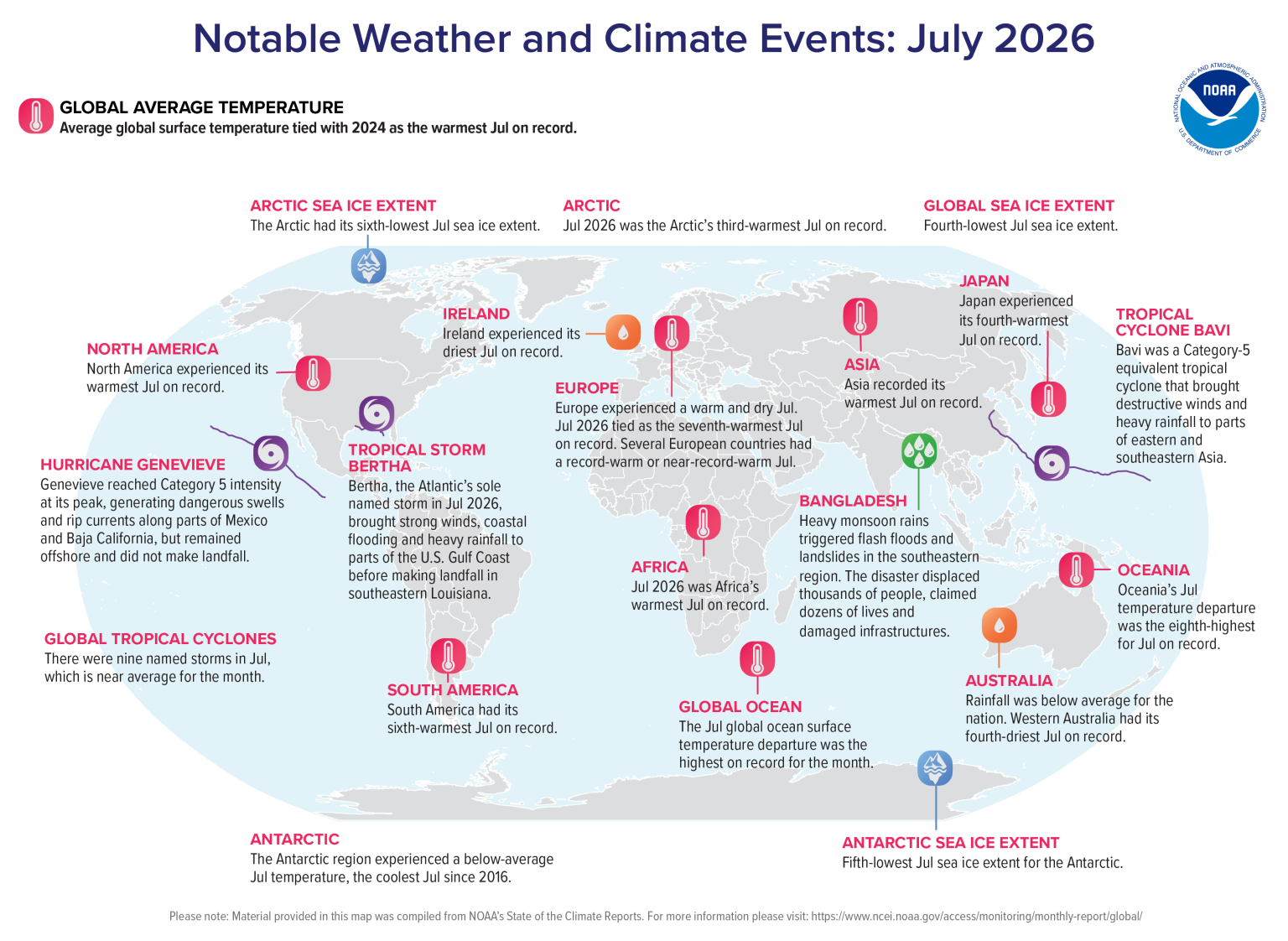
Over the past month, the world has experienced a succession of climate-related extremes. Across all regions extreme heat is becoming more frequent, more intense, and longer-lasting. Record-breaking heatwaves have gripped large parts of the Northern Hemisphere, with the World Meteorological Organization (WMO) reporting exceptional temperatures, persistent drought conditions, widespread wildfires, and severe flooding occurring simultaneously across different regions of the globe. Today’s heatwaves occur in a significantly warmer world than those experienced just a few decades ago, with warmer oceans, drier soils, and changing atmospheric conditions amplifying their impacts.
- Extreme Heat, Drought, Wildfires and Water Stress Across Europe | Europe has experienced one of its most intense summer periods on record. Western Europe experienced its hottest June-July period on record, with several countries facing multiple heatwaves since May. Persistent high temperatures and exceptionally dry conditions have increased wildfire risk, damaged ecosystems, reduced agricultural productivity, and strained energy systems. Water shortages have become increasingly visible across the continent. Major rivers, including the Rhine and Danube, have fallen to unusually low levels, disrupting navigation and trade, while declining lake and reservoir levels have raised concerns about water security and transboundary water management.
The Alpine region has emerged as one of the most visible symbols of accelerating climate change. Swiss glaciers have continued to lose mass at alarming rates, with recent heatwaves intensifying summer melt and exposing landscapes that were previously covered by ice. Reports from GLAMOS and regional media indicate that some smaller glaciers are approaching disappearance, while iconic glaciers such as the Rhône Glacier continue to retreat rapidly. Beyond their environmental significance, glaciers act as natural water reservoirs. Their decline threatens downstream water availability, hydropower production, agriculture, and tourism, while increasing risks associated with unstable slopes, rockfalls, and glacial lake formation. - Signs from a Warming Cryosphere in the Arctic and Greenland | The Arctic continues to warm at a pace far exceeding the global average. Recent reports highlighted exceptionally high temperatures in parts of the Arctic, alongside major glacier calving events in Greenland and the formation of new ice islands. These developments provide further evidence of the accelerating transformation of the cryosphere. Changes occurring in polar regions have global consequences. Loss of ice contributes to sea-level rise, alters ocean circulation, and affects weather patterns far beyond the Arctic itself. Scientists increasingly view the rapid changes observed in Greenland and the Arctic as key indicators of broader planetary warming trends.
- Record wildfire conditions across North America | The Pacific Northwest of the United States has also experienced extreme heat and an intense fire season. According to WMO assessments, North America experienced its warmest July on record. Extreme heat affected millions of people, placing pressure on health systems, energy infrastructure, and water resources.
- Emergence of a strong El Niño in Asia | Summer 2026 in Asia has been marked by the rapid development of a strong El Niño, combined with exceptionally warm oceans, which is driving heat, drought, and changing rainfall patterns across much of Asia.
- Climate variability in Africa | Africa has experienced a mix of extreme flooding, intense rainfall, drought, and rising temperatures this summer, reflecting the growing impact of climate variability and warming trends. A strengthening El Niño could worsen drought and hunger in several regions, increase flood risks in parts of East Africa, and intensify heat stress across the continent, while driving greater emphasis on adaptation and resilience.
Reflecting the growing urgency of these trends, UN Secretary-General António Guterres has urged governments to treat extreme heat as a growing global crisis requiring coordinated adaptation and mitigation measures. “Extreme heat is not a future threat. It is here. It is becoming more dangerous. And unless we act – to protect people and tackle the root cause of the crisis – it will become deadlier still.”
As we approach the 2026 edition of the UN Climate Change Conference (COP31), to be held in Antalya, Türkiye, from 9-20 November 2026, the COP30 Presidency and the incoming COP31 Presidency continue to work closely together through the UNFCCC’s “Road to Antalya” process to build momentum and support implementation-focused outcomes. Recent activities and key deadlines include:
- The incoming COP31 Presidency co-hosted a high-level retreat, bringing together the Chairs of UNFCCC negotiation groups and Heads of Delegation, on 22-23 July at Shamakhi, Azerbaijan. The theme of the Shamakhi Meeting focused on the key areas on the agenda of climate negotiations, including climate finance, just transition, adaptation to the consequences of climate change and the reduction of greenhouse gases, as well as the COP31 Presidency’s agenda of activities and the “Belém 1.5 Mission,” implemented within the framework of the Troika mandate of the COP29, COP30 and COP31 Presidencies.
- Media registration for COP31 is now open through the UNFCCC Online Registration System.
- COP-SCIENCE platform submissions remain open, enabling the academic community to contribute research, projects, and collaborative initiatives to support climate action and COP31 outcomes.
- To mark the momentum towards COP31, the COP31 Bike Ride brings together cyclists from around the world for a journey by bike and sailing boat from Belém, Brazil to Antalya, Türkiye, to highlight the benefits of everyday cycling in reducing carbon emissions, by presenting ten proposals for cycling policies at the COP, intended to be incorporated into countries’ climate plans.
Read more at:
- Current state of Swiss glaciers | GLAMOS | 14 August 2026
- How the London Declaration embedded climate action in standards development | WEF | 13 August 2026
- How Switzerland manages water resources with neighbouring countries | Swissinfo | 13 August 2026
- Record-breaking heat and extreme weather continue | WMO | 12 August 2026
- Current wildfire situation in Europe | EU Commission Joint Research Centre | 12 August 2026
- As climate change marches on, African churches keep the momentum | World Council of Churches | 11 August 2026
- Climate Bulletins | Copernicus | 10 August 2026
- Greenland glacier break creates new ice island | Bernard Rizk | Phys.Org | 10 August 2026
- Disparition du glacier de Bella Tola: «l’année exceptionnelle qu’on envisageait est bien arrivée» | Le Nouvelliste | 10 August 2026
- AI for Drought Detection | UN-Water | 10 August 2026
- How heatwaves are reshaping Switzerland’s glaciers (English) Suisse : le glacier du Rhône fond à un rythme alarmant après les vagues de chaleur (French) | Euronews | 8 August 2026
- Strengthening El Niño to push 49 million more people into acute hunger | UN News | 5 August 2026
- How Southeast Asia’s central banks can meet the climate challenge | EastAsiaForum | 5 August 2026
- Europe’s major rivers at record low water levels | EU Space Policy | 5 August 2026
- The Latest Data Confirms: Forest Fires Are Getting Worse | WRI | 4 August 2026
- «Pour Blatten, on ne peut plus parler de catastrophe naturelle», estime le géographe Bernard Debarbieux | Le Nouvelliste | 4 August 2026
- It’s 90 degrees in the Arctic right now | Scientific American | 3 August 2026
- Tackling Extreme Heat | UN Secretary-General António Guterres | 31 July 2026
- Secretary-General’s Press Encounter on his recent travels, the Middle East and Climate Change | UN Press Events | 31 July 2026
- As war on Iran drives monster Q2 profits for Big Oil, communities struggle with extreme weather and soaring costs | Greenpeace International | 31 August 2026
- Strong El Niño expected to intensify | WMO | 31 July 2026
- The climate pattern putting millions at risk: El Niño explained | UN News | 30 July 2026
- Wildfires highlight urgent need for prevention, resilience and climate action | UNECE | 30 July 2026
- Dans les Alpes, les coulées de débris deviennent plus violentes | UNIGE | 30 July 2026
- ‘Fire-Breathing Dragon Clouds’: The Health Threat of Wildfire Smoke Choking Europe and the World | Health Policy Watch | 29 July 2026
- Water level of Lake Constance falls to record low | Swissinfo | 28 July 2026
- The peculiar case of glacier-transported glass bottles at Piz Murtèl, Swiss Alps | Elisa Götza, Matthias Huss & Lander Van Tricht | Arctic, Antarctic, and Alpine Research | 28 July 2026
- Climate alarm ‘blaring from every direction’ | UN News | 28 July 2026
- Wildfires surge across Europe as Spain and France battle major blazes | UN News | 24 July 2026
- Increasingly hot Europe faces more severe droughts and growing challenges for water and land management | World Weather Attribution | 23 July 2026
- 5 764 décès en excès en France durant la période de canicule du 17 juin au 2 juillet | Santé publique France | 22 July 2026
- Climate, disasters and human mobility: What the Global Compact for Migration can advance by 2030 | Sanjula Weerasinghe, Timo Schmidt and Atle Solberg | Climate Mobility Hub | 20 July 2026
One Year After the ICJ Climate Advisory Opinion | Advancing Climate Accountability Through International Law
One year after the International Court of Justice (ICJ) issued its landmark Advisory Opinion on Climate Change on 23 July 2025, commentators and organizations said that the ruling had already begun reshaping climate law, litigation, and international diplomacy. The ICJ opinion had provided unprecedented legal clarity on states’ climate obligations and was already being used as a powerful tool to advance climate accountability worldwide. Key points highlighted on the first anniversary included:
- The ICJ opinion clarified that states have binding legal obligations to protect the climate system, prevent significant environmental harm, safeguard human rights affected by climate change, and provide reparations where climate-related harm results from breaches of international law.
- Legal experts noted that the opinion was already being cited in court cases around the world, despite being advisory rather than formally binding. Domestic courts and climate litigants have begun using it as an authoritative interpretation of international law.
- The opinion had moved from being “simply a legal milestone” to actively influencing climate diplomacy, national policymaking, litigation, and climate justice advocacy globally.
- Supporters emphasized that the judgement rejected arguments that major emitters could avoid responsibility and strengthened the legal foundation for demands for accountability and compensation for climate harm.
- The United Nations General Assembly reinforced the opinion in May 2026 by adopting a resolution stressing that addressing climate change is a legal duty under international law, not merely a political choice.
Read more at:
- From courts to legislatures, countries are embedding just transition in law and policy | UNEP | 28 July 2026
- How the Climate Change Advisory Opinion from the International Court of Justice is Influencing Domestic Jurisprudence | Cornestone Barristers | 23 July 2026
- One Year On: From Legal Clarity to Global Implementation of the ICJ Climate Advisory Opinion | CIEL | 22 July 2026
- Towards a Biodiversity Advisory Opinion | Andreas Buser, Verfassungsblog | 22 July 2026
- Symposium on the ICJ Advisory Opinion on Climate Change | Ginevra Le Moli | Review of European, Comparative & International Environmental Law | 15 July 2026
IPBES-IPCC Workshop on Biodiversity and Climate Change | Strengthening the Science-Policy Nexus
Science-Policy Interfaces (SPIs) are critical for translating scientific knowledge into effective and actionable policy. As the world confronts the triple planetary crisis — climate change, biodiversity loss, and pollution — the demand for robust, interdisciplinary, and inclusive SPIs has never been more important. Collaboration among SPIs is essential to maintain consistency across the science-policy architecture and strengthen coherence between science–policy interfaces.
This week, an Intergovernmental Science-Policy Platform on Biodiversity and Ecosystem Services (IPBES) and Intergovernmental Panel on Climate Change (IPCC) workshop on biodiversity and climate change is taking place from 18 to 20 August 2026 in at the Universal Postal Union Headquarters in Bern. The workshop is organized as part of the preparation of the Second Global Assessment of Biodiversity and Ecosystem Services (GA2), pursuant to IPBES Plenary decision IPBES-11/1
The workshop will take place back-to-back with the special event Biodiversity x Climate: Swiss community meets IPBES and the IPCC, organized by the Swiss Academy of Sciences (SCNAT) and the Swiss Federal Office for the Environment, at the Gurten Pavillon on 21 August 2026. The event will provide participants with insights into and discussions about relevant topics on the nexus of biodiversity and climate change. Various representatives from the international Science-Policy Interfaces IPBES and the IPCC, and experts from Geneva, will be present to share their experience of working in such an environment. Talks, panels and plenty of time for networking are key elements of the day.
Restoring Land, Restoring Hope | UNCCD COP17 Opens in Mongolia
The 17th session of the Conference of the Parties (COP17) to the United Nations Convention to Combat Desertification (UNCCD) is convening from 17 to 28 August 2026 in Ulaanbaatar, Mongolia, under the theme Restoring Land. Restoring Hope. COP17 brings together delegates from UNCCD’s 197 Parties, alongside leaders from government, business and civil society, as well as scientists, youth, Indigenous Peoples, pastoralists and smallholder farmers to forge solutions to the interconnected challenges of desertification, land degradation and drought, recognizing that restoring land is also essential to reducing instability, preventing displacement and strengthening human and national security in vulnerable regions. Taking place during the United Nations International Year of Rangelands and Pastoralists (IYRP 2026), declared by the United Nations General Assembly and championed by Mongolia, COP17 is a major opportunity to accelerate action on the sustainable management, restoration and conservation of rangelands, while spotlighting the needs of pastoralist communities who depend directly on these ecosystems for their livelihoods. → Learn more on the host country website, access all documents, follow the livestream on UN Web TV and the daily coverage of the Earth Negotiations Bulletin and UNCCD daily journals
Hosting leading organizations working on environmental issues, nature conservation, water, health, human rights and many relevant areas of work, Geneva plays an important role in the global response to desertification, land degradation, and drought. Various Geneva experts will be in Mongolia to contribute and actively participate in negotiations.
Read more at:
- Business for Land at COP17 to strengthen partnerships for regenerative landscapes | UNCCD | 14 August 2026
- What is COP17’s Secret Ingredient? | UN Volunteers | 14 August 2026
- UNCCD ‘Land’ COP17 | UNDP | 10 August 2026
- Mongolia-led project to tackle land degradation, as UNCCD COP17 approaches | IUCN | 7 August 2026
- The hidden cause of rising food prices, water shortages and migration | WWF | 6 August 2026
- This month’s biggest land story was 110 quadrillion kilometres long | Cultivate | 3 August 2026
- Why is the UN COP17 summit on droughts and land restoration so important? | WWF | 29 July 2026
- WWF UNCCD COP17 Expectations | WWF | July 2026
- Business4Land | UNCCD
- COP Resource Hub | Sustainable Development Solutions Network
- Stakeholders at UNCCD COP17 | UNEP at the UNCCD COP17 – UNDRR at UNCCD COP17 Mongolia – FAO at the UNCCD COP17 – IUCN at UNCCD COP17 – WWF at UNCCD COP17 – WCC at the UNCCD COP17
Advancing Global Biodiversity Goals | Outcomes of CBD & CITES Meetings
Last month, Member States, experts and stakeholders met in Geneva and Nairobi to advance the global biodiversity agenda, paving the way to the 2026 UN Biodiversity Conference, which will take place in Yerevan, Armenia from 19 to 30 October 2026.
- The twenty-eighth meeting of the Subsidiary Body on Scientific, Technical and Technological Advice (SBSTTA-28) and Subsidiary Body on Implementation (SBI-7) to the Convention on Biological Diversity (CBD) concluded respectively on 1 August and 12 August 2026 in Nairobi, Kenya. In both meetings Parties considered the first report on progress of the Kunming-Montreal Global Biodiversity Framework, the “State of Biodiversity Action,” with a view to forging a common understanding of how gaps in progress can be overcome.
- At SBSTTA-28, Parties found widespread consensus on issues surrounding sustainable wildlife management and the management of protected areas, synthetic biology and marine and coastal biodiversity conservation, and provided recommendations on the first update of the Convention’s Programme of Work on Protected Areas, global voluntary guidance for sustainable wildlife management, and a thematic action plan to strengthen capacity-building, technology access, and knowledge-sharing in synthetic biology. → Read more on SBSTTA-28 ouctomes.
- SBI-7 tackled how to strengthen key enablers of biodiversity action, including finance, mainstreaming, access to information, capacity-building and digital sequence information, communications and education as well as biodiversity mainstreaming. Parties advanced recommendations aimed at strengthening the policies, resources, institutions, cooperation, and capacity needed to translate national and global biodiversity commitments into action.
- The 28th meeting of the CITES Plants Committee (PC28) concluded on 23 July 2026 in Geneva, successfully advancing priorities in trade reviews, timber identification, traceability, and the sustainable management of edible tuberous orchids and medicinal and aromatic plants, among others. → Read more in CITES Press Release and consult executive summaries available in all languages on the CITES website
- The 34th meeting of the Animals Committee (AC34), concluded on 17 July 2026 with a joint session with PC28 and advanced its work on the oversight of captive-breeding operations. Members selected ten new species-country combinations for review and identified several potential systemic compliance concerns that may, if necessary, be referred to the CITES Standing Committee for further consideration at its 81st meeting in November 2026. → CITES Press Release and consult executive summaries available in all languages on the CITES website
Read more at:
- In Nairobi an informal dialogue seeks common ground on the functioning of the Subsidiary Body dedicated to Article 8(j) of the CBD | Astrid Schomaker, Executive Secretary, CBD | 14 August 2026
- Parties recognize the world is not on track to achieve biodiversity targets; Nairobi meetings pave the way for pivotal 2026 UN Biodiversity Conference in Yerevan | CBD | 12 August 2026
- Statement by the Executive Secretary of the Convention on Biological Diversity, Astrid Schomaker, at the closing of the seventh meeting of the Subsidiary Body on Implementation | CBD | 12 August 2026
- ICCWC expands coordinated global action against wildlife crime in 2025 | CITES | 4 August 2026
- Progress achieved on crucial scientific and technical issues ahead of COP 17 | CBD | 3 August 2026
- Amid concurrence and disagreement over various issues, SBSTTA28 ends in Nairobi ahead of CBD COP17 in Yerevan | Down to Earth | 2 August 2026
- CITES Plants Committee renews momentum for strengthening conservation and trade regulation for brazilwood, edible orchids, and aromatic plants | CITES | 30 July 2026
- From guidance to action: What will it take to implement Sustainable Wildlife Management under the GBF? | Earthmind | 30 July 2026
- World falling short on 22 of 23 nature targets for 2030, says draft UN report | Carbon Brief | 29 July 2026
- Draft global report on collective progress in the implementation of the Kunming-Montreal Global Biodiversity Framework | CBD | 26 July 2026
- Reptiles, eels, sharks and corals selected for CITES review process for ensuring trade sustainability and species survival | CITES | 22 July 202
- Summary, conclusions and key messages of the global review of collective progress in the implementation of the Kunming-Montreal Global Biodiversity Framework | CBD | 22 July 2026
One Year After Plastics Treaty INC-5.2
One year after the second part of the fifth session of the Intergovernmental Negotiating Committee to develop an international legally binding instrument on plastic pollution, including in the marine environment (INC-5.2), that convened in Geneva, negotiations are still ongoing:
- The process has successfully maintained international engagement and clarified areas of agreement, although governments have yet to bridge deep divisions over production limits and legally binding controls.
- A series of informal and formal meetings have been taking place throughout 2026.
- Discussions have focused on identifying “landing zones” for compromise while preparing for future negotiation rounds, including INC-5.4 planned for 2027.
- More than 100 countries have continued to support strong measures addressing the full life cycle of plastics, including product design requirements, phase-outs of harmful products, and financing mechanisms.
Major advancements in the process towards the fourth part of the fifth session (INC-5.4) have been documented in the latest correspondence from the INC Chair, H.E. Amb. Julio Cordano:
- In his fourth letter, dated 29 July 2026, the INC Chair brought attention to the success of the in-person meeting of the Heads of Delegation (HODs) that took place in Nairobi between 30 June and 3 July 2026 and underscored that its outcomes would be detailed in a Summary and an Aid to Negotiations Document. The letter highlights that:
- Member States should carefully consider, in the period preceding the informal in-person HODs meeting, scheduled to take place from 27 to 30 September 2026 in Bangkok, Thailand, the mandates that the Diplomatic Conference of Plenipotentiaries could set out in its resolutions, as these will be a component of the package to be agreed as part of the outcome of the INC.
- The structure of the meeting in Bangkok will follow as much as possible those used at the meeting in Nairobi — the organization of the work in Clusters, supported by the same Co-facilitators where possible, and providing space for bilateral exchanges and consultations among Members. The meeting is aimed at advancing considerations on outstanding issues, working with the help of the Aid to Negotiations to begin consolidating areas of convergence, advance consideration on outstanding issues, and hopefully start identifying some solutions.
- The participation of Observers in informal settings must be enhanced. As this issue remains unresolved, and following consultations with the Bureau, the format of the meeting in Bangkok will be the same as the informal in-person HODs meeting held in Nairobi.
- The meeting in Nairobi demonstrated that Member States can be united around one single purpose: to deliver an international legally binding instrument on plastic pollution, including in the marine environment, in line with our mandate established in UNEA Resolution 5/14.
- The Chair’s summary of the informal in-person meeting of Heads of Delegation to the INC on Plastic Pollution held from 30 June to 3 July 2026, published for informational and record-keeping purposes only, provides an overview of the various segments of the meetings, including the “Pamoja” opening session; Cluster discussions; Chair’s consultations on the scope of the treaty; decision-making and arrangements of elements in the text and of the“Umoja” closing session. The meeting also provided a space to discuss the next phases of the Roadmap to INC-5.4, including the possible convening of a third informal in-person meeting of Heads of Delegation during the week of 25 January 2027, before resuming negotiations at INC-5.4 in March 2027.
- The Aid to Negotiations, transmitted on 8 August 2026 as a living informal reference document aims at helping forthcoming discussions and contributing to structuring engagement in the next phase of preparations. While reflecting the discussions held at the informal in-person HODs meeting of June 2026, past texts released in this process, as well as the discussions in past INC sessions, the purpose of this document is to support the next informal in-person HODs meeting in Bangkok, after which a second iteration of the Aid to Negotiations document will be developed. The text is bracketed to reflect the current status of negotiations and placeholders have been used for topics for which further discussions are needed, such as the scope of the treaty, plastic products and the functions of the Conference of the Parties, among others.
Reactions to the Chair’s Aid to Negotiations and other opinions from engaged stakeholders include:
- Statement on the Aid to Negotiations Draft | Youth Plastic Action Network (YPAN) | 11 August 2026
- IUCN Statement on INC Chair Aid to Negotiations Text | IUCN & IUCN WCEL | 10 August 2026
- Chair’s Latest Global Plastics Treaty Draft is a Lowest-Common-Denominator Text, Not a Path Forward | CIEL | 10 August 2026
- New Global Plastics Treaty ‘Aid To Negotiations’ risks watering down ambition to irrelevance | EIA | 10 August 2026
- Chair of Plastic Pollution Treaty Talks Circulates Update on Intersessional Progress | IISD SDG Knowledge Hub | 5 August 2026
- The Plastics Treaty Process Needs Greatly Improved Observer Participation at this Critical Point in the Negotiations and Beyond | Stakeholder Forum for a sustainable future | 28 July 2026
ISA31 Concluded with Roadmap for Deep-Sea Mining Regulations
The Second Part of the 31st Annual Session of the International Seabed Authority (ISA31) concluded on 31 July 2026 after five intensive weeks of work across ISA’s organs, the Legal and Technical Commission (LTC), the Finance Committee and the Council, which resulted in decisive progress in advancing the Authority’s regulatory and institutional mandate. While the draft exploitation regulations were largely discussed at ISA31, most issues remain unresolved and work will continue intersessionally. Outcomes of ISA31 include:
- Roadmap for Future Work | The Council decided on the approach to the continuation of the elaboration of rules, regulations and procedures relating to exploitation for deep-sea mining and resolution of the remaining key outstanding issues, requesting the Secretariat to draft a roadmap setting out milestones for timely adoption of the rules, regulations, and procedures relating to exploitation and an updated indicative list of key outstanding issues requiring further thematic discussion by the Council. A draft roadmap should be shared by 31 October 2026 and will then be considered at Part I of the ISA-32 Council session.
- Support of a moratorium or precautionary pause on deep-sea mining | On an increased push to advance scientific implications of deep-sea mining ahead of allowing exploration and exploitation, the number of member states supporting a moratorium or precautionary pause on deep-sea mining grew to 46, with Mauritius, Mozambique and the Republic of the Congo joining.
- Exploration Contracts | The ISA Council approved the application for extension of three exploration contracts (Germany/polymetallic nodules, NORI/polymetallic nodules, China/polymetallic sulphides), requesting the Secretariat to take the necessary steps to execute the extension and report to the Council at its next session.
- Council Elections | Members elected 18 Council members for 2027–2030 by acclamation.
- Participation of observers | Assembly members accepted requests for observer status from 11 civil society organizations and adopted a decision on interim arrangements in respect of requests for observer status submitted by contractors.
Read more at:
- Earth Negotiations Bulletin Summary
- Deep-Seabed Mining: Outcomes from the ISA’s July 2026 Session – Continued Negotiations, Court Orders and Critical (In)Decisions | Samantha Robb, Ocean Vision Legal | 13 August 2026
- Data as a Voice: Bringing Deep-Sea Species to the ISA Negotiating Table | Senckenberg Ocean Species Alliance | 11 August 2026
- Key Takeaways from the July International Seabed Authority Council and Assembly Meetings 2026 | Deep Sea Conservation Coalition | 10 August 2026
- Complexity and Controversy Dominate Talks on Deep Seabed Exploitation Rules | IISD SDG Knowledge Hub | 5 August 2026
- Countries put science and precaution above race to start deep seabed mining | WWF | 3 August 2026
- ISA Assembly closes with more calls for a moratorium: governments must now turn words into action to protect our ocean | Sofia Tsenikli, Deep Sea Conservation Coalition | 1 August 2026
- Closing Remarks by Leticia Carvalho, Secretary-General, International Seabed Authority | 31 July 2026
- ISA Launches Gender Compact to Advance Women’s Leadership at Sea | ISA | 30 July 2026
- Week 2 from the ISA Council: The case for a moratorium is stronger than ever | Sofia Tsenikli, Deep Sea Conservation Coalition | 26 July 2026
- ISA Council developments reinforce the case for a deep-sea mining moratorium as contractor non-compliance inquiry continues | Deep Sea Conservation Coalition | 25 July 2026
- ISA hands contract extension to TMC despite support for unlawful deep sea mining, proving need for immediate moratorium, says Greenpeace | Greenpeace International | 23 July 2026
- Top maritime court rejects bid to halt UN deep-sea mining inquiry | Climate Home News | 20 July 2026
- Towards an ecologically meaningful toxicity assessment of deep-sea mining | Deep-Ocean Stewardship Initiative | July 2026
World Humanitarian Day | Environment in Ongoing Conflicts
World Humanitarian Day, observed on 19 August, honours humanitarian workers and shows solidarity with people affected by crises worldwide. It highlights the risks faced by aid workers, many of whom are local staff serving their own communities. Despite protections under international humanitarian law, humanitarian and medical personnel continue to face numerous attacks. As highlighted by the UN Secretary-General, “Serving others has become more dangerous than ever. More than a thousand humanitarians have been killed in the last three years.”
Humanitarian workers stand up for people in need. We must stand up for them. We must act for humanity – now.
On 19 August 2026, UN Geneva will hold a Commemoration Ceremony in memory of those who paid the utmost sacrifice in line of duty and to honour the invaluable contribution of humanitarian workers. The event will take place at Palais des Nations at 16:00 CEST in Salle des Pas Perdus.
As we mark World Humanitarian Day, the following recent stories are a stark reminder that humanitarian crises are intertwined with environmental destruction, and the protection of civilians and natural resources. From Sudan to Lebanon and Oman, communities are facing the devastating human consequences of violence, displacement, and ecological disaster.
- Gaza: Destruction of buildings rises by nearly 10 per cent since ceasefire | UN News | 13 August 2026
- Demolition of wells and fires at water stations deepen humanitarian and environmental impacts in southern Lebanon | OCHA Lebanon Flash Update #49 | 10 August 2026
- Oil disaster unfolds in protected marine area as Russian shadow fleet tanker leak accelerates off Omanv | Greenpeace | 5 August 2026
- Water access severely affected for 700,000 people due to conflict-related damage to infrastructure in southern Lebanon | OCHA Lebanon Flash Update #48 | 3 August 2026
- ‘We watched the fields burn, helpless and in tears’: In Yaroun, Israel reduces centuries-old olive trees to ashes | L’Orient Today | 3 August 2026
- In El Obeid, Sudanese women face drones by day, rape by night, to reach water | UN News | 24 July 2026
In Memoriam
On 18 July 2026, Magdi Tóth Nagy passed away peacefully after a short illness, a loss described to be a devastating blow to the environmental movement in Central and Eastern Europe. She served as Co-Executive Director of the Guta Association who represented the European ECO Forum at the Aarhus Convention. For 30 years, she was also the heart and soul of the Regional Environmental Center (REC) for Central and Eastern Europe, leading its Public Participation Programme.
A supporter of environmental human rights and environmental defenders, she was a pioneer of public participation and environmental democracy and a foundational spirit of the UNECE Aarhus Convention since its adoption, becoming one of its most respected experts and capacity builders. She later shared the Aarhus experience in the negotiations that led to the Escazú Agreement in the Latin American and Caribbean region. She leaves an extraordinary legacy, which lives on in every effort to strengthen access to information, public participation, access to justice, and the protection of environmental human rights defenders.
The Geneva Environment Network extends its deepest condolences to Magdi Tóth Nagy’s family and friends; Aarhus community; to colleagues; and to the broader environmental and human rights communities.
Tributes include:
- GUTA Association | Other tributes from those she touched at the REC, the Guta Association and her other endeavours are also available on the page.
- BlueLink Foundation
- Escazú Now Regional Network
Call for Submissions, Awards and Contests | Upcoming Deadlines
With the environment high on the agenda of International Geneva and beyond, international processes, negotiations, and fora regularly call for inputs in preparation for future reports and guidelines or for people to support their process. A dedicated update lists calls for submissions related to the environment. Additional updates also list those related to human rights mechanisms and ongoing contests launched by our partners. Deadlines not to be missed during the coming weeks include:
- Call for Comments: Nominations for New Issues of Concern | The Global Framework on Chemicals invites stakeholders to provide comments on nominations submitted for new issues of concern for consideration at the first meeting of the International Conference. Nominations and work plans include: (a) Chemicals management issues of special concern for children’s health; (b) Towards a broader approach on lead: expanding the scope beyond lead in paint; (c) Pharmaceutical pollution and its effects on human health and the environment; (d) Harmonization of global efforts to protect human, animal, and environment health against the threat from hazardous chemicals by transitioning to New Approach Methods. → Submit comments by 21 August 2026 on Forms
- Submit a case study for the Global Wetland Outlook 2028: Wetlands for Healthy Cities | The Global Wetland Outlook is the Convention on Wetlands’ flagship publication. GWO2028 will be launched ahead of COP16 in Panama City in June 2028. Case studies should address wetlands and sustainable urban development, e.g., how cities have integrated wetlands into urban planning, governance, financing, stakeholder engagement, biodiversity conservation, restoration, climate resilience, human health, or other relevant initiatives. Case studies should be submitted using this online form. → The deadline for submission is 30 August 2026.
- Sixth Round of National Reporting under the Stockholm Convention | Pursuant to decision SC-12/19, the Conference of the Parties to the Stockholm Convention decided that Parties shall submit their sixth national reports to the Secretariat by 31 August 2026 for consideration by the Conference of the Parties at its thirteenth meeting.
- Call for proposals for youth-led projects for flood and drought resilience | The Global Integrated Flood and Drought Management Competition for Youth-Led Projects supports innovative, youth-led ideas that enhance resilience to floods and droughts in vulnerable communities. The competition aims to empower young people to design and lead practical solutions for disaster risk reduction, preparedness, and response through projects rooted in local needs. It also seeks to highlight the important role youth can play in advancing climate action and building flood and drought resilience. → The deadline for proposals is 31 August 2026.
- Call for Information in Follow-Up to the Basel Convention 15th Meeting of the Open-ended Working Group | At the fifteenth meeting held from 23 to 26 June 2026, the Open-ended Working Group agreed to invite Parties, observers and others, as applicable, to provide written comments to the Secretariat on various products reflecting the outcomes of the meeting. A letter inviting the submission of comments and information as agreed by the Open-ended Working Group at its fifteenth meeting was sent to Parties and observers. → Comments are to be submitted by 31 August 2026
- Informal technical meeting on the draft rules of procedure of the Plenary of the Intergovernmental Science-Policy Panel on Chemicals, Waste and Pollution (ISP-CWP) | The informal technical meeting to advance on the draft Rules of Procedure (RoP) of the Plenary of the ISP-CWP, will be held from 1 to 3 October 2026 at the United Nations Conference Centre in Bangkok, Thailand, preceded by regional meetings on the afternoon of 30 September 2026, to advance on the draft rules of procedure through focused, text-based discussions among experts and to support the Chair in facilitating consensus on the outstanding provisions of the draft rules of procedure. → The deadline for registration is 6 September 2026. On-site registration will not be available.
More Happening Abroad
World Water Week 2026: Water for People and Progress | Gathering stakeholders from all over the world in Stockholm and online, the World Water Week 2026 will take place from 23 to 27 August 2026. Held under the theme Water for People and Progress, WWW 2026 will discuss progress on water for people in the Sustainable Development Goals (SDGs) and look ahead to the successors to the SDGs. In the build-up to the 2026 UN Water Conference, World Water Week will serve as a platform to help people prepare and achieve their aims ahead of this crucial water governance process. Highlighting its significance, the UN has recognized World Water Week as a “key global milestone” on the road to the 2026 UN Water Conference.
Enjoying the Final Month of a Green Summer in Geneva
While the summer is in its final month, there are still various green activities to explore. For those enjoying the last days of the holiday season or planning an afterwork or weekend activity, here are some suggestions for the upcoming week:
- Activités estivales pour les seniors | Marche sportive au parc des Eaux-Vives | 19 August 2026 | FLAG21 | Parc des Eaux-Vives
An outdoor morning designed for seniors, combining gentle physical activity with a friendly break. Participants will be introduced to sport walking from 9:30 to 10:30 CEST, followed by a healthy snack. Organised as part of the City of Geneva’s summer programme for seniors, the activity is free and does not require registration. - Visite d’exposition et débat mouvant – Atelier Hydromondes | 22 August 2026 | ASL | Espace Léman
Take a closer look at Lake Geneva through the exhibition Léman être vivant, then join a lively group discussion where everyone can share their views. Participants will move around the space according to their opinions and debate different questions about the lake, its future, and the way we relate to it. - Garden Party | 22 August 2026 | Jardin des Nations
Join this day-long party for plenty of open-air activities! - Lars Traversée | 23 August 2026 | Bain des Pâquis
Each summer, the Lars Traversée brings people together to honour the memory of Lars through a symbolic crossing of Lake Geneva. More than a sporting event, it is a moment of remembrance, friendship, and solidarity, where participants gather at the Bains des Pâquis to celebrate a life that left a lasting impact. - Scène Ella Fitzgerald | Until 29 August 2026 | Parc la Grange
Set in the beautiful surroundings of Parc La Grange, the Ella Fitzgerald Stage hosts a series of free open-air concerts throughout the summer. Featuring a diverse musical programme, these evening performances offer a unique opportunity to enjoy live music in one of Geneva’s most iconic parks. Concerts take place under the stars, creating a relaxed atmosphere for audiences of all ages. - Genève, Rêve d’Eau | Until 30 August 2026 | City of Geneva | Jardin Anglais
A new summer event in Geneva, offers a unique experience in the heart of the Jardin Anglais. Open to everyone, regardless of age, this free “event ” features water shows, music, entertainment, and spectacular nighttime performances, during which Lake Geneva becomes a living stage. - Datarium – Geneva at the Heart of Life Data | Until 30 August 2026 | Swiss Institute of Bionformatics | Parc des Bastions & Rotonde du Mont Blanc
Explore how data is transforming our understanding of health, biodiversity, and the environment through this free outdoor exhibition. Combining scientific visuals, real-life stories, and interactive displays, Datarium explains how bioinformatics supports fields such as precision medicine, epidemic monitoring, artificial intelligence, and wildlife conservation. The exhibition is presented in both French and English and is open to everyone aged 14 and over. - Exhibition “Quel froid!” | Until 30 August 2026 | Maison Tavel
This exhibition explores the theme of winter in Geneva and beyond, bringing together traditions, artists’ perspectives, and visual archives. Visitors are guided through popular practices, urban scenes, and majestic landscapes, from Lake Geneva to the Alps. - Emportons malin | Until 1 September 2026 | Various Locations
Choose a more sustainable way to enjoy your takeaway meal with Emportons Malin. This campaign encourages visitors to replace single-use packaging with reusable containers at participating food halls in Geneva. Meet the campaign team, discover practical waste-free solutions, and even receive a free reusable lunch box with the purchase of a meal while stocks last. - Janus at the Bioparc | Until 1 September 2026 | Muséum de Genève | Bioparc Genève
Meet Janus, Geneva’s remarkable two-headed Greek tortoise, during his temporary stay at the Bioparc. Each of his heads has its own brain and personality, which can make even a simple walk rather complicated. Visitors can see him in a specially designed enclosure and learn more about the daily care that has helped him reach the exceptional age of 26. - Théâtre de l’Orangerie | Until 5 September 2026 | Parc La Grange
The Théâtre de l’Orangerie returns for its summer season with a diverse programme of theatre, music, dance, exhibitions, and family-friendly performances. Taking place in the scenic setting of Parc La Grange, the festival gathers artists from a variety of disciplines, offering audiences a vibrant cultural programme during the summer. - Atelier sur la faune et la flore du lac | Until 16 September 2026 | La Libellule | Bains des Pâquis
Discover the hidden life of Lake Geneva during these interactive workshops led by the association La Libellule. Taking place at the Bains des Pâquis, the sessions introduce participants to the lake’s wildlife and plant life, from fish and birds to algae, crustaceans, and plankton. A fun and educational activity for anyone curious about the local environment. - Botanic Circus Exhibition | Until 30 September 2026 | Tuesday to Friday, from 4.00 pm to 9.00 pm | Alice Izzo | Jardin des Nations
Step into a colourful world where plants, flowers, and fruit take centre stage. Created by Geneva-based artist Alice Izzo, Botanic Circus transforms the Jardin des Nations into an immersive open-air exhibition blending nature, illustration, and imagination. Wander through the installations, discover playful artworks inspired by the living world, and enjoy a programme of workshops and events throughout the summer. - Prendre Racine – Hommes et Plantes en Exil | Until 30 September 2026 | ProSpecieRara | Various locations
This travelling exhibition explores the botanical knowledge and agricultural traditions brought north of the Alps by Huguenot and Waldensian refugees in the late 17th century. Through the stories of gardening and cultural exchange, it highlights the lasting impact of exile on landscapes and communities. The exhibition also draws connections to contemporary issues by showcasing intercultural gardens and reflecting on biodiversity, migration, and climate change across several locations in Switzerland. - Exhibition – LÉMAN ÊTRE VIVANT | Until 18 October 2026 | Espace Léman
See Lake Geneva from a completely different perspective through this immersive exhibition combining photography, films, sculptures, sound installations, and storytelling. Created by the Hydromondes collective, LÉMAN ÊTRE VIVANT invites visitors to think of the lake as a living ecosystem, connected to its rivers, forests, glaciers, wildlife, and communities. A programme of workshops and family activities complements the exhibition throughout the summer. - Hortus Botanicus Helveticus: Together for 30 years | Until 29 November 2026 | Jardin Botanique de Genève
Marking the 30th anniversary of Hortus Botanicus Helveticus, this outdoor exhibition celebrates the work of Switzerland’s 30 botanical gardens. As you walk through the Jardin Botanique de Genève, discover 30 illustrated displays, each featuring a representative plant species and highlighting the important role these gardens play in protecting biodiversity and preserving plant life for future generations. - Create Your Own Rousseau-Style Herbarium | Until 23 December 2026 | Jardin Botanique de Genève
Discover the art of herbarium making in this hands-on workshop inspired by Jean-Jacques Rousseau. Using dried flowers, plants, and traditional paper, participants can create their own herbarium sheet while learning about plant identification and the scientific techniques behind this botanical practice. The activity is free and suitable for visitors aged four and above.
What (Else) to Read Next?
- Quadripartite collaboration extends the One Health Joint Plan of Action to 2029 | WHO |
- Oman says massive oil spill reaches coastline: What damage could it do? | Al Jazeera | 13 August 2026
A vast oil spill from a leaking tanker reached Oman’s coastline on Wednesday, its environment agency said. This oil spill threatens to become one of the world’s worst in years after spreading largely unchecked for several weeks, experts say. - Safeguarding environmental democracy in challenging times | UNECE | 12 August 2026
Strengthening access to justice to address environmental crime and environmental damage, harnessing artificial intelligence for trustworthy environmental information, and promoting public participation in international fora were in focus of discussions at the thirtieth meeting of the Working Group of the Parties to the Convention on Access to Information, Public Participation in Decision-Making and Access to Justice in Environmental Matters (Aarhus Convention), held in Geneva on 24–26 June 2026 under the chairship of Finland. The meeting gathered more than 100 participants representing governments, judiciary, non-governmental organizations (NGOs) and other stakeholders. - Treaty Options Papers: Exploring possible elements of a Fossil Fuel Treaty | Fossil Fuel Treaty Initiative | 11 August 2026
This briefing series focuses primarily on the possible legal design of a treaty – including its scope, principles, commitments, and institutional architecture. It draws on precedents from international environmental, human rights, trade, arms control and other areas of international law to identify options for states and advocates to consider in the design of a Fossil Fuel Treaty. - WWF’s 10 point plan for effective ocean governance through the Ocean Act | WWF | 11 August 2026
Current ocean governance frameworks have not succeeded in putting in place planning systems that work for sea users and the environment. Member States did not reach Good Environmental Status in our oceans by the deadline of 2020 and are far off track to meeting the deadline of 2030 for protecting 30% of the ocean. WWF’s 10 point plan for effective ocean governance through the Ocean Act shows how the European Union can set this right by putting social and environmental concerns at the heart of ocean governance. - ENVIRONMENTAL INTELLIGENCE: The Missing Layer in Corporate Decision-Making | Adel Farid Abdel-Kader | 10 August 2026
Imagine walking into a board meeting ten years from now. The Chief Financial Officer is presenting the company’s financial outlook. The Chief Strategy Officer is discussing emerging opportunities and competitive threats. The Chief Risk Officer is addressing cyber resilience, geopolitical uncertainty, and operational vulnerabilities. Then another executive begins to speak, not the sustainability director and not the ESG manager, but the Chief Environmental Intelligence Officer. For many executives today, that title may seem unusual. However, if the past decade has taught us anything, it is that the forces shaping business performance are changing faster than many organizations realize. - Mapping Corporate Harm to Human Rights and the Environment: The Brave Database | Federica Nieri, Elena Assenza, Verdiana Morreale et al. | Cambridge University Press | 10 August 2026
This paper introduces a new open-access dataset documenting alleged human rights and environmental abuses—the REBALANCE Business-related Human Rights and Environmental (BRAVE) database—involving 83 of the largest publicly listed European multinational corporations between 2000 and 2020. - Peacock party takes pride of place in nod to decades of turbulent history | UN News | 7 August 2026
In a new twist on panda diplomacy, UN Geneva welcomed five young peacocks to the Palace of Nations on Friday, a gift of India that preserves a tradition of keeping the stately birds in the grounds, that predates both the global body and its ill-fated predecessor, the League of Nations. - Meet five Indigenous advocates fighting to protect the planet – and their traditions | UNEP | 7 August 2026
These men and women have all been named United Nations Champions of the Earth, the UN’s highest environmental honour, led by the United Nations Environment Programme (UNEP). And while they hail from different countries, they have shown that traditional knowledge can play a pivotal role in helping humanity navigate a series of mushrooming environmental crises far beyond their locations.
- EXCLUSIVE: Here is the ‘Final Text’ of UN Political Declaration on Pandemics – Although its Adoption is Far From Guaranteed | Kerry Cullinan, Health Policy Watch | 6 August 2026
United Nations member states are almost certain to break the silence on the final draft of the Political Declaration on Pandemic Prevention, Preparedness and Response (PPPR) that was sent to them recently– but likely for all the wrong reasons. Armenia and Rwanda, the co-facilitators of the declaration negotiations, put the “final” text of the declaration for the High-Level Meeting (HLM) on PPPR in September under the silence procedure on 28 July. - Oil disaster unfolds in protected marine area as Russian shadow fleet tanker leak accelerates off Oman | Greenpeace International | 5 August 2026
With oil apparently leaking at an accelerating pace and the tanker stranded in a difficult location, there is an imminent risk of an unprecedented oil disaster from a broken tanker, with devastating consequences for the region’s coastlines and marine ecosystems. - Diego Mesa Puyo selected as next GEF CEO and Chairperson | GEF | 5 August 2026
The Global Environment Facility (GEF) Council announced the selection of Diego Mesa Puyo as the family of funds’ next CEO and Chairperson. Mesa Puyo, an international leader in energy policy, economic development, and sustainability, and former Minister of Energy and Mines from Colombia, will serve an initial term of four years, aligned with the GEF-9 funding period and the last sprint towards critical 2030 environmental goals.
- Banks provide billions in “sustainable” loans to deforestation-linked palm oil firms | Global Witness | 5 August 2026
Banks hand out billions in sustainability-linked loans to palm oil companies, despite deforestation links, as voluntary standards mean companies are marking their own homework on environmental and human rights impacts. - IUCN Green Status Assessment reveals uneven recovery for Eastern Gorillas | Senckenberg Nature Research | 4 August 2026
IUCN released the first Green Status Assessment for the eastern gorilla (Gorilla beringei), offering the most comprehensive evaluation to date of the species’ recovery, ecological functionality, and long-term prospects. The assessment led by Senckenberg researcher Dr. Jessi Junker was conducted at both the species level and the subspecies level, with separate analyses for the two subspecies: Grauer’s gorilla (Gorilla beringei graueri) and the mountain gorilla (Gorilla beringei beringei). - World Development Report 2026. The Promise of Artificial Intelligence | World Bank Group | 4 August 2026
This report urges policy makers in developing countries to be blinded by neither the hype nor the hysteria surrounding AI in the global headlines. It reminds them instead that adopting and adapting AI—with care but without delay — and eventually advancing AI could enable developing countries to solve problems that have resisted solutions for decades. - World scientists’ warning to humanity: a third notice | William J. Ripple, Christopher Wolf, Johan Rockström et al. | Alliance of World Scientists | July 2026
The Third Notice concludes that humanity has entered a planetary emergency driven by climate change, biodiversity loss, pollution, and the crossing of multiple planetary boundaries. It identifies six broad transformations that can reduce environmental pressures while improving human well-being. → Scientists are invited to endorse the article World Scientists’ Warning to Humanity: A Third Notice. The full paper can be read in roughly eight minutes and the summary can be read in one minute. - Chile, China and Belgium are competing to host the headquarters of a landmark global ocean treaty. But why do they care so much? | Dialogue Earth | 31 July 2026
Countries spent 20 years negotiating the high seas treaty. It governs the use and protection of biodiversity on the high seas: those areas of the ocean beyond the jurisdiction of any country. The treaty is also known as the Biodiversity Beyond National Jurisdiction (BBNJ) agreement. […] Now that the treaty has entered into force, the inaugural conference of the parties to the agreement (COP1) can take place, in January. One of the first tasks for those parties will be deciding the location of the secretariat’s headquarters.
- Prepared for the Predictable? Overshoot and the Failure of Countries to Ready Themselves | Footprint Network | 30 July 2026
This report, which draws on countries’ published economic strategies as the source, examines whether those national economic strategies account for resource security and ecological overshoot. It argues that such resource security is essential because economies depend on finite physical inputs, yet their GDP-focused frameworks largely ignore these constraints, contributing to persistent global overshoot since the 1970s. - HD-Oslo Forum Briefing Paper “Cooling the heat: mediation in a warming world” | Sebastian Kratzer, HD Centre | 28 July 2026
Drawing on case studies from Nigeria, north-east Syria, Iraq, the Democratic Republic of the Congo and beyond, the briefing examines both established and emerging thematic areas of climate-related mediation, illustrating their different approaches and impacts. It shows how mediation is helping communities manage natural resources, negotiate water-sharing arrangements, protect the environment during conflict, and strengthen resilience to climate impacts. - Côte d’Ivoire: Trafigura’s “Probo Koala” toxic waste victims still awaiting justice after twenty years, say UN experts | OHCHR | 28 July 2026
Twenty years after Trafigura’s dumping of toxic waste from the M.V. Probo Koala in Côte d’Ivoire, thousands of victims continue to seek justice, accountability and effective remedies for the human rights infringements they suffered, UN experts said. - Towards safe and just planetary boundaries for novel entities | Miriam L. Diamond, Anna Shalin, Lin Boynton et al. | Nature Sustainability | 27 July 2026
The Planetary Boundaries framework shows that humanity is veering outside the conditions that safeguard the continued health and well-being of society. Setting safe and just limits for novel entities, specifically anthropogenic chemicals and materials, has been difficult because of their sheer number and diverse characteristics, hampering effective management. To inspire future work, this paper presents a conceptual framework comprising three interconnected pillars, considering both well-known novel entities and ‘unknown knowns and known unknowns’. This framework is intended to assess boundaries and chart transformation pathways towards societal systems that benefit from novel entities while minimizing pressures on ecosystems and human health.
- Seven IUCN-recommended Natural and Mixed sites join UNESCO World Heritage List | IUCN | 27 July 2026
The UNESCO World Heritage Committee has followed advice from IUCN, as the official advisor on nature, to inscribe seven new sites on the World Heritage list, expand one existing World Heritage site and approve the renomination and change in criteria of one other existing World Heritage site. - Security Council LIVE: Can critical minerals fuel peace and prosperity instead of conflict? | UN News | 23 July 2026
In a day-long debate, the Security Council discussed how natural-resource governance can promote peace, security and prosperity, as global demand for critical minerals such as lithium, cobalt, nickel and rare earth elements is projected to nearly triple by 2030. Speakers warned that the illicit exploitation of minerals continues to finance armed groups, organized crime and conflict, particularly in the Democratic Republic of the Congo and Sudan. - Satellites can now spot methane leaks in real time – but most go unfixed | UN News | 23 July 2026
Satellites can now spot major methane leaks from space within days. Yet only 13 per cent of those alerts lead to any response from the governments or companies responsible. UNEP wants to close that gap. Last month it announced a new push – backed by Bloomberg Philanthropies – to help countries investigate and fix 80 per cent of major leaks detected by 2030. Currently, only 10 countries manage that. - Fossilflation: how fossil fuels are driving today’s cost‑of‑living crisis | Greenpeace International | 23 July 2026
We are not just in a “cost‑of‑living crisis”. Across Asia, Africa, Europe and the Americas, fossil‑fuel price shocks are driving a new phase of inflation known as fossilflation, pushing up energy, food and housing costs while oil companies profit. - Uganda must deal with human rights concerns endured by small-scale fisherfolks | FIAN International | 22 July 2026
Small-scale fishing communities in Uganda are experiencing hardships due to silverfish fishing ban, heavy-handed and at times arbitrary enforcement practices, and lack to justice. Uganda must comply with its international human rights obligations and ensure that the legal frameworks protect small-scale fisherfolks. - How the Supreme Court ruled on the environment this term | Sambhav Sankar, Watershed | 22 July 2026
While I don’t see a “theme” to this term, I sure saw cases that reflect the policy agenda of the Court’s right wing. For us, the blockbuster was Trump v. Slaughter, which examined whether President Trump can replace a member of the Federal Trade Commission (FTC) despite a federal law saying that they can only be removed “for inefficiency, neglect of duty, or malfeasance in office.” This is a huge decision that significantly alters the separation of powers between our three branches of government — and not for the first time in recent years. - Big ideas: How to make the global energy system more sustainable | UNEP | 21 July 2026
There are some big problems with the global energy system. For one, it’s heavily reliant on fossil fuels, the burning of which is driving the climate crisis. It’s also frequently unfair: globally, more than 650 million people lack access to electricity. Those problems – and others – have led to calls for the world to overhaul the way it produces, distributes and consumes energy. But can we really change something as massive and complex as the global energy system? - UN report: Global hunger levels ease for third consecutive year as regional disparities persist | FAO | 21 July 2026
Global hunger declined for a third consecutive year in 2025, demonstrating that progress is possible. However, the improvements remain fragile, unevenly distributed and insufficient to achieve the Sustainable Development Goals by 2030, according to The State of Food Security and Nutrition in the World 2026(SOFI 2026) report, released on Tuesday by five United Nations specialized agencies. - What contains soy? So much more than you think—and it could contain deforestation | Greenpeace | 21 July 2026
‘Contains soy. May contain deforestation.’ is the alert from a new Greenpeace Brazil campaign. Without a clear commitment to zero deforestation from across the sector, it is difficult to guarantee that the soy used in thousands of everyday products does not come from a deforested area in the Amazon rainforest. - Menacées par Donald Trump, les données de la NASA sauvées au Tessin | RTS | 21 July 2026
Scientists in Zurich have transferred vast amounts of NASA’s publicly available climate and environmental data to a supercomputer. The goal is to safeguard the data and train artificial intelligence models, amid deep budget cuts in the United States. - Shoot for the Moon: Can space exploration be sustainable? | UNEP | 20 July 2026
Under the 1972 UN Liability Convention, every launching Member State is responsible for damage caused by its space objects on Earth. The term includes the country that commissions the launch and the country from whose territory or facilities it takes place. In practice, this means that a nation purchasing a launch abroad for its satellite shares responsibility alongside the country providing the launch services.
- To Attract Funding for Air Pollution, Africa Needs to ‘Speak the Language of Finance’ | Health Policy Watch | 20 July 2026
Multilateral agencies and funders urged African nations at last week’s Africa Clean Air Forum to speak the language of finance to attract investment in improving the continent’s air quality. - World Cup 2026: Who really wins in a world of war, fossilflation and inequality? | Greenpeace | 20 July 2026
In times when genocide, wars, extreme weather and the largest World Cup ever can coexist, the world’s biggest football tournament inevitably becomes a stage for geopolitical tensions and contradictions. Even more so when it is co-hosted by a country that has threatened to annex a fellow host country and started a war against one of the competing nations.
- , Satish Triplicane, Ieva Baršauskaitė | IISD, 17 July 2026
Governments are increasingly using economic agreements to cooperate on the green transition and enhance economic security and growth, as revealed by IISD’s new Trade & Climate Tracker, which analyzed 71 trade and economic deals signed between January 2025 and June 2026.
- Nobel Laureates sign Rome Declaration on Nuclear Weapons and AI | Vatican News | 17 July 2026
Nobel laureates, international experts and scientists, religious leaders, and former heads of state and government gather at Rome’s Capitoline Hill to sign the “Rome Declaration for an Unarmed and Disarming Peace” in the Age of Artificial Intelligence and Nuclear Weapons. The joint appeal, in the face of immense challenges posed by nuclear weapons and AI, calls for renewed international cooperation. - Can nature win the next World Cup? Lessons from 2026 host cities | UNEP | 16 July 2026
An assessment by UNEP of more than 100 sports organizations in 48 countries found that while many organizations recognize their responsibility to reduce their environmental impact, they often lack the funding, staff and expertise needed to do so. Yet several World Cup host cities are demonstrating how challenges can drive positive change. - State of environmental journalism in Africa | Julien Chambolle, Africa 21 Association | July 2026
Beyond providing a snapshot of environmental journalism across Africa, this report pursues two main objectives: to gain a deeper understanding of the professional realities faced by journalists and to identify the key challenges they are likely to encounter in the years ahead. The findings are also intended to inform the work of organizations, institutions, and development partners committed to strengthening media capacity and promoting high-quality environmental journalism across the African continent.
Events
See all


Info Session
Information Session: United Nations Chemicals and Waste Management Study Programme
19 Aug 2026 | 14:00 – 15:30
Online | Zoom
UNITAR

Conference
Human Rights and the Environment: Meeting on Activities Related to 63rd Session of the Human Rights Council
20 Aug 2026 | 10:00 – 11:00
International Environment House I, Room 2 & Online | Webex
GEN

Info Session
Information Session: The United Nations Climate Change Study Programme
20 Aug 2026 | 14:00 – 15:00
Online | Zoom
UNITAR
Jobs
See all


Consultant
Plastic Waste Technical Analysis and Monitoring Expert – International Individual Contractor
20 Aug 2026
BRS