
Event Virtual
Road to Busan | Plastics Treaty Talks: Designing an Effective Treaty

07 Nov 2024
16:00 – 17:30
Venue: Online | Webex
Organization: Center for International Environmental Law, Geneva Environment Network
This event is co-organized by the Center for International Environmental Law (CIEL) and the Geneva Environment Network within the framework of the Geneva Beat Plastic Pollution Dialogues Road to Busan event series ahead of the fifth session of the Intergovernmental Negotiating Committee to develop an international legally binding instrument on plastic pollution, including in the marine environment (INC-5), scheduled to take place from 25 November to 1 December 2024 in Busan, Republic of Korea.

About this Event
As governments and stakeholders prepare for the final negotiating session of the Intergovernmental Negotiating Committee to develop an international legally binding instrument on plastic pollution, including in the marine environment, this panel aims to explore the lessons learned from various multilateral spaces to inform the design of an effective treaty.
Since the INC-4 in Ottawa in April 2024, both formal and informal intersessional work has been taking place, including the ad hoc intersessional open-ended expert groups online and in-person meeting and the Heads of Delegations meetings to prepare for Busan. With only one more scheduled INC, Members and the Chair are exploring options to circumvent the lengthy Compilation Draft. Due to little time remaining in planned negotiations, some may be considering a framework convention or other options to reach an agreement on a treaty with limited details by the end of Busan.
This event was an opportunity to discuss different treaty approaches, compare experiences from other multilateral environmental agreements, and identify actions that can be deferred to the Conference of the Parties (COP) decisions versus those that would require future treaty amendments.
This event explored:
- Challenges with taking a “start-and-strengthen” approach
- How to avoid the pitfalls of the UNFCCC and Paris Agreement
- Distinguishing which actions may be left for the COP to advance through decisions and which would require a treaty or annex amendment
Geneva Beat Plastic Pollution Dialogues

The world is facing a plastic crisis, the status quo is not an option. Plastic pollution is a serious issue of global concern which requires an urgent and international response involving all relevant actors at different levels. Many initiatives, projects and governance responses and options have been developed to tackle this major environmental problem, but we are still unable to cope with the amount of plastic we generate. In addition, there is a lack of coordination which can better lead to a more effective and efficient response.
Various actors in Geneva are engaged in rethinking the way we manufacture, use, trade and manage plastics. The Geneva Beat Plastic Pollution Dialogues aim at outreaching and creating synergies among these actors, highlighting efforts made by intergovernmental organizations, governments, businesses, the scientific community, civil society and individuals in the hope of informing and creating synergies and coordinated actions. The dialogues highlight what the different stakeholders in Geneva and beyond have achieved at all levels, and present the latest research and governance options.
Following the landmark resolution adopted at UNEA-5 to end plastic pollution and building on the outcomes of the first two series, the third series of dialogues will encourage increased engagement of the Geneva community with future negotiations on the matter.
Speakers
By order of intervention.

Melissa BLUE SKY
Senior Attorney, People, Land & Resources Program, CIEL

Magnus LØVOLD
Project Supervisor, Norwegian Academy of International Law

Ian JOHNSTONE
Professor of International Law, Fletcher School of Law and Diplomacy, Tufts University

Joshua LINCOLN
Senior Fellow, Center for International Law and Governance, Fletcher School of Global Affairs, Tufts University

Helionor DE ANZIZU
Senior Attorney, International Trade and Investment Law, CIEL | Moderator
Highlights
Video
Live on Webex.
Summary
Opening
Helionor DE ANZIZU | Senior Attorney, International Trade and Investment Law, CIEL
- When designing a new instrument, three paramount elements include:
- Legal structure Parties agree to take: Whether the instrument is a substantive treaty (precise and provides detailed legal obligations); a framework convention (establishes broad principles but leaves concrete measures to subsequent agreements and protocols); or a hybrid convention (combines the element of both substantive and framework approaches).
- Legal language used and design of measures implemented: depending on whether the instrument affirms “Parties shall do X” or “Parties are encouraged to…”, the implementation of the treaty objectives will differ. Adopting a global target, without national obligation (e.g. the Paris Agreement) generates different outcomes compared to a treaty that designs and includes national control obligations. In absence of clear and harmonized obligations can lead to creating a potentially fragmented regulatory landscape with consequences for compliance and international cooperation, such as in the context of the Paris Agreement.
- Long-term effectiveness of a treaty also depends on the operational framework established through implementation and decision-making processes, including actions that can be conferred to COP and the voting rules.
- These elements not only shape the text of the treaty itself but also have profound implications for the treaty’s long-term effectiveness and potential subsequent negotiations, including protocols, or annexes.
Treaty Design and Elements: Key Considerations for a Future Global Plastics Treaty
Melissa BLUE SKY | Senior Attorney, People, Land & Resources Program, CIEL
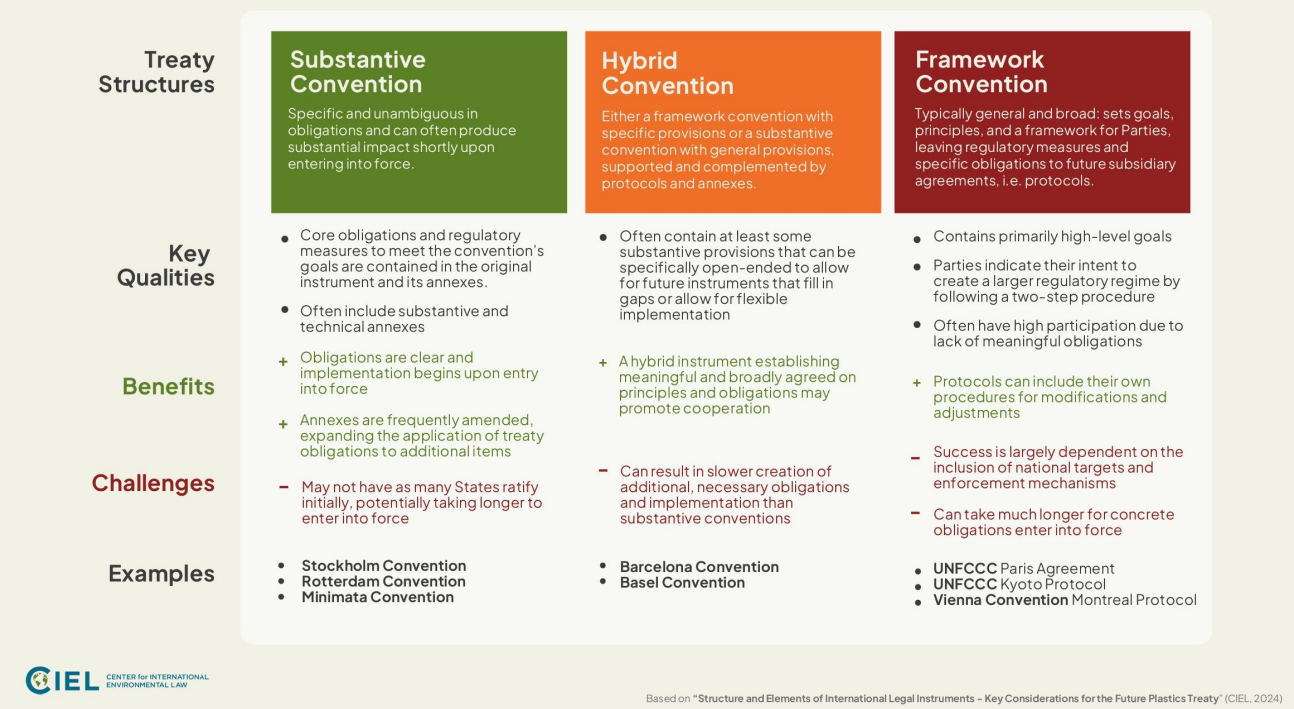
- Conventions can be divided into three types depending on their different approaches and effects:
- Substantive conventions provide clear, specific obligations for Parties to implement, with annexes that are frequently amended to expand treaty provisions to encompass additional substances. There may not be as many States ratifying initially, potentially requiring more time for it to enter into force. Examples include the Stockholm Convention, Rotterdam Convention, and Minamata Convention.
- Hybrid conventions contain some substantive elements but leave some decisions for future protocols, which can result in slower creation of necessary, substantive obligations. Examples include the Barcelona Convention and the Basel Convention.
- Framework conventions contain primarily high-level goals, without any specific clear obligations for Parties to implement from the beginning. The participation rates are often high, due to a lack of meaningful obligations. Experience from the UNFCCC has shown that success is largely dependent on the inclusion of national targets and enforcement mechanisms, often taking a long time for decisions and obligations to enter into force. The Kyoto Protocol and Vienna Convention are also framework conventions.
Decisions
- COPs can take a vast array of decisions:
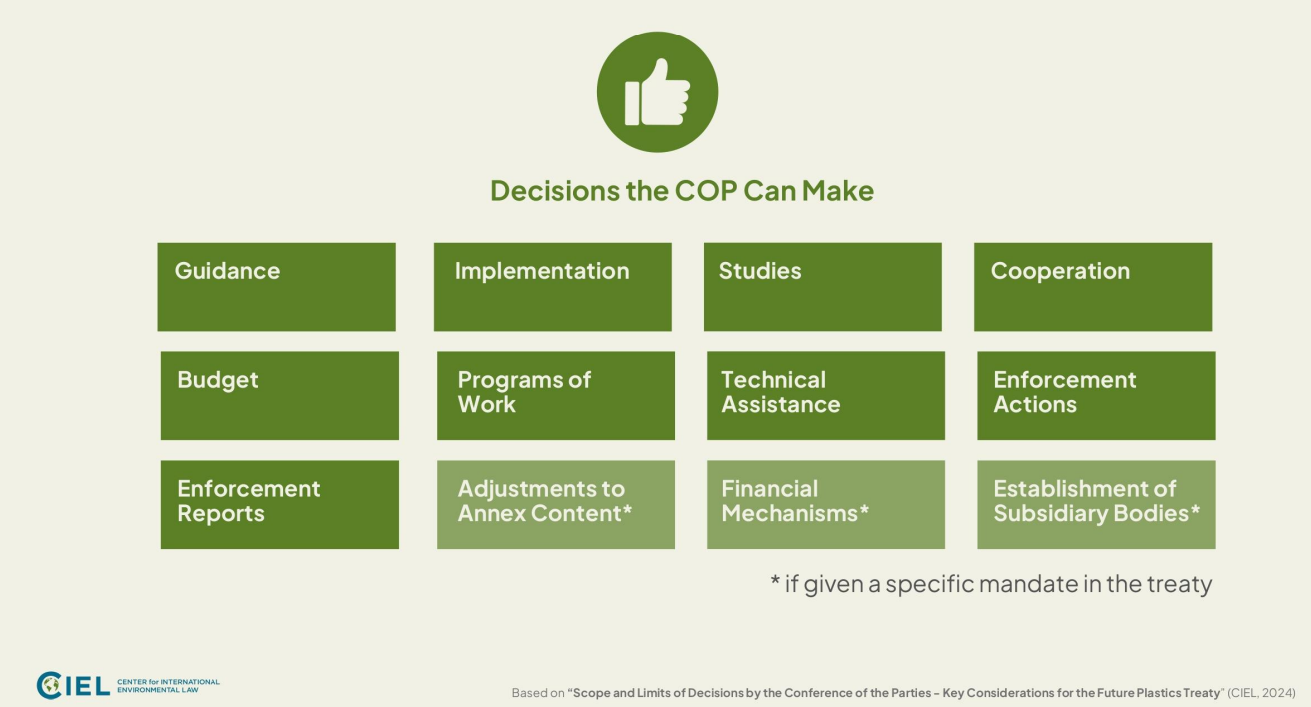
- COP decisions have been challenged, for example in the Basel Convention, which included a mandate for the COP to “consider the adoption of a complete or partial ban”. COP decided to ban exports of hazardous waste from OECD countries to non-OECD countries, but was contested by Parties who argued that the COP did not have the authority to adopt a ban. The decision entered into force 24 years later through a treaty amendment.
- Another example was at the Kyoto Protocol, where the request of Belarus for its addition to the annex required an annex amendment rather than a COP decision.
Actions Requiring Distinct Processes and Their Challenges
- Actions requiring distinct processes have been included in the draft text of the co-facilitators of Contact Group two — tasked to identify and analyze criteria and non-criteria-based approaches regarding plastic products and chemicals of concern in plastic products, and product design focusing on recyclability and reusability of plastic products, considering their uses and applications — as well as in the third non-paper released by the INC Chair.
- When creating or modifying party obligations, a new agreement or protocol, or a treaty amendment may be necessary. The adoption will be based on terms in the treaty of the Agreement itself, and it only applies to ratified Parties, which often leads to taking many years for the required number of Parties to ratify. The idea of relying on future new agreements or protocols is problematic due to uncertainty and the high bar of approval and ratification.
- The creation or modification of an annex is specified in the final provisions of the treaty. It requires two-thirds or three-quarters majority of Parties at COP, with a set timeframe for entry into force after adoption. Ratification is not required, and Parties not wanting to be bound may opt-out.
Critical Challenges in the Plastics Treaty:
- Obstructionism: The goal of some States is to create an agreement with no binding obligations, or no agreement at all, which delays progress on substance and derails negotiations.
- Timeline: With the last negotiation scheduled at the end of November, the INC is running out of time. Deferring obligations to future amendments or protocols could delay concrete actions by years.
- Abandonment: Future proposals may lack majority support or fail to be approved through a vote.
Considerations
- Requiring decisions to be made by consensus — whether by design or as a result of bracketed voting procedures — delays or prevents action by disincentivizing parties to come together and find common positions and compromises.
- Parties are not expected to be in full compliance with all provisions from the entry into force of the treaty. Some countries may not be ready to implement obligations, and preparation and support need to be provided during the period between adoption at the Diplomatic Conference and entry into force.
- Several previous treaty negotiations have continued beyond the initially set timeline. Additional meetings may be necessary to finish negotiations, since changing an agreed treaty is very difficult.
Recommendations
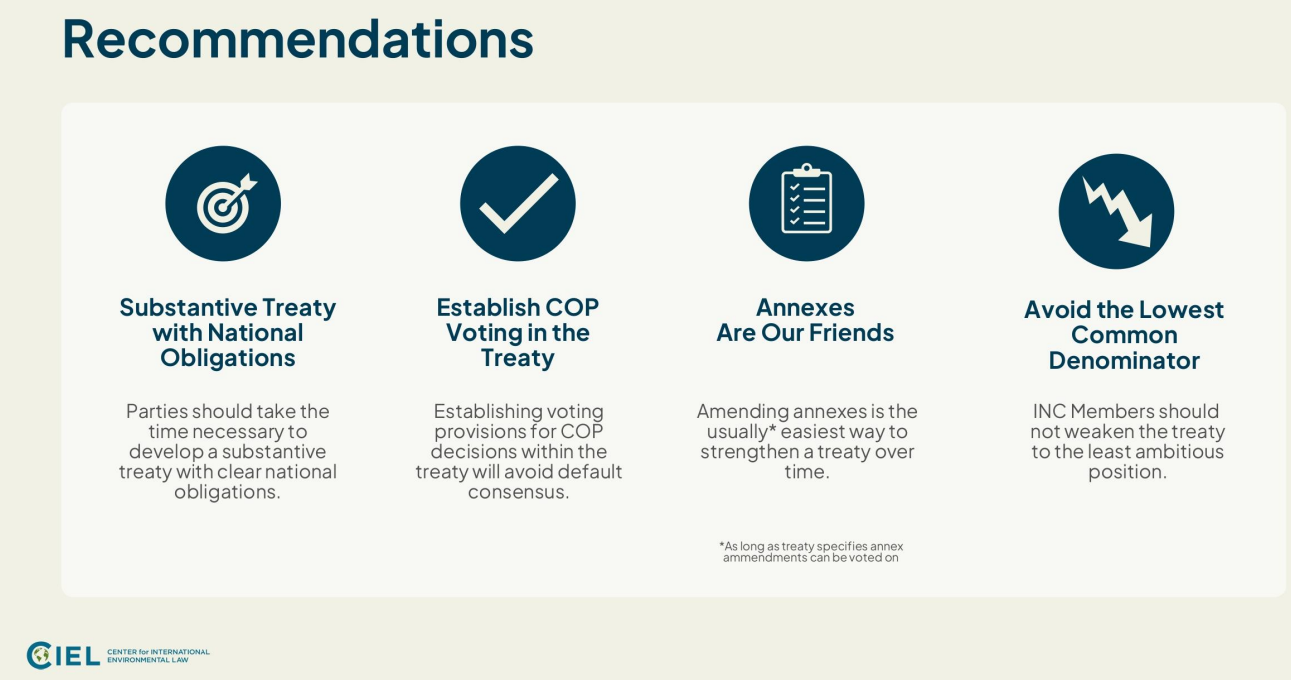
- It is important to have a substantive treaty with concrete and clear obligations so that Parties know what they need to do when the treaty enters into force. Leaving decision-taking to COPs by consensus significantly delays or prevents action.
- We need to try to get the strongest treaty possible before adoption, instead of prioritizing agreement for all, which leads to a weak and ineffective treaty.
Panel Discussion
Ian JOHNSTONE | Professor of International Law, Fletcher School of Law and Diplomacy, Tufts University
- All treaties need to be thought of as living trees. Even the firmest, most precise obligations have the possibility of evolution over time.
- Although building in as many substantive obligations as politically possible in the treaty is important, we need to keep in mind that the notion of obligations is on a spectrum; the line between binding obligations and voluntary commitments is blurry, and this uncertainty and possibility of evolution should be considered in designing a treaty.
- The viability of the treaty will depend on how strong the implementation mechanisms are. The systematic ways for Parties to interact and build the treaty over time need to be designed thoughtfully.
- The pandemic agreement negotiations and the International Health Regulations took place in parallel processes, covering the same territory. The negotiations were able to carve out a relatively narrow set of issues to be addressed within the context of the International Health Regulations, while including language on equity and ensuring continued commitment. Attention was shifted to the pandemic agreement, where equity concerns would be much more in the front and center.
- The negotiations were meant to conclude in May 2024 but were extended for a year. There are still discussions around substantive obligations and the tradeoff between health security, sharing of access to pathogens and genetic sequencing data, and ensuring access to the benefits of health products, including vaccines and therapeutics.
Joshua LINCOLN | Senior Fellow, Center for International Law and Governance, Fletcher School of Global Affairs, Tufts University
- All agreements and treaties combine obligations and cooperation. This combination determines the degree of participation, which affects the overall effectiveness of the instrument.
- Treaty strength, or treaty health, can be understood along two axes: substantive obligations and cooperation, with a focus on both core issues and the flexibility of the implementation process over time. For example, the Copenhagen Failure of 2009 refers to the outcome of the UN Climate Conference COP15 which lacked legitimacy and where many developed countries were not prepared to adopt restrictive targets on limiting greenhouse gas emissions.
- The 2015 Paris Agreement advanced the new approach of self-determined, nationally specific goals and pledges to encourage universal participation. It relied on coaxing countries towards greater levels of ambition and lacked an enforcement mechanism. While it achieved near-universal participation, with 198 signatories by last year, it has struggled to reduce the gap between collective climate goals and individual national pledges.
- The Paris Agreement encourages countries to increase their climate ambition, but the issue of limiting temperature rise remains unsolved, despite three decades of negotiations and 10 years since the Paris Agreement.
- If the problem is not solved through an effective treaty instrument at the first time, the problem does not go away. As member states are currently preparing NDCs 3.0, they are still under pressure to raise their climate ambition, leading some to make long-term pledges that may be unrealistic or lack the necessary national commitment and planning to achieve them.
- Despite efforts over the past 30 years, fundamental issues remain unresolved, including questions about phasing out fossil fuels, even for countries that have successfully pushed back against them.
- The plastics crisis does not go away. In 10 to 20 years, rivers will contain more plastic, and the impacts on human health will be worse. As science advances, awareness of this global issue will grow, intensifying pressure to address it.
- As an example, the review process of the UN Convention on Certain Conventional Weapons (CCW) ultimately failed, leading Canada to invite a coalition of countries and organizations to Ottawa for a conference. This resulted in the creation of the Ottawa Landmines Treaty, which now has 164-165 ratifying countries.
- Recently, at the Summit of the Future in New York, a two-year negotiation process led to the adoption of the Pact for the Future, despite a last-minute amendment by Russia emphasizing non-interference in domestic affairs. The African Group raised a No Action Motion, followed by a vote to reject the amendment, allowing the General Assembly to adopt the Pact for the Future.
Magnus LØVOLD | Project Supervisor, Norwegian Academy of International Law
- Critical challenges regarding the plastics treaty are similar to those in international weapons governance, which involve the intersection of international security and international humanitarian law.
- The distinction between substantive treaties, hybrid treaties, and framework conventions depends on whether a treaty aims to establish rules and institutions immediately or provide a space for future rule development. In weapons governance, treaties like the Anti-Personnel Mine Ban Convention and the Convention on Cluster Munitions are examples of substantive, comprehensive treaties that include obligations related to disarmament, stockpile destruction, and victim assistance.
- The Arms Trade Treaty (ATT), adopted in 2013, is a substantive treaty but is considered relatively weak in its core obligations. This is due to the complexity of arms transfers and the consensus-based negotiation process, which led to a lowest-common-denominator agreement, a challenge also relevant to plastics treaty negotiations.
- The Nuclear Nonproliferation Treaty and the Treaty on the Prohibition of Nuclear Weapons are hybrid treaties, containing core obligations but allowing for future development on issues like verification and compliance. Similarly, the Convention on Certain Conventional Weapons (CCW), adopted in the 1980s, is a framework convention with five protocols on specific weapons types, but its strict consensus requirement has led to challenges similar to those in other multilateral negotiations.
- There are gray areas between treaty categories, and one example is the Biological Weapons Convention. This is a ban treaty adopted in 1972 that initially did not explicitly allow for future rule development and only allowed for amendments, but the review conference in 1994 decided to create a legally binding verification protocol. This shows that treaties can evolve, though the effort ultimately failed in this case.
- Treaty negotiations are fundamentally political; countries not only balance shared understanding and commitments but also advocate for their own interests. It is important to recognize the political dimension when designing a treaty, rather than only focusing on technical design.
Q&A
Q: What are the key elements needed for a treaty to function and succeed in meeting its objectives, especially in the context of the US election?
Melissa BLUE SKY: Rather than having a broad, non-binding agreement that results in long discussions, we should have a treaty with clear, binding obligations to address plastic pollution, even if the initial ratifying countries are fewer. Given the uncertainty and challenges with US ratification, it is better to aim for a stronger treaty to allow countries to take concrete steps sooner.
Ian JOHNSTONE: The US may adopt the Plastics and Pandemics treaties through executive agreements, without requiring ratification, as was done with the Paris Agreement. However, the challenge is whether the US will agree to such treaties during the current administration, considering domestic political factors and the possibility of a less supportive position from the next administration.
Joshua LINCOLN: With significant policy shifts over the summer, US negotiators intend to secure an international agreement that the executive branch can endorse without Senate ratification. The final outcome will depend on the new executive branch, regarding commitments to be made in Busan.
A WWF study revealed that while the cost of producing 1 kilo of plastic is about $1, cleaning up the plastic can cost $19 in developed countries and between $50 to $200 in developing countries, being a significant economic burden. This raises concerns about national competitiveness and the financial drain on public funds, but the framework going into Busan offers a range of possibilities and it is still early to discuss participation or specific outcomes.
Magnus LØVOLD: I have not seen much leadership from the US in this process, so I am not sure about the impact of the US election. The effectiveness of the treaty depends on the clarity of the policy prescriptions outlined in its core provisions. In the Nuclear Nonproliferation Treaty, the clear prohibition on non-nuclear states from developing weapons has been highly effective, while the ambiguous obligation for nuclear states to disarm has been much less successful.
Q: A third non-paper was released last week. How would you reflect on its design and approach outlined?
Magnus LØVOLD: The main purpose of the third non-paper is to provide a focus for the negotiations in Busan, which has been lacking so far. While it is difficult to assess the legal clarity of obligations since it does not provide text on upstream provisions, the non-paper outlines legally binding obligations in areas where national circumstances align with common obligations, such as Article 7 on emissions and releases management reduction and elimination of plastic leakage and Article 8 on waste management, while giving states flexibility regarding the means of implementation.
Ian JOHNSTONE: One impressive aspect of the non-paper is the implementation and compliance committee in Article 13, how the members of the committee are independent and how it can review party, individual, and system implementation and compliance. While voting in the committee will be decided by the majority if necessary, the potential improvement could be allowing reliance on information from non-governmental sources.
Joshua LINCOLN: The third non-paper provides a crucial framework for negotiations, offering structure for both obligations and processes. Time is sometimes the most useful tool for negotiators, as a way of gradually building sections and subjects, and introducing “gray”, instead of choosing between black and white. There are concerns about combining chemicals and problematic plastics in one article as these problems follow a different logic, and the issue of supply also needs to be dealt with.
Language use, such as “may” and “shall” needs to be considered carefully as well.
Two things missing in the COP decision-making are human rights language and scientific input. These need to be included in the treaty to address the wide variety of questions that come up throughout the life of the treaty.
Closing
Helionor DE ANZIZU | Senior Attorney, International Trade and Investment Law, CIEL
Documents
Links
- Fifth Session (INC-5) | UNEP
- Road to Busan | Plastics INC-5 | GEN
- Conference of the Parties (COP) Decisions: Scope and Limits | CIEL
- Structure and Elements of International Legal Instruments. Key Considerations for the Future Plastics Treaty | CIEL
More on the Road to Busan Series


Road to Busan | Strengthening the Health Aspects of the Future Plastics Treaty
14 November 2024 | 14:00 – 15:30 CET | IEH 1

Road to Busan | Launch and Panel Discussion | Analysis of Governments’ Authority to Mitigate Micro- and Nanoplastic Releases to Inform the Global Plastics Treaty Negotiations
06 November 2024 | 14:00 – 15:30 CET | Online