Event Conference
One Health Approach to Addressing Pharmaceuticals in the Environment Across Key Sectors | 2025 BRS COPs Side Event

09 May 2025
13:15 – 14:45
Venue: CICG, Room C & Online | Webex
Organization: United Nations Environment Programme, World Health Organization, Basel, Rotterdam and Stockholm Conventions
This side event to the 2025 meetings of the Conference of the Parties to the Basel, Rotterdam and Stockholm Conventions is organized by the United Nations Environment Programme, the World Health Organization and the Basel, Rotterdam and Stockholm Conventions with the support of the Geneva Environment Network.

About this Event
Pharmaceuticals play a critical role in maintaining human and animal health, enhancing food production, and driving economic prosperity. However, their release into the environment—whether during manufacturing, use, or end of life — may pose significant risks. These include contributing to antimicrobial resistance, endocrine disruption, and toxic effects on ecosystems and public health.
This side event highlighted challenges and opportunities of the sound management of pharmaceuticals, considering priority areas for action. It also explored innovative practices throughout pharmaceutical lifecycle and across key sectors such as pharmaceutical manufacturing, healthcare facilities, agriculture, food production, and municipalities/households, shedding light on the benefits of action as well as existing tools.
Addressing Pharmaceuticals in the Environment through a Lifecycle Approach Event Series
The United Nations Environment Programme, in cooperation with the World Health Organization, the Geneva Environment Network, and other key partners, is organizing a series of events to raise awareness and share best practices, challenges and opportunities to address this pressing issue. The virtual events bring together experts, decision makers and other relevant stakeholders from around the world to discuss innovative practices throughout pharmaceutical lifecycle and across key sectors such as pharmaceutical manufacturing, healthcare facilities, agriculture, food production, and municipalities/households, shedding light on the benefits of action as well as existing tools.
2025 Meetings of the Conference of the Parties to the Basel, Rotterdam and Stockholm Conventions
The seventeenth meeting of the Conference of the Parties to the Basel Convention (BC COP-17), the twelfth meeting of the Conference of the Parties to the Rotterdam Convention (RC COP-12) and the twelfth meeting of the Conference of the Parties to the Stockholm Convention (SC COP-12) will be held back-to-back in Geneva from 28 April to 9 May 2025. Side events to the 2025 meetings of the BRS COPs will serve as a platform for Parties and observers to share knowledge, build capacity, network and exchange on experience in the implementation of the BRS conventions. They also contribute to fostering discussions on specific issues under consideration at the COPs.
Speakers
By order of intervention.

Stephanie LARUELLE
Programme Management Officer, Chemicals and Health Branch, UN Environment Programme

Carmen BULLON
Legal Officer, FAO

Diego ESCOBAR OCAMPO
Coordinator, Chemical Substances, Hazardous Waste and UTO Group, Ministry of the Environment and Sustainable Development, Colombia

Angela RIVERA
Office of International Affairs, Ministry of the Environment and Sustainable Development, Colombia

Maggie MONTGOMERY
Technical Officer, Water, Sanitation, Hygiene and Health, World Health Organization (WHO)

Piyush MOHAPATRA
Senior Program Coordinator, Chemicals and Health Team, Toxics Link, India

Slobodanka PAVLOVIC
Vice Chair, Health Care Waste Working Group, International Solid Waste Association, & Professor at Slobomir P University

Carla VALLE-KLANN
Programme Officer, Basel, Rotterdam and Stockholm Conventions | Moderator
Highlights
Video
Live from CICG.
Summary
Opening Remarks
Stephanie LARUELLE | Programme Management Officer, UNEP
The event welcomed participants to discuss a One Health approach to managing pharmaceuticals in the environment, launching a series of related activities. Pharmaceuticals are crucial for health and development but pose environmental and health risks if not properly managed. Despite increased monitoring, actions remain inconsistent across sectors involved in the pharmaceutical lifecycle. Addressing these risks requires strong legal frameworks, innovation, and collaboration. The issue is key to the Basel Convention and the Global Framework on Chemicals, with Environmental persistent pharmaceutical pollutants and endocrine-disrupting chemicals set for discussion at the 2026 Chemicals Conference. Continued action under both frameworks is vital. The event aims to highlight challenges, opportunities, and solutions under a One Health framework.
Carmen BULLON | Legal Officer, Food and Agriculture Organization (FAO)
The presentation explores how a One Health approach can be integrated into environmental regulation to address the environmental impact of pharmaceuticals, particularly from veterinary sources. It highlights the fragmented legal landscape across sectors such as animal health, aquaculture, waste, and water, and introduces the Quadripartite One Health Tool for assessing AMR-relevant legislation. Key legal mechanisms are discussed across the pharmaceutical lifecycle—from manufacturing to disposal—including licensing, environmental impact assessments, and extended producer responsibility. The presentation emphasizes that embedding One Health into environmental law is essential for sustainable pharmaceutical stewardship.
Diego ESCOBAR OCAMPO | Coordinator, Chemical Substances, Hazardous Waste and UTO Group, Ministry of the Environment and Sustainable Development, Colombia
- Colombia has a strong framework for the management of pharmaceutical waste, as well as an environmental policy for the management of hazardous waste, which comprises an action plan that extends to until 2030.
- In the Colombian case, it is the manufacturer or the importer of medicines that are must implement EPR strategies.
- The activities proposed in the policy aim to improve the management of waste associated with health care, especially pharmaceutical waste, through two approaches:
- Focus in on the responsibilities and obligations of the hazardous waste generator. It follows several regulations, such as the compilation of information on a register. With approximately 5,000 generators of pharmaceutical waste, they must deliver the waste to transport companies that meet specific requirements and that have an environmental license in Colombia. The number of current companies with amount to almost 200 and so far they generate around 4,000 tons of pharmaceutical waste per year. This data is also disaggregated to get information on whether medicines are expired, supporting the implementation of strategies to reduce or minimize residues, or to classify the activity source of the waste.
- Focus on the responsibilities and obligations of the producers. Producers establish different mechanisms to collect pharmaceutical wastes, including collection points or camps, especially in the most remote regions. Collected waste must be delivered to transport and management companies that meet environmental requirements. Around 93% of pharmaceutical waste goes to incineration.
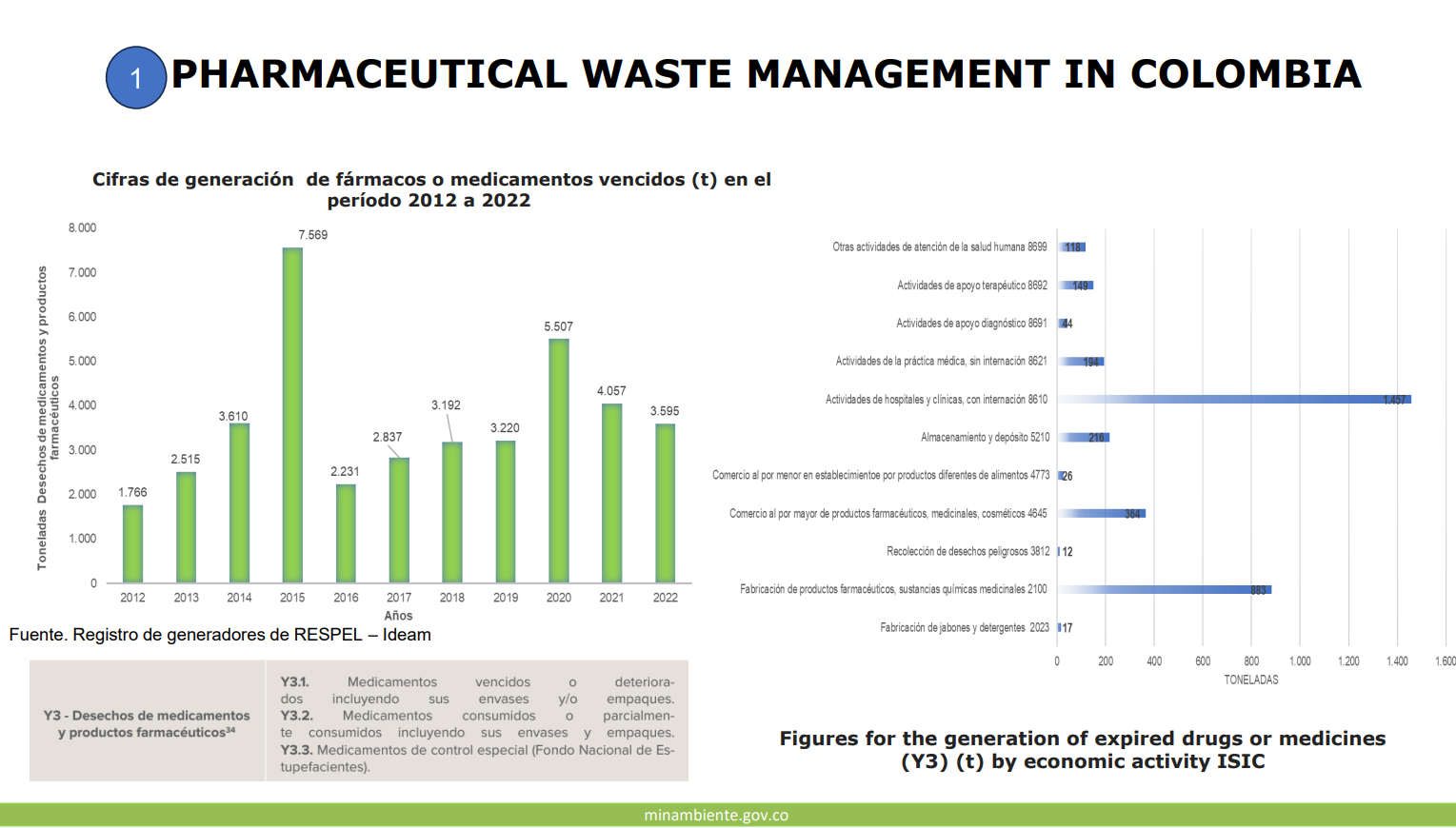
- To inform the public on the locations of the collection points of pharmaceuticals, an online platform has been launched. There currently are more than 4,000 collection points, to be expanded also beyond the most developed regions of the country.
- More information is available on the Colombian Ministry of Environment Website
Maggie MONTGOMERY | Technical Officer, Water, Sanitation, Hygiene and Health, World Health Organization (WHO)
The key elements of two recent WHO-led global documents concerning pharmaceutical waste and prevention of Antimicrobial Resistance were presented. The Guidance on wastewater and solid waste management for manufacturing of antibiotics, co-published with UNEP, provides risk-based limits and a framework for controlling pollution from wastewater and solid waste management for the manufacturing of antibiotics. The Safe management of pharmaceutical waste from health care facilities: global best practices provides a summary of existing, relevant recommendations for the safe management of pharmaceutical waste from health care facilities, emphasizing waste reduction, systems strengthening, and safe treatment. Case studies were presented from Nepal, Indonesia, Australia, Oman, and Guinea, pointing towards best practices around strong guidelines rooted in local advocacy and community and health worker groups, mandatory recycling, and post-outbreak centralized clean-up of pharmaceuticals. In the next phase of efforts, the focus will be on country adaptation and implementation, working collaboratively with governments and partners.
Piyush MOHAPATRA | Senior Program Coordinator, Chemicals and Health Team, Toxics Link, India
Pharmaceutical pollution is a growing environmental and public health concern globally, considering the challenges of AMR and environmentally persistent pharmaceutical pollutants (EPPPs), resulting in chemical pollution.
Toxics Link has been working on the issue of pharmaceutical pollution from various sectors, including health care setups, the pharma industry, and poultry, to create information on the existing problems and challenges of pharmaceuticals to reduce their footprint in the environment. The challenges are very unique in India, considering the size and population of the country and the complexity of implementing regulations at various levels. Further, as a growing pharmaceutical manufacturing hub, the country needs to adopt better technology to prevent the release of pharmaceuticals and antibiotics into the environment. Moreover, better cooperation and efforts are needed from IGOs and other global actors to facilitate technology transfer to developing countries to mitigate the challenges of pharmaceutical pollution.
Slobodanka PAVLOVIC | Vice Chair, Health Care Waste Working Group, International Solid Waste Association, & Professor at Slobomir P University
The management of pharmaceutical waste begins at the point of generation, which is critical because it determines what technologies and strategies are appropriate for treatment. In theory, global institutions and national governments have developed robust frameworks—such as the EU Waste Framework Directive and environmental risk assessments—to guide safe disposal. These policies assume that structured, advanced technologies like high-temperature incinerators, wastewater treatment plants, and take-back programs are in place. However, practice often diverges sharply from theory, even in high-income countries, where studies show that pharmaceuticals still end up in rivers and treated wastewater.
In low- and middle-income countries (LMICs), the situation is more severe: healthcare facilities may lack basic segregation practices, and open burning or landfilling is common, leading to toxic exposure and antimicrobial resistance. This gap highlights the importance of context—technologies that are viable in developed countries may not be realistic in resource-limited settings. Therefore, effective pharmaceutical waste management must be technologically appropriate and context-sensitive.
Additionally, manufacturers have a role to play by incorporating “benign by design” principles, providing clear disposal instructions, and considering full life-cycle impacts. While the theory presents a comprehensive vision, real-world implementation remains fragmented. A successful strategy must connect theory with practice—beginning at the source, adapting to local infrastructure, and ending in responsible, sustainable disposal.
Closing Remarks
Carla VALLE-KLANN | Programme Officer, Basel, Rotterdam and Stockholm Conventions Secretariat
The event emphasized the need for strong legislation, enforcement, and innovation to address pharmaceutical pollution and protect health and the environment. Panelists stressed addressing the full life cycle of pharmaceuticals with effective waste management technologies and practices.
Collaboration across sectors—demonstrated by UNEP, WHO, and the BRS Secretariat—was seen as essential. The discussions align with the Global Framework on Chemicals (GFC) and the BRS Conventions, highlighting the relevance of current and future discussions on chemical issues under the GFC.
UNEP announced upcoming reports and a series of webinars on pharmaceutical pollution and safe disposal. The event concluded with a call for a One Health Approach to address these complex, interconnected challenges.
GEN @ 2025 BRS COPs


Gender, Toxics Exposures and the Right to a Clean, Safe, Healthy, and Sustainable Environment | 2025 BRS COPs Side Event
29 April 2025 | 18:15 – 19:45 CEST


Preventing Plastic and E-Waste Trafficking: Lessons from the Frontlines | 2025 BRS COPs Side Event
4 May 2025 | 18:15 – 19:45 CEST


The Potential of the Bamako Convention in Furthering Implementation of the Basel Convention in Africa | 2025 BRS COPs Side Event
6 May 2025 | 18:15 – 19:45 CEST

Photo Gallery
More photos can be found on the BRS dedicated album.


