
Event Virtual
Introducing the Intergovernmental Science-Policy Panel on Chemicals, Waste and Pollution: Its Foundational Document, Draft Rules of Procedure and Next Steps | Road to ISP-CWP P1

19 Nov 2025
14:00 – 15:30
Venue: Online | Webex
Organization: Intergovernmental Science-Policy Panel on Chemicals, Waste and Pollution, Geneva Environment Network
This online event is part of the series of events organized in preparation of the first session of the Plenary of the Intergovernmental Science-Policy Panel on Chemicals, Waste and Pollution, to take place in Geneva in February 2026.

About this Event
The Intergovernmental Science-Policy Panel on Chemicals, Waste and Pollution (ISP-CWP) is a new, independent intergovernmental body established on 20 June 2025 under the mandate of the United Nations Environment Assembly (UNEA) resolution 5/8, to strengthen the global science-policy interface. The panel completes the “trio of panels”, alongside the Intergovernmental Panel on Climate Change (IPCC) tackling climate change and the Intergovernmental Science-Policy Platform on Biodiversity and Ecosystem Services (IPBES) tackling biodiversity loss, thus covering the whole triple planetary crisis.
The Panel will provide policymakers with authoritative, policy-relevant scientific advice to support the sound management of chemicals and waste and to prevent pollution, taking into account different national circumstances, development priorities, and capacities. Its goal is to help protect human health and safeguard the environment for present and future generations.
In preparation for the first session of the Plenary (P1), to be hosted by the Government of Switzerland from 2 February to 6 February 2026, at the Geneva International Conference Centre (CICG), this online event provided an overview of the Panel’s objective, functions, operating principles, and institutional arrangements as agreed on 20 June 2025 in Punta del Este, Uruguay. This event also provided an opportunity for a detailed presentation of the draft Rules of Procedure; these are expected to be a central focus of P1. Finally, next steps in preparations for P1 were presented, including forthcoming opportunities for engagement.
Road to the First ISP-CWP Plenary Session Series
To support Members, governments and other stakeholders in their preparations for the first session of the Plenary of the Intergovernmental Science-Policy Panel on Chemicals, Waste and Pollution (ISP-CWP P1), the ISP-CWP Secretariat, in collaboration with the Geneva Environment Network, is organizing the “Road to the First ISP-CWP Plenary Session” series of events. The series is designed to provide essential information about the first Plenary session, address key questions, and foster dialogue to ensure inclusive and informed participation.
Speakers
By order of intervention

Alejandro NARIO
National Director, Quality and Environmental Assessment, Ministry of Environment, Uruguay

Tessa GOVERSE
Head, Interim Secretariat of ISP-CWP, UNEP

Alvin GACHIE
Legal Officer, Law Division, UNEP

Koki TAKAKI
Director of Office of Mercury and International Chemicals Management, Ministry of the Environment, Japan

Nalini SHARMA
Programme Officer, Interim Secretariat of ISP-CWP, UNEP | Moderator
Highlights
Video
Summary
Opening Remarks
Alejandro NARIO | National Director, Quality and Environmental Assessment, Ministry of Environment, Uruguay
- The creation of the Science-Policy Panel on Chemicals, Waste and Pollution (ISP-CWP) in June 2025 in Punta del Este marked a moment of enormous relevance for international environmental governance. There, states agreed that pollution, waste, and the management of chemical substances must reach the same level of scientific, political and multilateral ambition that already exists for climate change and biodiversity.
- This panel completes the necessary architecture to address the triple planetary crisis in an integrated way.
- Uruguay is proud to have hosted the negotiations that enabled agreement on the foundational document and the principles that guide the work of the panel. This is a commitment Uruguay has undertaken with the deep conviction that public decisions must rely on solid, transparent, and accessible scientific evidence and that international cooperation is essential.
- The panel’s work is especially important in a world where production, consumption, and waste-generation chains are increasingly more global and growing in magnitude.
- The panel’s approach – independent, rigorous and inclusive – will strengthen the science-policy interface, identifying emerging risks, synthesizing knowledge and guiding policies based on the best available evidence. In turn, it will help reduce asymmetries between countries, supporting capacity-building and respecting the different national realities.
- For developing countries, such as those in the GRULAC region, this is a fundamental tool to improve the management of chemical substances, prevent pollution and move towards more responsible productive models.
- Uruguay considers it essential that the rules of procedure of the Panel ensure scientific independence, transparency, geographical balance and meaningful participation of experts from all regions and fields of knowledge.
- This panel is not merely a technical tool to organize knowledge, it is a clear expression of the will of the international community to acknowledge that sustainability is a collective project that requires strong institutions, ongoing cooperation and science capable of guiding bold decisions.
- Uruguay sees this panel as a part of an international network that is becoming denser, a network of agreements, multilateral processes and institutions that, if mutually reinforcing, can shift the course of the planetary crisis.
- As affirmed during the 2025 UN climate change conference COP30, for the GRULAC region climate justice and environmental justice are inseparable and we need to build solutions that integrate biodiversity, climate, chemical, waste, pollution and health into a single agenda. That is the specific contribution of this panel – to enable science to connect and support these issues and to allow countries to act coherently and to strengthen the cooperation network that will make a sustainable future possible.
- Uruguay is deeply committed to this vision, to strong multilateralism, to regional integration, to the production of high-quality scientific knowledge, and to the defense of the most vulnerable from the impacts of pollution and environmental degradation.
- Advancing this agenda is not only about reducing risks, it is about protecting lives, democratizing opportunities and ensuring that development is not built upon invisible harms shifted onto others. It is ultimately about making environmental justice a reality as an essential part of the 21st-century social contract.
Tessa GOVERSE | Head, Interim Secretariat of ISP-CWP, UNEP
- Independent intergovernmental science-policy panels such as the IPCC and IPBES have played an important role in informing policy action and addressing planetary challenges over the past decades. Their demonstrated importance and success have played an important role in also strengthening calls for a counterpart science-policy interface to address chemicals, pollution and waste issues.
- The international community, through various publications and decisions increasingly recognized the need for a science-policy interface to support countries in their efforts to better manage chemicals and waste and to prevent pollution and support the implementation of relevant multilateral environmental agreements (MEAs).
- The journey to the ISP-CWP begins in 2022, when the United Nations Environment Assembly (UNEA) adopted resolution 5/8, which convened the ad hoc open-ended working group (OEWG) to prepare proposals for a science-policy panel on chemicals, waste, and pollution prevention.
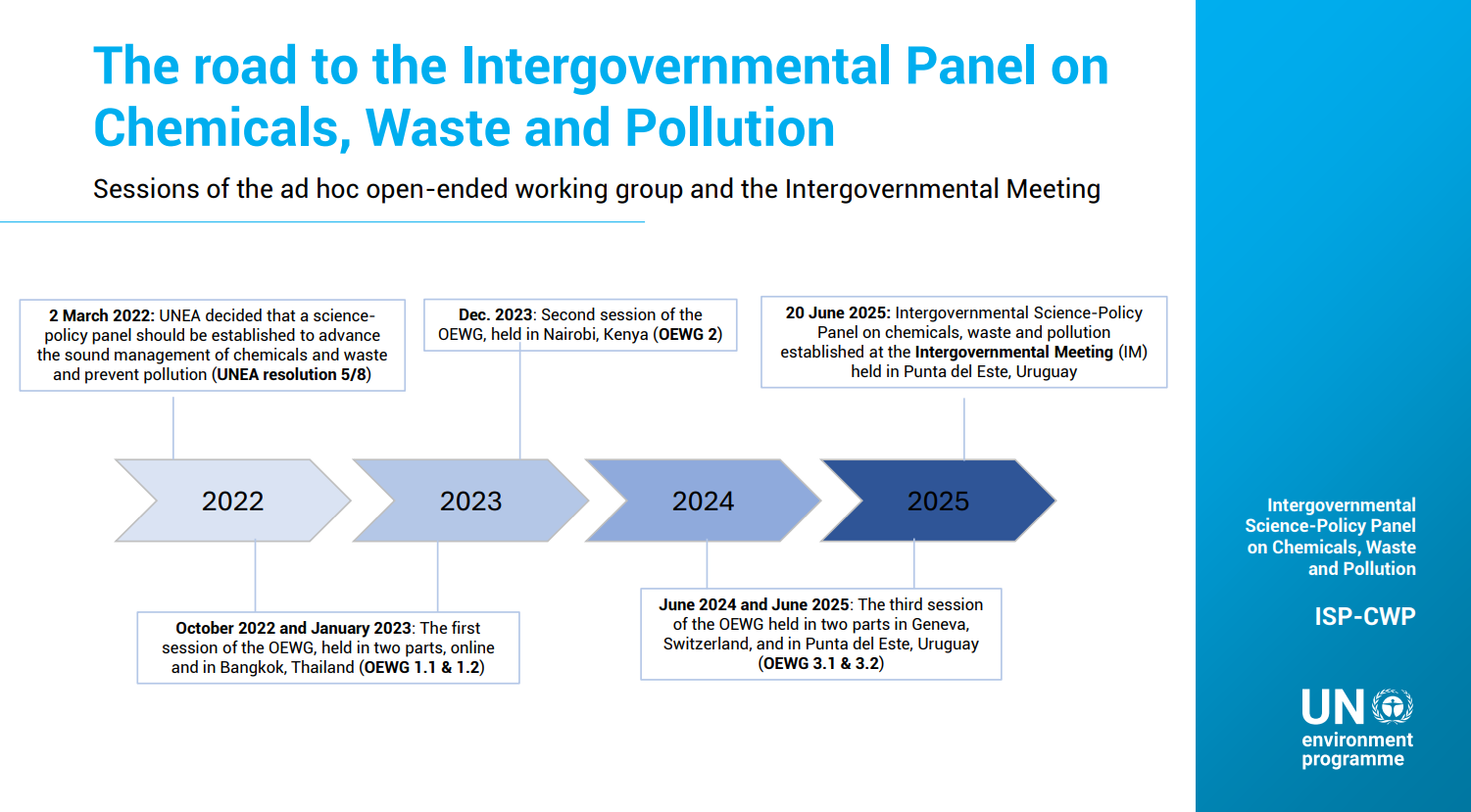 Outcomes of the Intergovernmental Meeting (IM )
- To make sure that we all start from this juncture on the same page, looking at the outcomes of the IM is key.
- Decision IM/1: Establishment of the Intergovernmental Science-Policy Panel on Chemicals, Waste and Pollution. This decision has an annex that contains the foundational document that sets out the features of the panel.
- Decision IM/2: Recommendations for consideration by the Plenary at its first session. This decision has an annex which has four documents included, which were the outputs of the OWG process. The most advanced of which are the draft rules of procedure.
- Decision IM/3: Arrangements for the interim period. This decision put in motion the preparations for the operationalization of the panel itself and for the first plenary.
- All decisions can be found as annexes to the Advance English version of the Report of the intergovernmental meeting to establish a
science-policy panel to contribute further to the sound management of chemicals and waste and to prevent pollution (UNEP/SPP-CWP/IM/5)
Foundational Document
- The foundational document specifies the features of the panel, sets out the key components of the panel, including its:
- Scope, objective, and functions.
- Operating principles and approaches
- Institutional arrangements
- Evaluation of the effectiveness
Objective of the Panel
- The objective of the Panel is to strengthen the science-policy interface to contribute to the sound management of chemicals, waste and pollution. The objective is closely tied to the panel’s five interconnected functions:
- Undertaking horizon scanning – This will identify issues of relevance to policy makers and propose evidence-based options to address them. This is a function not currently carried out by the other panels like the IPCC or IPBES.
- Conducting assessments – This involves conducting assessments of current issues and identifying potential evidence-based options to address where possible, in particular those relevant to developing countries.
- Providing up-to-date and relevant information – This ensures the panel provides necessary information, identifies key gapes in scientific research, encourages and supports communication between scientists and policy makers, explains and disseminates findings for different audiences, and raises public awareness.
- Facilitating information sharing – Particularly to developing countries seeking relevant scientific information.
- Integrating capacity building – This calls for integrating capacity building into all functions and the work of the panel to strengthen the science-policy interface.
Operating Principles and Approaches
- Set out in the foundational document, in carrying out its work, the Panel will be guided by its operating principles and
approaches, including:- Being scientifically independent and ensuring credibility and legitimacy, including through peer review of its work.
- Upholding consensus in its decision-making processes.
- Respecting the independence of science, while ensuring that differing scientific views are adequately reflected by the Panel.
- Ensuring impartiality and transparency.
- Producing deliverables that are policy relevant without being policy prescriptive, and scientifically robust, unbiased, and accessible.
Institutional Arrangements
Plenary
- The plenary is the governing and decision-making body of the panel.
- Membership of the plenary is open to state members of the UN and UN non-member states observers. A list of panel members can be found here.
- Its functions, among others, include:
- (a) Adopting the Panel’s work programme to deliver on each of its functions
- (e) Electing the Bureau, the members of the Interdisciplinary Expert Committee and other subsidiary bodies, in accordance with the rules of procedure
- (f) Establishing subsidiary bodies, in accordance with the rules of procedure
- (h) Approving a budget and overseeing the allocation of the Trust Fund
- (k) Adopting the rules of procedure by consensus
Bureau
- The bureau comprises two members from each of the UN regional groups and is elected by the plenary, including one chair and nine vice-chairs.
- Members of the bureau are selected for their expertise relevant to the functions of the Bureau.
- Some of the functions of the bureau include supporting the panel’s work during the intersessional periods and overseeing efforts related to communications between the panel and other relevant science-policy bodies, international organizations, international instruments and relevant MEAs to build upon existing efforts and avoid overlap and duplication of work.
Interdisciplinary Expert Community (IEC)
- The IEC will be comprised of experts from each of the five UN regional groups with due regard to equitable geographical representation.
- The IEC members are selected for their expertise, including, but not limited to, scientific, socioeconomic, and technical expertise, and knowledge of the main elements of the work of the panel.
- The functions of the IEC include providing advice to the plenary and the bureau on, and coordinating of, the delivery of scientific and technical and capacity building aspects of the panel’s programme of work.
- The number of experts for each of the five UN regional groups that will make up the IEC is not specified in the foundational document and will need to be further detailed in the rules of procedures. Hence, there is a need for this to be further considered and agreed by the plenary before the nominations of the IEC can be solicited and it can be fully operational.
Secretariat, Financial Arrangements, and Partnerships
- The panel will be supported by a secretariat and at the first session of the plenary, it will secure secretariat services provided by UNEP.
- The secretariat will be hosted in a single location based on proposals by members.
- A trust fund is also to be requested by the plenary and the first plenary is also expected to decide on the financial procedures that will apply.
- The plenary will also request the secretariat to develop a proposal on establishing different types of partnerships to be considered by the panel.
- Many aspects of the Panel still need to be determined and it will be very important that the rules of procedure are put in place at the First Plenary. It is proposed that the UNEA rules of procedure will apply to P1.
Alvin GACHIE | Legal Officer, Law Division, UNEP
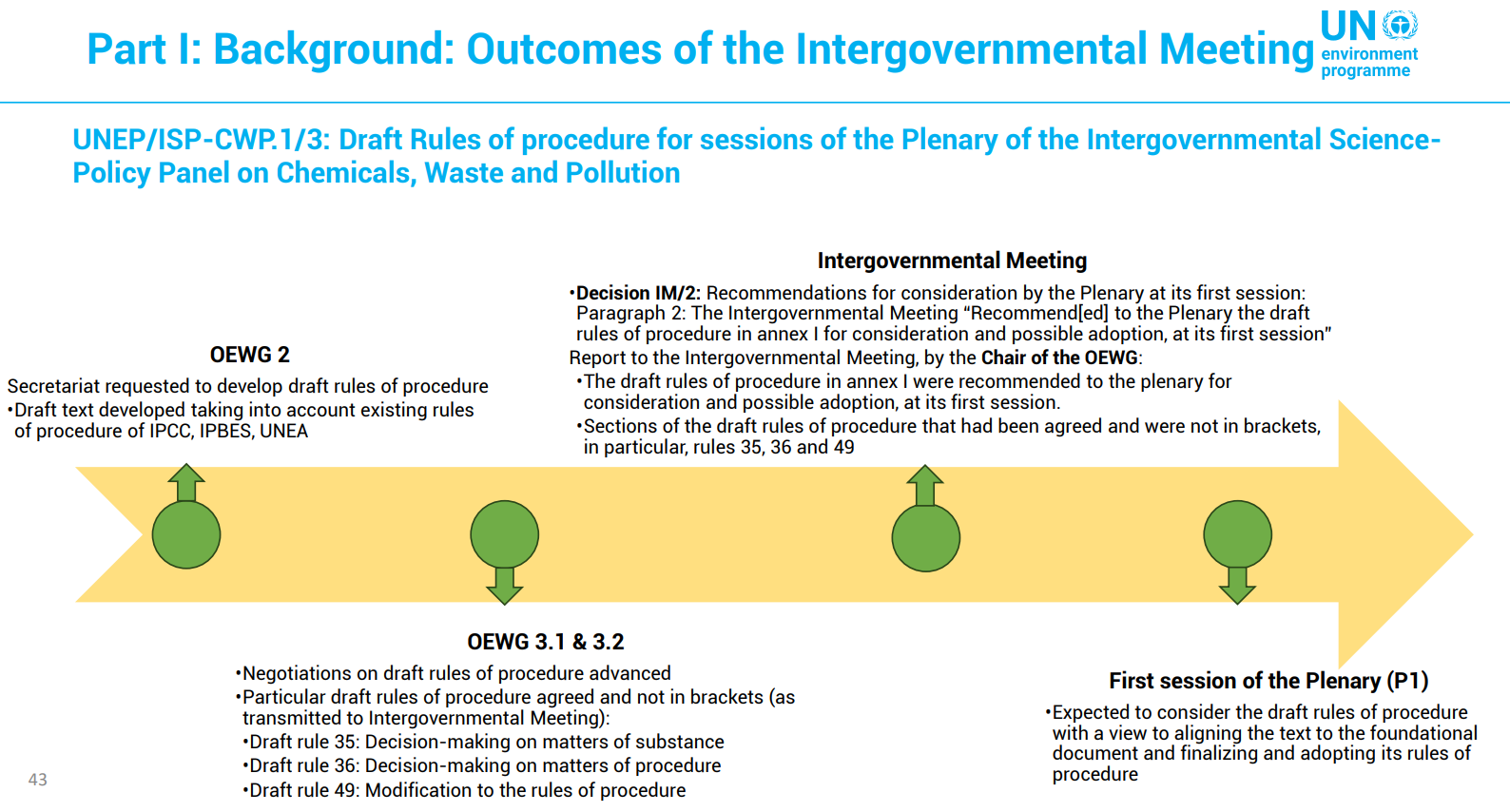
- The chair of the Open-ended Working Group (OEWG) confirmed that the draft rules of procedure had advanced sufficiently to be recommended for consideration and possible adoption at the first plenary (P1).
- Three draft rules, 35, 36 and 49, were fully negotiated and left unbracketed, covering decision-making on matters of substance, matters of procedure, and amendments to the rules of procedure.
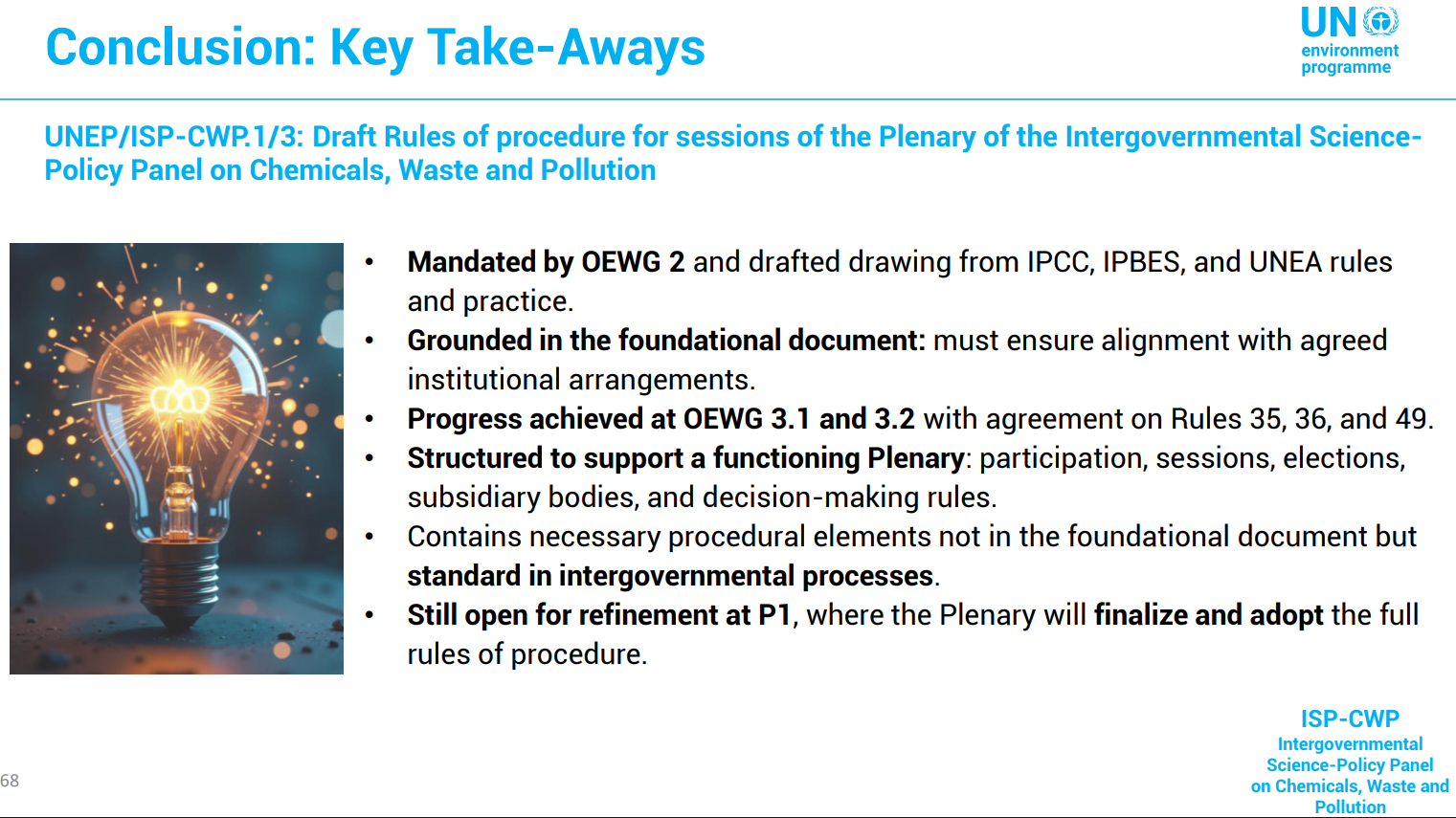
- These agreed elements provide a strong foundation for the Panel to begin operating, while other provisions remain open for refinement.
- In the second and third sessions of the OWEG, the draft rules of procedure were developed and consolidated based on guidance from member states and the foundational document.
- In OWEG 2, member states requested the secretariat to prepare draft rules of procedure for the future panel, drawing on existing practices from comparable science-policy bodies (e.g. IPCC, IPBES, UNEA)
- During OEWG 3, 3.1, and 3.2 the draft rules were further negotiated, and member states reached an agreement on three rules. These agreed elements represent an important early convergence and demonstrate that the draft rules of procedure are nearing finalization.
Part II: Opportunities for Alignment with the Intergovernmental Meeting Outcomes
For a complete explanation of the opportunities for alignment with the Intergovernmental Meeting outcomes, consulting slides 42-51 is recommended.
Part III: Other Procedural Elements Not Explicitly in the Foundational Document
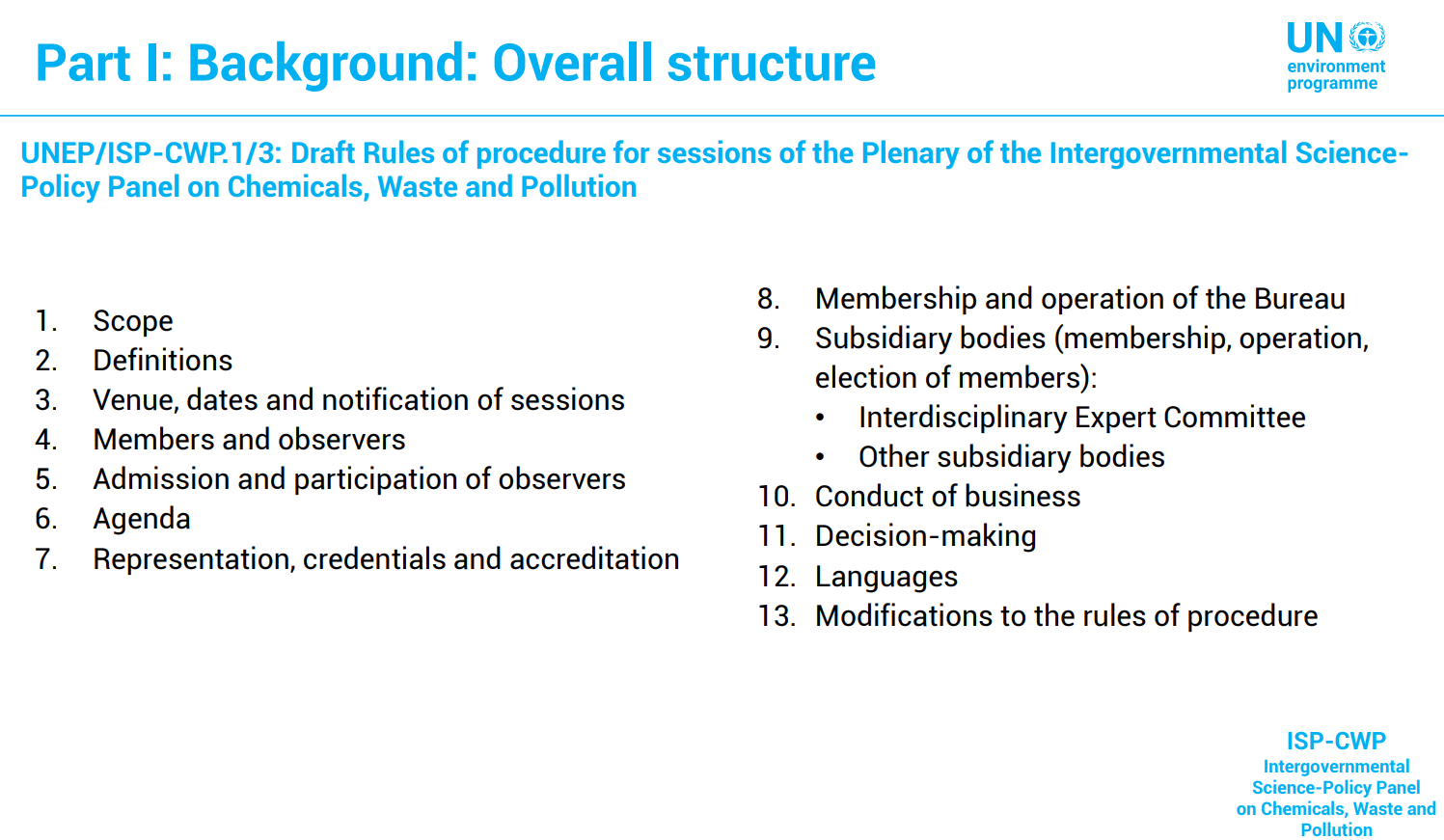
- Scope: Draft rule 1: The following rules of procedure apply to all sessions of the Plenary of the Intergovernmental Science Policy Panel on Chemicals, Waste and Pollution (hereafter “the Panel”) convened in accordance with a decision of the Plenary and in compliance with the rules of procedure.
- Bureau (membership and operation, nomination, and election): Draft rules of procedure corresponding to paragraph 10 of the foundational document: on operation, nomination, and election of the Bureau:
- Draft rule 13(4) The term of office of a Bureau member is two years, with the opportunity for reelection for one consecutive term. Such term of office starts at the end of the session at which the member is elected and ends at the close of the session at which the member’s successor is elected. The Chair will be rotated among the five United Nations regions every two years, without the possibility of re-election as Chair.
- Draft rule 13(5) [Each region designates alternates, to be approved by the Plenary, to represent the region at a Bureau meeting if a Bureau member is unable to attend.]
- Draft rule 19: The secretariat will invite members to submit to the secretariat, no less than four months before the election, written nominations and accompanying curricula vitae of nominees to the Bureau. The Plenary may accept late nominations at its discretion. The secretariat will post the nominees’ names and curricula vitae, as well as the identity of the nominating region, on the website of the Panel within a time frame that facilitates consideration of the nominees by members prior to the session of the Plenary at which elections are to take place.
- Draft Rule 20(1) The members of the Bureau will be elected by the Plenary by consensus [unless the Plenary decides otherwise] [unless a member requests a Bureau member or members to be elected by vote][unless consensus is not reached and the Plenary to proceed to a vote].
- Draft rule 20 (2) If the Plenary decides to elect members of the Bureau by vote, the vote will be held at an ordinary session of the Plenary and in accordance with the rules of procedure.
- Subsidiary bodies (membership, operation, election of members): Interdisciplinary Expert Committee (IEC)
- Draft Rule 23(1) Candidates for the Interdisciplinary Expert Committee are to be proposed by members and observers of the Plenary.
- Draft Rule 24(1) The secretariat will invite members and observers of the [Plenary of the] Panel to submit written nominations and accompanying curricula vitae of nominees for the Committee to the secretariat no less than four months before the scheduled election. Curricula vitae of all nominees are to be submitted to the secretariat and made available to members [of the Panel] on the website of the Panel, together with the names of persons nominated, as well as the identity of the nominating region or observer.
- Draft rule 25(1) The members of the Interdisciplinary Expert Committee will be elected by the Plenary by consensus unless the Plenary decides otherwise.
- Decision-making: (excl rules 35 & 36) voting, elections, equally divided votes
- Draft rule 37: Each member of the [Plenary of the] Panel has one vote.
- Draft rule 38(1) [Except where the rules of procedure expressly provide otherwise, the decisions of the Plenary will be made by a majority of the members present and voting.]
- Draft rule 38(2) For the purposes of the rules, the phrase “members present and voting” means members present and casting an affirmative or negative vote. Members who abstain from voting are considered as not voting.
- Draft rule 39: Subject to rules [[–] and [–]], the Plenary of the Panel will normally vote by a show of hands, but any representative may request a roll call, which will then be taken in the English alphabetical order of the names of the members, beginning with the member whose name is drawn by lot by the Chair.
- Draft rule 42(1) All elections will be held by secret ballot unless the Plenary decides otherwise.
- Draft rule 42(2) After completion of the elections, the number of votes for each candidate and the number of abstentions will be recorded
- Draft rule 45: If a vote is equally divided on matters other than elections, the proposal will be regarded as rejected.]
- Venue, dates and notification of sessions
- Draft rule 3: The venue and dates of each [ordinary] session are to be decided on by the Plenary at the preceding session. [If this is not possible, they should be decided on by the Bureau [, subject to paragraph [5] of the present rules].]
- Draft rule 4(1) Ordinary sessions of the Plenary will be held once every year [unless otherwise decided by the Plenary].
- Draft rule 4(2) Extraordinary sessions of the Plenary are to be held pursuant to a decision taken by the Plenary at an ordinary session, or at the request of a majority of its members. In the event that the secretariat receives a request from a member for an extraordinary session, it will immediately inform all members of the request, as well as of the approximate costs and relevant administrative considerations including the budgetary implications for the approved budget. If a majority of the members explicitly agree with the request within 21 days of the secretariat’s communication, the secretariat will convene an extraordinary session not more than 90 days after the request has been approved.
- Draft rule 4(3) The secretariat will notify members and observers of the dates and venue of any session at least [eight][twelve] weeks before the session is due to begin.]
- Agenda
- Draft rule 9 (1) The secretariat will, in consultation with the Chair and under the guidance of the Bureau, prepare a provisional agenda for each session in accordance with the guidance of the Plenary. Any member may request the secretariat to include specific items on the provisional agenda.
- Draft rule 9(2) After consultation with the Chair and under the guidance of the Bureau, the secretariat will distribute the provisional agenda to members and observers, along with other official documents to be considered at the session, in [United Nations][the] official languages of the Panel, at least six weeks before the session is due to begin.
- Draft rule 9(3) Between the date of distribution of the provisional agenda and the adoption of the agenda by the Plenary, members may propose supplementary items for inclusion on the agenda, provided they are of an important and urgent nature. The secretariat will, after consultation with the Chair and under the guidance of the Bureau, include such items on a revised provisional agenda.
- Representation, credentials and accreditation
- Draft rule 12(1) Each member participating in a session will be represented by a delegation consisting of a head of delegation and such other accredited representatives, alternate representatives and advisers as it may require.
- Draft rule 12(2) The credentials of representatives of members and the names of alternate representatives and advisers [should][need to] be submitted to the secretariat before the first meeting that the representatives are to attend, and [if possible] no later than 24 hours after the opening of the session. Information regarding any later change in the composition of a delegation, along with any necessary credentials, [should][need to] be submitted to the secretariat.
- Draft rule 12(3) The credentials of the representatives of any member are to be signed by, or on behalf of, [an appropriate government authority] of the member and will be regarded as appropriate credentials for the participation of the individuals named therein in all activities of the session.
- Draft rule 12(4) The Bureau will examine the credentials and submit a report thereon to the Plenary.
- Draft rule 12(5) Representatives of members are entitled to participate provisionally in sessions of the Plenary pending a decision by the Plenary regarding acceptance of their credentials. Representatives do not have the right to participate in decision-making until their credentials have been accepted.
- Draft rule 12[5 bis. Participation of members by using proxy procedure is not allowed.]]
- Conduct of Business
- Draft rule 31(1) [Sessions of the Plenary and its subsidiary bodies will be held in public unless the body concerned decides otherwise.]
- Draft rule 31(2) [Meetings of the Bureau will be held in private unless the Bureau decides otherwise.]
- Draft rule 31(3) Sessions of the Plenary and its subsidiary bodies and meetings of the Bureau[may][will] be held in person [or by electronic means as necessary].
- Draft rule 32 (1) The Chair may not declare a meeting of any session open or permit discussion to proceed unless at least one third of the members of the [Plenary of the] Panel participating in the session are present.
- Draft rule 32(2) The presence of a [two-thirds] majority of the members [of the Panel] participating in the session is needed for any decision to be taken.
Q&A
Q: Since there are still some brackets around the foundational document, will these be resolved when the plenary meets?
Tessa GOVERSE | Head, Interim Secretariat of ISP-CSW, UNEP
- The foundational document is a final document that is adopted as it is; there will not be further discussions and negotiations around those brackets.
Q: How can individuals such as experts get involved in the work of the panel?
Tessa GOVERSE | Head, Interim Secretariat of ISP-CSW, UNEP
- If it concerns an interest in engaging at the level of preparing deliverables for the panel, for example, people should attend the future webinar, especially the next one, which will be more closely looking at engagement with key relevant stakeholders and scientists.
- As outlined in the foundational document, it is very important that this panel will collaborate and make sure it doesn’t duplicate work and that it looks to work closely together with key relevant stakeholders.
- One of the asks in the foundational document that will come to the secretariat at P1 will be to come up with a typology of the type of partnerships that the panel may engage in.
Q: Could you please clarify what is meant in the context of “membership of a specialized agency having expressed its intent to be a member of the panel”?
Alvin GACHIE | Legal Officer, Law Division, UNEP
- The agreed language in the foundational document has a possibility for state members of the UN and non-member observer states, which is different from the formulation in the current draft rules, which need to be revised and aligned to the IM outcomes. This is with respect to the text of the draft rules, providing that members of specialized agencies are a category that can become members.
- UN non-member observer states include those that are not members of the UN but have the non-member observer status with the UN, which is a special status attributed to certain states. They would then become member of the panel by formally communicating the intention to do so to the secretariat. There is no additional criterion that applies to them beyond that expression of intent.
Q: Regarding draft rule 38, paragraph 2 on decision making by vote from majority, how will the bureau ensure fairness of participation to ensure regional representation?
Alvin GACHIE | Legal Officer, Law Division, UNEP
- The bureau is already supposed to ensure that there is fairness and geographical representation in terms of nominees being made from certain regions and there being a specific number of members from each region.
Q: Could you reiterate what the status of the foundational document is and why is there the need for alignment of the text with the foundational document and draft rules of procedures to be discussed at P1?
Alvin GACHIE | Legal Officer, Law Division, UNEP
- The foundational document is final and adopted and the draft rules which will be negotiated and adopted in P1 need to be aligned with the provisions agreed upon in the foundational document.
- For example, if in the foundational document there is a provision of the IEC having certain representation from geographical regions, whereas in the draft rules there is a provision which can be further refined that provides that there can be five nominees from each of the five regions, then it must be ensured throughout the negotiation process that these draft rules are in line with the foundational document which is already agreed.
Next Steps and the Roadmap to ISP-CWP P1
Tessa GOVERSE | Head, Interim Secretariat of ISP-CSW, UNEP
- Decision IM/3 on arrangements for the interim period requests the Executive Director of UNEP to provide the interim secretariat supporting the operation of the ISP-CWP
- Invites Governments and others in a position to do so to provide voluntary financial contributions to UNEP to support the interim arrangements.
- Requests the UNEP Executive Director, subject to the availability of resources, to convene the first session of the Plenary guided by the draft rules of procedure and to ensure inclusive participation.
- Thanks to the offer of the Government of Switzerland, the first session of the Plenary will take place 2–6 February 2026, at the International Conference Centre Geneva (CICG).
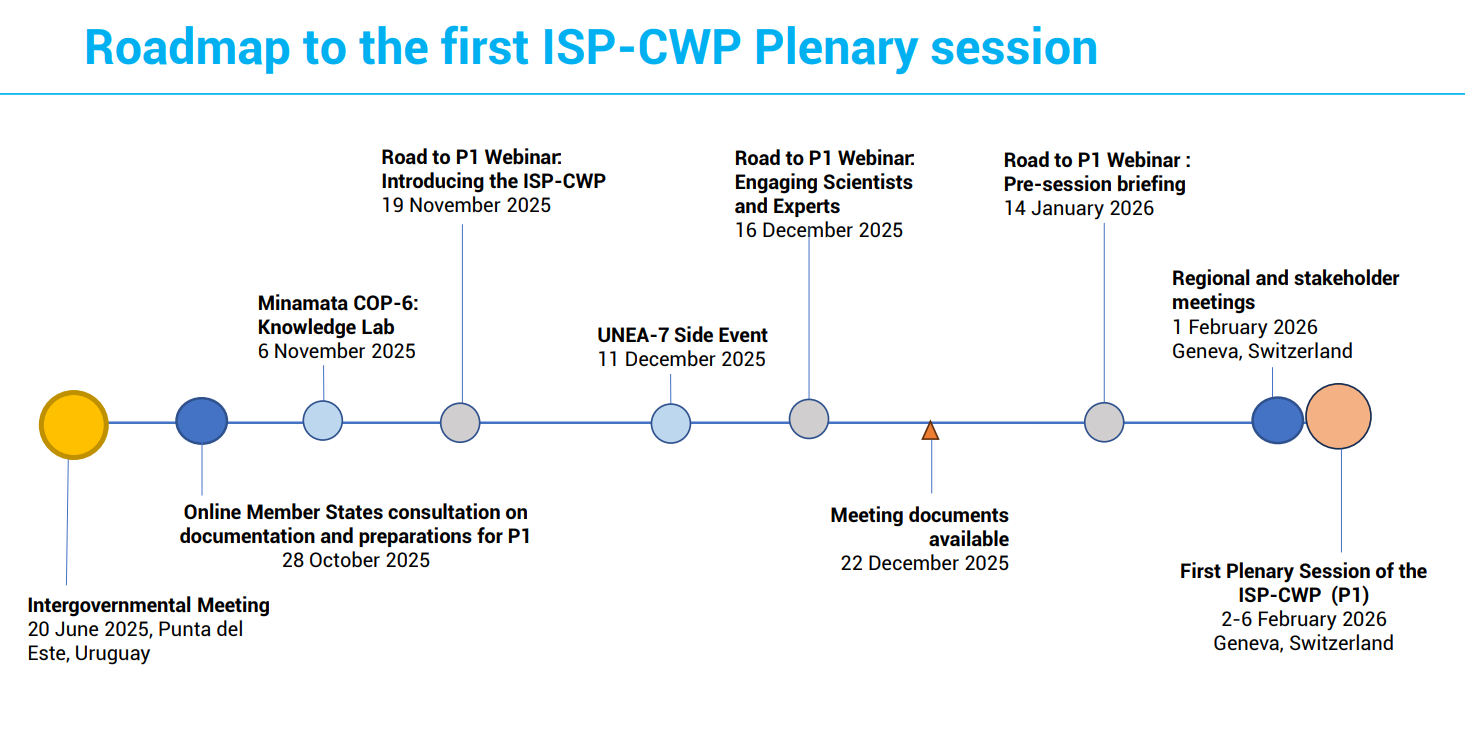
- Meeting documents are expected to be available by the 22 December 2025.
Closing Remarks
Koki TAKAKI | Director of Office of Mercury and International Chemicals Management, Ministry of the Environment, Japan
- Japan was honored to serve as co-chair alongside Uruguay at the intergovernmental meeting in June 2025.
- The intergovernmental meeting showed the strong spirit of collaboration that continue to guide us through moving forward.
- Looking ahead at the first plenary in February 2026, the key milestone will be the finalization and adoption of the draft rules of procedure. This is essential to ensure that the panel can bring its work smoothly with transparency and inclusiveness.
- If possible, we should aim to advance other important elements such as a process for determining the work program and the conflicts of interest policy. Together, these elements will provide the institutional foundation that enables the panel to operate effectively and with credibility from the very start.
- Japan has set up a national sharing committee that brings together twelve Japanese academic societies in the fields of chemicals, waste, and pollution prevention. This helps scientists take part actively and shows how academia and government can work hand in hand to strengthen the science-policy interface.
- Similar efforts in other regions bringing together academia, research institutions, and civil society show how inclusive collaboration can contribute to the panel’s work and reinforce the science policy interface across countries.
- The smooth establishment of the panel is a collective responsibility. By advancing these institutional elements and engaging national and academic network can ensure the ISP-CWP starts on solid ground and quickly becomes an impactful platform to tackle global challenges related to chemicals, waste and pollution.
Documents
- Presentations made during the event
- Report of the intergovernmental meeting to establish a science-policy panel to contribute further to the sound management of chemicals and waste and to prevent pollution (UNEP/SPP-CWP/IM/5)
- Information note for participants

