Event Conference
Education for Biodiversity: Accelerating Delivery of the Global Biodiversity Framework | RFSD 2026

20 Apr 2026
11:45 – 13:00
Venue: Palais des Nations | S-225-4 & Online | Webex
Organization: Cyprus, Slovenia, Armenia, UNEP Europe Office, United Nations Educational, Scientific and Cultural Organization, United Nations Economic Commission for Europe, Convention on Biological Diversity, Geneva Environment Network
This side event to the 2026 Regional Forum on Sustainable Development (RFSD 2026) is co-organized by UNEP and Geneva Environment Network, UNECE, UNESCO, CBD and Governments of Cyprus, Slovenia and Armenia.

About this Event
The Seventeenth meeting of the Conference of the Parties to the Convention on Biological Diversity (CBD COP17), the Twelfth meeting of the Conference of the Parties serving as the meeting of the Parties to the Cartagena Protocol on Biosafety, and the Sixth meeting of the Conference of the Parties serving as the meeting of the Parties to the Nagoya protocol on Access to Genetic Resources – also commonly referred to as the 2026 UN Biodiversity Conference – will convene in Yerevan, Armenia, from 19 to 30 October 2026.
CBD COP17 will assess collective progress toward the targets of the Kunming-Montreal Global Biodiversity Framework (KMGBF) and identify the actions needed to accelerate delivery of its 23 targets. COP17 is expected to address the biodiversity financing gap, strengthen gender-responsive approaches, and reinforce integrated responses to biodiversity and climate change.
In this context, education for biodiversity is a critical but often under-recognized enabler of implementation.
Education plays a transformative role in advancing the KMGBF by strengthening institutional and technical capacities, promoting behavioural change, and fostering societal ownership of biodiversity goals. It supports improved governance, more sustainable production and consumption patterns, and informed decision-making across sectors.
Education is also central to closing the financing gap. Strengthened environmental literacy enhances the capacity of countries and institutions to design, implement, and monitor biodiversity investments effectively. At the same time, gender-responsive education systems promote inclusive participation and leadership in biodiversity conservation, ensuring that women and marginalized groups are empowered as agents of change.
Importantly, education provides a foundation for integrated climate–biodiversity action. By embedding ecosystem-based approaches, restoration, and resilience into learning systems, countries can better align biodiversity strategies with climate commitments and sustainable development pathways.
This side event at RFSD 2026 explored how education (formal, non-formal, and informal) can serve as a strategic accelerator for KMGBF implementation at regional and national levels. It showcased regional experiences, identified policy entry points, and examined how education systems can better align with national biodiversity strategies.
Positioning education as a core implementation tool will help ensure that progress toward COP17 outcomes is sustained, inclusive, and transformative.
2026 Regional Forum for Sustainable Development
The 2026 Regional Forum on Sustainable Development (#RFSD2026) for the ECE region – the region’s official input to the High-level Political Forum on Sustainable Development and the UN’s main platform for global follow-up on the 2030 Agenda –will convene in Geneva on 21-22 April 2026, under the theme Transforming Together: Innovative and Equitable Actions for the SDGs.
As the end date of the 2030 Agenda for Sustainable Development approaches, the Forum aims to accelerate and coordinate actions towards the SDGs and maintain the momentum for innovative policies and solutions.
Speakers

H.E. Amb. Mher MARGARYAN
Special Envoy for the Armenian Presidency of the CBD COP17

Françoise JACOB
UN Resident Coordinator in Armenia

Elisabeth BERNHARDT
Head, Communication and Awareness, CBD

Cristina ROMANELLI
Programme Officer, Department of Environment, Climate Change, One Health and Migration, WHO

Samuel PARTEY
Head, Science Unit, Regional Bureau for Science and Culture in Europe, UNESCO

Vardan MELIKYAN
Environmental Technical Advisor, NBSAP Accelerator Partnership, Armenia

Rowan PALMER
Programme Management Officer, Resources and Market Branch, UN Environment Programme

Katalin CZIPPAN
Strategic Advisor & Nature Education for Sustainability Co-Chair, IUCN Commission on Education and Communication

Bernard COMBES
Independent Expert

Wondwosen ASNAKE KIBRET
Regional Coordinator for Nature Action, Europe Office, UN Environment Programme | Moderator
Highlights
Video
Live on Webex
Summary
H.E. Amb. Mher MARGARYAN | Special Envoy for the Armenian Presidency of the CBD COP17
- It is a pleasure to join this important discussion on education for biodiversity at a moment when the international community is accelerating efforts towards the 2030 Agenda and the implementation of the Global Biodiversity Framework (GBF).
- As incoming presidency of COP17, Armenia approaches this agenda with a sense of urgency and responsibility.
- Biodiversity, as we know, is the living fabric of our planet. It underpins human well-being, economic resilience, and cultural identity. Yet its rapid decline continues to threaten both nature and people alike.
- If we are to reverse this trend, we must move beyond awareness towards transforming how societies understand, value, and interact with nature. This is where learning systems become essential not only to raise awareness but to build the skills and competencies needed for action. Embedding biodiversity across curricular professional training and lifelong learning is essential to translate knowledge into implementation.
- As we prepare for COP 17 to be held in Yeravan, one of the central milestones will be the first global review of collective progress under the GBF. This review will provide a clear picture of where we stand, where progress is made, where things are falling behind and where gaps persist.
- But these gaps are not only financial or technical, they are also capacity related. Strengthening environmental literacy and institutional capacities at all levels from policy makers to local communities, is essential for translating national biodiversity strategies into tangible outcomes.
- Education in this sense serves as a foundation for building these capacities and sustaining implementation over time. Stronger institutional and technical capacities enable countries to design, access, and effectively implement biodiversity investments.
- At the same time, learning and awareness shape a new generation of decision makers, investors, and consumers who recognize the value of nature and integrate it into economic and policy choices.
- Equally important is the role of knowledge systems in strengthening coherence across Rio Conventions. We know that climate change, biodiversity loss, and land degradation are deeply interconnected.
- Integrating ecosystem-based approaches, restoration practices, and resilience thinking into learning systems and training frameworks can help align biodiversity strategies with climate and land degradation agendas.
- This coherence must be reflected not only in policy but also in society’s capacity to act. At the same time, education must be inclusive and gender responsive.
- Empowering women, youth, and marginalized groups through access to environmental knowledge, strengthens participation in biodiversity governance and implementation.
- The Armenian COP 17 presidency places strong emphasis on the human dimension of biodiversity policy including inclusive participation, knowledge sharing and capacity development across all stakeholder groups.
- We are committed to ensuring that COP 17 serves as a platform for meaningful negotiations and practical solution-oriented exchange bringing together governments, international organizations, academia, civil society, Indigenous peoples and local communities.
- COP 17 is not going to be simply another meeting. It is a milestone on the road to a moment of truth for delivery.
- The global review will provide a better understand what is working, where additional support is needed, and how to accelerate collective progress.
- One of the most powerful drivers of transformation remains knowledge and learning. Promoting biodiversity literacy and supporting diverse knowledge systems creates the conditions for informed decision making, behavioral change, and societal ownership of biodiversity goals.
- In this context, positioning learning and capacity buildings as core implementation tools will be essential to ensuring that the outcomes of COP 17 are ambitious but also inclusive, durable, and transformative.
- We also welcome the development of the Global Action Plan for Education on Biodiversity in partnership with UNESCO as an important step toward integrating biodiversity across education systems and strengthening environmental literacy at all levels.
- Armenia is committed to delivering a strengthened global trust, advancing delivery, and supporting all countries in meeting their biodiversity commitments. We look forward to working with all partners and stakeholders to ensure that education for biodiversity becomes a central pillar of this collective effort.
Françoise JACOB | United Nations Resident Coordinator in Armenia
- As we are in this event a day ahead of the Regional Forum for Sustainable Development, I want to highlight that what we are discussing today links to SDG 4 on quality education, SDG 15 on life on land, SDG 12 on sustainable production, SDG 13 on climate action, and SDG 17 on partnership.
- I will speak about how Armenia is currently already using education, knowledge systems, and innovation as strong political tools for the implementation of Armenia’s National Biodiversity Strategy and Action Plan (NBSAP).
- The upcoming NBSAP, which is about to be approved, positions education, science, and stakeholder engagement as an enabler of the delivery of this very ambitious biodiversity agenda, not just a standalone objective. This means working across the full education cycle from early learning in primary schools and there are some interesting experiences in universities.
- Biodiversity literacy starts very early, linking science, technology, agriculture, governance and other matters.
- Universities are increasingly platforms for applied research and innovation, supporting the country’s national target.
- It’s important to keep in mind for the years to come, we need to ensure we have good incentives to bring students into the science area, and especially into the environmental science area. This requires dedicated effort. There are a lot of students going to IT, but we also need students in science beyond the formal system.
- Non-formal education and community learning are very important, and there is something that is very specific in Armenia, which is that there is a very rich rural landscape. That’s one of the reasons why Armenia was selected, the diversity of biodiversity and because it holds very rich traditional ecological knowledge, especially in agrobiodiversity and in land management. So combined with modern science, this strengthens biodiversity outcomes and local livelihood.
- The UN system already delivers practical delivery models.
- The World Food Programme has a school feeding program that starts with 5-year-old kids and includes gardens, and that links how education, biodiversity, nutrition, and food systems can reinforce one another to have a sustainable development model.
- UNICEF works on inclusive child-centered education and to ensure environmental awareness reaches children and there are efforts to develop a specific curriculum on biodiversity.
- As we look towards COP 17, one very important element is broadening the level of knowledge among citizens through the media. Therefore, jointly with the Ministry of Environment of Armenia and different partners, we are about to launch the COP 17 Media School to strengthen accurate, analytical and impactful biodiversity information sharing and reporting.
- When we started and launched this idea, we got a lot of support because it is a political choice in Armenia to invest in informed public discourse and accountability when it comes to the environment.
- Armenia is very tech savvy and we think there is a huge space for developing data and there is a need for more data on the environment. We see that digitla tools can be used from species monitoring to green technology and green innovation. There’s a lot of startups that are interested in these areas and they are essential to scale up protection of the environment while also supporting sustainable use of natural resources.
- When it comes to the private sector, we’ve had a lot of interest from big industry leaders in various industrials area and we believe that it’s quite important to also share knowledge with the industry leaders because they have the capacity, if they want, and if they understand better, to really weave the biodiversity and environmental agenda into the value chains. Finance is also very important.
- We have a good opportunity this week and in the coming months to connect again education, technology, markets, partnership into one coherent delivery agenda for Armenia, for the region, and for the Global Biodiversity Framework.
Wondwosen ASNAKE KIBRET | Regional Coordinator for Nature Action, Europe Office, UN Environment Programme | Moderator
- To support this agenda, UNEP has published our State of Finance for Nature report, looking at how much is invested in nature vis-à-vis other investments. This could help the work that is being done in the lead-up to COP 17.
- The UNEP Finance Initiative also comes in handy in terms of supporting the plans ahead of COP 17 but also in terms of the COP17 Media School – UNEP is a reservoir of science and knowledge.
- We have expressed our interest to engage, and we would be more than happy to provide the training that is needed, whether to students or government, or the private sector, in the context of that science policy interface.
- We had an earlier session looking at how education for sustainable development is advancing under the five SDGs under review this year. It was a fascinating conversation with a diversity of people and institutions reflecting on that.
- Our initial point is looking at the 2026 SDG report for this region that was launched last week. The picture is not good; there is a lot that needs to be done.
- At the rate we are going, we can only achieve 19 targets by 2030. That is scary to comprehend. Education has a significant role in terms of advancing the SDGs.
- We are moving in the right direction for 13 targets.
- Progress is inefficient for 69 targets.
- What worries us most is that for 26 targets it’s reversed.
- SDG 15 is one of the areas where for the second time in a year, the environmental targets are being read and we fundamentally need to change in terms of desertification, non-degradation and nature and habitat loss.
- We need to do more, environmental targets are flashing red and we need to change it.
Elisabeth BERNHARDT | Head, Communication and Awareness, CBD
- The Convention on Biological Diversity has a very large membership, 196 parties, including the EU.
- Biodiversity loss has raised so much attention but sadly, the reason for this increased attention is that the crisis is becoming acute.
- The world is paying attention, we have seen the World Economic Forum also raise it in their 2026 Global Risks Report and the UK recently put out a report on how biodiversity is undermining national security and global military security – that’s a real acknowledgement of the central role of biodiversity.
- The convention has three complementary objectives:
- Protecting species, halting biodiversity loss.
- Sustainably using the components of biodiversity.
- Fair and equitable sharing of the benefits of biodiversity.
- The Kunming Montreal Global Biodiversity Framework (KMGBF) was adopted at COP 15 in December 2022 and aims to halt and reverse biodiversity loss with 23 specific targets by the year 2030.
- This year marks the halfway mark through the biodiversity framework and for that reason, we have our midterm global review of progress happening later this year at COP 17.
- Since the creation of CBD, CEPA – Communication, Education and Public Awareness was acknowledged as being core to its achievement.
- The parties that put in place the CBD noted that the involvement of an active and informed citizenry is key to achieving all the objectives of the CBD and that these elements of CEPA are core to every country’s national and international implementation strategies.
- From the very beginning, CEPA was really put at the center and over the years, the parties to the convention had increasingly created very specific and practical programs of work that they asked the CBD secretariat, together with parties and other stakeholders, to implement.
- CEPA was also acknowledged as a cross-cutting theme across all of CBD’s work and you can see that in the way we connect to the other areas of work of the secretariat.
- The latest decision (16/10) that was passed for CEPA at COP 16 in Cali will determine a number of things we’re doing this year that we’re submitting and getting ready for COP 17.
- COP decision 16/10 acknowledged that not enough work has been done yet on education. The parties really say education has to be ramped up.
- It requested an acceleration of work on CEPA and alignment with CEPA work to the KMGBF, because CEPA predates the KMGBF.
- It asked to reconvene an informal advisory committee for CEPA, which has recently been done.
- It asked the CBD secretariat to collaborate with a number of partners, including UNESCO, other relevant organizations, indigenous peoples, local communities, women and youth, and the private sector.
- It asked us to create a Global Plan of Action (GPA) on education for biodiversity and to submit that for review and consideration at COP 17. This means that it needs to go first to SBI-7, the subsidiary body meeting for implementation, happening this August in Nairobi.
- The draft GPA will soon be made available as a background document for SBI-7. As we are drafting this GPA over the last 9 months, we have looked at a results framework that considers several outcomes we hope for education for biodiversity, as well as what we would consider important priority areas for action and enabling conditions for its implementation
- Expected outcomes
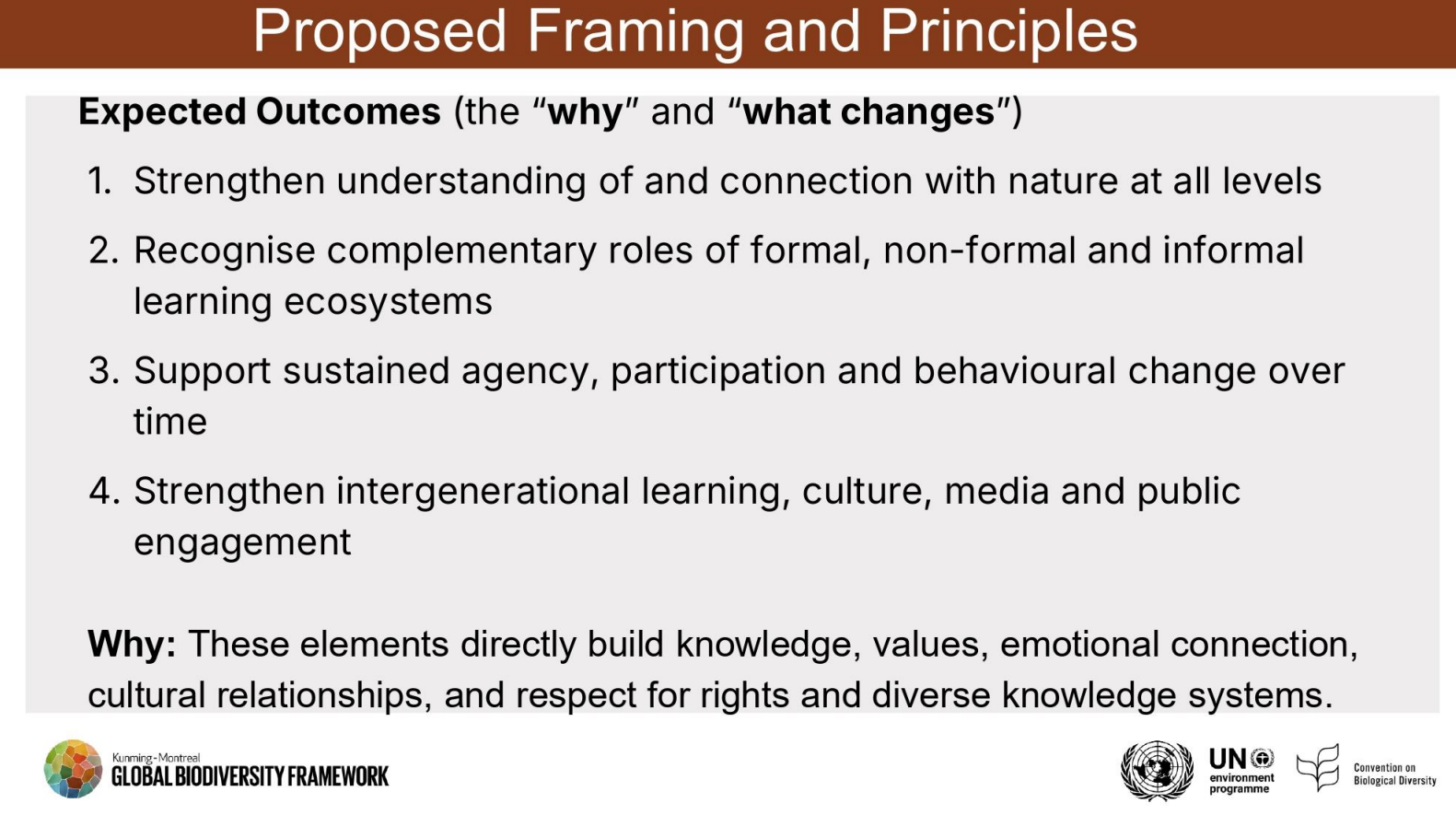
- We have five areas that we would consider priority areas for engagement.
- Fostering of human nature connectedness.
- This means strengthening our understanding of humans as being central to nature and nature being essential for our lives.
- We want to propose the prioritization of experiential place based physical learning in nature that is culturally grounded across all ages.
- We propose the scaling of green, blue, and living learning spaces, for example biodiverse school yards, biodiverse campuses and people really being in nature and learning from nature.
- We also propose to support together with UNESCO to leverage heritage and protected sites around the world, cultural institutions as place-based learning institutions and platforms for biodiversity and nature.
2. For GPA on education that is pluralistic, holistic, and equitable. This means:
-
- Integrating scientific knowledge with Indigenous people and local community knowledge systems.
- Understanding that biodiversity is linked to climate, health, gender, water, food, culture, and other aspects of life.
- Embedding equitable, gender-responsive, and participatory justice across the design and delivery of a global plan of action on education.
- We need to support systems thinking, value-based learning, and safe dialogue across all of these perspectives.
3. Develop capacity building for educators and learning systems by:
- Building the capacity for educators and for systemic learning systems.
- Leveraging the complementary roles of universities and teacher education together with civil society and community actors.
4. Looking at national education platforms and data systems to strengthen those platforms and networks for exchange and better coordination and for peer learning across sectors. We propose:
- Enabling access to shared tools, resources and data through platforms and innovation.
- Addressing the fragmentation and duplication of efforts and to accelerate learning from practice across all of these contexts.
- Supporting the creation of national indicators and data systems to measure capacity and priorities across the world.
5. Embedding biodiversity into national policy and curriculum frameworks. This means:
- Integrating education for biodiversity across other curricula and areas. Not just keeping it separate but across curricula standards and assessment approaches.
- We should be looking at education sector plans and aligning them with NBSAPs and other relevant national frameworks.
- We need to support whole of government coherence across different sectors and across ministries for education, environment, youth, culture and finance.
- We need to be translating commitments into implementable national guidance with resourced delivery pathways.
- Our proposal for the draft plan relies on a number of enabling conditions such as:
- Fostering an idea of lifelong and life-wide learning.
- Sustaining the capacity of educators and institutions.
- Creating partnerships for this work.
- Mobilizing sustainable financing and incentives for innovation.

- Important opportunities for engagement on SEPA and on education from now until COP 17 include:
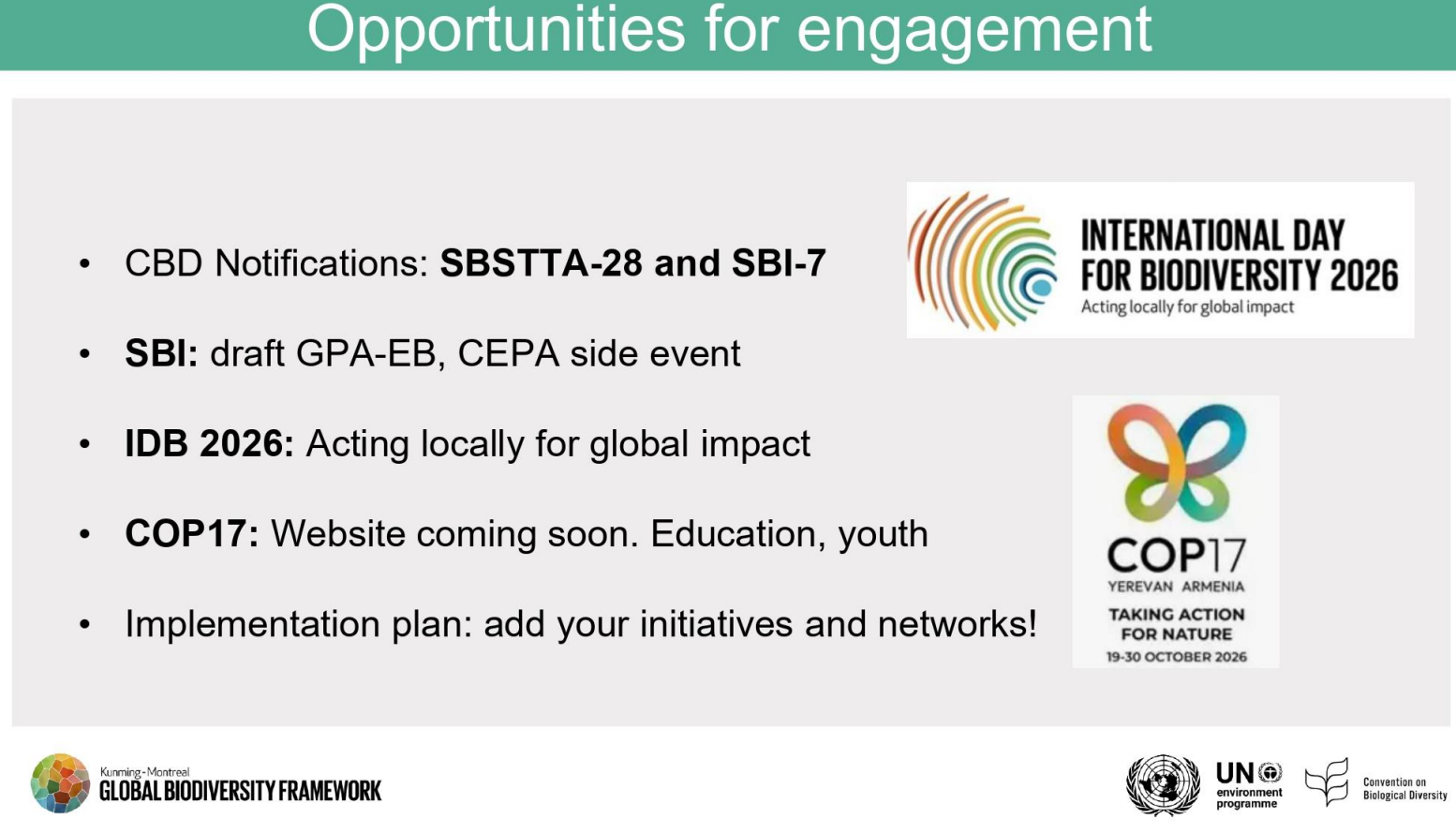
- At COP 17, education will be a strong priority and we can likely expect an education day happening on the sidelines, as well as opportunities for the engagement of youth. We hope the GPA will be well-received at COP and that it will be passed there.
Cristina ROMANELLI | Programme Officer, Biodiversity, Climate Change and Health, WHO
- Our health really depends on our relationships with the living world and protecting those begins with knowledge.
- If CBD COP 17 is to accelerate the implementation of the Kunming Montreal Global Biodiversity Framework (KMGBF), then biodiversity education should be recognized not only as an important delivery mechanism for the framework itself, but also as a public health priority.
- If there’s one thing biodiversity knowledge now shows us so clearly, it is that biodiversity is not only an environmental concern or an economic concern, but also an upstream health infrastructure.
- We frequently hear in important global conversations that biodiversity underpins food systems, water security, healthy soils, climate regulation, and the natural processes that help regulate pests and disease. But are policymakers really thinking about what that means? Are they also realizing that one in four premature deaths is attributable to preventable environmental factors?
- We know that 75% of global food crops depend in part on pollinators, contributing hundreds of billions annually in agricultural value. We also know that around 75% of emerging infectious diseases in humans are zoonotic and transmitted from animals to humans, but are also linked further upstream to land use change, habitat disruption and ecosystem degradation.
- When biodiversity is degraded, risks do not only stay within ecosystems or have consequences for our precious flora and fauna. They move into health systems, into economies and into societies.
- This is precisely why cross-sectoral knowledge, which is the foundation to the One Health approach, is so important to address concurrent environmental global health and also the equity crisis.
- One Health helps us to understand that the health of people, animals, plants and ecosystems is so inextricably interconnected and that environmental, human and ecosystem health outcomes have to be addressed together and not in isolation.
- It’s especially significant that the quadripartite definition of One Health that was endorsed by the WHO, FAO, the World Organization for Animal Health and UNEP, explicitly and for the first time in this common definition of One Health, now places ecosystems and environmental determinants of health at the center of One Health and that matters.
- It matters because it marks an important shift from a narrow understanding of health focused mainly on outbreaks and disease towards a more complete model of prevention and health.
- Once we recognize that ecosystem degradation is a health driver, the logic of prevention at source becomes clear because prevention at source means reducing risks before they appear as public health emergencies, before outbreaks reach hospitals, before so many practices that are associated with industrial agriculture for example become malnutrition, before water and heat stress become disease and mortality, before ecosystem decline becomes a public health and an economic crisis.
- It means acting earlier on those root causes of health risk, whether those be deforestation or unsustainable land use or biodiversity loss, pollution, or poorly planned development.
- Education is what actually makes that shift possible.
- Education equips health professionals, veterinarians, and epidemiologists to understand environmental determinants of health.
- It helps finance ministries recognize nature-related risks and invest in preventive action.
- It supports policy makers, planners, farmers and communities to apply resilient ecosystem you know based solutions.
- It empowers citizens. It empowers the present and the generations of tomorrow, especially youth to play a leadership role in that transition toward a healthier, more sustainable and equitable future.
- It’s really important to emphasize that when biodiversity is absent from education, it’s also absent from our hearts and minds, and we really protect and conserve what we care about. Importantly, it’s also absent from decision-making. It’s absent from investment and opportunities for prevention.
- Currently, less than 3% of all health expenditures globally go to prevention. This matters directly not only to the WHO or the global health community but also for COP 17:
- It matters to close that financing gap because resources require capacities to be used effectively.
- It also matters for gender responsive implementation because inclusive education expands participation, expands leadership and agency.
- It also matters for integrated biodiversity climate health action because education helps countries move from parallel agendas to more coherent delivery.
- It is important to remember that we’re not starting from scratch. As mentioned, we now have a draft action plan for education on biodiversity, but we also have a Global Action Plan on Biodiversity and Health, which provides pathways for integrating biodiversity into health policy and planning. Biodiversity education can help turn that pathway into practical implementation while complementing broader education efforts under the GBF.
- As I join you from the UN Permanent Forum on Indigenous Issues, I want to remind us all that education has to include respectful, reciprocal, and rights-based learning with Indigenous peoples as essential knowledge partners.
- As we look to Yerevan later priorities include:
- Embed biodiversity literacy across sectors – not just three sectors and only in environment ministries, but in all sectors.
- Align education with biodiversity, climate, and health action plans.
- Invest in institutional and community capacity.
- Value indigenous and traditional knowledge systems.
- Treat education as infrastructure for prevention.
- COP 17 is not only an opportunity for making new commitments, but also an opportunity to ensure that we’re able to build the capacity to deliver on those commitments. If we could say that biodiversity loss is one of the key defining risks of our time, then education is one of the key defining and underused solutions of our time.
Samuel PARTEY | Head, Science Unit, Regional Bureau for Science and Culture in Europe, UNESCO
- As an organization with a mandate in science, one of the areas UNESCO works to advance is the science of biodiversity through our network of biosphere reserves.
- UNESCO has designated sites, biosphere reserves, global geoparks, and natural heritage and through these sites, we are able to demonstrate the science of biodiversity. We are able to test different approaches to biodiversity monitoring, generating data, biodiversity trends, ecosystem services and the impact of climate change on biodiversity. This all significantly contributes to the KMGBF’s monitoring and implementation.
- We have about 780 of these sites in our network of biosphere reserves covering about 142 countries and 7.5 million km2. They are home to more than 300 million people. These sites are essential social and ecological environments.
- These sites enable the testing of different approaches by which humanity can build peace with nature. This is one of the essential areas by which we are able to demonstrate the science of biodiversity.
- At UNESCO, advancing the science of biodiversity is not only about generating knowledge but also about ensuring that science is translated into learning, into policy, into investable solutions and directly supports the KMGBF.
- For instance, in the biosphere reserves, we are able to test different nature-based solutions (NBS) such as mangrove restoration initiatives. We’ve been able to do this in the Caribbean where scientific assessments and community engagement have enabled certain policy decisions on ecosystem recovery while strengthening local livelihoods.
- More broadly, these sites bring together governments, scientists, communities, and the private sector to implement integrated landscape approaches directly supporting multiple targets of the convention, support the reduction in biodiversity loss, and sustain the ecosystem services that they provide.
- Through this evidence, we are able to inform national policies on the environment and on biodiversity.
- UNESCO has a biodiversity portal and site navigator where we are trying to build the necessary evidence and build a database on biodiversity based on the monitoring that is happening in various UNESCO sites. These support the monitoring of how countries are progressing towards the KMGBF and how they are able to monitor the implementation of their own NDSAP.
- UNESCO is keen on ensuring biodiversity is mainstreamed in education systems and in society. This is where we bring a unique comparative advantage as an entity that is promoting education.
- UNESCO has a unique portal called Education for Sustainable Development whereby biodiversity is integrated across education systems, curricula, teacher trainings and community-based learning.
- We’ve done some studies looking at how biodiversity and climate change is mainstreamed into education curricula and found significant gaps. Education needs to be intensified as a means of ensuring people have the right mindset towards biodiversity.
- Within our UNESCO sites, we build evidence on conservation and through these sites, we are able to conduct some research and engage the community. Community engagement is also a very important part of the education process to be able to foster behavioral change and long-term stewardship.
- In parallel, UNESCO is co-leading, together with the CBD secretariat and the IUCN, the development of the global action plan on education for biodiversity.
- UNESCO ensures inclusivity and knowledge diversity through our Local Indigenous Knowledge System (LINK) program. Indigenous and local knowledge is integrated with scientific research and communities are engaged as co-producers of knowledge.
- UNESCO has supported the integration of Indigenous and local knowledge into biodiversity assessment processes.
- For example, we did some work in Bosnia and Herzegovina, where community knowledge has led to the development of an assessment framework for biodiversity to better understand ecosystem changes and inform local decision-making.
- This is critical to achieving durable biodiversity outcomes that align closely with the CBD priorities on inclusive and participatory governance.
- In practice, what UNESCO brings is a global infrastructure for implementation, a network of places where biodiversity science is generated, tested, and applied in the real-world context.
- The CBD process is clearly moving in this direction from recognizing education as supportive to positioning it as a core implementation mechanism of the GBF.
- UNESCO’s role is to ensure that biodiversity science is not only produced but understood, applied, and sustained across societies. These efforts are also fully aligned with our recently adopted Hangzhou Strategic Action Plan of the Man and the Biosphere Program. This action plan explicitly links science, culture, and education, promotes open and citizen science, and strengthens the integration of indigenous and local knowledge with scientific and technological approaches for sustainability.
Vardan MELIKYAN | Environmental Technical Advisor, NBSAP Accelerator Partnership, Armenia
- Armenia, as part of the larger Caucasus region, is a global biodiversity hotspot with high endemism and ecosystem biodiversity. However, biodiversity loss is accelerating due to factors such as climate change, land use change, and overexploitation.
- Armenia’s National Biodiversity Strategy and Action Plan (NBSAP) for 2026-2030 is not just a policy document; it is a knowledge-driven implementation framework.
- The document has been developed by a group of experts who represent academic institutions involved in biodiversity conservation for decades. Academia is expected to support the implementation as well. Without science, there can be no credible action and universities are expected to become a pipeline for science.
- The strategic role of universities and research institutions in NBSAP implementation consists in:
- Knowledge generation through biodiversity research and species assessments and ecosystem studies.
- Data systems and monitoring, including things like inventories, long-term monitoring, geospatial data collection and analysis.
- Innovation and technology transfer on topics related to remote sensing, genetic resources, and restoration techniques.
- Human capital development. This includes training of next-generation experts and public awareness raising, which are key elements for NBSAP implementation.
- There are several targets under the NBSAP related to this. There are targets related to research and capacity building, monitoring systems, data sharing, citizen science, and education.
- What are the key contribution areas of academia?
- The development of evidence for policy and planning.
- Universities are expected to participate in Red List assessments, ecosystem mapping, and climate biodiversity interaction analysis.
- They are also expected to support with spatial planning, protected areas expansion, and restoration.
- For example, one of the activities on the NBSAP is capacity building on red list methodologies, which will involve national universities and research centers.
- Another important task is enhancing biodiversity monitoring data systems and this includes shifting from fragmented data to integrated national systems.
- Universities could help with field service, taxonomy research, and long-term data sets.
- All of this should result in supporting the transition from data to information and then to decision-making.
- Innovation and technology transfer are another important topic where academia contribution can be critical. Their role could include remote sensing for ecosystem monitoring, genetic resource and seed bank development, restoration and climate resilient species development or studies related to this.
- These activities will be critical for forest resilience. Armenia is not very rich in terms of forest resources. However, the country is planning to increase the forest cover significantly.
- The next critical topic is the restoration of degraded ecosystems and climate adaptation. The topic of data access sharing and open science is also important for the involvement of academia.
- There are current challenges related to data fragmentation and the NBSAP’s response is the establishment of mechanisms for data access and sharing.
- Universities can also lead activities to national biodiversity databases, open access platforms, interoperability with global systems, and a critical role in education awareness and citizen science. Here, universities can act, and already are acting, as bridges towards a society, becoming translators between the policy and the common language.
- It is expected that academia will contribute to building of public ownership, expanding monitoring capacity and connecting science with communities as a result of the implementation of respective activities related with educating the general public in particular.
- What is the institutional ecosystem? Actors that are already engaged and are explicitly mentioned in NBSAP as implementation partners. This includes:
- The National Academy of Sciences has numerous research centers under it.
- The Yerevan State University and its several faculties, including the faculty of biology.
- The American University of Armenia, which is a key partner, including its Acopian Center for the Environment. It is also supporting Armenia’s government with preparations for COP 17.
- Numerous botanical gardens, seed banks and zoological collections under different institutions which are very important for the implementation of NBSAP. These already have critical data sets and significant scientific experience, as well as infrastructure for ex situ conservation.
- The key gaps that will need to be addressed include:
- Limited funding and limited funding for research to policy translation. We often talk in Armenia, and elsewhere, about the need to translate the biodiversity or science language into policy language. This is largely missing.
- Fragmented data systems.
- Weak science-policy interface.
- Insufficient applied research for decision-making.
- Science has to move beyond publications and be more involved in policy planning and implementation activities and evolve from simply knowledge producers into implementation partners.
- If biodiversity is Armenia’s natural capital, then universities are the institutions that can turn knowledge into its protection.
Rowan PALMER | Programme Management Officer, Resources and Market Branch, UN Environment Programme
- UNEP has been collaborating with the ILO and IUCN in examining the relationship between nature-based solutions (NBS) and green jobs and decent work.
- This is a biannual report series – with two reports that have been published so far in 2022 and 2024 – is based on NBS investment data from UNEP’s State of Finance for Nature (SFN) reports and then uses modeling to estimate the current number of jobs in NBS, as well as the potential additional jobs that could be created if the nature financing gap is closed.
- In the 2024 report, we also did a qualitative analysis of skills and training needs for the NBS workforce.
- Based on the financial flow data in the SFN report, our modeling in our 2024 report estimates that there are currently 60 to 63 million people working in NBS around the world.
- The modelling also estimates that if all of the nature investment required to meet the Rio Conventions targets by 2030 is realized, then an additional 20 to 31 million people could be employed in new NBS jobs, mostly in Asia-Pacific, then Africa, and then Latin America.
- Simply mobilizing financial flows is not enough to create and fill jobs on its own. Other enabling conditions need to be met and one of those is that the workforce needs to have the right skills, knowledge, and training. This is where education comes in.
- In order to try and understand these education and training needs, we reviewed relevant literature and then surveyed different types of NBS practitioners from around the world and they confirmed that there is indeed a skills gap that i that impacts implementation and that needs to be addressed.
- Types of jobs and skills needed include:
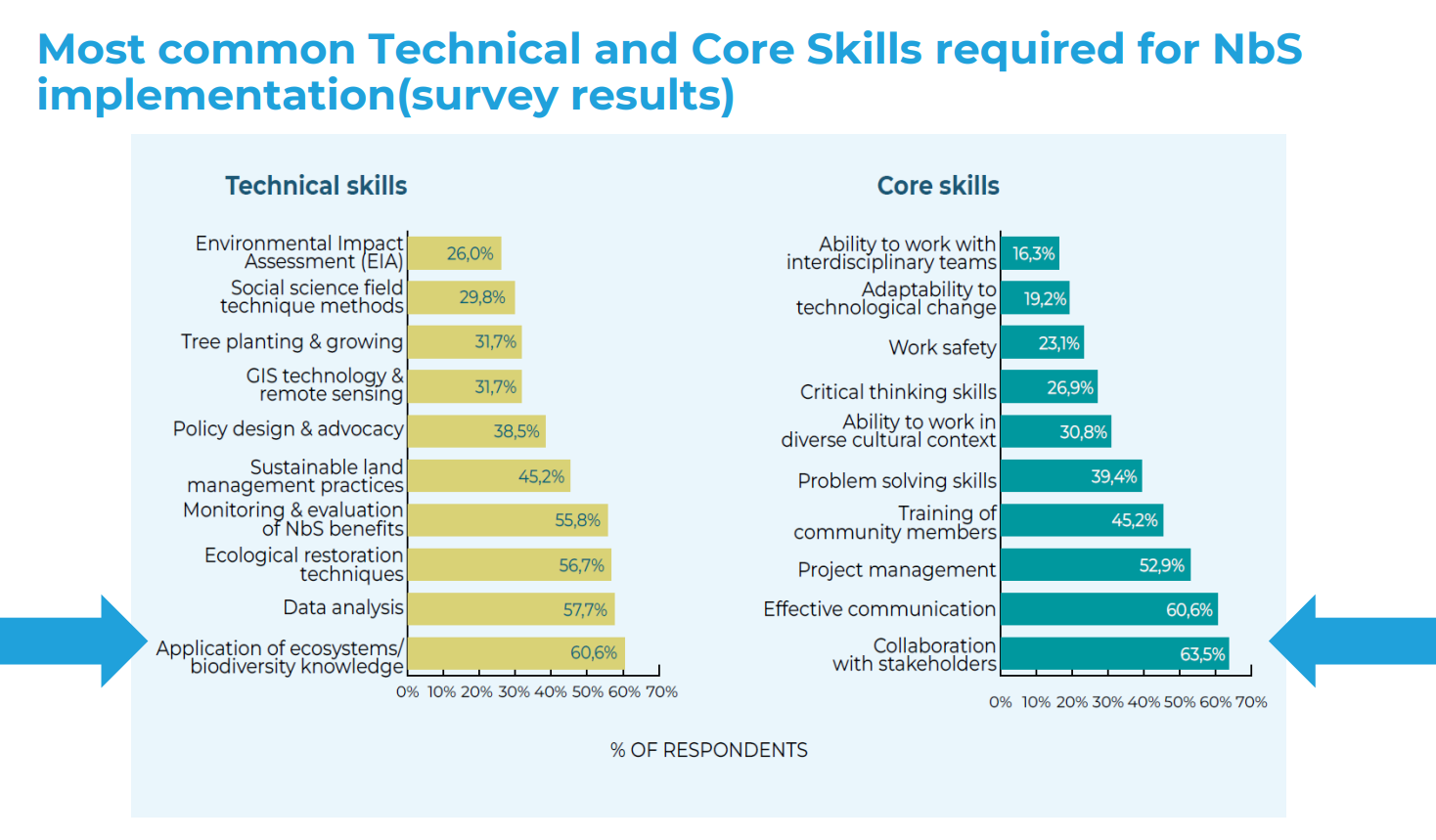
- These are a mix of more nature-specific technical skills and then more general skills.
- The top skills identified are more general ones like collaboration with stakeholders and communication skills which speaks to the interdisciplinary and multistakeholder nature of many NBS interventions.
- There are more technical skills like expertise on ecosystems and biodiversity restoration techniques and data analysis that are also among the top skills identified.
- We then asked the practitioners about the biggest gap they identified. There were various technical skills along with fundraising and resource mobilization skills, then problem solving and interdisciplinary working skills as additional gaps.
- If we look at all this data, the main takeaways are that:
- Investment in nature and NbS can have significant benefits for job creation. While NbS implementation does include more low-skilled jobs, it also creates higher-skilled jobs that require specific technical training and education. This goes against a common perception that NbS involves a lot of low-skilled labor and not high-quality jobs to implement.
- Education for biodiversity is not just about education in biodiversity. While there are a lot of technical skills needed related directly to biodiversity, there’s also a big need for more general technical and core skills. When we’re thinking about wider benefits for people in society, NbS training can give people a lot of transferable skills thatcan be used for other jobs as well.
- The need for interdisciplinary training and education and the integration of relevant skills and knowledge across different types of programs. Successful NBS implementation requires a lot of different occupations and professionals and practitioners to all work together.
- People must be exposed to different types of knowledge and methodologies and ways of working so that they can work together more effectively. It’s not just about biology or ecology programs or training engineers in engineering. It’s about enabling that sort of cross-pollination and equipping these people to work together in the future.
Katalin CZIPPAN | Strategic Advisor & Nature Education for Sustainability Co-Chair, IUCN Commission on Education and Communication
- When we are talking about education for sustainability, biodiversity education, and environmental education, we are talking about the triple planetary crisis – by which we mainly mean climate change, biodiversity loss, and pollution.
- This is true, but on the other hand, the countries that will implement the NBSAPs will listen to their country decision makers say there are other crises, highlighted by the three horses
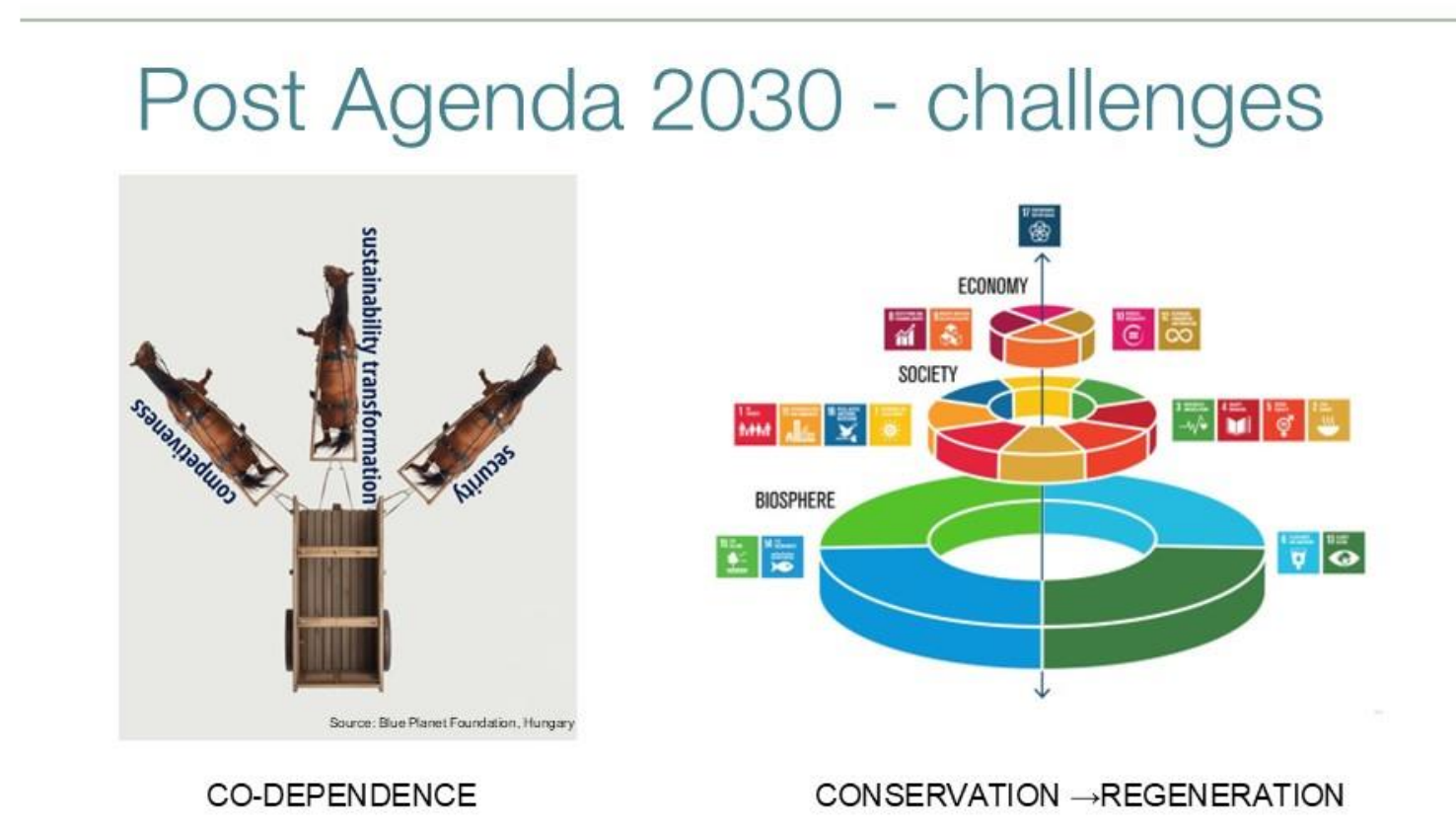
- Countries are spending and focusing on competitiveness and security and then focus on environmental sustainability and other issues. This is not a good way of thinking.
- If we focus on nature and biodiversity education, we could bring this idea into the hearts and minds of people that we live on one Earth and in one carrying capacity.
- This wedding cake illustrates that if we don’t live within that frame, these three horses will tear our world apart.
- We need to think about using nature as a basis of education that can bring these horses together and find a direction together.
- At the IUCN Commission on Education and Communication (IUCN CEC), we set the goal more than 10 years ago to work on education and bring nature into the heart of education, and make education be used strategically by those who are planning and want to achieve biodiversity goals. This includes putting education as the enabling condition for conservation.
- 20 years ago, we prepared the research and sent it to UNESCO on why nature is a key part of education and demonstrated that many other issues they are addressing with education can be solved if we focus on nature.
- Then we started to work with our network, we organized a session on the World Environmental Education Congress, we put together an action plan on how we can mainstream nature into education in the near future, and then we created the IUCN task force on Nature-based Education.
- We have more than 150 members worldwide and our nature-based framework has more than a thousand members. We are discussing how we can mainstream education and biodiversity into the conservation agenda and into the education agenda and bring them together.
- We organized an education day at COP 16. It was very successful. They agreed on preparing a global action plan on education for biodiversity.
- The next stage was that we invited several speakers and experts to the Salzburg Global Seminar to discuss how we can envision a global plan of education for biodiversity.
- At the same time, we were successfully mainstreaming education into the IUCN work program for the next 4 years, where education is one of the key enablers.
- Hopefully, those who are members of the IUCN and beyond will use education in a more comprehensive way and we can bring it together.
- We then invited a drafting team and created a draft for the global plan of action for education on biodiversity and sent it to UNESCO and CBD.
- We are supporting the global plan of action on education for biodiversity with all of our knowledge.
- Finally, we need to use systemic thinking, we need to use all forms of education, it has to be a co-creation and have a whole government approach because it cannot just be education and the conservation sector. We need the finance sector and other sectors to work together to mainstream this biodiversity issue and to save our life within this limited carrying capacity of ours.
Bernard COMBES | Independent Expert
- The first thing would be to remember the motto of the International Year of Biodiversity, which was “Biodiversity is life, biodiversity is our life.”
- What should be part of going forward on the Global Plan of Action on Education for Biodiversity?
- An integrative, innovative, inclusive, and holistic vision of education and lifelong learning about biodiversity for biodiversity.
- Adopting a whole sector approach to the to the is the issues of biodiversity.
- Understanding that these issues are connected to each other.
- Links the UN decade on ecosystem restoration and focus on the linkages between ecosystems and livelihoods and how education and learning can help in implementing them or reinforce their impact.
- Enhancing traditional knowledge and interactive approaches adopted in the local context and biodiversity education.
- We need to focus on stewardship and active citizenship to guide individuals, institutions, and countries to more respect for nature and humanity and solidarity and intergenerational responsibility.
- Placing young people at the center of biodiversity, conservation, awareness, movement and driving.
- Promote more identification and compilation of information and good practices through various platforms.
- Ensuring cooperative processes based on networks and partnerships and strengthen the links between not only the regional and global partnership, but also at the local level.
- We need to have a newer approach to CEPA where we should focus on co-creation, co-learning, empowerment, engagement, participation, advocacy.
- As Jane Goodall said, “You cannot get through a single day without having an impact on the world around you. What you do makes a difference, and you have to decide what kind of a difference you want to make.”
- We need to be able to experience nature and biodiversity, not only as individuals, including the decision makers, who next year in Yerevan, will sign off and say “yes, we all agree to this global plan and we need to implement it.”
Documents
Links
- Regional Forum on Sustainable Development 2026 | UNECE
- Environment @ RFSD 2026
- Addressing Biodiversity Loss and the Role of Geneva
- From Geneva to Yerevan | International Geneva @ UN Biodiversity Conference
Other RFSD 2026 Side Events

Innovative Action for the SDGs through Education for Sustainable Development | RFSD 2026
20 April 2026 | 10:00 CEST
UNEP Europe Office, Geneva Environment Network, United Nations Economic Commission for Europe, Cyprus, Slovenia