
Event Conference
Core Human Rights Principles for Private Conservation Organizations and Funders | HRC58 Side Event

12 Mar 2025
12:00 – 13:00
Venue: Palais des Nations | Room XXII & Online
Organization: United Nations Environment Programme, ICCA Consortium, World Wildlife Fund, Special Procedures of the UN Human Rights Council, Women4Biodiversity, International Indian Treaty Council
This side event to the 58th session of the Human Rights Council will formally present these principles and foster discussions on their implementation, alongside other relevant efforts that can promote a stronger rights-based approach to conservation within the KMGBF.
The international community faces an unprecedented biodiversity crisis, which is also a crisis of human rights. The loss of biodiversity threatens the enjoyment of human rights globally, especially for Indigenous Peoples, Afro-descendant and other tribal communities, and peasants, who directly depend on natural ecosystems for their material, cultural, and spiritual well-being.
The Kunming-Montreal Global Biodiversity Framework (KMGBF), adopted in 2022, marked a major milestone by committing to a human rights-based approach to biodiversity conservation. Despite this, human rights violations persist in conservation, particularly affecting Indigenous Peoples, and communities and groups in situation of vulnerability and marginalization. One critical gap has been the lack of clear guidance for private conservation organizations and funders on integrating human rights into their efforts.
In response, UNEP helped to facilitate a multi-stakeholder process from 2022 to 2024, engaging Indigenous Peoples, civil society organizations, private conservation entities, and human rights experts. This culminated in the Core Human Rights Principles for Private Conservation Organizations and Funders, which clarify the application of international human rights standards to private conservation efforts.
Rather than creating new rights or duties, or superseding existing norms and standards, the principles reflect and clarify the existing human rights norms and standards applicable to conservation. While primarily addressed to private conservation organizations and funders, including non-profit organizations, these principles may also offer guidance for other actors to enhance their respect for human rights and adherence to international human rights norms and standards in conservation endeavors. Overall, adherence to these principles fosters a more responsible, rights-based approach to conservation, which ultimately benefits all of us who share this beautiful planet.
This side event will formally present these principles and foster discussions on their implementation, alongside other relevant efforts that can promote a stronger rights-based approach to conservation within the KMGBF.
We invite all interested stakeholders to join this conversation to shape the future of conservation efforts that respect both people and nature. By fostering dialogue and collaboration, this event aims to contribute to the broader movement for human rights-based environmental governance and to ensure that conservation efforts uphold dignity, equity, and justice for all.
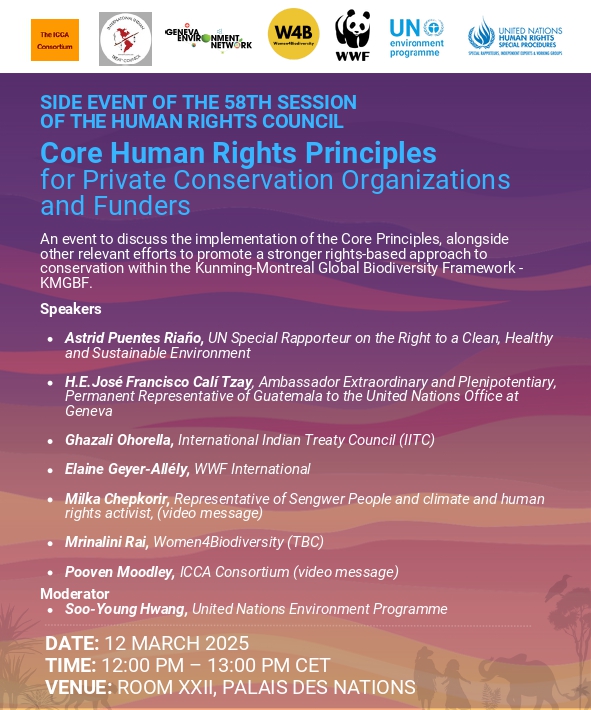
Speakers
By order of intervention.

H.E. Amb. José Francisco CALÍ TZAY
Permanent Representative of Guatemala to the UN Office at Geneva

Astrid PUENTES RIAÑO
UN Special Rapporteur on the human right to a clean, healthy and sustainable environment

Ghazali OHORELLA
Legal Counsel, International Indian Treaty Council

Elaine GEYER-ALLÉLY
Interim Leader, Governance Practice, WWF International

Mrinalini RAI
Director, Women4Biodiversity

Milka CHEPKORIR
Representative of Sengwer People and climate and human rights activist (video message)

Pooven MOODLEY
Executive Director, Natural Justice | ICCA Consortium (video message)

Soo-Young HWANG
Legal Office, UN Environment Programme | Moderator
Environment @ HRC58
The 58th Regular Session of the Human Rights Council (HRC58) is taking place in Geneva from 24 February to 4 April 2025. This regularly-updated page highlights the environmental-related activities of this session.

Highlights
Video
Live from Palais des Nations.
Video Messages | Milka CHEPKORIR, Representative of Sengwer People & Pooven MOODLEY, Natural Justice
Summary
Soo-Young HWANG | Legal Office, UN Environment Programme | Moderator
- Attention is brought to the final version of the core human rights principles for conservation organizations and funders, which was released in December. The discussion aims to exchange views on the development and operationalization of these principles, as well as explore a broader rights-based approach to conservation.
- The principles were developed to promote a human rights-based approach to conservation and contribute to the Kunming-Montreal Global Biodiversity Framework, which integrates Indigenous rights, gender perspectives, and protections for environmental defenders.
- A key objective is to clarify how international human rights standards apply to private conservation efforts. While much focus is placed on how governments meet biodiversity commitments, there is a need to address the role of the private sector in conservation.
- The principles are not a new set of rights but are based on existing frameworks, including the UN Declaration on the Rights of Indigenous Peoples and the UN Guiding Principles on Business and Human Rights. The development process was participatory and inclusive, incorporating extensive consultations with stakeholders to ensure a broad range of input.
- Emphasis is placed on practical implementation rather than just theoretical guidance. The principles are action-oriented, aiming to provide clear steps on how conservation efforts can integrate human rights due diligence and address issues such as rights violations, access to remedies, and law enforcement practices.
- The publication was launched with the support of over 70 organizations and experts, and it is available in multiple languages on the UNEP website.
- Implementation will be an ongoing process, with plans to establish a community of practice focused on conservation and human rights. This space would bring together conservation organizations, Indigenous representatives, and experts to discuss best practices, challenges, and solutions for applying human rights principles in conservation work.
- Capacity-building is identified as a critical area for improvement, particularly for funders and conservation organizations. Many funders lack training on human rights considerations in their funding decisions, and some conservation organizations have highlighted the need for additional training.
- Plans for further engagement remain open-ended, with ongoing consultation and collaboration to refine and expand these efforts.
H.E. Amb. José Francisco CALÍ TZAY | Permanent Representative of Guatemala to the UN Office at Geneva
- There is a strong emphasis on the inseparable link between conservation and human rights, making it clear that conservation efforts must respect fundamental rights.
- Private conservation organizations and funders have a responsibility to uphold Indigenous rights. History has shown that when human rights are ignored in the name of conservation, it not only leads to injustices but also weakens environmental efforts.
- A call is made for states and UN member nations to uphold commitments outlined in the UN Declaration on the Rights of Indigenous Peoples and ILO Convention 169. Those who have not ratified Convention 169 are urged to do so, as it is not against the state but rather strengthens the rule of law while ensuring the protection and respect of Indigenous communities.
Astrid PUENTES RIAÑO | UN Special Rapporteur on the human right to a clean, healthy and sustainable environment
- The principles are recognized as an important tool for addressing human rights challenges in private conservation efforts. While many private entities engage in conservation, there have also been cases of human rights violations.
- A key issue is the compartmentalization of responsibilities—while human rights obligations are well-defined for states, they are often unclear or ignored by private actors, despite the existence of the UN Guiding Principles on Business and Human Rights.
- A common issue observed is that private conservation entities, including funders and organizations, either do not believe they have human rights obligations or are unaware of what those obligations entail.
- The core human rights principles for private conservation help bridge this gap, providing clarity on responsibilities and guiding those unfamiliar with human rights frameworks toward better understanding and implementation.
- By increasing awareness and accountability, the principles contribute to identifying and reducing human rights violations, as well as addressing systemic inequalities, discrimination, and power imbalances—especially those affecting Indigenous peoples, descendants, and peasant communities in conservation areas.
- While the principles are not a solution to all challenges, they serve as a framework to better understand conflicts, obligations, and pathways for resolution. This, in turn, supports the broader implementation of state obligations and ensures a more balanced distribution of responsibilities among all conservation stakeholders.
Ghazali OHORELLA | Legal Counsel, International Indian Treaty Council
- The principles and the inclusion of the rights of Indigenous Peoples are very important, and gratefulness towards the development and facilitation of these principles is expressed.
- The Special Rapporteur on the Rights of Indigenous Peoples issued a letter highlighting the disproportionate application of funding to Indigenous Peoples, with less than 11% of funding going to the ground.
- The knowledge of Indigenous Peoples is not traditional, it’s not old, rusty, and dusty. It’s still in development, even almost scientific. Funders as well as the private sector need to understand this for more ethical engagement, as it is also the role of the private sector to ensure the respect of human rights.
- The last thing you want to do is chase the people that are taking care of the land off the land, hence the need to protect those that are effectively taking care of the people, and it all starts with the meaningful participation of Indigenous Peoples, not only in decision making but also in the allocation of funding.
Elaine GEYER-ALLÉLY | Interim Leader, Governance Practice, WWF International
- WWF, known as the World Wide Fund for Nature or World Wildlife Fund in some offices, is a large global network with around 80 offices operating in approximately 100 locations. It works from highly local levels in remote areas to national, regional, and global levels, providing broad insight into conservation challenges and solutions.
- The organization has a complex governance structure, with each office having its own strategy and, in some cases, independent boards. However, all WWF offices are bound by a shared mission, a common set of values, the WWF brand, and a core set of standards that all staff must follow. These standards are directly relevant to today’s discussion.
- WWF was founded in 1961 with a focus on wildlife conservation, which remains central to its work, but its agenda has expanded to include ecosystem protection and tackling systemic drivers of nature loss, environmental degradation, and climate change, including policy, finance, and economic systems.
- The core principles provide an important benchmark for strengthening WWF’s internal systems to ensure conservation does no harm and contributes to people’s well-being. Acknowledging past failures, WWF faced a crisis several years ago due to human rights abuse allegations involving government rangers and law enforcement in conservation areas. The organization commissioned an independent review, which led to significant reforms in its conservation practices.
- Over the past five years, WWF has made network-wide investments, including updating its Environmental and Social Safeguards Framework (ESSF), now applied in nearly 300 landscapes, which has provided critical learning on how to implement these standards effectively. The WWF has also developed conservation law enforcement guidelines, addressing weaknesses related to prohibited activities and financial payments, and is finalizing an orientation note on human rights due diligence in conservation law enforcement.
- All WWF offices have formally committed to upholding updated human rights principles, including statements on gender equality and Indigenous peoples’ rights.
- The core principles help WWF assess its existing standards and identify areas needing improvement. One ongoing challenge is grievance mechanisms, which are established but function more effectively in some contexts than others. The organization is working with communities to improve them and has introduced a new position focused on problem resolution and ensuring effective remedies.
- Beyond safeguards and technical principles, WWF is fostering a cultural shift toward inclusive and rights-based conservation, working with offices across its network to identify nine good practices for inclusive conservation. These include learning from past mistakes, co-developing shared agendas, reshaping partnerships for equity, and supporting Indigenous leadership in conservation efforts. These are not rigid standards but serve as a tool for internal reflection, discussion, and cultural change. The approach extends beyond conservation design to WWF’s communications, operations, and resource mobilization.
- Inclusive conservation has gained strong momentum within the organization and is now a pillar of WWF’s 2030 network roadmap, which includes increasing support for Indigenous and Community Conserved Areas, catalyzing more direct funding for local communities, and internally benchmarking offices on their adoption of inclusive conservation practices.
- Over 60% of the landscapes where WWF operates are classified as unstable, requiring teams to navigate complex power dynamics, conflict, and environmental corruption. The organization is building internal capacity to work effectively in these contexts and is advocating for stronger human rights-based approaches in global policy frameworks such as the Global Biodiversity Framework.
- The core principles and the establishment of a community of practice provide an important opportunity to move beyond commitments on paper toward effective implementation. WWF and other members of the Conservation Initiative on Human Rights see great value in exchanging learnings, approaches, and challenges.
- Given increasing pushback on human rights, shrinking civic space, and rising threats to environmental defenders, WWF stresses the need for stronger cross-sector collaboration to protect both people and nature.
Mrinalini RAI | Director, Women4Biodiversity
- The Human Rights Council reaffirms the need to respect, protect and promote all human rights and fundamental freedoms, “including the right to development for all women and girls through their life force without distinction of any kind”, upholding fundamental principles such as non-discrimination, equal access to justice and removal of all structural barriers to the empowerment of all women and girls, taking into consideration the diverse situations in which they live.
- The preamble of the Convention on Biological Diversity (CBD) recognizes the roles and contributions of women to biodiversity conservation. This sets the ground for the action of Women4Biodiversity, which tries to operationalise the principles as well as this aspiration of the convention, and to widespread recognition of the roles and contributions of women to biodiversity.
- In 2022 at COP15, a target for gender equality (Target 23) and the target to ensure the gender responsiveness aspect of that target (Target 22) were adopted.
- An integrated approach is needed: a human rights-based approach with intersectionality.
- Ensuring human rights and non-discrimination starts by giving women and girls equal opportunities. Empowering young girls starts with giving them access to education. It is also highly needed to tackle gender-based violence.
- It is also important to recognize women’s traditional knowledge, their contributions, and how they can be supported.
- There is a need for a very transparent, robust mechanism for accountability, ensuring inclusive and culturally sensitive approaches taking into account geographical and cultural diversity.
- Needs, priorities, and aspirations of women depend on the local context: it is core that, when conservation organization partners come, they come with investment, looking at the local context of what’s happening, to make sure to implement actions that are specific and adapt to diversities and that address women’s rights and human rights in the local context.
- Conservation organizations and funders need to understand the links between gender, local contexts, and biodiversity, and that human rights are true core work, not a name branding to put in a report.
Milka CHEPKORIR | Representative of Sengwer People and climate and human rights activist (video message)
- The core principles are not new but are necessary due to ongoing violations against Indigenous Peoples in the name of conservation, including evictions from their lands and restrictions on access to water, sacred sites, and other essential resources.
- These violations persist despite the existence of international human rights laws, including the UN Declaration on the Rights of Indigenous Peoples, which is meant to safeguard Indigenous rights.
- With the finalization and adoption of the core principles by conservation organizations and funders, there is hope that greater responsibility will be taken to ensure their implementation.
- While conservation organizations and funders work to integrate these principles, Indigenous organizations and those working with Indigenous communities are encouraged to translate them into local languages and make them accessible.
- Indigenous communities may choose to adopt the principles in full or in sections as part of their community bylaws, establishing them as a minimum standard when engaging with conservation organizations and funders in their territories.
- This approach ensures that conservation organizations and funders adhere to the principles, regardless of whether they have formally adopted them, creating a “sandwich process” where Indigenous peoples actively uphold their rights rather than relying solely on external commitments.
- Indigenous peoples are equal partners in conservation and must have their rights protected throughout the process.
- Conservation organizations and funders are urged to integrate these principles into their work and allocate budgetary resources for their implementation, particularly through Free, Prior, and Informed Consent (FPIC) processes when engaging with Indigenous communities.
Pooven MOODLEY | Executive Director, Natural Justice | ICCA Consortium (video message)
- Despite existing human rights frameworks and national laws, violations persist, often without accountability. Establishing core principles is crucial to ensuring safeguards, accountability, and redress mechanisms that prevent such violations.
- Meaningful engagement with communities is essential—beyond simply ticking a Free, Prior, and Informed Consent box. The ICCA Consortium works in a spirit of collaboration with everyone to ensure that members are informed, that they know what their rights are, and can engage appropriately with conservation organizations, governments, etc.
- Accountability is key for both communities and donors. Funders must ensure the organizations and projects they support do not contribute to rights violations.
- Although it requires time and effort, socializing the principles and integrating them within policy is imperative to ensure their implementation.
- Funders also play a vital role in building capacity to operationalize these principles within funding and international organizations. Rather than focusing solely on individual donor-supported projects in specific regions, a collective approach is needed—pooling resources to integrate and enforce these principles, ensuring violations finally come to an end.
Photo Gallery


Documents
- Core Human Rights Principles for Private Conservation Organizations and Funders
- Presentations made during the event
Links
- Environment @ 58th Session of the UN Human Rights Council
- Human Rights, Biodiversity, and the Role of Geneva