
Event Conference
Briefing on the World Wildlife Conference | 20th meeting of the Conference of the Parties to CITES

29 Oct 2025
10:30 – 12:00
Venue: International Environment House I | Room 3 & Online | Webex
Organization: Convention on International Trade in Endangered Species of Wild Fauna and Flora, Geneva Environment Network
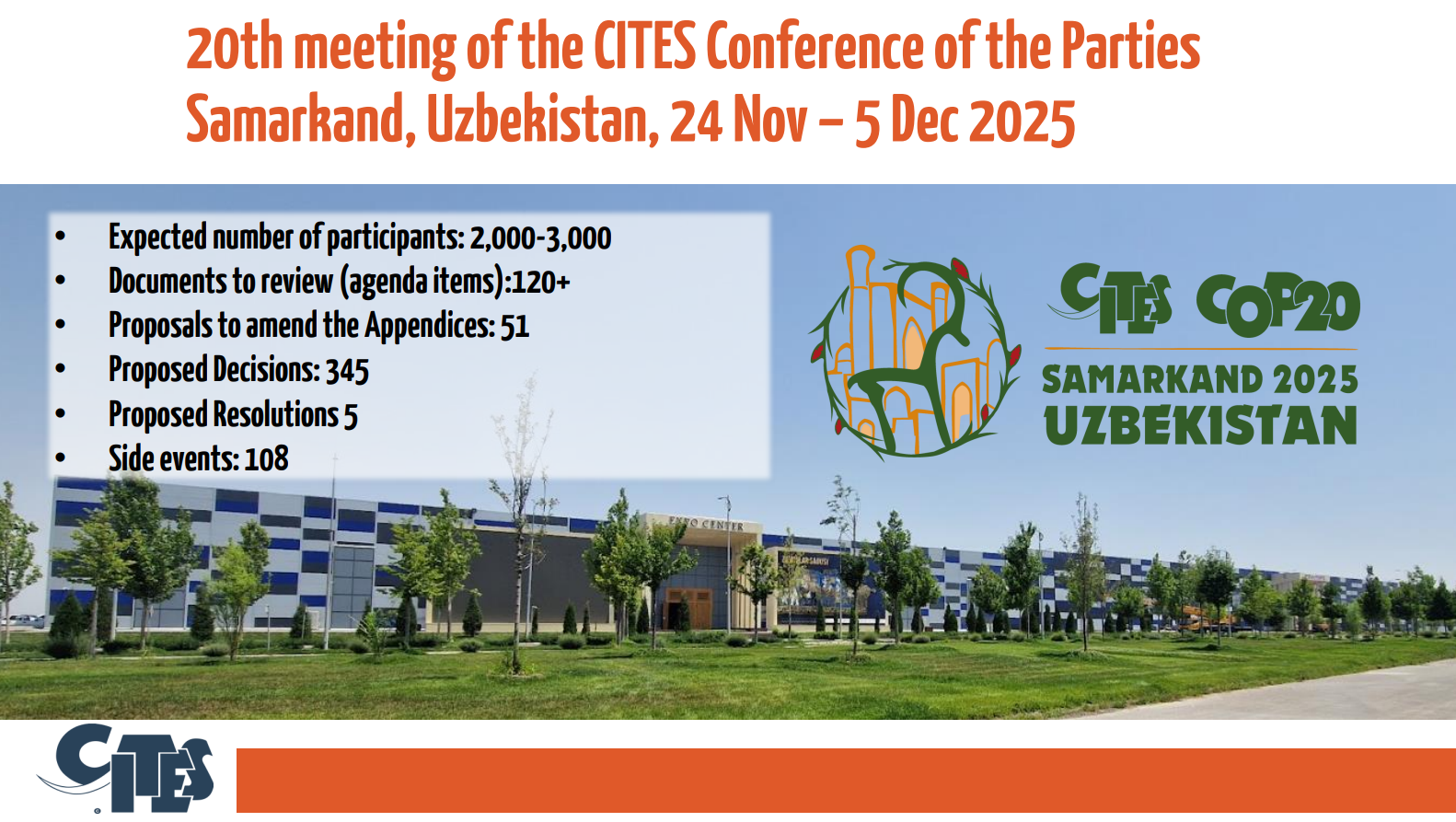
This briefing on the 20th meeting of the Conference of the Parties to the Convention on International Trade in Endangered Species of Wild Fauna and Flora, which will take place in Samarkand, Uzbekistan from 24 November to 5 December 2025, is organized within the framework of the Geneva Environment Network.

About this Event
The upcoming 20th meeting of the Conference of the Parties to the Convention on International Trade in Endangered Species of Wild Fauna and Flora (CITES), also known as the World Wildlife Conference, will take place in Samarkand, Uzbekistan, from 24 November to 5 December 2025. Nearly 3,000 government officials, experts, representatives of local, national and international intergovernmental and non-governmental organizations working in the areas of species conservation or management of wild fauna and flora and visitors are expected to attend the meeting. The 79th and 80th meetings of the Standing Committee will be held at the same venue on 23 November and 5 December, respectively.
The objective of the Convention is to ensure all international trade in CITES-listed species is sustainable, legal and traceable – and consistent with the long-term conservation of species. CITES plays an important part in halting biodiversity loss, ensuring its sustainable use, and achieving the 2030 Agenda for Sustainable Development as well as the Kunming-Montreal Global Biodiversity Framework.
Parties at CoP20 will discuss a total 114 agenda items, including 149 working documents and 51 amendment proposals under the following themes:
- Strategic matters
- Interpretation and implementation matters
- Species specific matters
- Maintenance of the Appendices
- Proposals to amend the Appendices
Whenever the Conference does not reach consensus on a given matter, the decision may be put to a vote. Decisions taken by Parties will come into force 90 days after the end of the meeting unless agreed otherwise.
Speakers
By order of intervention.

Ivonne HIGUERO
Secretary-General, CITES

H.E. Amb. Eldiyor TOSHMATOV
Permanent Representative of the Republic of Uzbekistan to the United Nations Office and other international organizations in Geneva

Mathias LÖRTSCHER
Nominated Chair of Committee I, Switzerland

Anna WONG
Nominated Chair of Committee II, Singapore

Haruko OKUSU
Governing Bodies Unit, CITES

Thea CARROLL
Science Unit, CITES

Sofie H. FLENSBORG
Legal Unit, CITES

Ben Janse VAN RENSBURG
Enforcement Unit, CITES

Kristina RODINA DE CARVALHO
Outreach and Projects Unit, CITES
Highlights
Video
Live from International Environment House 1
Summary
Welcome and Introduction
Ivonne HIGUERO | CITES Secretary-General
- The 20th meeting of the CITES Conference of the Parties or CoP20 is scheduled to take place from 24 November to 5 December 2025 in Samarkand, Uzbekistan.
- Originally designed for Geneva-based missions, these briefings have grown into a global platform for wider engagement ahead of CoP and other major meetings.
- CoP20 will be the first-ever CITES CoP held in Central Asia, marking an important milestone that reflects the region’s global role in global conservation efforts.
- CoP20-nominated Chairs Mathias Lörtscher of Switzerland and Anna Wong of Singapore will guide CoP20 towards ensuring that discussions are fruitful and conducted with integrity in accordance with the CITES rules of procedure.
- In a time when environmental priorities seem to be competing with other pressing global challenges, the role of CITES remains vital. Our Convention stands at the nexus of conservation, commerce, and community, aiming is to ensure that international wildlife trade supports biodiversity.
- This year marks 50 years since CITES entered into force. The Convention continues to evolve and meet new challenges, reaffirming its relevance in a changing world. CITES contributes directly to addressing the triple planetary crisis of biodiversity loss, climate change and pollution.
- The CITES strategic vision for 2021 to 2030 promotes legal, traceable and ecologically sustainable wildlife trade. This vision aligns with the 2030 agenda for sustainable development and the Kunming-Montreal Global Biodiversity Framework (KMGBF), reinforcing collaboration with partners.
- The meeting of the Conference of the Parties is the highest decision-making forum of the Convention and is convened every three years to reshape the future of species conservation through trade regulation. It serves as a moment for parties to assess progress, set priorities, and most importantly, take collective action.
- At CoP20, parties will consider 51 proposals to amend Appendices I and II. Covering a diversity of species from Okapi and striped hyena to sea cucumbers, song birds, these decisions will influence how international trade is managed for species whose survival could be compromised by overexploitation and illegal trade.
- In today’s financial landscape, we must find ways to continue implementing the Convention effectively. The growing complexity of our work demands both efficiency and innovation. Sustainable financing will be critical for enabling CITES to deliver on its mandate.
- The budget to be adopted at CoP20 will be central to this effort. With 185 parties and over 41000 species under its mandate, CITES is a testament of global cooperation. The Secretariat remains committed to supporting parties, especially those facing implementation challenges, through technical assistance, capacity building, and policy guidance.
- As we approach CoP20, we must collectively focus on strategic prioritization, practical solutions and measurable impacts. This requires working together on our common environmental goals.
- This briefing will give an overview of the key issues and priorities ahead and will deepen awareness on how CITES continues to evolve, building a future where people, planet, and nature thrive together.
H.E. Amb. Eldiyor TOSHMATOV | Permanent Representative ofthe Republic of Uzbekistan to the United Nations Office and other international organizations in Geneva
- CITES COP20 will be held in the ancient city of Samarkand, which is a real marvel of Uzbekistan.
- The upcoming event, hosted at the Expo Center of the Silk Road Samarkand EXPO complex, is expected to bring together around 3,500 people from all 185 member countries of the Convention as well as representatives of international organizations, research institutions and civil society.
- The day before the official opening on 23 November 2025, a High Level Dialogue of CITES CoP20 will take place under the theme “Elevating the Strategic Impact of CITES CoP20 – From Policy to Practice: Monitoring, Funding and Action for Regulated Wildlife Trade.” This event will convene Ministers from other countries and heads of international organizations. As of today, 20 ministers and representative from over 10 international organizations have already confirmed their participation.
- To date, the organization of over 110 side events, including thematic sessions, workshops and exhibitions, has been finalized. In preparation for the conference, over 400 visit-related documents have already been processed for delegates and participants.
- Visas (2025/122) for all registered participants will be issued free of charge by all embassies to the Republic of Uzbekistan abroad or upon arrival at the Tashkent International Airport or Samarkand International Airport. → More information on Visa Information, Notification 2025/058, Visa application form
- Information on more than 130 recommended hotels in Samarkand is available on the CITES CoP20 website.
- It will be a great honor for my country to welcome CITES member states, partners and delegates from all over the world to the historic city of Samarkand, located at the crossroads of the ancient Silk Road. The 3,000-year-old city of Samarkand was once a vibrant center of ancient civilizations, a place where people lived in harmony with nature. Situated in the heart of the Eurasian continent, Samarkand offers convenient international travel connections and benefits from a visa-free regime with nearly 100 countries, ensuring a smooth and welcoming arrival experience for all delegates.
- During your stay, we warmly invite you to explore Samarkand’s rich cultural and historical heritage, its diverse gastronomy and renowned hospitality. Among the city’s most visited landmarks are the Registan Square, the Shah-i-Zinda complex and Ulugbek observatory. These are recognized worldwide as the symbols of Samarkand’s enduring legacy.
- Today, Samarkand seamlessly blends its ancient heritage with modern architecture and infrastructure. The city offers a wide range of accommodation and conference facilities.
- Tour operators stand ready to assist delegates in creating personalized programs, ensuring that every visit is both comfortable and memorable.
Mathias LÖRTSCHER | Nominated Chair of Committee I, Switzerland
- It is an honor to have been chosen to chair Committee I of CITES CoP20.
- One of the main challenges that the Committees will face is the sheer amount of documents and topics to be addressed. It will be my aim to give all the topics the needed time and to the parties the possibility to express their views and to reach good conclusions.
- Committee I will be mainly dealing with scientific issues and proposals for putting species in Appendices.
- Some of the issues to be tackled will be quite complicated and reaching consensus may be difficult. I also call upon all parties to arrive prepared, having read all documents and to be willing to find compromises.
- In the possibility that consensus is not reached, voting will be necessary. Yet, in CITES, the delegates have often demonstrated an ability to reach conclusions and decide.
Anna WONG | Nominated Chair of Committee II, Singapore
- It is truly an honor to be nominated as chair of Committee II, which will oversee strategic and procedural matters.
- Committee II will also examine around 87 documents, for which the CITES secretariat is providing exceptional support to detail the complexities of these matters.
- I am approaching CITES CoP20 with tremendous enthusiasm and confidence about our collective potential, as CITES delegates are committed to working diligently to ensure this conference stands out not merely as another conference but as a transformative milestone where we all unite to elevate our aspirations and achieve tangible progress.
The Big Issues: Efficiency of the Convention, Cooperation with organizations and Multilateral Environmental Agreements
Haruko OKUSU | Governing Bodies Unit, CITES Proposed amendments to the CITES Appendices, species conservation and trade
- The Convention on International Trade in Endangered Species of Wild Fauna and Flora is a multilateral environmental agreement that gathers multiple states to ensure international trade in specimens of wild animals and plants does not threaten their survival in the wild. The Convention categorizes species into three different appendices, each of which is accorded with different levels of regulation and along with that there are procedures and process-related mandates related to those appendices. The Convention was finalized in 1973 and it has been enforced since 1975. This year, we are celebrating the 50th anniversary of the Convention coming into force. CITES currently counts 185 parties, with Turkmenistan being the latest party to join the Convention.
- CITES CoPs are its ultimate decision-making body, which is structured on two sides. This body meets every three years to make decisions related to amendments to the appendices and to make decisions regarding resolutions. At CoPs, parties also decide on the resolution of the triannual budget and the cost of the work program of the Secretariat. CoPs also take decisions of the Conference of the Parties.
CoP20
Efficiency of the Convention, Cooperation with organizations and Multilateral Environmental Agreements
Administrative and Financial Matters
- For an outlook of what is being discussed and on which day and what time, delegates are invited to consult the Agenda of the CoP (CoP20 Doc. 2) and the Working Programme (CoP20 Doc. 3).
- Additional documents to be noted under these matters include:
Arrangements for Meetings of the CoP (CoP Doc. 7.5)
- The document looks at the efficiency and effectiveness of the meetings of the CITES governing bodies.
- It highlights the kind of financial and logistical challenges that the Convention is faced with in recent times, especially what to do when there are no host countries that have proposed to hold our CoP.
- The budget and finance subcommittee of the Standing Committee has been looking at different ideas, including fundraising innovatively, looking at adding budget lines specifically for the COP host countries and looking for cost reduction strategies.
- This document also looks at rising conference costs and funding gaps that exist, which all threaten the Secretariat’s services to the parties, which could include maintenance of databases, servicing and providing venues for the different meetings of the governing bodies, providing translation and interpretation into the working languages of the Convention and providing audiovisual equipment as well as e-voting. These all impact the core functions of the Convention.
- The document proposes to shift the COP cycle from three to four years, starting with CoP22 in 2032, to save costs and improve the intersectional work efficiency.
- It contains some draft decisions and recommendations that urge parties to consider some of these matters.
Enhancing the work and efficiency of the Convention through the permanent Committees (CoP Doc. 14)
- This document was submitted jointly by the Chairs of the Standing Committee, Animals Committee, Plans Committee and the Finance and Budget Subcommittee of the Standing Committee. It highlights the unsustainable growth in tasks and decisions that have overloaded the committees’ work. This has resulted in time constraints with their work as well as during their meetings and these have strained both the budget of holding these meetings and reduced the effectiveness of these committees in making decisions using their time effectively.
- There are some implementation gaps identified because many working groups are struggling to complete the mandates within the given time and also parties are having to juggle so many subject areas and they struggle to keep up with them.
- The Chairs have jointly tried to think about how to tackle these challenges and one of the proposals is to start using a prioritization matrix to focus the Committees’ efforts on high-impact and core tasks of these committees.
- This also calls on the Parties to look at the draft decision so that these matrices can be refined and improve coordination to safeguard the convention’s core mandates.
Proposed amendments to the CITES Appendices, species conservation and trade
Thea CARROLL Science Unit, CITES Legal and compliance matters
- Ahead of CoP20, 51 proposals were submitted to amend the CITES appendices I and II. These proposals were submitted by parties in terms of Article 15 to the Convention.
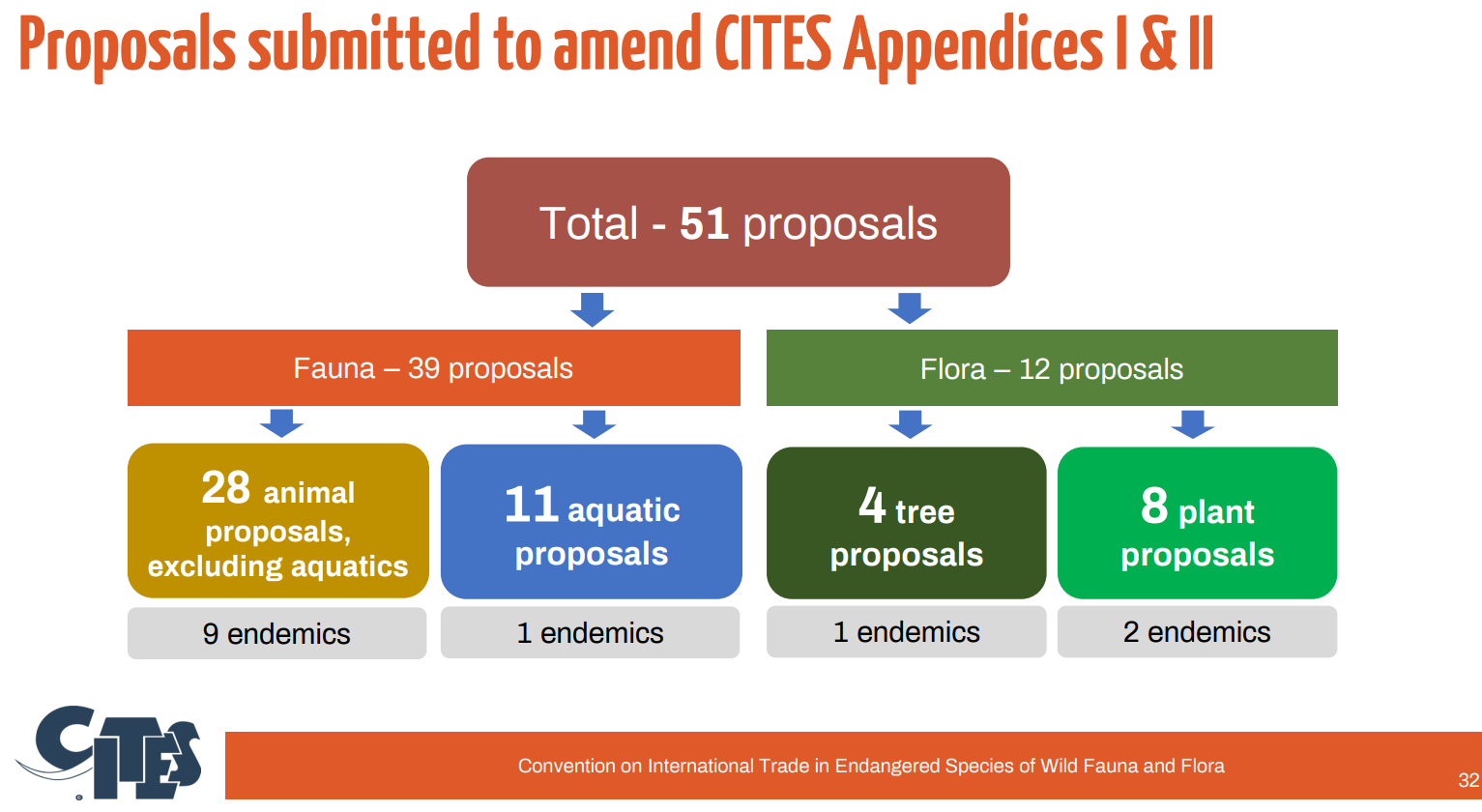
- The Secretariat assessed all proposals against the text of the Convention and made recommendations, which can be found in CoP20 Doc. 114.1 (Rev. 1) or No. 2025/119.
- The Secretariat received proposals covering a wide diversity of species and different taxonomic groups. Among these, there are proposals to include species in Appendix I, as in the case of the endemic Okapi, Striped Hyena, Bale Mountains Adder, and Galliwasp. There are also proposals to include species in Appendix II to the Convention, as in the case of Orcas, Gazelles, Two-toed Sloths, Hornbulls, Geckos, School Sharks, Gulper Sharks, Sea Cucumbers and Abalone.
- The proposals also include requests to transfer species from one appendix to the other or to delete species from the appendices or the inclusion of new species in the appendices.
- The three proposals to transfer species from Appendix II to Appendix I include, for exampl,e Brazil Wood and some succulent species from South Africa.
- There are also proposals to address numeric changes and proposals were received to delete certain tree species from the appendices.
Role of CITES in Reducing Risk of Future Zoonotic Disease Emergence
Much work has been done in this regard during the intersectional by the different committees. This includes:
- Report on the implementation of decisions adopted at CoP19 (CoP Doc 15.1)
- Measures to prevent and mitigate the risk of pathogen spillover and transmission (wildlife trade and supply chains)
- Cooperation with World Organization of Animal Health (WOAH): MoU signed and workplan developed
- Cooperation with the Convention on Migratory Species (CMS): CMS Resolution on Wildlife health and migratory species, Avian influenza and CMS Decisions on Wildlife disease
- Cooperation with other organizations, including the Kunming-Montreal Global Biodiversity Framework (KMGBF) and Global Action Plan for Biodiversity and Health
- UNEP: Updates on One Health Quadripartite activities and Nature4Health initiative
- Animals Committee: Practical solutions to reduce pathogen spillover risk & opportunities for collaboration
- Standing Committee: Agreed – no need for the establishment of CITES advisory body; no consensus on matter of a new Resolution on One Health; and draft decisions proposed.
- Proposed draft resolution on One Health and CITES and draft decisions – Submitted by Senegal (CoP Doc 15.2)
CITES and Forests
- An interdisciplinary study considering the potential scope of initiative on CITES and forest was conducted and is available as Annex 2 to CoP Doc. 18. It includes key issues to be addressed going forward, including the review of a CITES forest compendium that consolidates all decisions relating to tree species in one place, as well as the relevant resolutions.
- Key consideration in the document will be whether we will continue discussions relating to a potential initiative on CITES and forests that focuses on collaboration and strategic engagement on CITES-listed three species matters and how we can leverage partnerships and improve data quality.
Brazilwood (Paubrasilia echinata)
- Document CoP Doc. 97 relates to a study related to traceability systems to look at the provenance of Paubrasilia used in the musical industry.
- The report was revised based on inputs received from the standing committee as well as additional information provided by Brazil.
- Parties will consider this study as well as the proposed draft decisions to further develop voluntary marking and identification systems as well as mechanisms to register Paubrasiliaechinata, bows and wood stockpiles.
- There is a proposal as well on Brazilwood that will be considered on non-detriment findings.
Non-detriment findings (CoP Doc 50)
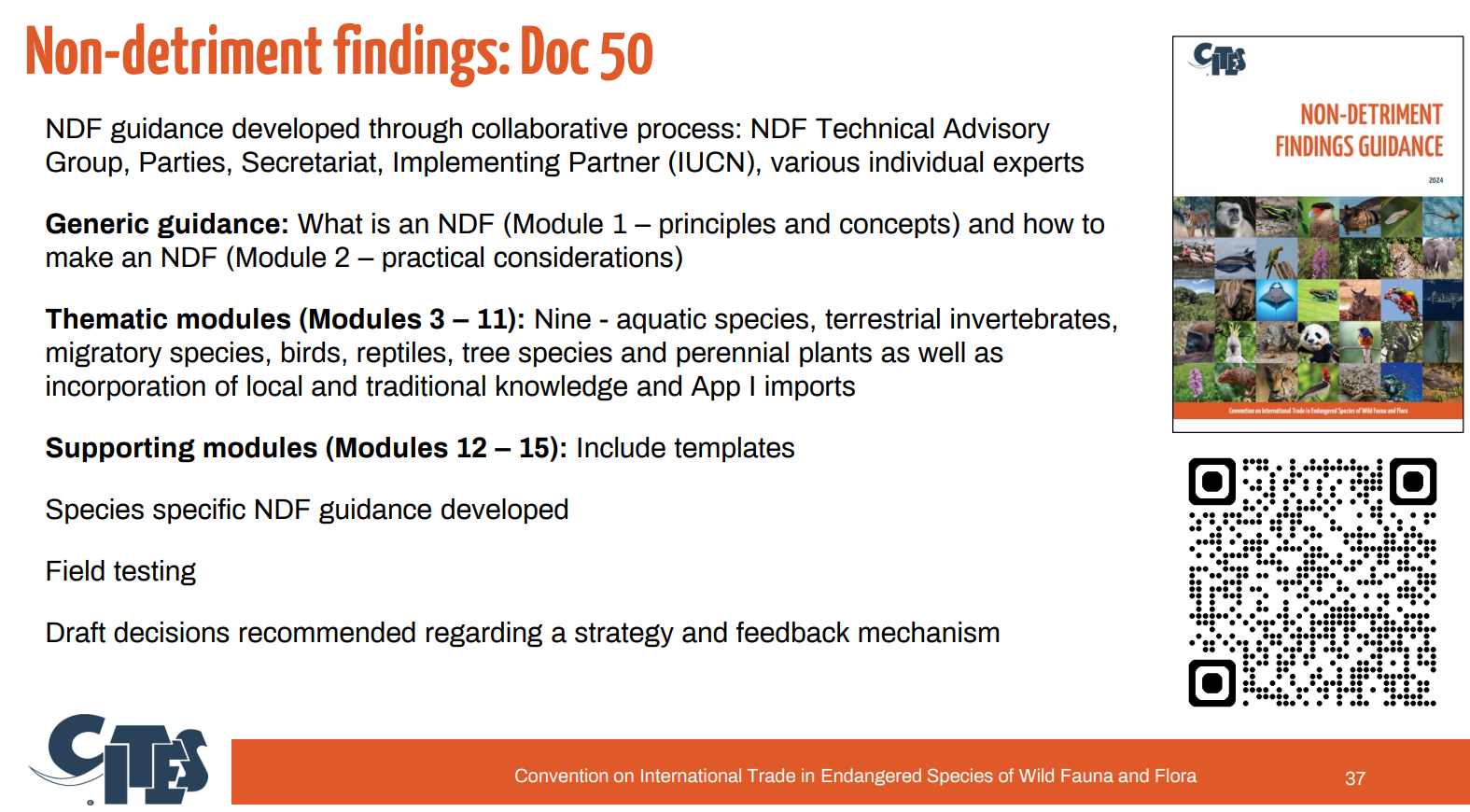
- A Non-Detriment Findings (NDF) Guidance is now available and refers to findings that must be made by parties to ensure that trade is sustainable.
- The NDF guidance was developed through a process guided by a technical advisory group and involved many parties, including the Secretariat, the implementing partners, IUCN and various individual experts.
Eels
- CoP Doc 87 includes information on the status, management and conservation of all anguillid eels and the levels of emergence trends in trade in specimens of Anguilla spp.
- It also discusses gaps in the knowledge of certain species and intersessionally, there was consideration on whether there is a need to develop a specific resolution on European eels or a resolution on the genus Anguilla spp.
- The conference of the parties will consider a draft resolution on trade conservation and management of anguillid eel species together with some draft decisions.
Conservation of and trade in sea cucumbers:
- There are two proposals on cucumbers to be discussed.
- CoP Doc. 90, submitted by a party, covers the more than 20 years of history of discussions on cucumbers within the Conventions, including various recommendations to range States to promote the conservation and management of sea cucumbers. It also discusses legal and illegal trade matters and issues around conservation and management.
- The CoP is invited to adopt draft decisions to obtain more information from parties on how they make non-determined findings and legal acquisition findings (LAFs) for listed sea-cucumbers and to prepare documentation and organize technical workshops to assist parties to better understand the needs in terms of cucumbers in terms of regulation.
Sharks and Rays
- There are two documents on sharks and rays.
- CoP Doc.88.1 is done in terms of the resolution adopted by the parties. It gives information on the conservation and management of sharks and reflects on our engagements with regional fisheries management organizations. It includes a study on the apparent mismatch between reported and expected trade in shark species and also addresses the need for more specific guidance for CITES-listed shark species to support the making of LAFs findings.
- The CoP is invited to consider draft amendments to the resolution on legal acquisition findings and draft decisions on sharks and rays that includes the feasibility of an adapted review of significant trade process and hosting a e-NDF tool on the CITES website.
- The second document was submitted by submitted by the European Union and its Member States and the United Kingdom of Great Britain and Northern Ireland and address issues around deep-water elasmobranchs (CoP Doc. 88.2). The document includes information on the conservation status, trade and management of deep-water elasmobranchs, including threats and management issues.
- The CoP is invited to adopt decisions to prepare technical documents and organize workshops, including a series of workshops to discuss these matters.
Medicinal and Aromatic Plant Species
- Agarwood-producing taxa (Aquilaria and Gyrinops spp.) (CoP Doc.93)
- The Plants Committee formulated recommendations regarding the Agarwood glossary and considered potential revisions to Resolution 16.10 on Implementation of the Convention for agarwood-producing taxa
- CoP20 is invited to adopt the proposed draft amendments to Resolution Conf. 16.10 together with a proposed glossary to better understand the terminology used in this trade.
- Trade in medicinal and aromatic plant species
- CoP Doc.100 that covers several issues, including the utility of the Medicinal Plant Names Services (MPNS) database in routine CITES work, and and how to cross-reference that database with the CITES databases.
- Information materials on the awareness raising relating to CITES regulations and use of these species have been published on the CITES website.
- A study has been conducted in terms of the species in trade (on Trade in medicinal and aromatic plant species – revised report shared in CoP20 Inf. 1).
- There were further discussions relating to a possible resolution on medicinal and aromatic plant species. Although a draft has been produced, there are decisions put forward to continue consideration of this draft resolution in the next intersessional period.
Legal and Compliance Matters
Sofie H. FLENSBORG | Legal Unit, CITES Enforcement issues – combating illegal wildlife trade
Letters of Credentials
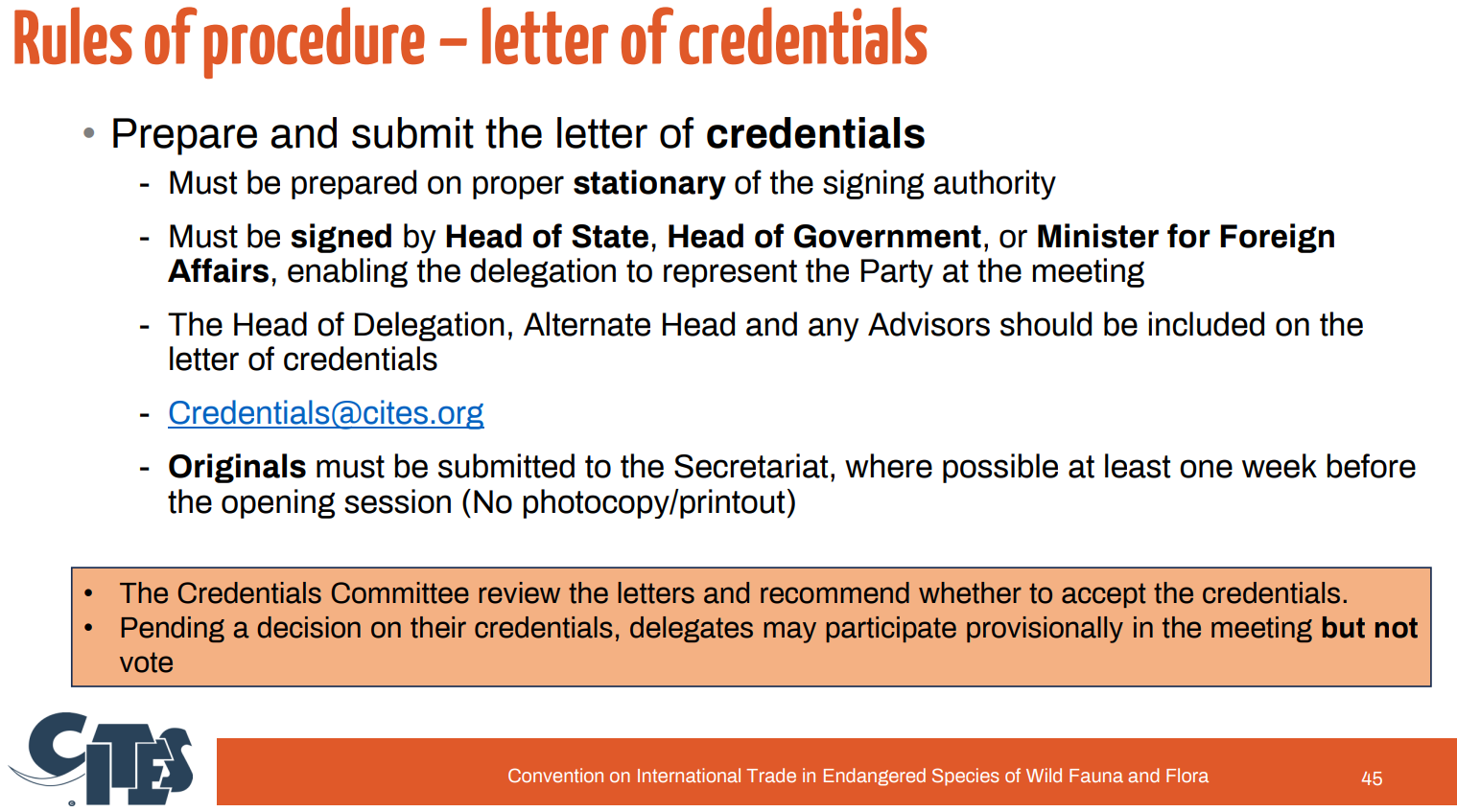
- Letter of credentials can be sent in advance to the Secretariat to allow checking these requirements are met. Otherwise original copies of the letter of credentials must be brought to Samarkand. A scanned or a photocopy or print out of the letter will not be accepted.
CITES & People
- Agenda Item 27 (CoP Doc. 27): Consideration of a new non-binding Guidance on consulting indigenous peoples and local communities on proposals to amend the Appendices and the proposed next steps on the use of the Guidance in draft decisions. Consideration of terminology to be used in CITES with respect to such communities.
- Agenda Item 28 (CoP20 Doc. 28): Proposal to establish a new advisory sub-committee of people living alongside species of wild fauna and flora included in the CITES Appendices and a new voluntary trust fund to finance the work of the sub-committee
- Agenda Item 29 (including CoP20 Doc. 29.1 and CoP20 Doc. 29.2) : Livelihoods – It tackles a proposal to recognize six strategies aiming to guide the participation of rural communities in legal and sustainable trade in CITES-listed species in the Resolution Conf. 16.6 on CITES and livelihoods. Proposal to develop case studies on the use of certification and labelling systems for products from Indigenous peoples and local communities in international trade to explore feasibility and identify best practices.
Compliance Matters
More documents are related to compliance matters.
National laws for implementation of the Convention (CoP20 Doc. 34): We have a process in CITES that reviews national legislations (National Legislation Project). As of October 2025, 11 additional countries have put in place legislation that meets the CITES minimum requirements and this brings the total up to almost two-thirds of the parties that have adequate legislation i.e. 119 parties out of the 185. Under this agenda item, the conference of the parties is also invited to consider short guidance on how to implement the Convention in exceptional circumstances such as war or natural disasters. It is just a very short guidance available to parties that experience such exceptional circumstances.
Possession of specimens of species included in Appendix I (CoP20 Doc. 37): The CoP is invited to agree that penalization of possession of illegally traded specimens should be included as a minimum requirement under the CITES National Legislation Project to be fully consistent with the text of the Convention. Currently, it is not included in the text of the Convention and we are aiming to align CITES minimum requirements with the Convention.
- Documents under Agenda Item 35 include CoP20 Doc. 35.1 on Compliance Matters, which provides an overview of compliance matters that have been considered by the standing committee over the past period and proposes a small amendment to the resolution on compliance and enforcement to introduce a compliance action plan template. This is intended to help parties that are facing challenges with implementing the Convention and being in full compliance with the Convention to actually address these challenges in an orderly, systemic and structured way to ensure they can come into compliance and meet the requirements of the Convention completely.
Regulation of Trade
- Agenda Item 49 (CoP20 Doc. 49) on Legal Acquisition Findings (LAF) – The parties are invited to consider a proposal to make small updates to Annexes I and III of the Resolution on LAF. Proposal to consider new Guidance on LAF for breeding stock of animals used in captive breeding facilities – based on the same risk assessment approach used for other specimens.
- Agenda Item 52 (CoP20 Doc. 52) Introduction from the sea – implementation challenges, including those identified at the workshop on NDF for aquatic species, should be considered and addressed to ensure consistent and effective implementation of the Convention for marine species. Proposed work on this in the next inter-sessional period. The Agreement on Biodiversity Beyond Areas of National Jurisdiction (BBNJ) set to enter into force on 17 January 2026, could be recognized in the preambular part.
- Agenda Items 59 (CoP20 Doc. 59) and 64 regard stockpiles, management and disposal of seized or confiscated specimens. Both are important because parties need to have a common understanding of what stockpiles mean and what they mean in the context of the Convention. So we have we have seen parties having stockpiles of seized and confiscated specimens, for instance, rhino horn, saiga horn, pangolin scales, elephant ivory and timber stockpiles. It is important that parties share the understanding of how stockpiles this regulated in the various resolutions under the Convention.
- Agenda Item 64 includes three documents (CoP20 Doc. 64.1, CoP20 Doc. 64.2 and CoP20 Doc. 64.3 (Rev. 1)) addressing how to handle and manage and dispose of confiscated specimens. This is critical in the context of the fight against illegal trade. Once an illegally traded specimen is seized, it is necessary to know what to do with it and how it is managed at the national level to ensure it does not fall back into illegal trade. One of the documents also concerns rescue centers and how we handle live animals that have been seized and confiscated.
- Agenda Item 105 on the Implications of the transfer of a species from one Appendix to another aims to reach a common understanding in situations where a shipment has left the country of export before the entry into force of a new listing but arrives in the country of import after the entry into force. At present, parties have different practices which could pose some problems, particularly for shipments that take a long time to go from the imported from the importing party to the exporting party, and the documents (CoP20 Doc. 105.1 and CoP20 Doc. 105.2) discuss options for better aligning these.
Enforcement issues – combating illegal wildlife trade
Barend Janse VAN RENSBURG | Enforcement Unit, CITES Capacity-building and traceability of products in trade
Totoaba (Totoaba macdonaldi)
- CoP20 Doc. 35.3 provides reporting on the implementations of decisions that were adopted at COP19 by the parties that are affected by Totaba trafficking.
- It also includes reporting on Mexico’s implementation of its compliance action plan (CAP) on totoaba (this matter will also be addressed at SC79 – See SC79 Doc. 6.5).
- It also reports on collaboration through the trilateral enforcement contact group between China, Mexico and the United States of America and it provides information on a study on Vaquita and Totoaba that was commissioned by the CITES secretariat.
- The document provides a comprehensive set of decisions proposed for adoption at COP 20. These aim to ensure continued strong action is taken against illegal fishing and trafficking of totoaba and the threat it poses to the vaquita.
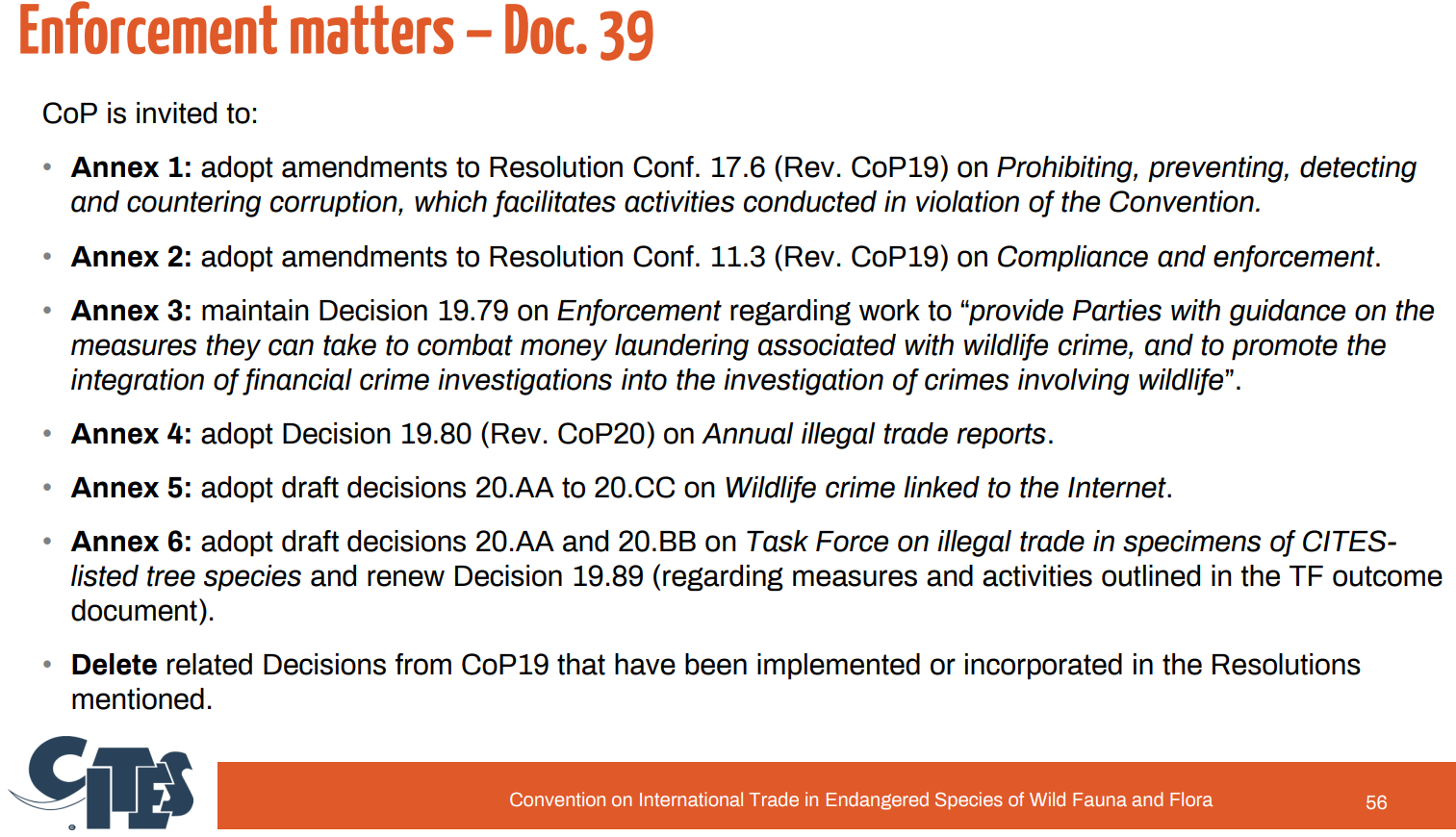
Enforcement matters (CoP20 Doc. 39)
Multiple matters addressed in the document, including:
- Addressing corruption
- Addressing illicit financial flows from wildlife crime
- Annual illegal trade reports and the CITES Illegal Trade Database
- Wildlife crime linked to the Internet
- Task Force on illegal trade in specimens of CITES-listed tree species
- Directory of laboratories that conduct wildlife forensic testing
- The documents contains multiple annexes, each of which addresses one of these issues:
International Consortium on Combating Wildlife Crime (CoP20 Doc. 16.4):
- The International Consortium on Combating Wildlife Crime, or ICCWC, is a collaborative effort between the CITES Secretariat, INTERPOL, UNODC, the World Bank and the WCO to support Parties and enhance efforts to combat wildlife crime.
- It contains a report on a broad range of activities conducted under the auspices of ICCWC, which continues to play a critical role in assisting Parties globally to combat wildlife crime using a coordinated and cohesive approach.
- ICCWC Vision 2030 – provides the roadmap for the work of the Consortium, currently being implemented through the 2023-2026 Strategic Action Plan.
- The CoP is invited to consider draft decisions related to ICCWC, including those related to its upcoming 2027-2030 Strategic Action Plan.
- The 2024 ICCWC Annual Report is contained in CoP20 Inf. 15
Wildlife crime enforcement support in West and Central Africa:
- CoP20 Doc. 40 reports on the implementation of decisions on wildlife crime enforcement support in West and Central Africa.
- Wildlife crime continues to affect parties and there is a need for continued support.
- In this document the COP is invited to adopt draft decisions that will facilitate such continued support as well as a decision that will facilitate continued support to parties in Western Central Africa through ICCWC.
CITES Big Cats Task Force (CoP20 Doc. 41)
- The task force convened in April 2023 and the outcome document comprehensively outlines strategies, measures and activities to be undertaken by parties to address illegal trade affecting big cats.
- In this document, the CoP is invited to adopt draft decisions to encourage parties affected by this illegal trade to make every effort to implement the measures and activities that the task force agreed on in its outcome document and also a decision which will request the Secretariat to follow up and report on implementation to the next standing committee meeting.
- Several documents related to big cats will be discussed at CoP:
- Cheetahs (Acinonyx jubatus) (CoP20 Doc. 45)
- Jaguars (Panthera onca) (CoP20 Doc. 81)
- Implementation of Resolution Conf.12.5 (Rev. CoP19) on Conservation of and trade in tigers and other Appendix-I Asian big cat species (CoP20 Doc. 77.1)
- Asian big cats in captivity (CoP20 Doc. 77.2)
Rhinoceroses (Rhinocerotidae):
- For each meeting of the CoP, in accordance with the resolution on rhinos, a comprehensive report on the rhinos is prepared and is contained in Annex 2 of CoP Doc. 84.
- It reports on the national and continental conservation status and trends for African and Asian rhinos, illegal killing of rhinos in Africa and Asia.
- Another Annex to the document is the outcomes agreed at the CITES Rhinoceros Enforcement Task Force meeting held in May 2025.
- The document includes a section on parties most affected by illegal trade in Rhino Horn, identified by the comprehensive study (South Africa, Malaysia, Viet Nam, Qatar and the United Arab Emirates).
- The document also specifically addresses Indonesia, which had a significant decline in its Javan rhinos.
- The CoP is invited to maintain decision 18.116, which deals with demand reduction and also to adopt new proposed draft decisions.
Pangolins
- CoP20 Doc. 79.1 is a report of the Secretariat on the implementation of Resolution Conf. 17.10 (Rev. CoP19) on Conservation of and trade in pangolins.
- A comprehensive report on pangolins has been prepared for CoP in accordance with the resolution on pangolins. It is the first time it is done for a CoP.
- In the document, the CoP is invited to adopt the proposed amendments to Resolution Conf. 17.10 (Rev. CoP19) on Conservation of and trade in pangolins; and on new proposed decisions.
- CoP20 Doc. 79.2 is a report of the Standing Committee in consultation with the chair of the Animals Committee and the Secretariat.
- It provides information on in situ management and conservation programs for pangolins and on conversion parameters for pangolins that have been developed to date. The CoP is invited to adopt draft decisions to develop further Conservation parameters for all pangolin species.
Other documents related to enforcement matters:
- Marine turtles (Cheloniidae spp. and Dermochelyidae spp.) (CoP20 Doc. 46)
- Tortoises and freshwater turtles (Testudines spp.) (CoP20 Doc. 47.1 and
CoP20 Doc. 47.2) - Great apes (Hominidae spp.)( CoP20 Doc. 78.1 and CoP20 Doc. 78.2)
- Seahorses (Hippocampus spp.) (CoP20 Doc. 89)
- Others
Capacity-Building, ESIT and Traceability
Kristina RODINA DE CARVALHO | Outreach and Projects Unit, CITES Programme of Work and budget
Capacity-Building
- This does not tackle the building of capacities of CITES parties from scratch; it rather deals with strengthening and enhancing the already strong foundation that exists in many CITES parties.
- The Capacity building framework (CoP Doc. 20) is intended to help the improvement in terms of implementation of the Convention by bringing greater coordination and coherence in all capacity building activities. Due to the limited financial and human resources and time, progress on developing this framework has been slower than hoped. Under this item, the CoP is invited to consider a few decisions:
- The standing committee is invited to establish the intersectional working group to continue advancing this work. This group would focus on developing a common language and a clear definition that could make the capacity-building efforts more consistent and more effective across parties.
- The conference of parties also invited to maintain the decisions from CoP19, which encourages parties to share experiences, ideas and information related to the framework.
- Subject to the external funding, the Secretariat shall organize a number of technical workshops and consultations that would facilitate the implementation of the decision on the intersessional Working Group.
- The Secretariat has proposed the development of this framework, where appropriate, could also be aligned with their long-term capacity building strategy of the Kunmin- Montreal Global Biodiversity Framework.
Compliance Assistance Programme (CAP) (CoP Doc. 21):
- This program helps parties achieve or restore compliance within the Convention. It provides tailored, country-specific support to help implement the recommendations made by the SC and/or the CoP to take action under specific compliance processes when needed.
- Agenda Item 21 provides an update on the program implementation since CoP19. It highlights the work that has been carried out in eight pilot countries (Cambodia, Guinea, Lao People’s Democratic Republic, Nigeria, the Solomon Islands, Surinam, Togo and Vietnam).
- At this CoP parties are invited to adopt a new decision to allow the continuation and expansion of this program to other eligible parties, subject to external funding.
Capacity building efforts on CITES Trees Species Programme (CTSP) (CoP Doc. 23):
- The CTSP program links the Convention requirements on international trade in tree species with the efforts to improve overall forest governance.
- The program’s goal is to help tackle the illegal and unsustainable harvesting and trade in CITES-listed tree species and reduce deforestation.
- Since CoP19 the program has benefited from financial support from the European Union and Germany, which has helped parties to strengthen the implementation of the Convention for CITES-listed trees species.
- The secretariat received 50 project proposals from parties for the new phase of the CTSP program.
Electronic Systems and Information Technology and Traceability (ESIT)
It focuses on the electronic CITES (eCITES) permitting systems, which are the key tools to ensure sustainability, legality and traceability in trade. This allows moving from paper-based systems to electronic systems, making the process more reliable, more transparent and it also less prone to irregularities.
- The Report of the Standing Committee (CoP Doc. 56.1) proposes draft decisions on the use of standards and guidance, such as the eCITES implementation framework, Ecites toolkit and EPIX. It also proposes the adoption of their newly developed guidance on the use of the two-dimensional barcodes inside as permits and certificates.
Document CoP Doc. 56.2 proposes conducting a feasibility study for creating a hub model for the electronic exchange of CITES permit information. This is similar to the IPPC ePhyto Solution for phytosanitary certificates.
- In terms of traceability CoP Doc.104 proposes a draft decision inviting parties and organizations to provide information to the Secretariat on traceability systems and related resources developed and use for trade inside CITES-listed tree species. It also indicates that, subject to the external funding, the secretariat would also consult with a standard-setting bodies on the development and use of uh technical standard and traceability for sites listed-tree species.
UN World Wildlife Day (CoP Doc. 24):
- The CoP reports on the celebration and implementation of various activities of the WWD from 2023 to 2025. During this period, the CITES Secretariat and a number of partners coordinated global celebrations, maintained an official dedicated website and social media platform and ran a number of global awareness campaigns on thematic topics of the day.
- WWD 2026 will shine a light on medicinal and aromatic plants.
Programme of Work and Budget
Ivonne HIGUERO | CITES Secretary-General
- We are currently facing difficult times as we have not received the contributions from the parties in accordance with the assessed contributions. CITES bases these voluntary contributions on the assessed contributions calculations from the United Nations Secretariat. Arrears are not just limited to the current year.
- Within the current global financial situation characterized by inflation, the increasing problems with the exchange rate between the dollar and the Swiss Franc, CITES is faced with increased operational costs to support the secretariat, meeting venues, and more.
- Decisions have been taken to reduce the risk that, in the next triennium, when a new budget will be established, we would not be able to meet our obligations or maintain the Secretariat’s capacity to support the parties as we have been doing in the past.
- These decisions are reflected in the documents distributed. These regard the composition of the Secretariat, which restructuring will start in 2026 to lower expenses because the standard cost of salaries is increasing for the next triennium. We must find a way to address that and all other costs.
- We created the three scenarios as requested by the parties:
- Scenario 1 (Zero Nominal Growth) is a copy and paste of the expenses of last year to the next year. This would mean that there would be no growth, not taking into account standard costs of salaries, venues, interpretation, and more that are rising. It would not consider what is going to happen in the next 3 years. If we go for zero nominal growth, we will have to make serious changes to the composition of the Secretariat because we would not be able to continue with the same number of people under those conditions if there are no changes in the budget.
- Scenario 2 (Zero Real Growth) considers inflation and part of the rising costs, the standard cost of salaries for the secretariat over three years. It represents a moderate increase compared to Scenario 1.
- Scenario 3 (Incremental), which is the proposal of the Secretary General that considers the changing situation and the needs of the Secretariat.
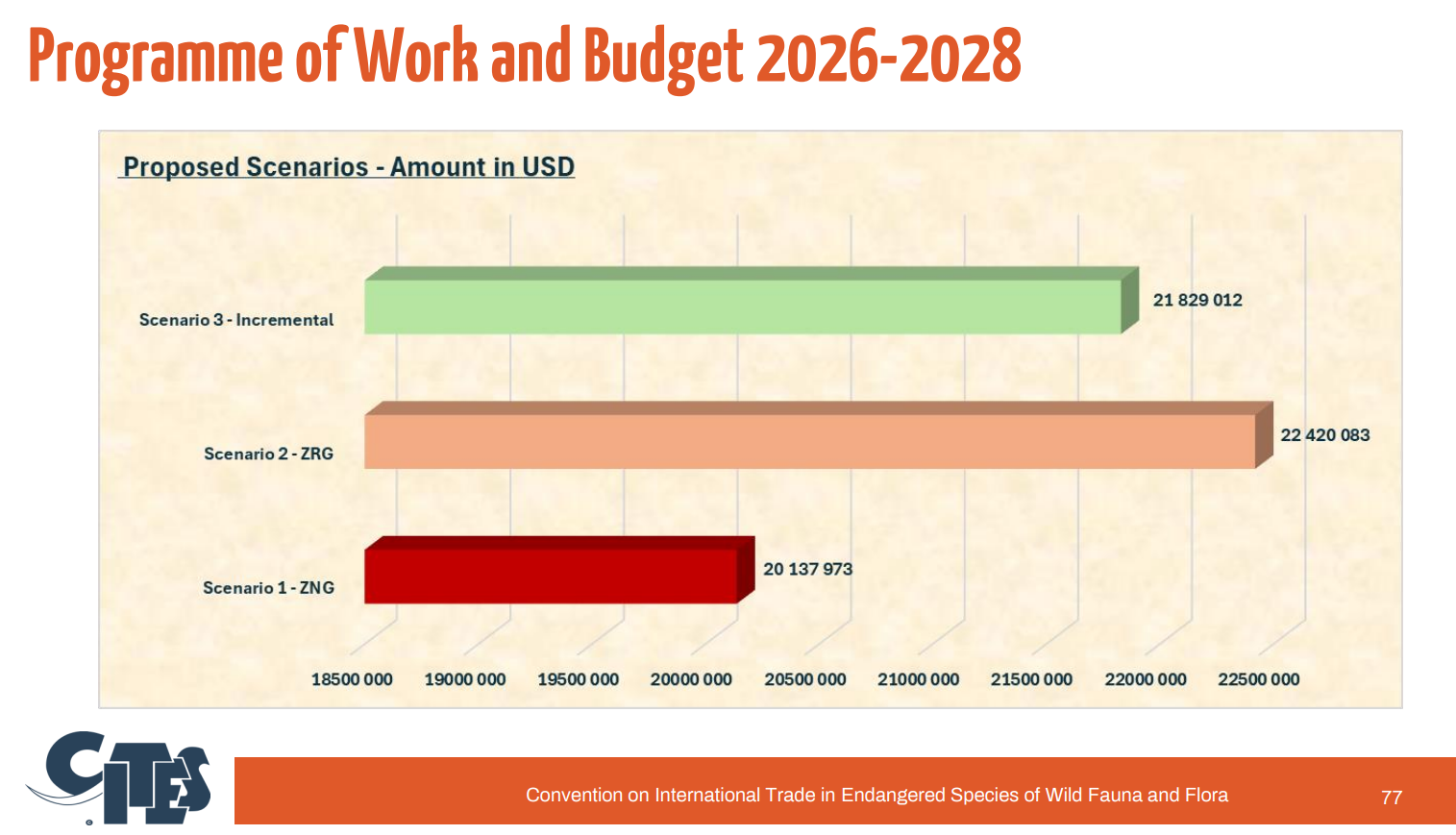
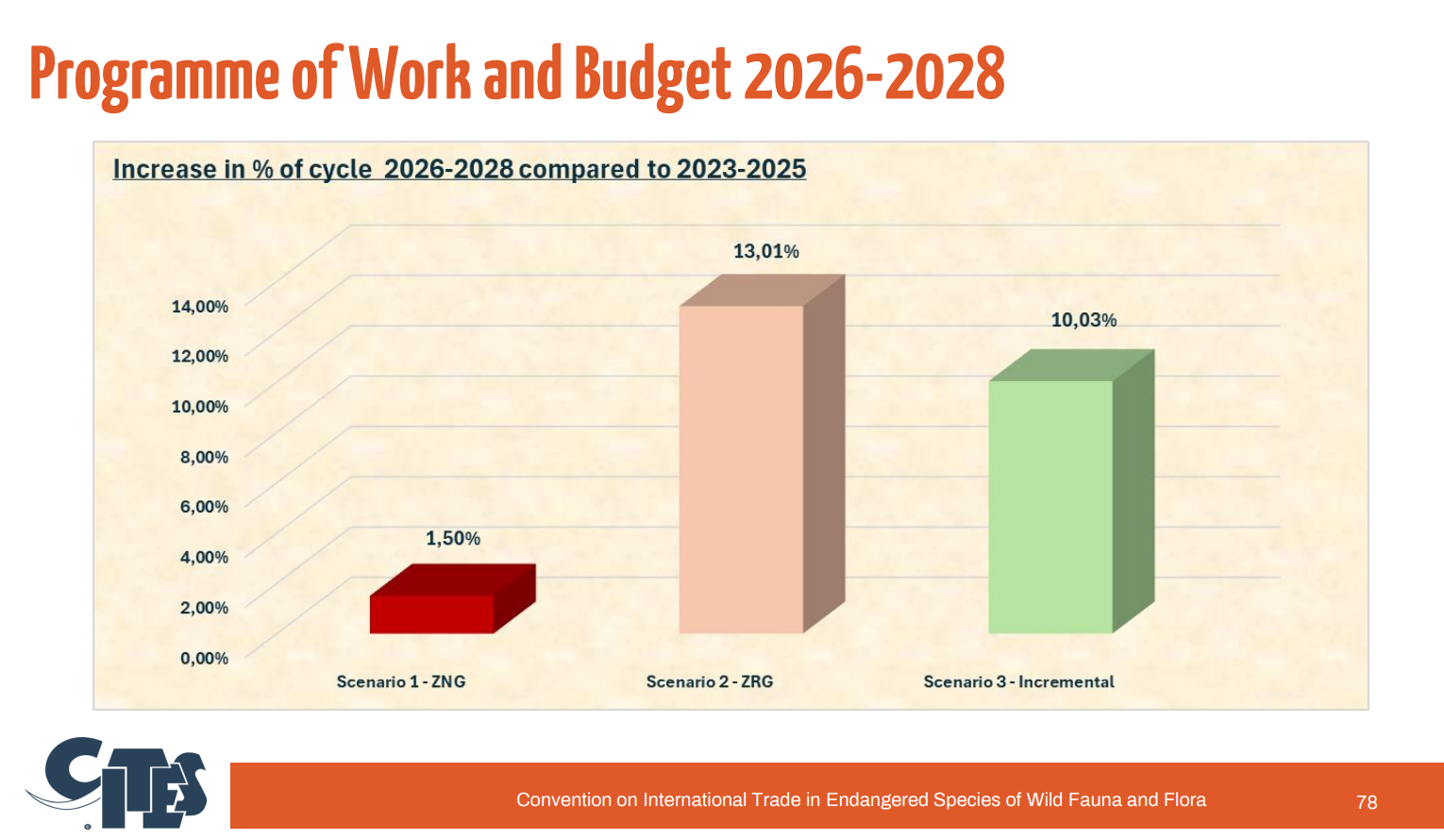
- The percentage difference is because every year there’s been a little bit of a rise, and we take the average. Scenario 2 takes into account the real cost of the standard salary cost of the Secretariat and includes the rising cost that we have to take into account for the venues and for other perational costs of the Secretariat. Taking all that into account leads to a budget rise of 13.01%.
- Then in Scenario 3, which takes into account the changing times, the restructuring of the Secretariat, looking at what’s happening overall in the United Nations, looking at the decreased contributions that one we have tried to reduce some costs reduce the size of the secretariat uh some of the levels of the secretariat it now comes to 10.03%. It is less than zero real growth, but still an increase and this is the one the Secretary will continue to be able to service the parties in the way that we have been doing in the past.
- The agenda keeps growing, the number of decisions keeps growing, the program of work keeps growing, but the number of staff stays the same and we simply will not be able to do more with less. As of now, we are going to have to do less with less.
- This will be presented at the CoP and then the finance and budget subcommittee has to come to an agreement and present it to the plenary for the final decision and the budget-related CoP resolution.
- A reduced Secretariat will not be able to deliver as well. The CITES Secretariat is already small and composed of hard-working people who dedicate their time and service to support the parties with the documentation and help to prepare for the meetings, with technical assistance, and technical workshops for the effective implementation of the Convention.
COP20 – your questions answered
Q: Would it be possible to know which weeks are expected to focus on more political issues rather than the technical ones? This will allow to better manage the composition of delegations and ensure effective participation.
A: The two committees will meet in parallel to discuss a number of policy issues, the implementation of the Convention, and the scientific matters. Therefore, the best way to navigate the daily schedule is to refer to the agenda and select the themes that will be discussed on a given day.
Q: Is the list of proposed amendments to the Appendices still open?
A: The date to submit proposals has long passed. Of course, a party is able to raise any issue at the meeting, but I do not think that any of the parties would be in agreement to have a new proposal at the last minute in the CoP without having had the time to research and investigate it properly.
Issues can be added, but amendment proposals according to the rules of the Convention itself have to be submitted 150 days ahead of the meeting. It would not be in accordance with the text of the Convention to submit further amendment proposals at this time. On the other hand, proposals can be changed during the meeting. According to the rules, it is only possible to reduce the scope of an existing proposal that has been submitted or the splitting of a proposal, for example, in the case of two species, there can be splitting for these to be treated separately. But adding new species would not be possible.
The Guide to CoP20 decision-making process provides information on how the decisions are made, especially for difficult decisions where it is impossible to reach consensus and on what happens next.
Q: From the perspective of the Secretariat, which agenda items are deemed to be most challenging in terms of reaching consensus? If so, are there any options as side meetings or informal consultations during the meeting?
A: The potential timing to discuss within informal meeting settings is available in between lunches, dinners, and all of these times that parties get together in the corridors to speak. If an item that the Chairs feel needs further discussion and will require a few days to discuss, working groups can be set up to then report to the plenary. The number of working groups is still to be limited as time is scarce and they will have to meet when the committees are not meeting.
In advance of the CoP, parties should be discussing issues that are sticky for them with other parties, especially when it concerns proposals, ensuring to get to the CoP with some agreements. For example, the Jaguar resolution and the Jaguar decisions are already in advanced status as two range state meetings have already taken place to get to CoP20 with an agreed draft resolution.
Q: What are the views of the Secretariat in terms of the proposal to amend Rule 25?
- Rule 25 on the methods of voting is really complicated. It entails that, ideally, the CoP adopts amendments by consensus. However, if there is no consensus, decisions are taken through a voting system. The majority required to pass an amendment is two-thirds of the delegates present in the room and by a yes or a no to that proposal.
- Then there are some small ways whereby decisions can be made not just on the proposal that has been presented, but maybe this can be reduced in scope so that it can pass more easily. It could be divided into several proposals in the case of a proposal covering several species or several taxa.
- There are specific rules when there are overlapping proposals: proposals that concern the same taxa, for instance, but are not fully overlapping, are subjected to the rule for which the proposals that have the least restrictive effect on trade will be decided upon first. If that means that the other proposals concerning the same taxa will no longer make any sense, they will not be decided upon and will be considered as rejected.
- There is a proposal for a new rule that the CoP will need to consider in the first plenary session, which concerns this particular situation, and that means that the new rule will require all overlapping proposals to be presented before the committee or the plenary session for Committee I to make a decision. The Committee will have all the overlapping proposals in front of it and may be able to see whether there are some parts that could be agreed upon, whereas other parts would not be agreed upon. This is a new provision that all proposals would be introduced before they are discussed and decided upon.
- The other new idea is that, if there are overlapping proposals but they’re not fully overlapping, the CoP can decide on certain taxa and then, on the subsequent proposals, will not be debated for the taxa that were overlapping but for any remaining taxa, there can be a decision. In the potential case of a proposal that is for one species, but another proposal is for a whole genus, the decision could be made to adopt the first proposal for just one species and then the second proposal concerning many more species can still be considered, except for the species that has already been considered in the first proposal.
Visa Process
The visa process for application and checking the status of your visa application is outlined in three different notifications to the parties: No. 2025-058, No. 2025/088 – and No. 2025/122. There are two ways to apply for the visas: application upon arrival and a particular way you can check for your status because of officers on the other side who ensure your visa on arrival is going to be secured.
Photo Gallery


